
COLUMN · Orthodontics
Can Braces Fix an Open Bite?
Tongue Thrust, Mouth Breathing and How to Keep It From Reopening
Braces can often fix an anterior open bite, where the front teeth do not meet even when the back teeth bite together, when the cause is tooth position and a tongue thrust habit. When the back of the jaws is too tall (a skeletal open bite), pushing the upper molars up into the bone with mini-screws is considered. The harder part is keeping it closed: in a meta-analysis, about three quarters of open bites corrected without surgery still had the front teeth overlapping a year or more later, and some reopened partly. So I plan tongue position, breathing and retainers from the start.
I am Dr. Sunmin Kim, head dentist at Ceramic Dental Clinic in Gangnam, Seoul, and a board-certified orthodontist with 16 years in practice. In open bite consultations I hear "Can braces close it?" about as often as "I had braces before and it opened again." Our main page on open bite treatment covers the four causes and real cases. This article focuses on something else: how to tell a habit-related open bite from a skeletal one, and what keeps it from coming back.
Is an open bite caused by habits or by the jaw?
Usually a bit of both. In the clinic I separate them by the height of the back teeth and the slope of the lower jaw.
- Mainly habit and tooth position: the jaw proportions are normal, but the front teeth are tipped forward or have not come down enough, leaving a small gap only at the front. Many of these patients push the tongue into the gap when swallowing, or sucked a thumb as children.
- Mainly skeletal: the upper back teeth sit low (tall back teeth region) and the lower border of the jaw slopes steeply. Only the back molars touch and the gap widens like a wedge toward the front; the lower face tends to be long.
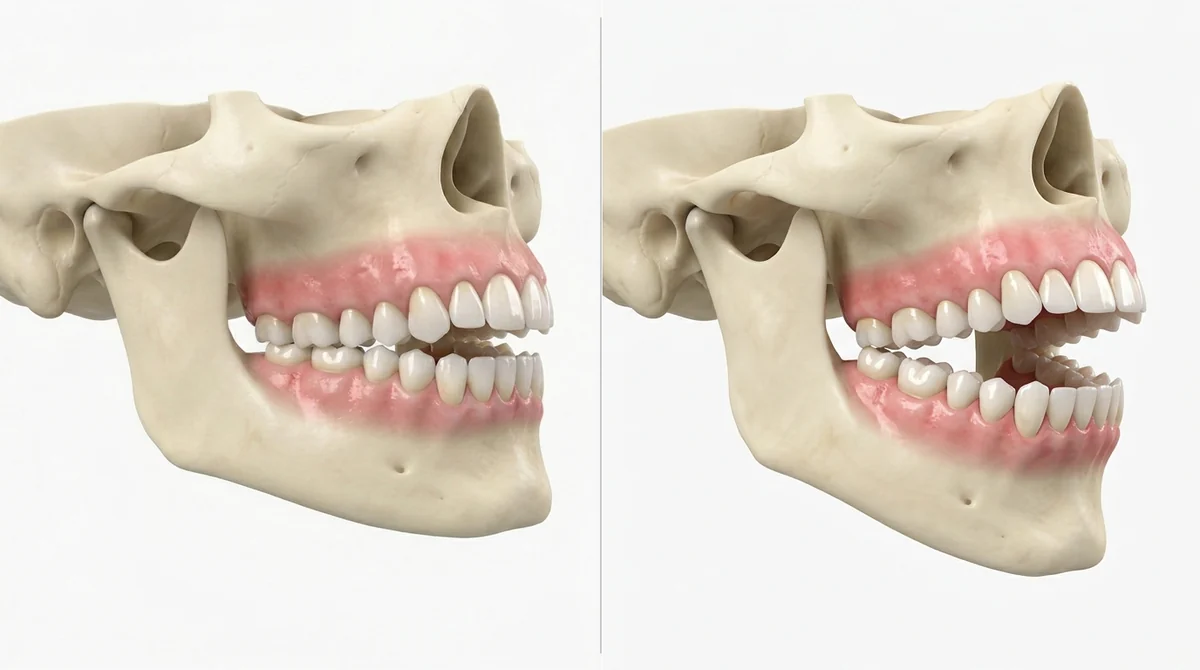
Whether the tongue causes an open bite or adapts to it is still debated. A 2025 review of studies from 2014 to 2024 concluded that it is unclear whether the tongue is a primary cause, a contributing factor or a consequence of an existing open bite (Bunta et al., 2025). When the front teeth are apart, the tongue tends to move forward to seal the mouth during swallowing. So I do not simply say "your tongue did this"; I check whether the tongue is pushing on the front teeth now.
Does mouth breathing play a part?
People who breathe through the mouth because of a blocked nose keep the mouth open for long periods, and the tongue often rests low instead of against the palate. A Cochrane review of open bite treatment in children lists oral habits, unfavorable growth patterns and enlarged adenoids or tonsils with mouth breathing among the causes, and notes that the treatments studied are not supported by strong evidence (Lentini-Oliveira et al., 2014).
If a patient's nose is often blocked, I ask them to see an ear, nose and throat specialist before braces. Asking someone to keep the tongue on the palate while the airway is still blocked rarely works for long.
Can braces fix an open bite caused by tongue thrust?
When tooth position and a tongue habit are the cause, braces often close it. Pushing the tongue between the front teeth when swallowing often keeps a front gap open, as in the first photo below. The before-and-after case that follows is a different patient with the same habit and front-tooth cause, treated with extraction braces and tongue training.
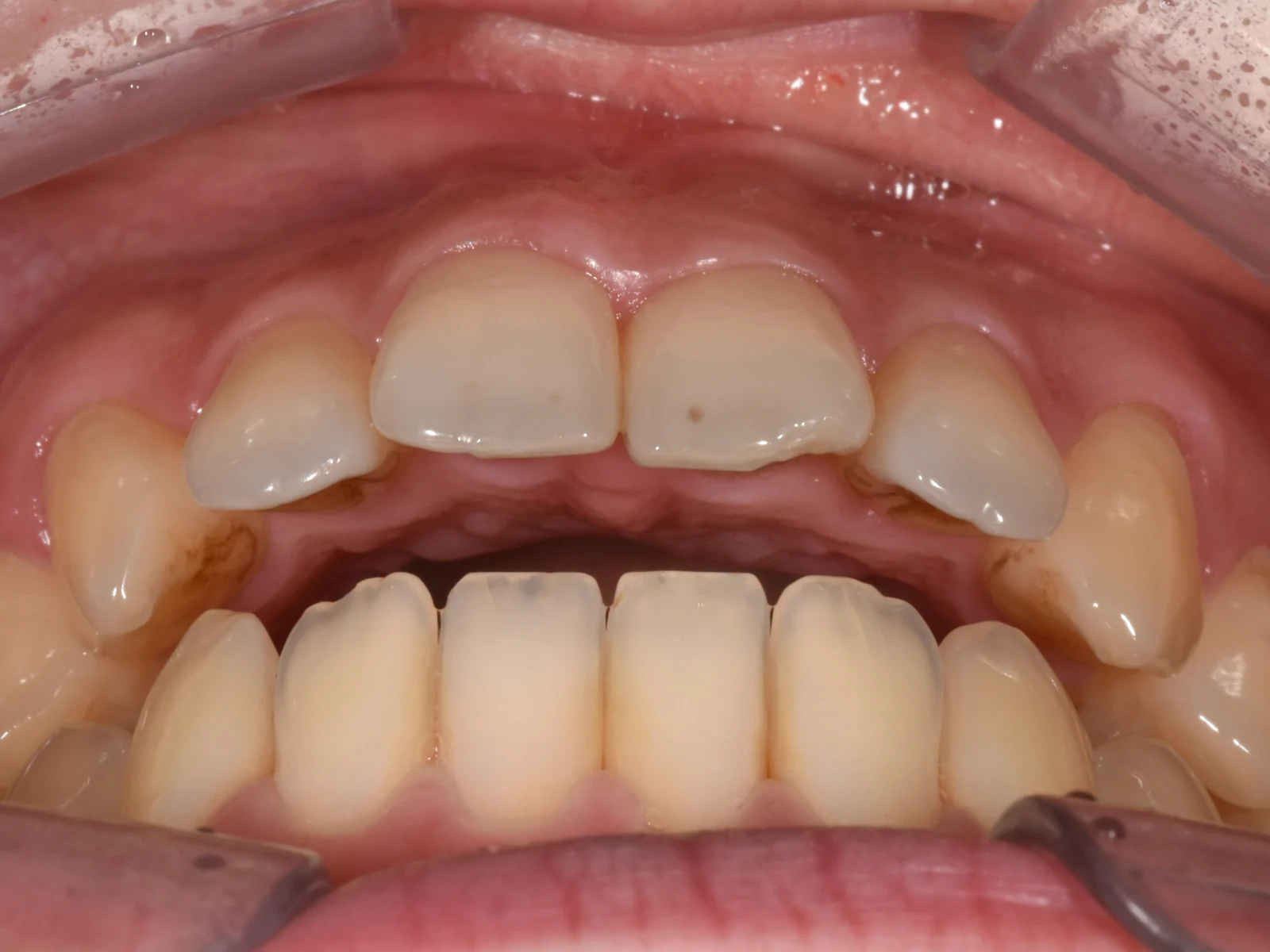
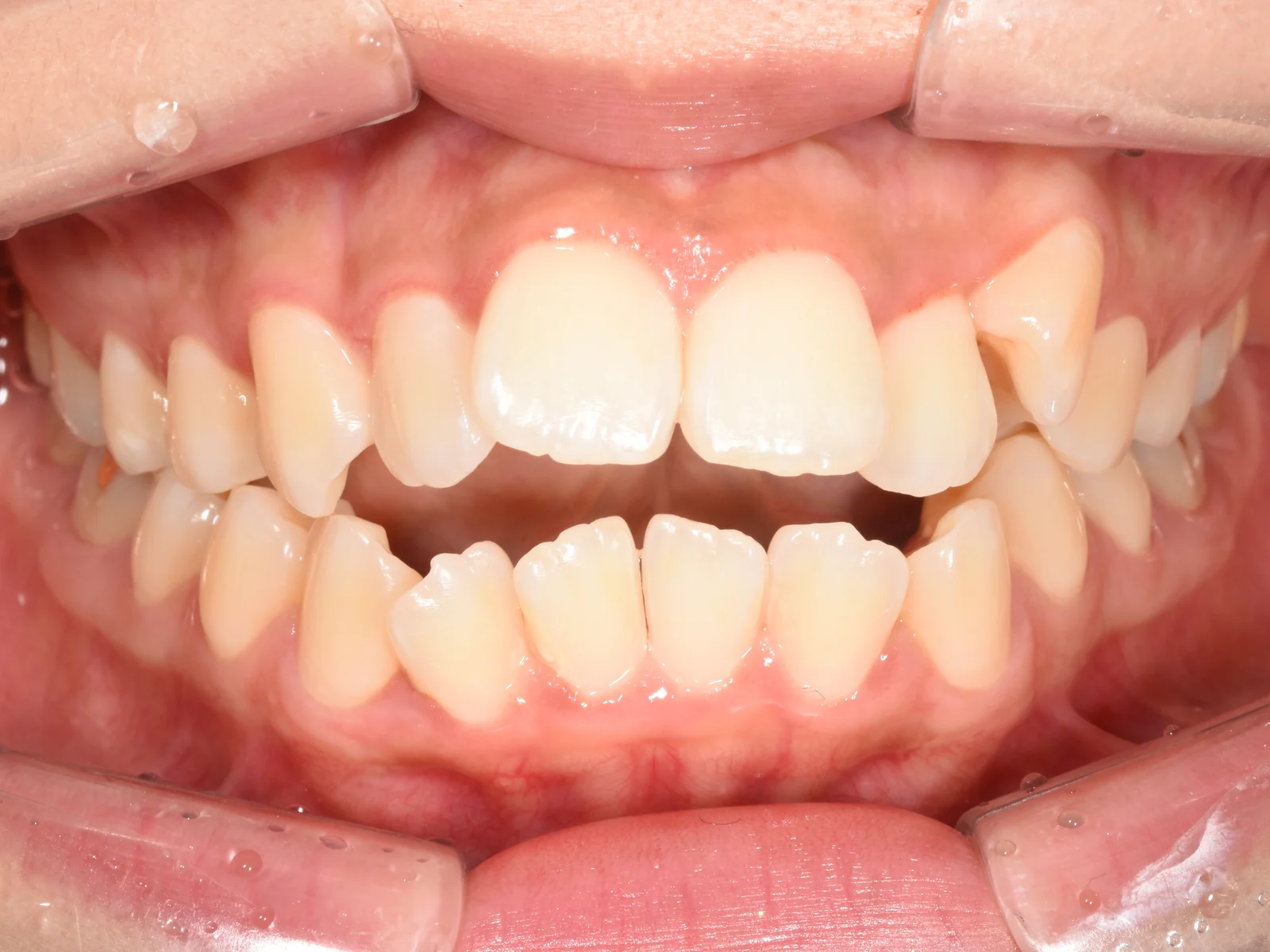
Before · April 2024
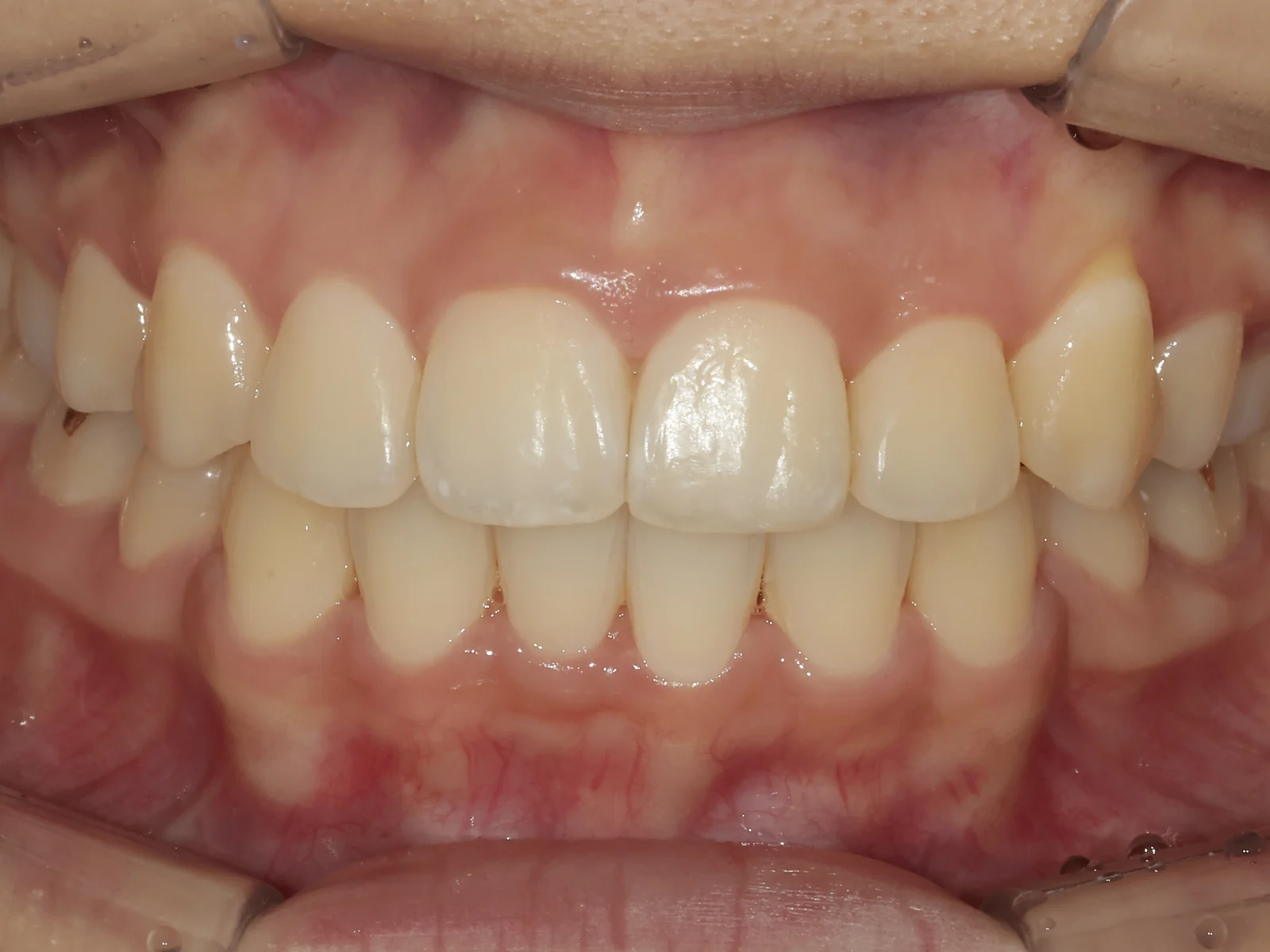
After · September 2026
Front intraoral photos of the same area from the same direction. Braces with extractions corrected the front teeth while the patient practiced resting the tongue on the palate. The jaw joint exam was normal, and mini-screws were not used because molar height was not the cause. Treatment took about 2 years 6 months. Retainers and habit checks continue, because the gap can reopen if the tongue habit returns.Possible side effects: relapse, mini-screw loosening, root resorption, gum recession. Published with the patient's consent. Results and treatment time vary from person to person.
One caution: closing the gap only by pulling the upper front teeth down a long way can show too much gum in a smile and reopen easily if the tongue habit stays. I decide how far to bring the upper front teeth down by looking at tooth display and gum display in a smile.
How is a skeletal open bite closed with braces?
If tall back teeth hold the jaw open, intruding the upper molars (moving them up into the bone) is considered. The lower jaw opens and closes around the jaw joint, so when the back teeth get shorter, the jaw closes a little further and the front gap narrows.
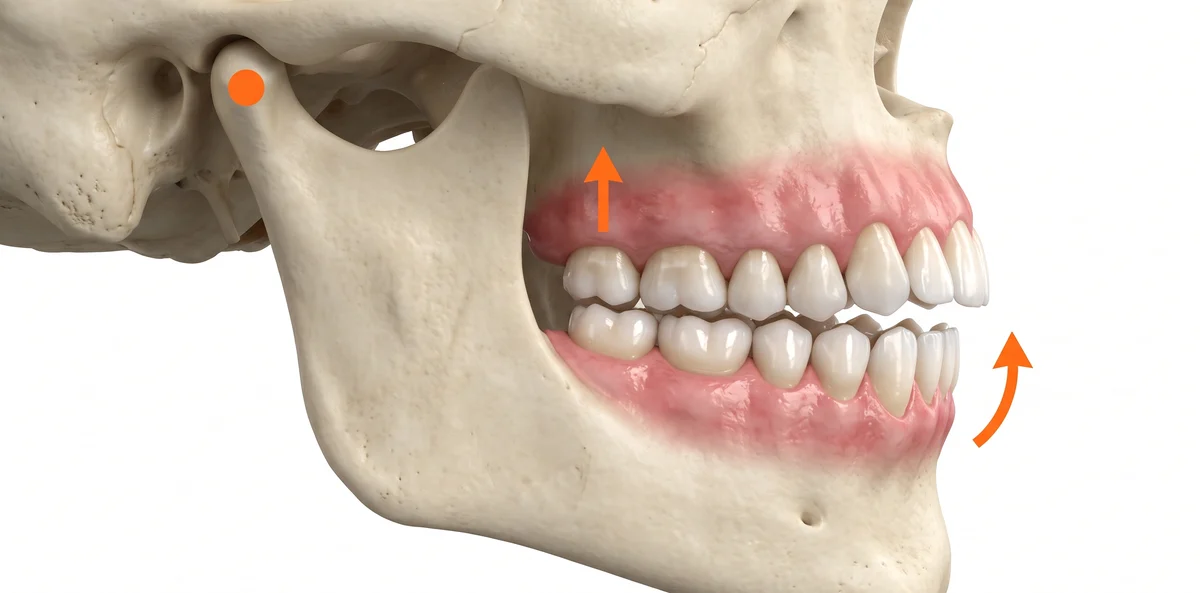
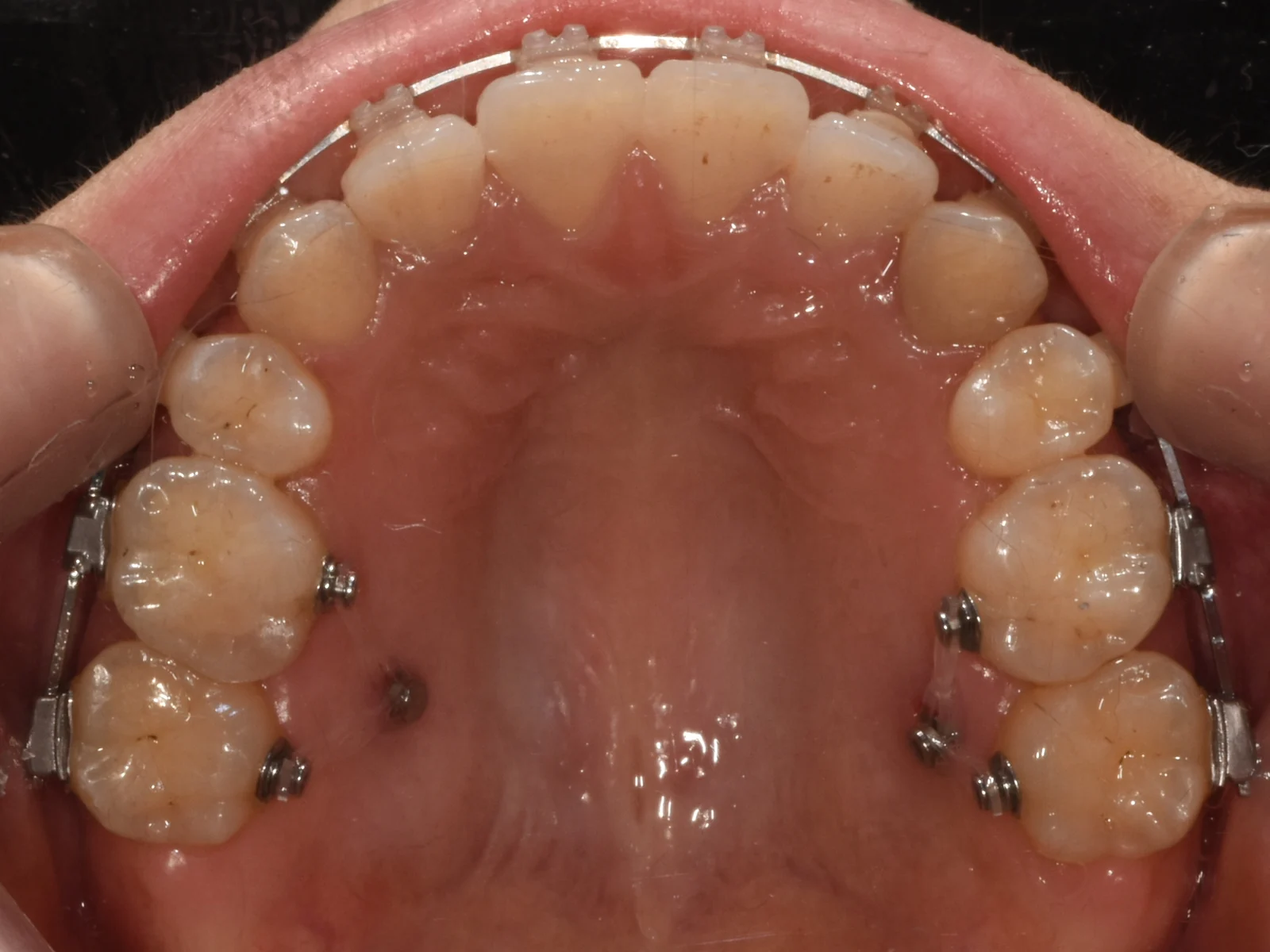
Molars have thick roots and need firm anchorage. At our clinic, a mini-screw is placed on the palate side between the upper first and second molars and connected to buttons on the inside of the molars.
A 2024 meta-analysis of 24 studies (362 patients) treated with skeletal anchorage found that overbite increased by 3.88 mm on average and the upper molars were intruded by 2.15 mm, with the lower jaw rotating up and forward. Over the long term, though, overbite decreased by 19.9% and molar intrusion by 22.9%, and the authors rated the risk of bias as moderate to high (Kwon et al., 2024). If the skeletal difference is too large to close with braces alone, jaw surgery can be considered.
When and why does an open bite reopen after braces?
In a meta-analysis of open bite stability, the front teeth still overlapped 12 months or more after treatment in 82% of surgical cases and 75% of non-surgical cases; both groups lost some overlap. The two groups came from different studies and populations, so they cannot be compared directly, and all included studies were case series (Greenlee et al., 2011).
In a three-year study of nine adults, most of the movement back after upper molar intrusion was observed in the first year (Baek et al., 2010).
In my practice, the three reasons I see most are the tongue pushing between the front teeth again, the intruded molars coming down a little, and changes in the shape of the jaw joint (condyle). If an open bite has started in the last few years, a jaw joint change should be suspected first, and the joint needs to be stable before braces.
How can you prevent an open bite from coming back?
The most evidence is for tongue and lip muscle training. In a study comparing 27 people who had orofacial myofunctional therapy with braces and 49 who had braces alone, overbite relapsed by 0.5 mm on average with therapy and 3.4 mm without (Smithpeter and Covell, 2010). It was not a randomized trial, and the comparison group had been referred after relapse, so the difference may be overstated.
- Tongue position training: from midway through treatment, we coach you to rest the tongue tip on the palate just behind the upper front teeth and to swallow without pushing it forward, and we check your swallow at each visit.
- Retainers: a fixed retainer is bonded the day braces come off, plus a clear retainer. If a tongue habit remains, we sometimes use an upper retainer with a wire tongue crib behind the front teeth.
- Close checks in year one: because relapse can occur early, check-ups are closer together then. Retainer check-ups and adjustments for 2 years after treatment are included in the orthodontic fee.
- Airway and jaw joint: if the nose stays blocked, we recommend an ENT visit, and at check-ups we record jaw joint clicking or pain along with the overbite.
Some people ask whether porcelain veneers (laminates) could lengthen the front teeth to close a very small gap. If the cause is the tongue or molar height, covering it with longer front teeth leaves the cause in place, so I recommend treating the cause with braces first.
Coming from abroad: visits, time and cost
The first visit includes face and tooth photos, an intraoral scan, a panoramic X-ray, a side (cephalometric) X-ray and a jaw joint check, with a CT scan if a joint change is suspected. The orthodontic records fee is included in the orthodontic fee if you start treatment.
| Item | Open bite braces (typical) |
|---|---|
| Orthodontic fee | Set by appliance (ceramic, Invisalign, combination, lingual). See orthodontic costs |
| Included in the fee | Extractions (except wisdom teeth), mini-screws, standard retainers, and retainer check-ups and adjustments for 2 years after treatment |
| Treatment time | Braces with tongue habit training: usually 1.5–2 years. With mini-screw molar intrusion: usually 2–2.5 years |
| Visits with braces | The first two visits 2 weeks apart, then usually once a month |
| After braces come off | A fixed retainer is bonded the same day; clear retainers can be sent abroad |
Open bite treatment needs monthly adjustments and tongue habit checks, so it suits people who can come to Seoul about once a month. The first year after braces is when relapse is most likely, so please plan a few retention visits in that year. See braces in Seoul while living abroad, how many days dental treatment in Korea takes and our FAQ for international patients. Between visits, you can send us a photo of your bite on WhatsApp.
Frequently asked questions
Can braces fix an open bite in adults?
How do you prevent open bite relapse after braces?
Does tongue thrust cause an open bite?
Can Invisalign fix an open bite?
Will fixing an open bite change my face?
References
- Greenlee GM, Huang GJ, Chen SS, Chen J, Koepsell T, Hujoel P. Stability of treatment for anterior open-bite malocclusion: a meta-analysis. American Journal of Orthodontics and Dentofacial Orthopedics. 2011;139(2):154-169. PubMed 21300243
- Kwon TG, Elnagar MH, Shirazi S, Goben AH, Miloro M, Han MD. Orthodontic correction of anterior open bite using skeletal anchorage: systematic review and meta-analysis. International Journal of Oral and Maxillofacial Surgery. 2024;53(5):393-404. PubMed 37949782
- Baek MS, Choi YJ, Yu HS, Lee KJ, Kwak J, Park YC. Long-term stability of anterior open-bite treatment by intrusion of maxillary posterior teeth. American Journal of Orthodontics and Dentofacial Orthopedics. 2010;138(4):396.e1-396.e9. PubMed 20889043
- Smithpeter J, Covell D Jr. Relapse of anterior open bites treated with orthodontic appliances with and without orofacial myofunctional therapy. American Journal of Orthodontics and Dentofacial Orthopedics. 2010;137(5):605-614. PubMed 20451779
- Bunta O, Filip I, Garba C, et al. Tongue behavior in anterior open bite: a narrative review. Diagnostics. 2025;15(6):724. PubMed 40150067
- Lentini-Oliveira DA, Carvalho FR, Rodrigues CG, et al. Orthodontic and orthopaedic treatment for anterior open bite in children. Cochrane Database of Systematic Reviews. 2014;(9):CD005515. PubMed 25247473
Not sure what is causing your open bite?
Send us two photos of your teeth biting together, one from the front and one from the side, for a rough direction. The diagnosis and total cost are given after an examination in person.
Ask on WhatsAppThis article is for general information and does not promise any particular result. Suitability, treatment plan, results and schedules differ from person to person. Please have a consultation and examination with a dentist before treatment. For current prices, see our price list.