
COLUMN · Veneers
Veneers Side Effects and Problems:
How Often They Happen, When, What to Do, and Who Shouldn't Get Veneers
The side effects people usually mean when they talk about porcelain veneers are sensitivity, chipping or a veneer coming off, staining at the edge, and gum inflammation. Pooled studies report, over about 9 years, chipping or fracture in 4%, debonding in 2%, severe edge staining in 2%, pulp-related problems in 2% and decay at the edge in 1% (Morimoto et al., 2016). When they appear and what care they need varies. But if your front teeth stick out, the back of your teeth is worn away, or you grind your teeth without protection, another treatment usually makes more sense than veneers.
At Ceramic Dental Clinic in Gangnam, Seoul, veneers are treated by Dr. Ilsub Ahn, a periodontist and integrated dentistry specialist, and the bite is checked by Dr. Sunmin Kim, a board-certified orthodontist. Veneer types and the treatment steps are on our porcelain veneers page. Many people searching "why you shouldn't get veneers" have read a horror story online. Sometimes that advice is right; often the problems can be prevented or managed if you know them in advance. This article goes through each side effect: how common it is, when it tends to appear and what we do about it. At the end we list the situations where it is better not to get veneers, and the alternatives. Reasons people regret veneers are covered separately in Porcelain Veneers Regret.
How common are veneer side effects?
A meta-analysis of 13 clinical studies on feldspathic porcelain and glass-ceramic veneers found an overall survival rate of 89% over a median follow-up of 9 years. The event rates were 4% for fracture or chipping, 2% for debonding, 2% for severe marginal discoloration, 2% for endodontic problems and 1% for secondary caries. Chipping was the most frequent complication (Morimoto et al., International Journal of Prosthodontics, 2016).
A systematic review of 25 studies with 6,500 veneers, each followed for at least 3 years, estimated a 10-year cumulative survival rate of 95.5%. Fracture was the most common complication, followed by debonding, and both happened more often in the first years after bonding (Alenezi et al., Journal of Clinical Medicine, 2021).
Material matters too. In a 2025 meta-analysis, survival was high for all ceramics, but technical complications (such as chipping and debonding) at about 10 years were 41.48% for feldspathic porcelain, 29.87% for leucite-reinforced glass-ceramic and 6.1% for lithium disilicate (Klein et al., Journal of Esthetic and Restorative Dentistry, 2025). Studies use different definitions and patients, so these numbers are not your personal odds. They do show which problems are common and which are rare.
| Side effect | When it usually appears | What we do |
|---|---|---|
| Sensitivity | Right after bonding to a few weeks | Usually fades; if it keeps getting worse, we test the nerve |
| Chipping or debonding | More often in the first few years | Bring the piece; rebond, repair or remake |
| Edge staining | Slowly, over years | Polish; if the edge has opened, consider replacement |
| Gum inflammation or recession | Any time care slips | Cleaning and flossing; check where the edge sits |
Why are my teeth sensitive after veneers, and how long does it last?
Enamel, the outer layer of the tooth, has no channels to the nerve. Dentin underneath it has tiny tubules running toward the nerve. If the preparation stays within enamel, sensitivity may be less likely; if dentin is exposed near the gum line, cold can reach the nerve more easily. Enamel is naturally thin near the gums, so how much is removed there makes a big difference.
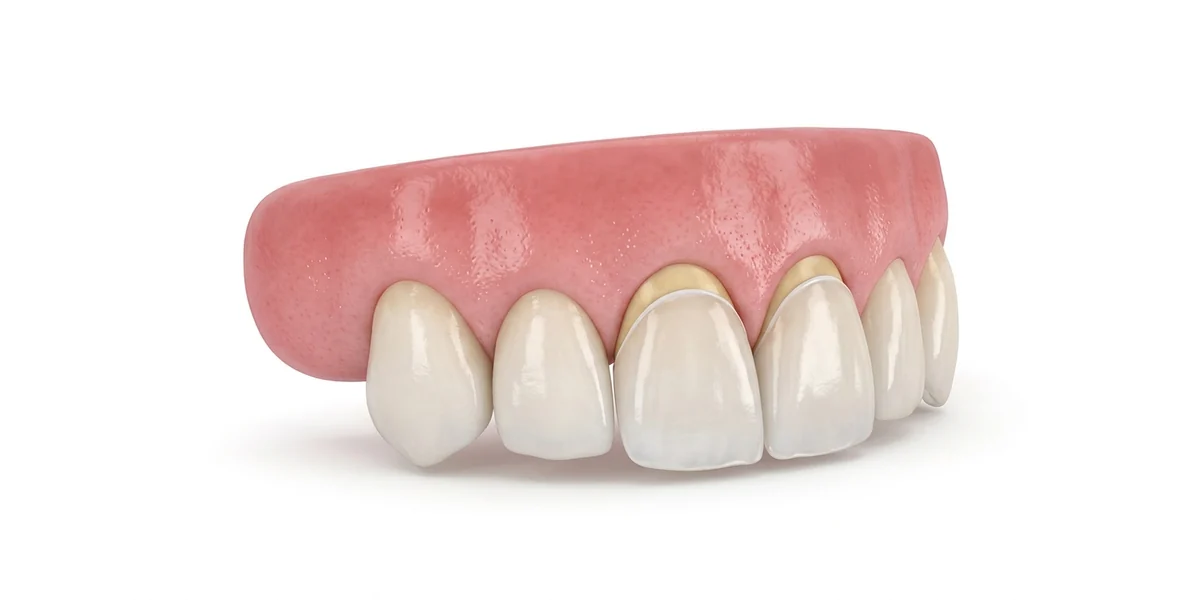
A 2-year study of 125 veneers grouped by how much dentin was exposed found more failures when veneers were bonded to teeth with extensive dentin exposure than to enamel or minimally exposed dentin (Öztürk and Bolay, Journal of Adhesive Dentistry, 2014). Enamel is better for both comfort and bond strength.
Sensitivity to cold water or air for a few days to a few weeks after bonding is common and usually fades; avoiding very hot or cold food for a while helps. If it gets worse over time, throbs on its own or wakes you at night, the nerve may be inflamed and you should be checked promptly. The review reported pulp-related problems in 2% but did not identify that figure as the rate of root canal treatment. We plan the reduction for each tooth backward from the final shape and try to keep it within enamel; see no-prep or minimal-prep veneers.
What happens if a veneer chips or falls off?
Chipping usually means a small piece breaks off at the biting edge. Debonding usually starts as a lifted edge where the bond has weakened. Common causes are biting ice or shells with the front teeth, grinding or clenching, and a bite where the front teeth hit hard.
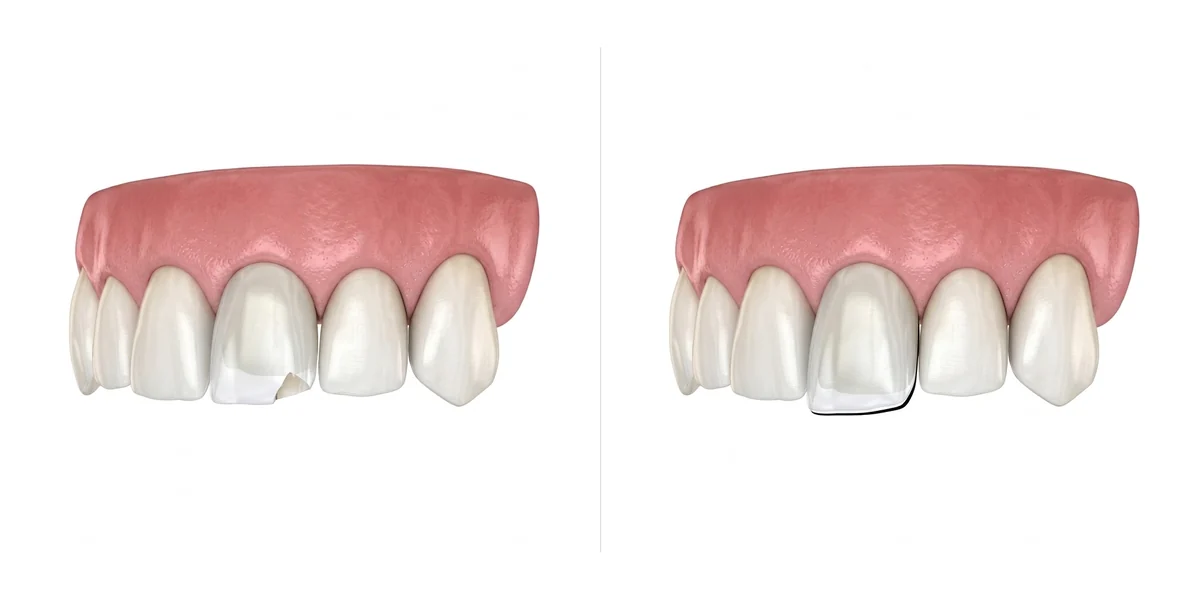
Grinding is a major risk. An 8-year study of 364 feldspathic veneers found that patients who grind their teeth and wore a night guard had a 7-year survival rate of 89.1%, compared with 63.9% for those who did not wear one (Faus-Matoses et al., Journal of Dentistry, 2020). Grinding does not rule veneers out, but wearing a night guard consistently is close to a condition; see teeth grinding and clenching.
If a veneer comes off, keep it in a clean container and bring it in. If the ceramic is intact and the tooth is healthy, it can sometimes be bonded again. Small chips can be smoothed or repaired with composite; larger fractures mean a new veneer. Leaving the tooth uncovered for long can cause sensitivity or let neighboring teeth shift, so come in as soon as you can.
Why do veneer edges stain, and why do gums get inflamed?
There is a very thin layer of bonding cement where the veneer meets the tooth. Over time, coffee, tea or tobacco can stain this edge as a thin brown line, and if the gums recede a little, the natural tooth color above the veneer can show as a band.
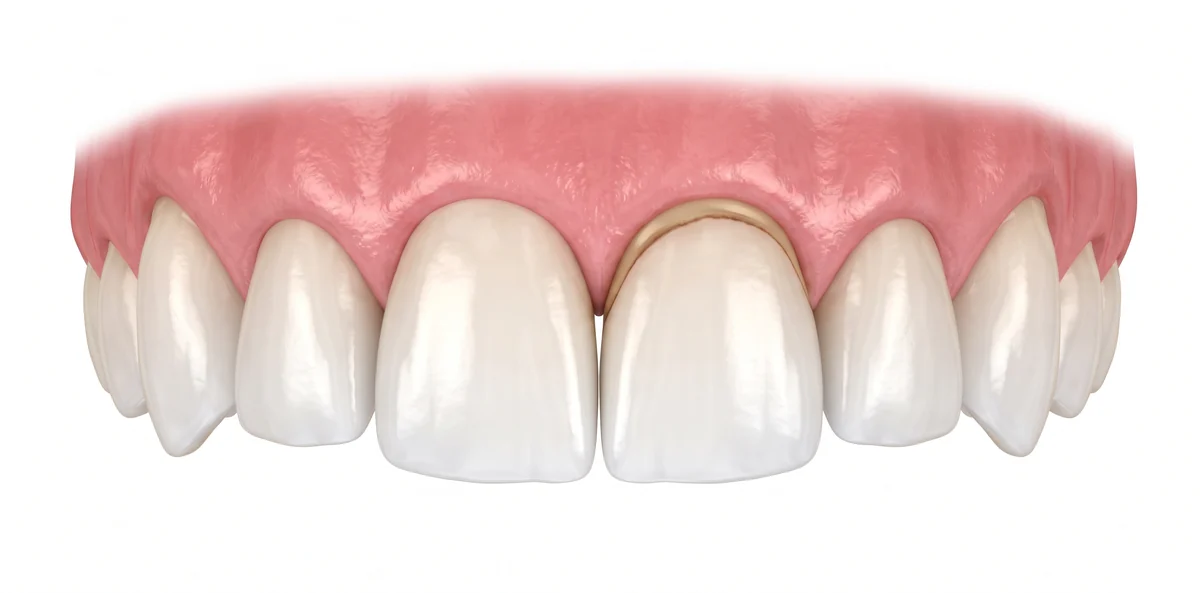
Gum inflammation starts when plaque builds up at the edge. If the edge is bulky or sits deep under the gum, a toothbrush and floss cannot reach it well, and the gum swells and bleeds more easily.
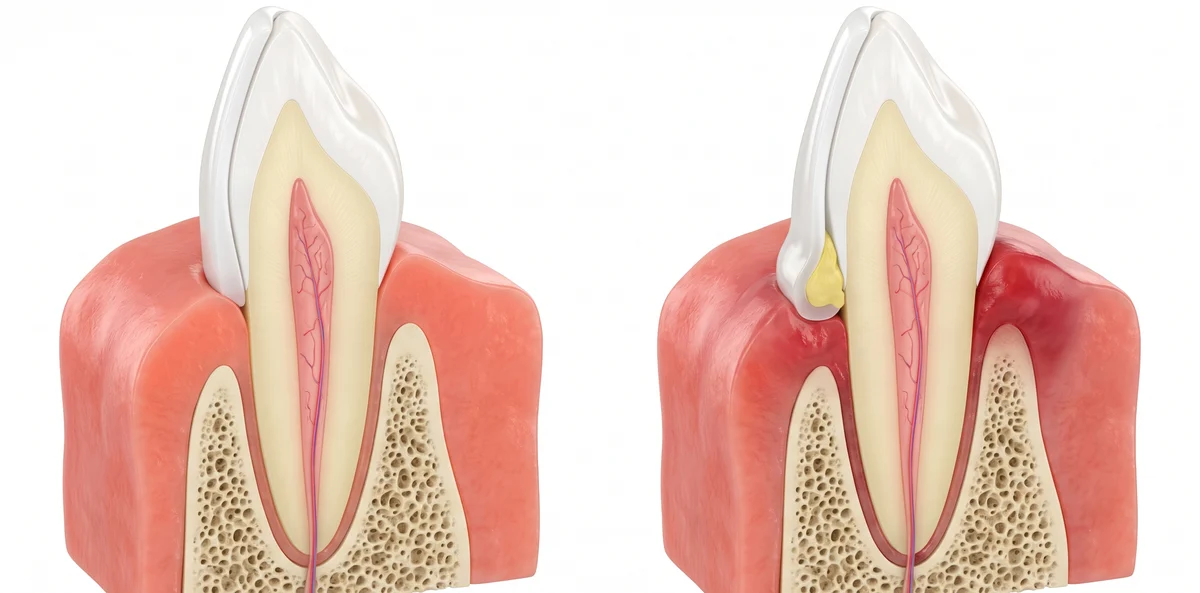
When teeth with veneers placed 7 to 14 years earlier were re-examined, the gums were normal around 43%, mildly inflamed around 15% and moderately inflamed with bleeding around 42%; recession was seen in 27%. Pocket depth did not differ between the veneered front surface and the unveneered back surface of the same teeth (Arif et al., Operative Dentistry, 2019). This study does not establish whether the veneers or care around their edges caused the inflammation.
Surface stains often polish away. If the edge has opened or decay has started there, we consider repair or replacement. Gum inflammation often settles with professional cleaning and flossing; if recession has exposed the edge, we look at the gum recession first. Before bonding, our periodontist checks gum thickness and inflammation to decide where the edge should sit. We check the gums and bite about 2 weeks after bonding, then the edges every 6 to 12 months with a cleaning.
When is it true that you shouldn't get veneers?
Veneers add a thin layer to the front of the teeth. When the real problem is not on that surface, side effects become more likely. In these cases we postpone veneers or suggest something else first:
- Front teeth that stick out or overlap. Hiding them means removing more tooth, which raises the risk of dentin exposure and sensitivity. Moving the teeth first with short orthodontics can make no-prep or minimal-prep veneers possible; see braces or veneers first?
- Worn-away backs of the teeth, large decay or cracks. Veneers cover only the front and cannot protect the back. A front-tooth crown may fit better.
- Grinding or clenching you cannot control. We first check the bite and whether you can wear a night guard.
- Gum inflammation. We treat the gums first, then decide where the edges go.
- Color is the only concern and whitening reaches the shade you want, or a small gap can be closed with bonding. You may not need veneers at all; see teeth whitening.
This patient wanted no-prep veneers, but the front teeth stuck out. Instead of trimming them down to hide them, we moved them first with 6 months of partial orthodontics, then bonded veneers about 2 months after the braces came off.
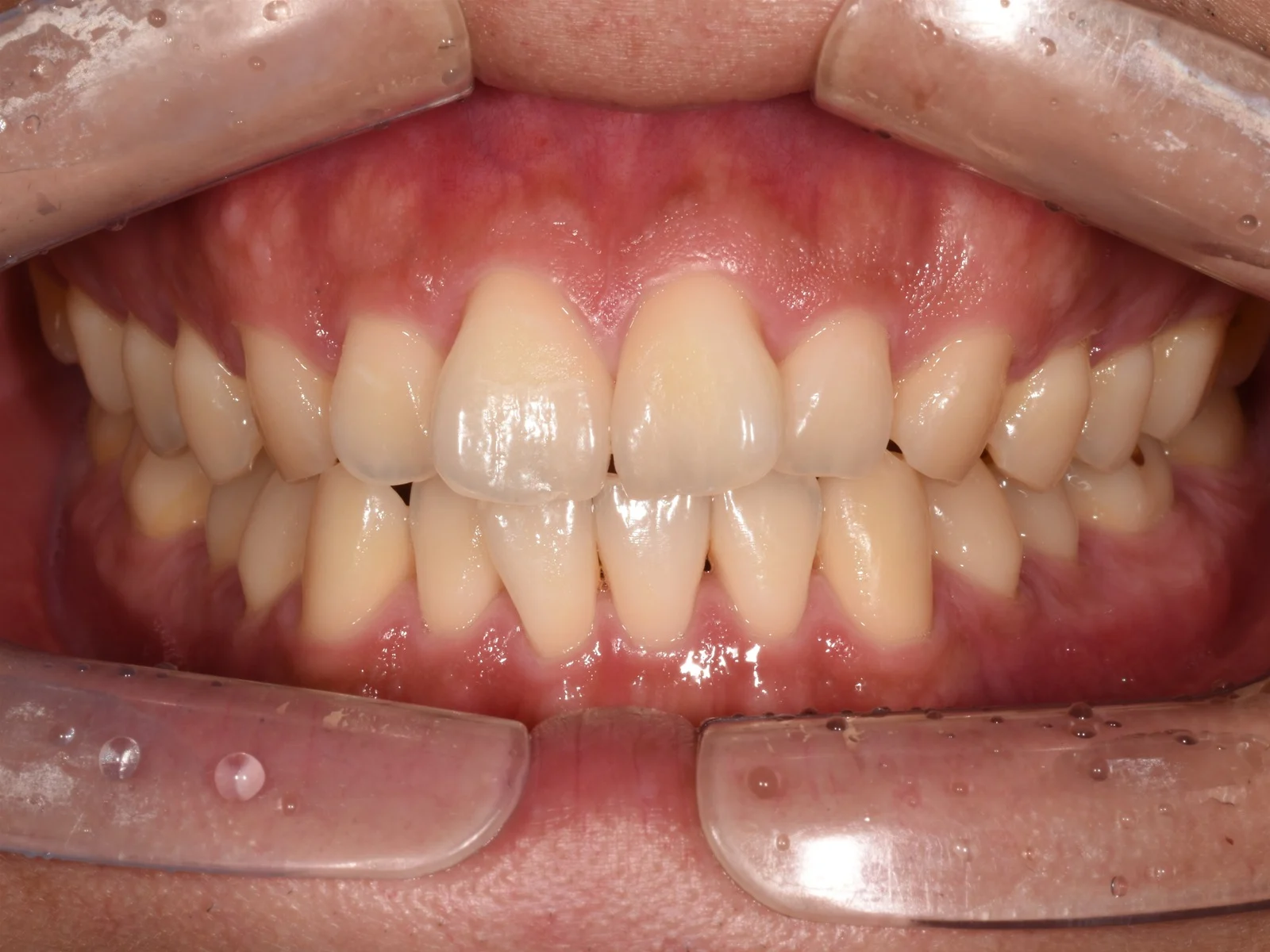
Before orthodontics · Apr 2025
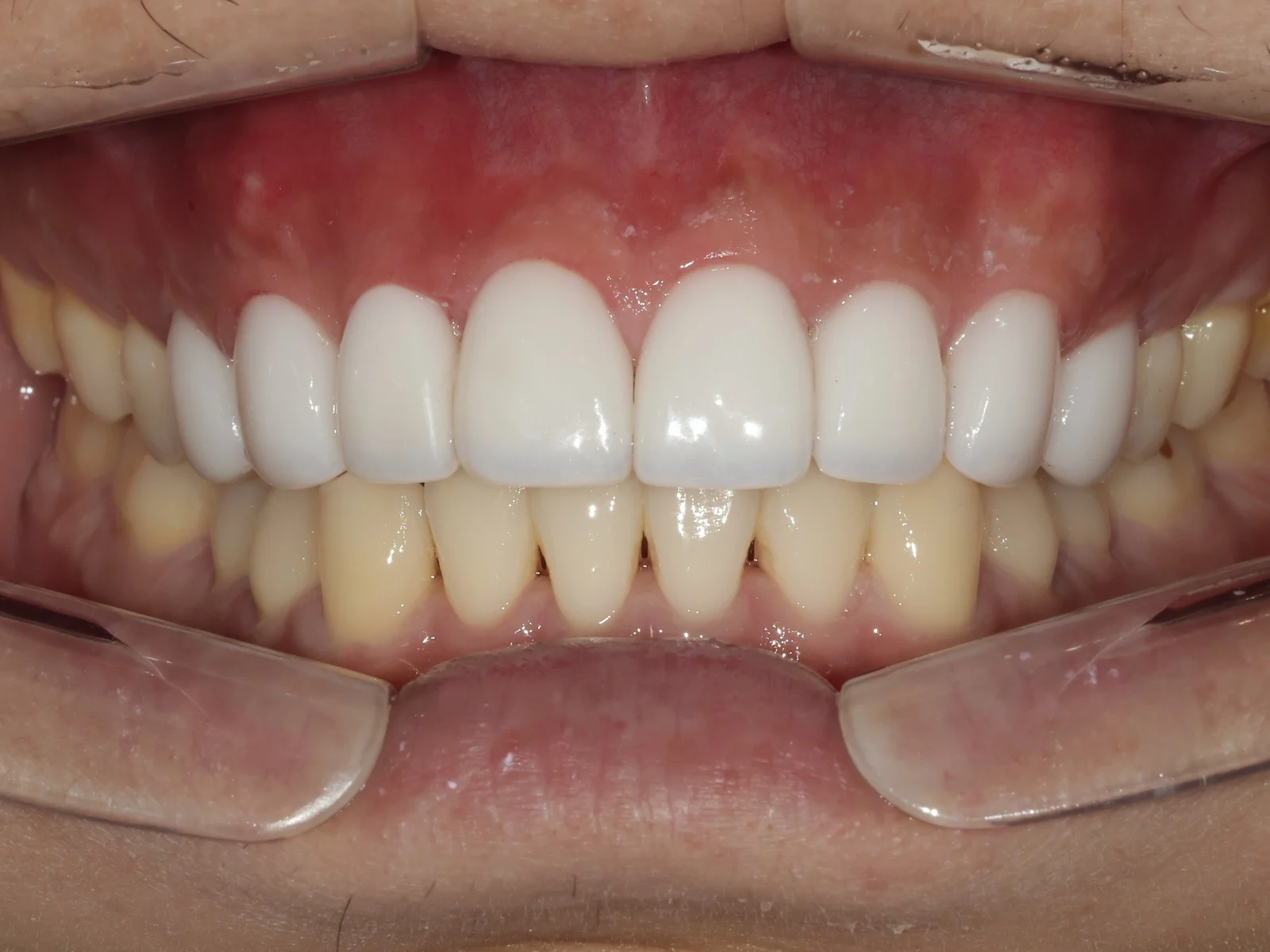
After veneers · Apr 2026
Before orthodontics, the two upper central front teeth stood out more than the neighboring teeth and the lower front teeth were unevenly aligned. After 6 months of front-teeth partial orthodontics, 8 upper no-prep veneers (premolar to premolar) were bonded to match color and shape. No reduction was done to hide teeth that stuck out.Possible side effects: bulky feel, chipping, margin staining and gum inflammation, original tooth colour showing through. Published with the patient's consent; before and after photos were taken of the same area from the same direction. Results and side effects vary from person to person.
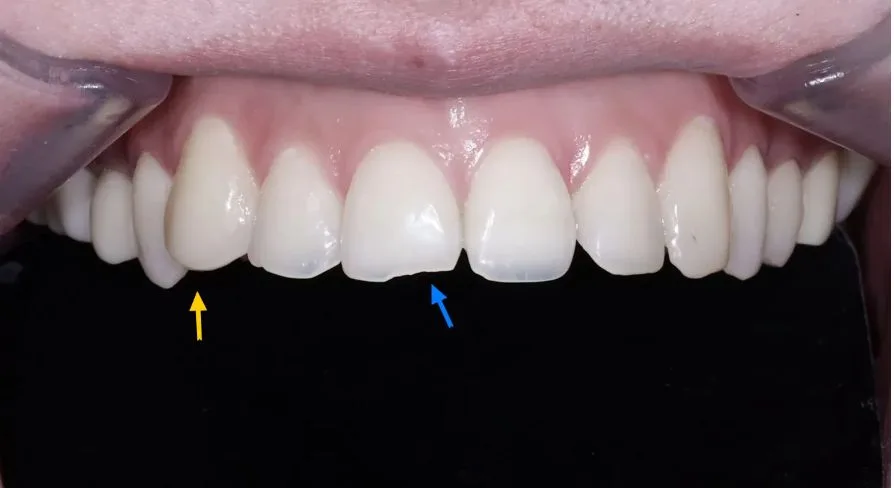
This patient came in asking for veneers, but long-term acid reflux had dissolved about half of the back surface of her upper front teeth, exposing dentin. Veneers cover only the front, so we recommended all-ceramic crowns on 8 upper front teeth instead; all 8 teeth kept their nerves.
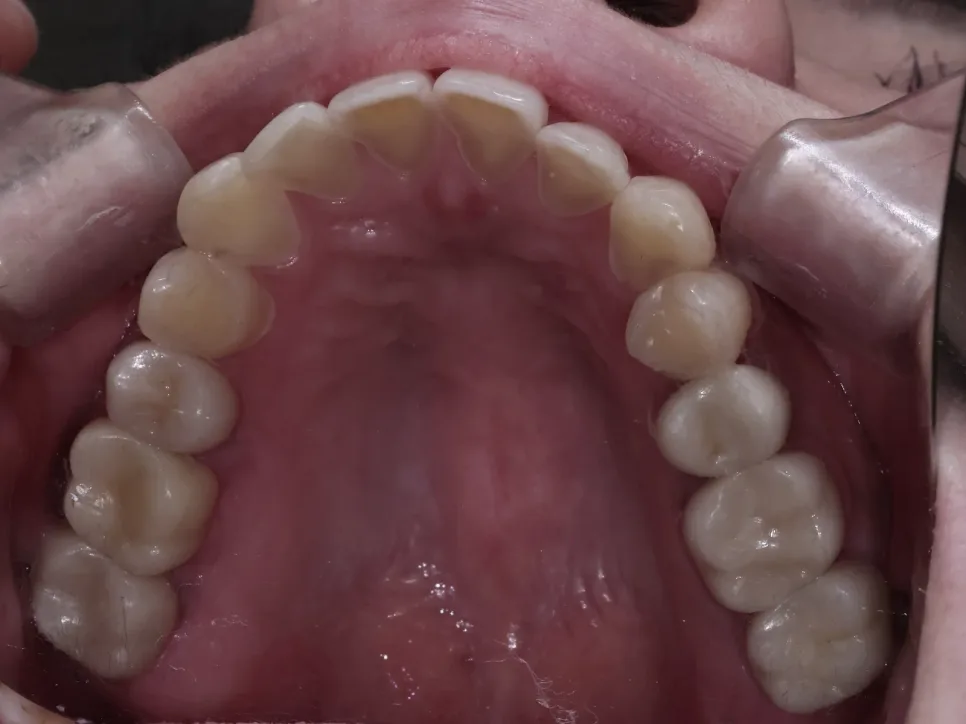
Before · Jan 2026
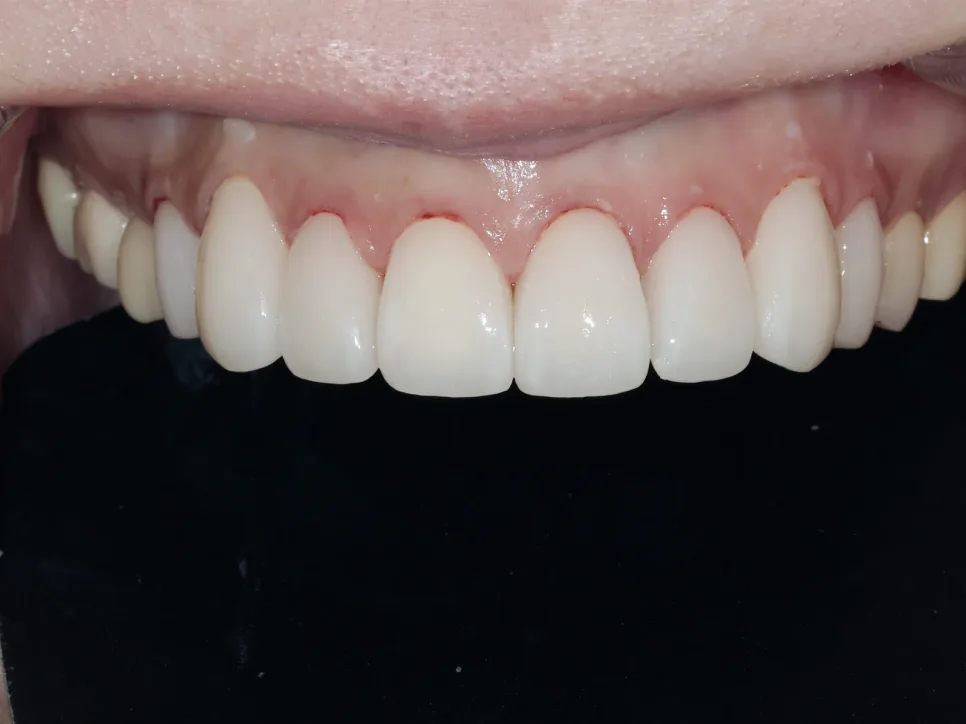
After · Feb 2026
Woman in her late 30s. Eight upper front teeth were restored with all-ceramic crowns, designed so the upper front teeth overlap the lower ones by about 1 mm. About 1 week, 2 visits. Lighting and size differ between the before and after photos.Crowns remove more tooth than veneers. Sensitivity, chipping, debonding and gum changes can occur, so regular check-ups are needed. If reflux continues it also affects the remaining teeth and restorations, so medical treatment is recommended alongside. Published with the patient's consent. Results, duration and number of visits vary. See the full case
If I live abroad, how many trips does this take, and what does it cost?
CERANATE veneers are usually completed in 2 visits about 1 week apart; One-Day can be prepared in the morning and bonded the same evening or the next day, if it suits your teeth after diagnosis. Leave 1–2 spare days before your flight. The gum and bite check about 2 weeks after bonding can be done by photo on WhatsApp, and we keep following up with photos after you go home. A warranty card is issued after treatment, with up to 5 years of after-care depending on regular check-ups and the contract terms, explained before treatment.
| Item | Typical for veneers |
|---|---|
| Fee | Depends on the number of teeth and the CERANATE type chosen for each; see our dental costs page |
| Visits | 2 visits about 1 week apart (One-Day: 1–2 days, decided after diagnosis) |
| Check-up | About 2 weeks after bonding (by photo on WhatsApp if you are home), then every 6–12 months with a cleaning |
| If a veneer chips or comes off at home | Keep the piece and send us a photo on WhatsApp; we advise whether it can wait until your next visit. Repair or re-bonding needs a visit |
See how many days dental treatment in Korea takes and our FAQ for international patients. If anything comes up after you go home, send us a photo on WhatsApp.
Frequently asked questions
What are the long-term side effects of veneers?
Can a veneer that fell off be put back on?
Does sensitivity after veneers go away?
Do veneers cause cavities?
Can I get veneers if I grind my teeth?
References
- Morimoto S, Albanesi RB, Sesma N, Agra CM, Braga MM. Main Clinical Outcomes of Feldspathic Porcelain and Glass-Ceramic Laminate Veneers: A Systematic Review and Meta-Analysis of Survival and Complication Rates. International Journal of Prosthodontics. 2016;29(1):38-49. PubMed 26757327
- Alenezi A, Alsweed M, Alsidrani S, Chrcanovic BR. Long-Term Survival and Complication Rates of Porcelain Laminate Veneers in Clinical Studies: A Systematic Review. Journal of Clinical Medicine. 2021;10(5):1074. PubMed 33807504
- Klein P, Spitznagel FA, Zembic A, et al. Survival and Complication Rates of Feldspathic, Leucite-Reinforced, Lithium Disilicate and Zirconia Ceramic Laminate Veneers: A Systematic Review and Meta-Analysis. Journal of Esthetic and Restorative Dentistry. 2025;37(3):601-619. PubMed 39523553
- Öztürk E, Bolay S. Survival of porcelain laminate veneers with different degrees of dentin exposure: 2-year clinical results. Journal of Adhesive Dentistry. 2014;16(5):481-9. PubMed 25279393
- Faus-Matoses V, Ruiz-Bell E, Faus-Matoses I, Özcan M, Salvatore S, Faus-Llácer VJ. An 8-year prospective clinical investigation on the survival rate of feldspathic veneers: Influence of occlusal splint in patients with bruxism. Journal of Dentistry. 2020;99:103352. PubMed 32413382
- Arif R, Dennison JB, Garcia D, Yaman P. Gingival Health of Porcelain Laminate Veneered Teeth: A Retrospective Assessment. Operative Dentistry. 2019;44(5):452-458. PubMed 30673371
Not sure if veneers are right for your teeth?
Send us a smiling front photo and a close-up of your front teeth for a rough direction. The diagnosis and total cost are given after an examination in person.
Ask on WhatsAppThis article is for general information and does not promise any particular result. Suitability, treatment plan, results and schedules differ from person to person. Please have a consultation and examination with a dentist before treatment. For current prices, see our price list.