
COLUMN · Orthodontics
Can Braces Fix Facial Asymmetry?
How to Tell Tooth-Related Asymmetry From Jaw Asymmetry
Facial asymmetry that comes from tooth position, or from the jaw shifting sideways when you bite, can often be improved with braces: a dental midline that is off to one side, part of a tilted (canted) bite line, or a jaw that slides sideways because one tooth touches first when you close. Braces barely change asymmetry that comes from the jawbone itself, such as one side of the lower jaw being longer so the chin points to one side, or from a difference in jaw muscle size. Telling them apart starts with three lines on a front-facing photo: the facial midline, the dental midline and the occlusal plane.
I am Dr. Sunmin Kim, head dentist at Ceramic Dental Clinic in Gangnam, Seoul, and a board-certified orthodontist with 16 years in practice. The question I hear most about an asymmetrical face is, "Will braces make my face symmetrical?" There is no one-line answer. Two faces can look equally uneven in the mirror while the cause sits in the teeth for one person and in the jawbone or muscles for the other, and what braces can do depends on that. This article explains how I separate the two in the clinic, and what habits, chewing on one side or Botox can and cannot change. Our main page on facial asymmetry and braces covers the four causes, three real cases and the treatment steps.
How common is facial asymmetry, and where does it show up?
No face is completely symmetrical; that small difference is why a mirrored selfie can look strange to you. It becomes a concern when the difference is large enough to notice, or when it comes with a bite problem.
In a review of 1,460 patients seen at the University of North Carolina's dentofacial clinic, 34% had clinically apparent facial asymmetry. Among them, 74% had it in the chin, 36% in the midface (mainly the nose) and only 5% in the upper face, and 41% had a canted occlusal plane (Severt and Proffit, 1997). These were people who came for jaw and bite treatment, so the numbers do not describe the general population. Still, the pattern matches what I see: asymmetry gathers in the lower face, especially the chin and the line of the teeth.
Which lines on a front photo show whether it is your teeth or your jaw?
I look at three lines on a front-facing photo: the facial midline from between the eyebrows to the tip of the nose, the dental midline between the two upper front teeth, and the occlusal plane, the line along the biting surfaces from the back teeth to the front. The occlusal plane normally runs almost parallel to the line between the pupils.
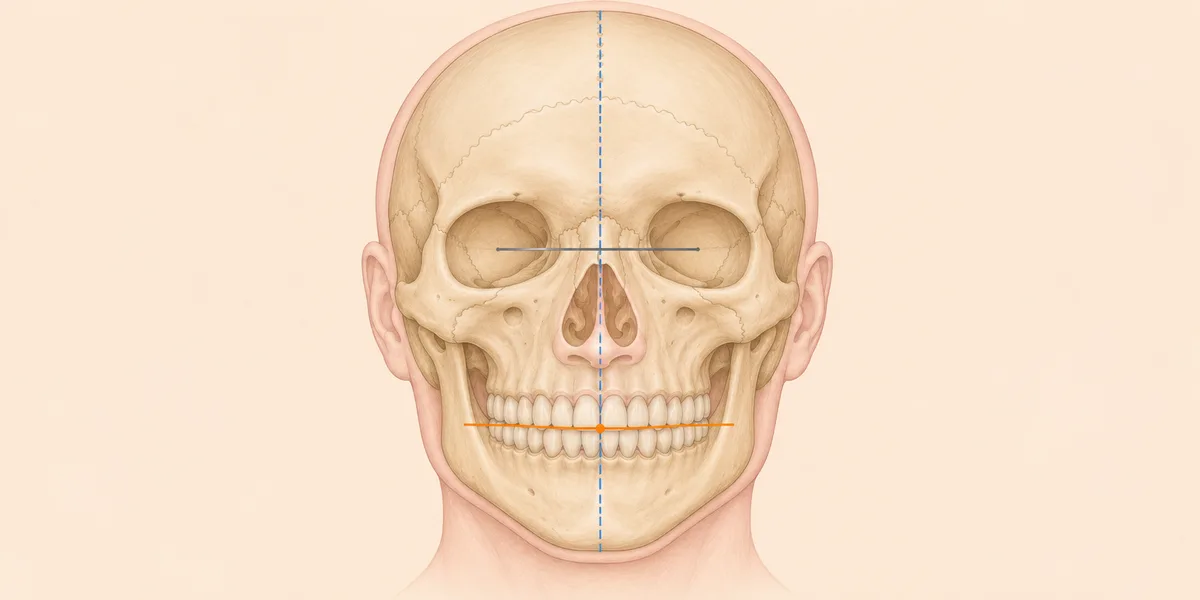
- Only the dental midline is off, and the chin is centered: the asymmetry is probably dental. This is where braces change the most.
- The occlusal plane is tilted: either the upper back teeth sit lower on one side, or the upper jawbone itself is tilted. If the teeth are the bigger part, braces can correct some of it.
- The chin itself points to one side: I then check whether the jaw slides sideways when closing (functional asymmetry) or whether one side of the lower jaw is longer (skeletal asymmetry).
You can get a rough idea at home. Stand straight, take a front photo, then lightly bite a wooden chopstick or a tongue depressor across the teeth just behind your canines and take another one, checking whether the stick runs parallel to the line between your eyes. A slight head tilt changes the result, though, and the photo cannot tell whether the tilt is in the teeth or the bone. I have not found evidence that biting a chopstick for long periods corrects asymmetry, so use it only as a check.
What is the difference between dental and skeletal facial asymmetry?
In dental asymmetry the jaws are close to symmetrical, but the teeth have drifted to one side, often because of crowding, a missing tooth or space on one side. In skeletal asymmetry one side of the lower jaw is longer or taller, so the chin bone itself sits off the facial midline.
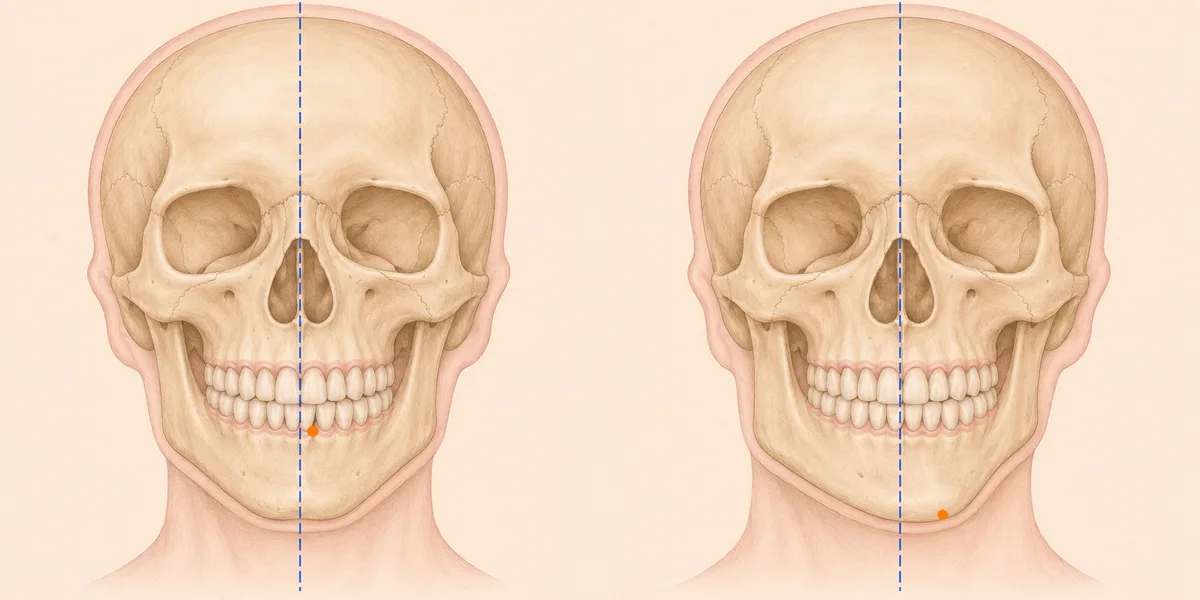
Below is a real case we diagnosed as dental asymmetry. The lower dental midline was 4 mm off the upper one and the left-right difference in the jaws was small. Without extractions, we organized the space on one side and moved the lower midline across.
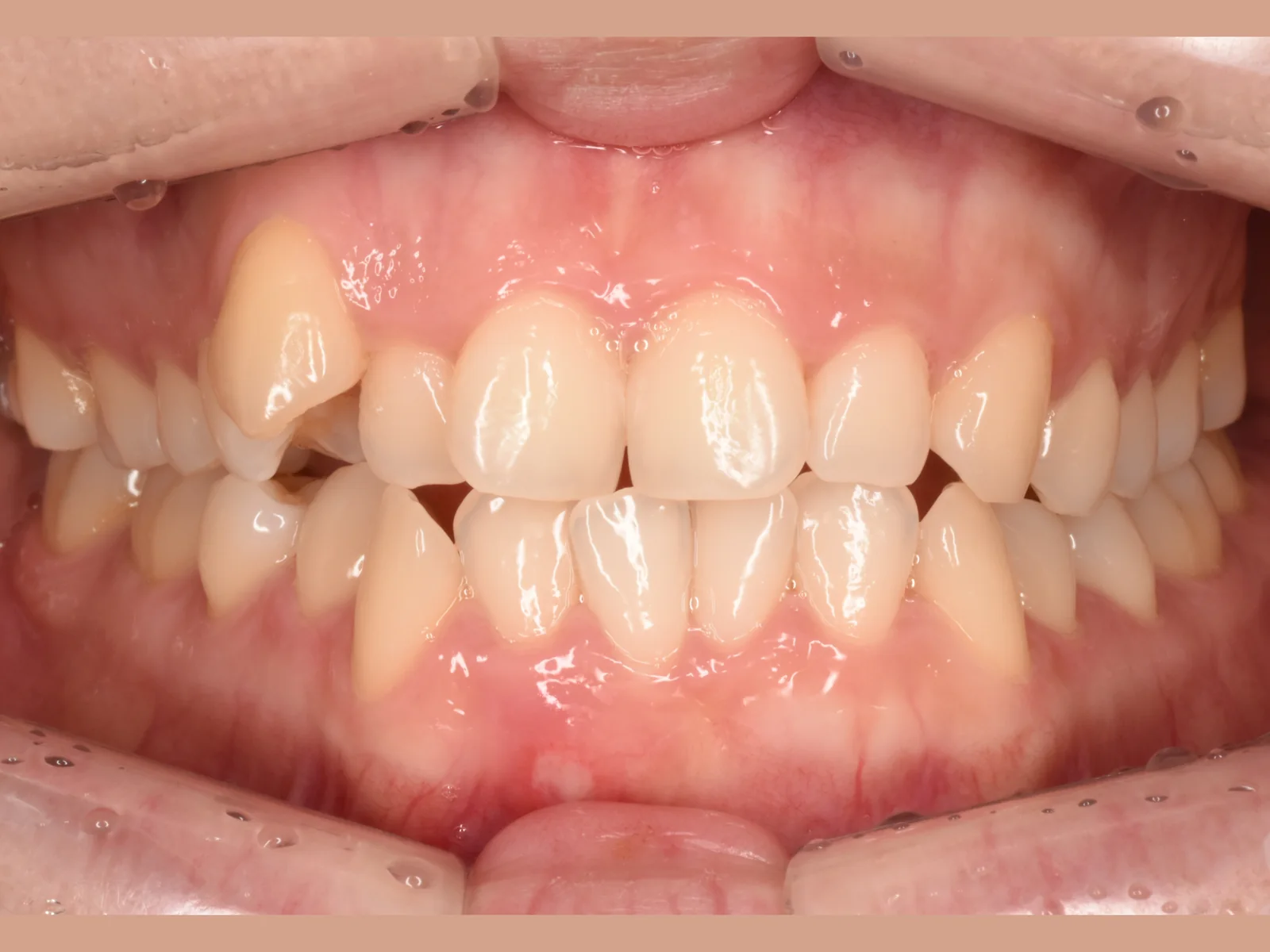
Before · photo July 2023
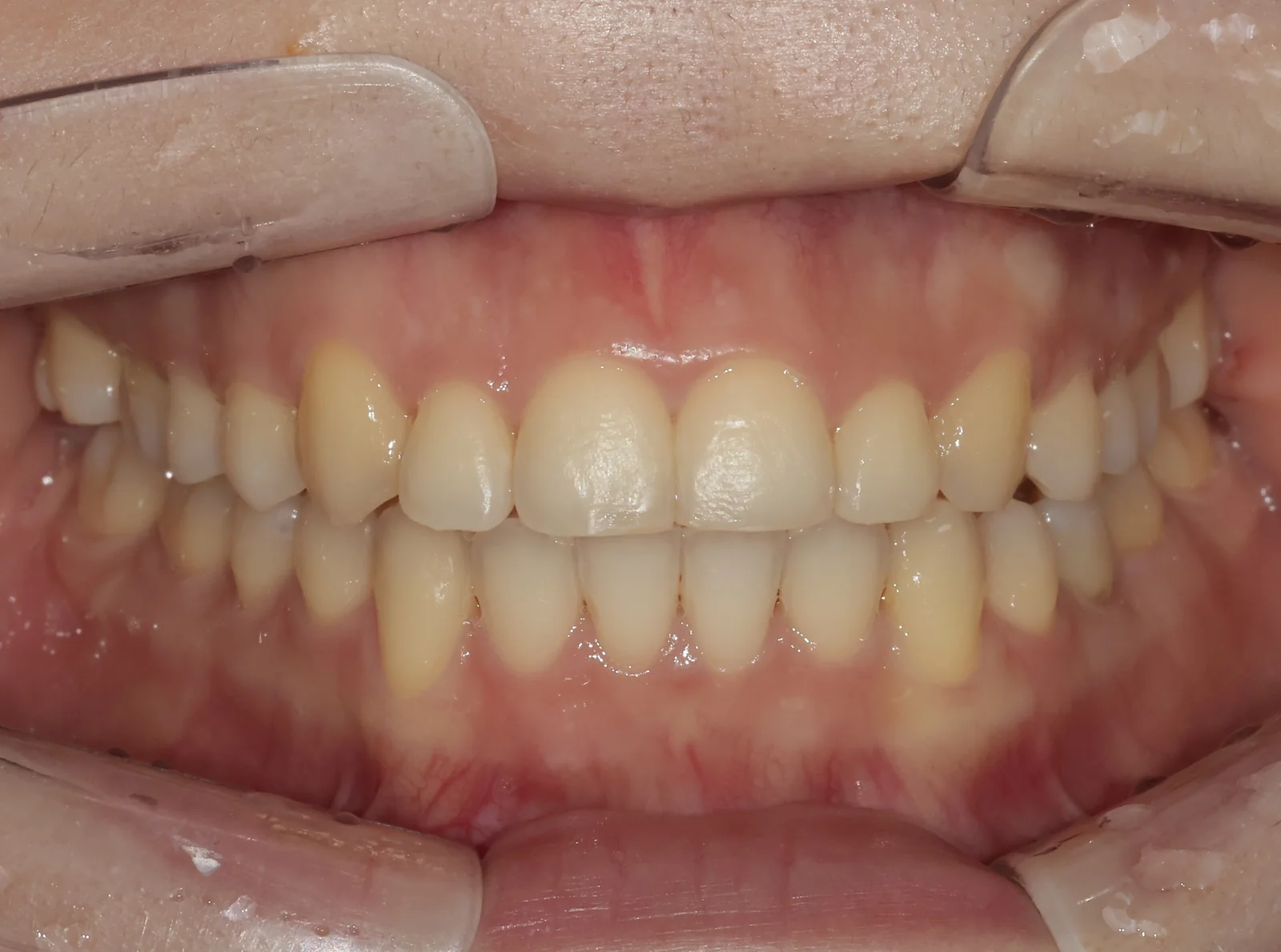
After · photo May 2026
Front intraoral photos taken of the same area from the same direction. Aligning the crowded teeth and moving the lower midline brought the upper and lower midlines together. Active treatment with braces took about 2 years 2 months (the after photo was taken some time after treatment ended, so the gap between the photo dates is longer than the active treatment time). Surgery was not considered because the jaw difference was small. The small left-right differences everyone has in the face remain.Possible side effects: root resorption, gum recession, teeth finishing slightly tilted, mini-screw loosening, relapse without retainers. Published with the patient's consent. Results and treatment time vary from person to person.
Skeletal asymmetry shows more clearly on a frontal X-ray (PA cephalogram) than on a photo. The X-ray below belongs to a patient whose lower jaw was longer on one side, leaving the chin 9 mm off center. She did not want surgery, so we only lined up the bite and dental midlines by adjusting tooth angles; her chin position and facial outline did not change.
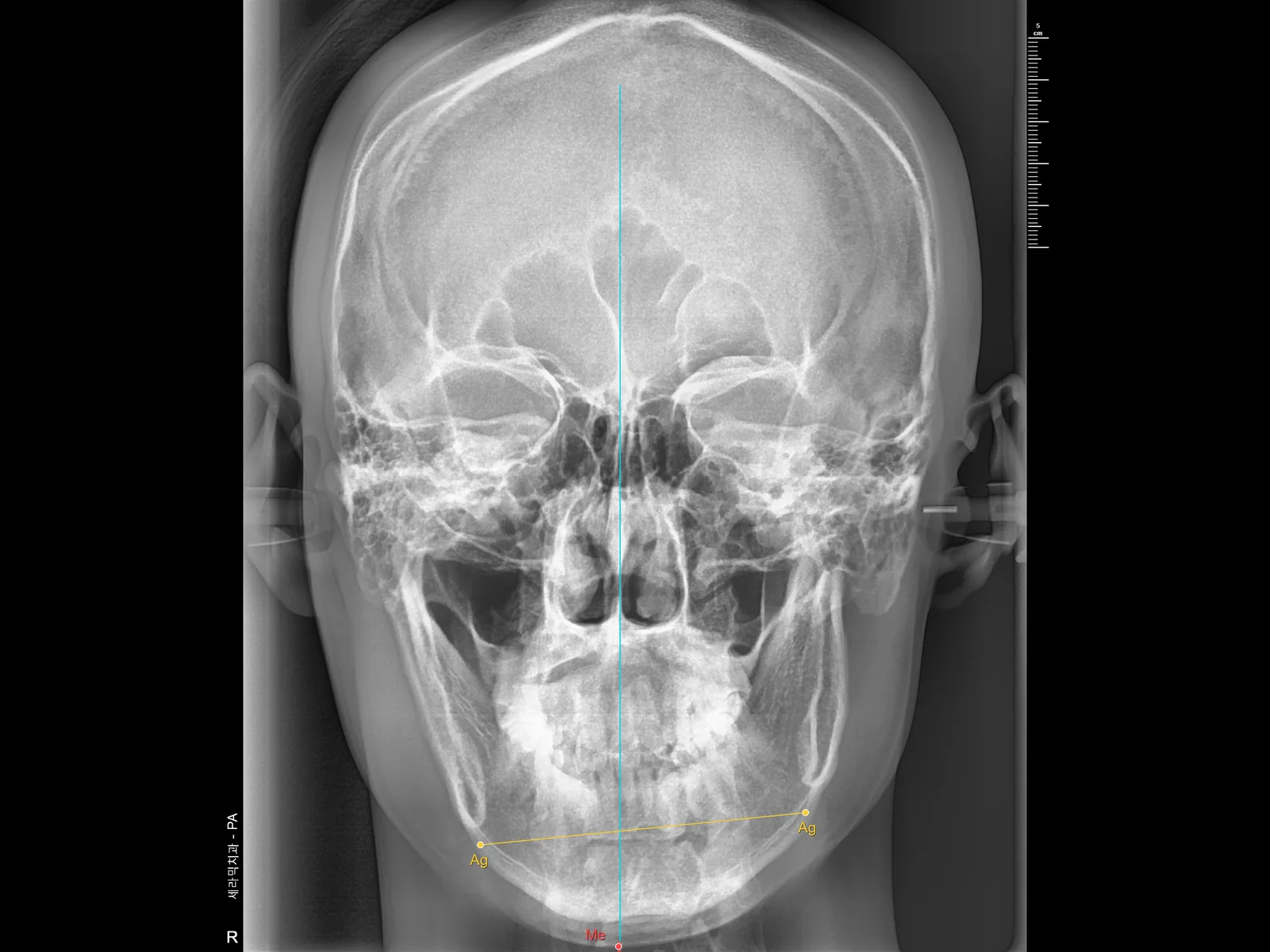
Many people have a mix of both. So I first measure how much of the chin's deviation comes from bone, because that part will not change with braces. A 3D CT scan is considered when regular X-rays are not enough, or when the skeletal difference or the jaw joints need a closer look.
Can braces fix a tilted smile or occlusal cant?
When the occlusal plane is canted, one side shows more gum in a smile, or the corners of the mouth look uneven. How noticeable that is varies. In one study, the same smile photo was tilted to 0°, 2° and 4° and shown to 40 orthodontists, 40 general dentists and 40 laypeople. All three groups rated 0° and 2° as esthetically acceptable; orthodontists judged 4° more harshly than the other two groups (Olivares et al., 2013). A small cant may bother you more than anyone else.
When the cant comes from the teeth, braces can correct it by moving the upper back teeth on the lower side up into the bone (intrusion) to match the other side. Molars have thick roots and resist moving, so a mini-screw (a small anchor screw) placed in the bone on that side is used as the anchor.
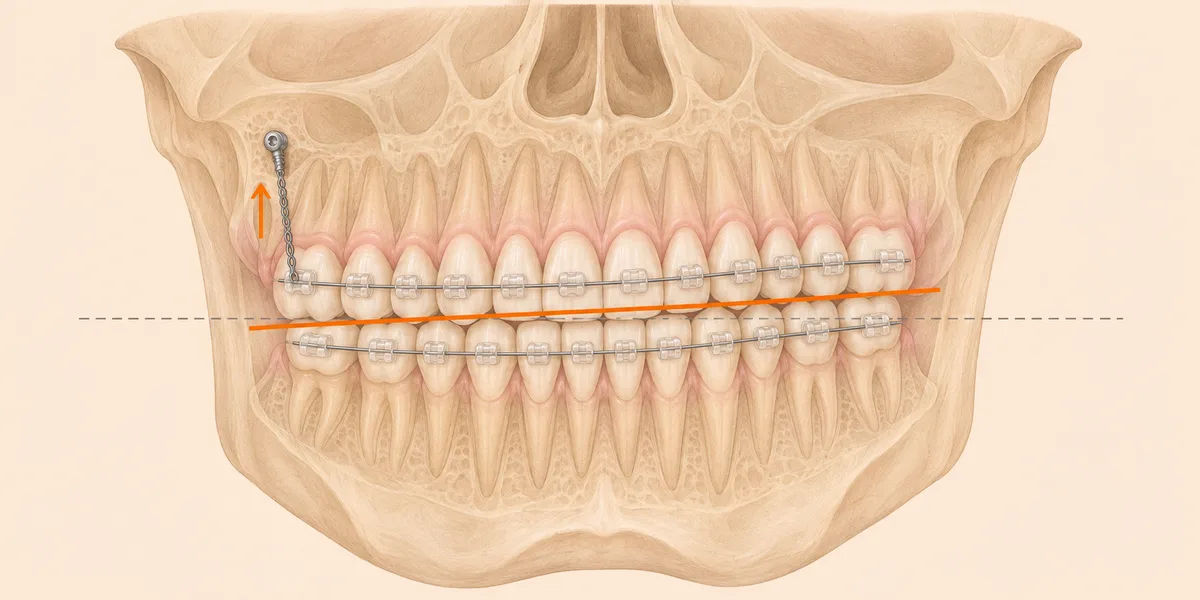
In practice this means designing different forces for each side. The illustration below shows treatment with a mini-screw and a coil spring on one side only, so the two sides move differently. With the same force on both sides, the teeth simply line up while staying off center.
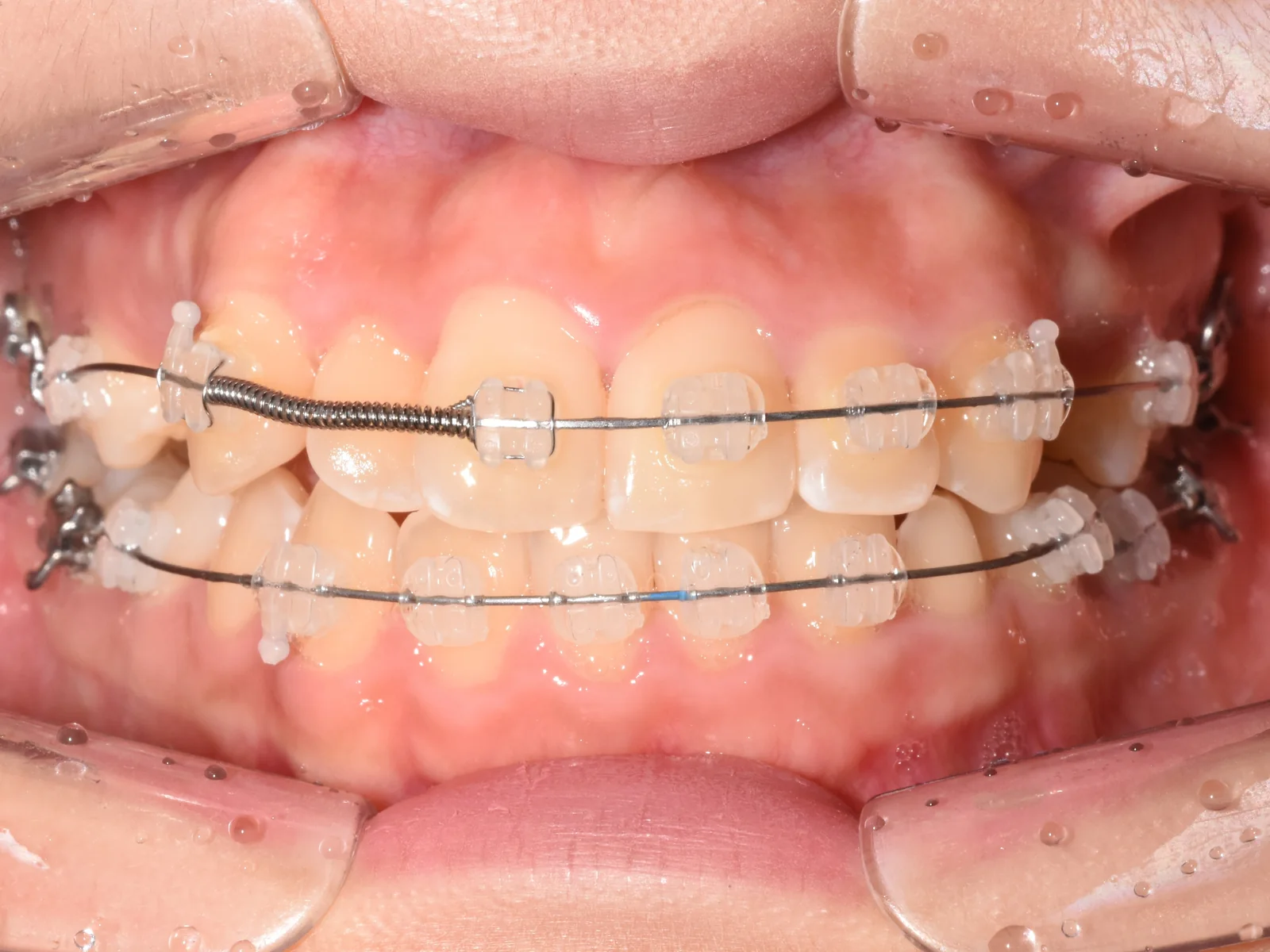
The limits are real. If the upper jawbone itself is strongly tilted, intruding teeth cannot level it all, and forcing it can leave teeth tilted or gums receded. In that case I explain how far braces can go, and if you want to change the facial outline too, orthognathic (jaw) surgery can be considered. Most published reports of correcting a cant with braces are single case reports, so I cannot give you an average amount of change.
Did chewing on one side or leaning on my jaw cause it, and will fixing the habit help?
Many patients tell me, "I think I only chew on one side, and that's why." The research is mixed. A 2024 study of 748 adults from a Finnish birth cohort, using 3D facial scans, found that the preferred chewing side had no statistically significant effect on facial asymmetry; missing teeth on the other side made people more likely to chew on one side (Heikkinen et al., 2024). A 2022 study of 106 twin pairs by the same group reported that the chin was larger on the side opposite the habitual chewing side (Heikkinen et al., 2022).
I take two things from this. Chewing on one side may be a cause of asymmetry, but it may also be a result of existing asymmetry or a missing tooth. And as far as I can find, there is no evidence that changing a habit alone reverses bone asymmetry in a fully grown adult. The same goes for leaning on your jaw or sleeping position: I do not tell patients that habit changes or facial massage will undo a bone difference. If a tooth that touches first or a missing tooth is making you chew on one side, treating that cause does make sense.
Could it be a jaw muscle difference or the jaw joint?
Sometimes the bones and teeth are close to symmetrical, yet the lower face looks wider on one side. If the masseter, the muscle that hardens when you clench, is bulkier on one side, the jawline looks wider there.
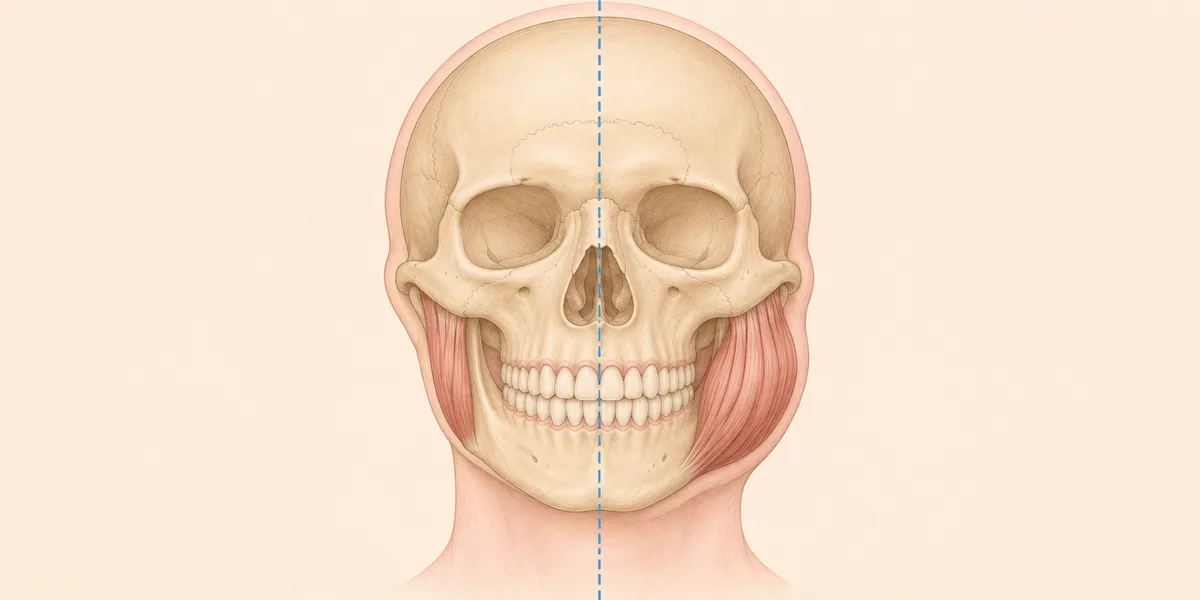
If muscle bulk is the main cause, masseter Botox can be considered. It reduces the muscle's force and bulk for a few months; it does not change the dental midline or a bone difference. What masseter Botox can and cannot do is explained on our jaw joint and bruxism Botox page.
If the asymmetry has become noticeably worse over the past few years, or your jaw clicks and hurts, the order changes. A jaw joint (condyle) that is changing shape on one side can tilt the jaw, so we first confirm the joint is stable (TMJ treatment). Lining up the bite while the joint is still changing can let it shift again after braces.
Braces alone or jaw surgery: how is it decided?
- How much of the chin's deviation comes from bone
- Whether the occlusal cant comes from the teeth or from the upper jawbone
- Whether your goal is the bite and dental midline, or the jawline and facial outline
- How much room the bone gives to tilt teeth, and the state of the jaw joint
If the bite and midline are the goal, there is a compromise approach with braces alone (orthodontic camouflage). If you want to change the chin position and facial outline and the bone accounts for much of it, jaw surgery can be considered. Surgery is done by an oral and maxillofacial surgeon; we handle the orthodontics before and after.
Patients sometimes ask whether porcelain veneers (laminates) could hide the asymmetry. Veneers change the color and shape of teeth; they do not fix a midline shift or an occlusal cant that comes from tooth position. Position problems call for braces first, and color or shape concerns are a separate conversation afterwards.
Coming from abroad: visits, time and cost
At the first visit we take face and tooth photos, an intraoral scan, a panoramic X-ray and frontal and side X-rays, plus a CT scan if needed. The orthodontic records fee is included in the orthodontic fee if you start treatment. Asymmetry treatment with braces alone usually takes about 1.5 to 2.5 years.
| Item | Facial asymmetry braces (typical) |
|---|---|
| Orthodontic fee | Set by appliance (ceramic, Invisalign, combination, lingual). See orthodontic costs |
| Included in the fee | Extractions (except wisdom teeth), mini-screws, standard retainers, and retainer check-ups and adjustments for 2 years after treatment |
| Treatment time | Usually about 1.5 to 2.5 years with braces alone |
| Visits with braces | Usually about once a month |
| After braces come off | A fixed retainer is bonded the same day; clear retainers can be sent abroad |
Asymmetry treatment needs regular adjustments, often with mini-screws and different forces on each side, so it suits people who can come to Seoul about once a month. If you can only visit every few months, tell us at the consultation; whether a plan with fewer visits is realistic depends on the cause. See braces in Seoul while living abroad, how many days dental treatment in Korea takes and our FAQ for international patients for visit intervals, retainers and what to do if something comes off after you go home. Between visits, you can send us a photo on WhatsApp.
Frequently asked questions
Can braces fix facial asymmetry in adults?
Can braces fix jaw asymmetry?
Why does my face look asymmetrical after braces?
Will chewing on the other side fix my facial asymmetry?
Can Botox fix facial asymmetry?
References
- Severt TR, Proffit WR. The prevalence of facial asymmetry in the dentofacial deformities population at the University of North Carolina. International Journal of Adult Orthodontics and Orthognathic Surgery. 1997;12(3):171-176. PubMed 9511487
- Olivares A, Vicente A, Jacobo C, Molina SM, Rodríguez A, Bravo LA. Canting of the occlusal plane: perceptions of dental professionals and laypersons. Medicina Oral, Patología Oral y Cirugía Bucal. 2013;18(3):e516-e520. PubMed 23524412
- Heikkinen EV, Vuollo V, Heikkinen T, Harila V. Chewing side preference, facial asymmetry and related factors in the Northern Finland Birth Cohort 1986. Acta Odontologica Scandinavica. 2024;83:500-506. PubMed 39291747
- Heikkinen EV, Vuollo V, Harila V, Sidlauskas A, Heikkinen T. Facial asymmetry and chewing sides in twins. Acta Odontologica Scandinavica. 2022;80(3):197-202. PubMed 34619067
Not sure whether your asymmetry is in the teeth or the jaw?
Send us two front photos, one with a relaxed face and one smiling with your teeth together, for a rough direction. The diagnosis and total cost are given after an examination in person.
Ask on WhatsAppThis article is for general information and does not promise any particular result. Suitability, treatment plan, results and schedules differ from person to person. Please have a consultation and examination with a dentist before treatment. For current prices, see our price list.