Last reviewed October 29, 2026 · Dr. Sunmin Kim (board-certified orthodontist, Certified Orthodontist of the Korean Association of Orthodontists)
At a glance
Good for
Muscle-related pain or strong clenching that has not improved enough with medication and physical therapy
Treatment flow
Check whether the pain comes from the muscles → explanation of limits and consent → injection only when needed
Duration and limits
Not recommended as the first treatment, but if you are already receiving it or the cause is clear, we sometimes use it from the start. The effect lasts a few months
Details
We do not recommend Botox (botulinum toxin) as the first treatment for jaw joint (TMJ) pain or teeth grinding. It is an option we consider only in limited cases of muscle-related pain or strong clenching that has not improved enough at the reassessment about 2 months after daily-habit guidance, home exercises, medication, and laser physical therapy. It only reduces the strength of the chewing muscles for a few months; it does not fix the joint disc or bone, study results are mixed, and it is not approved for TMJ disorder in the United States. However, if you are already receiving Botox, or your symptoms clearly point to the muscles as the cause, we sometimes use it from the start. We first determine whether the pain comes from the muscles, explain these limits, and go ahead only with your consent.
01°
Even among people who came wanting Botox, the actual treatment differed from person to person
We show progress records not only for a case that received Botox, but also for a case that improved with the earlier steps and did not need it, and a case where we did not recommend it because the cause was in the joint.
CASE01
Came wanting Botox but improved with the earlier steps
Muscle-related pain · daily-habit guidance and home exercises, medication, PHL-15 physical therapy → reassessment at about 2 months → no Botox
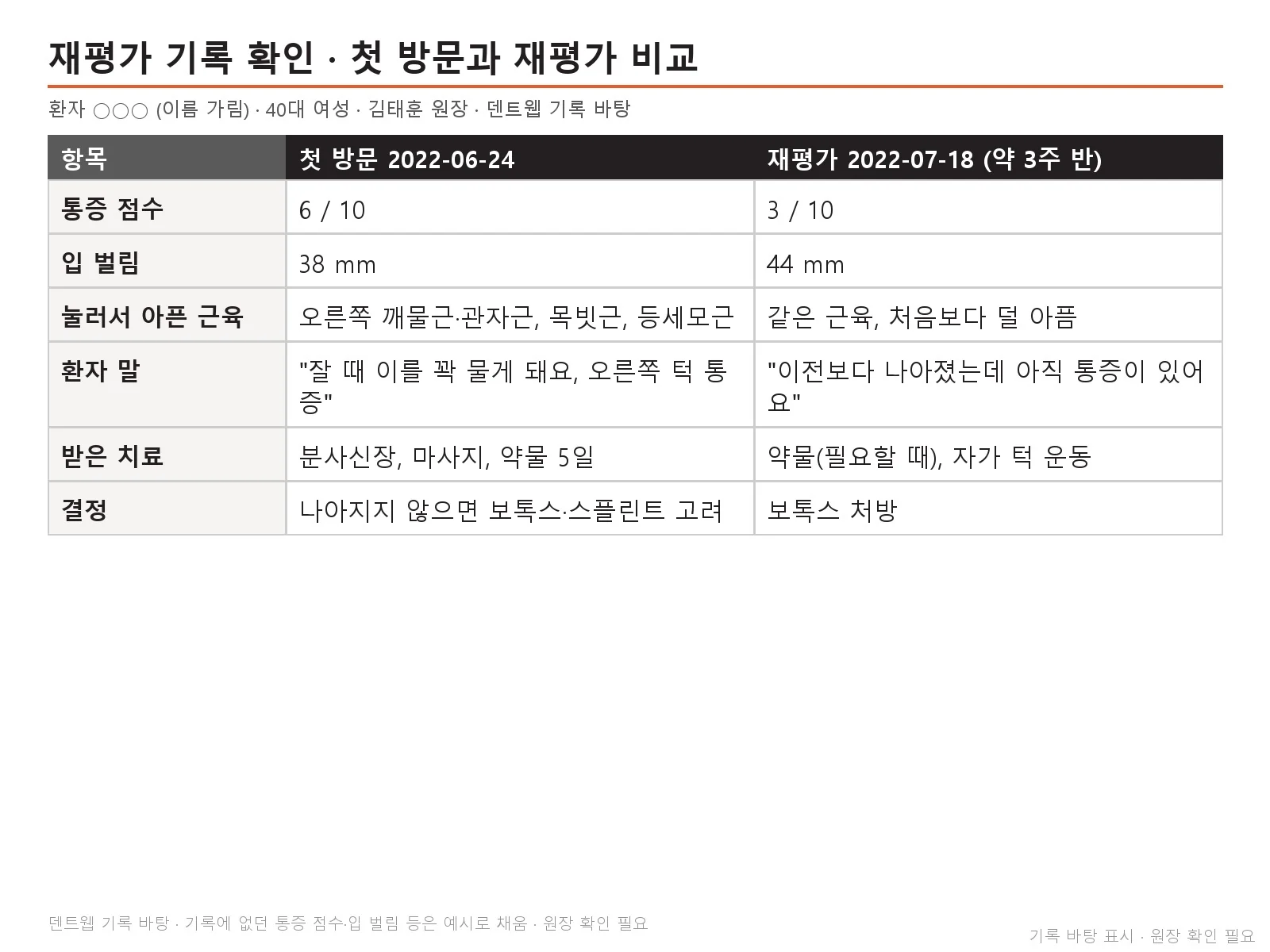
First visit
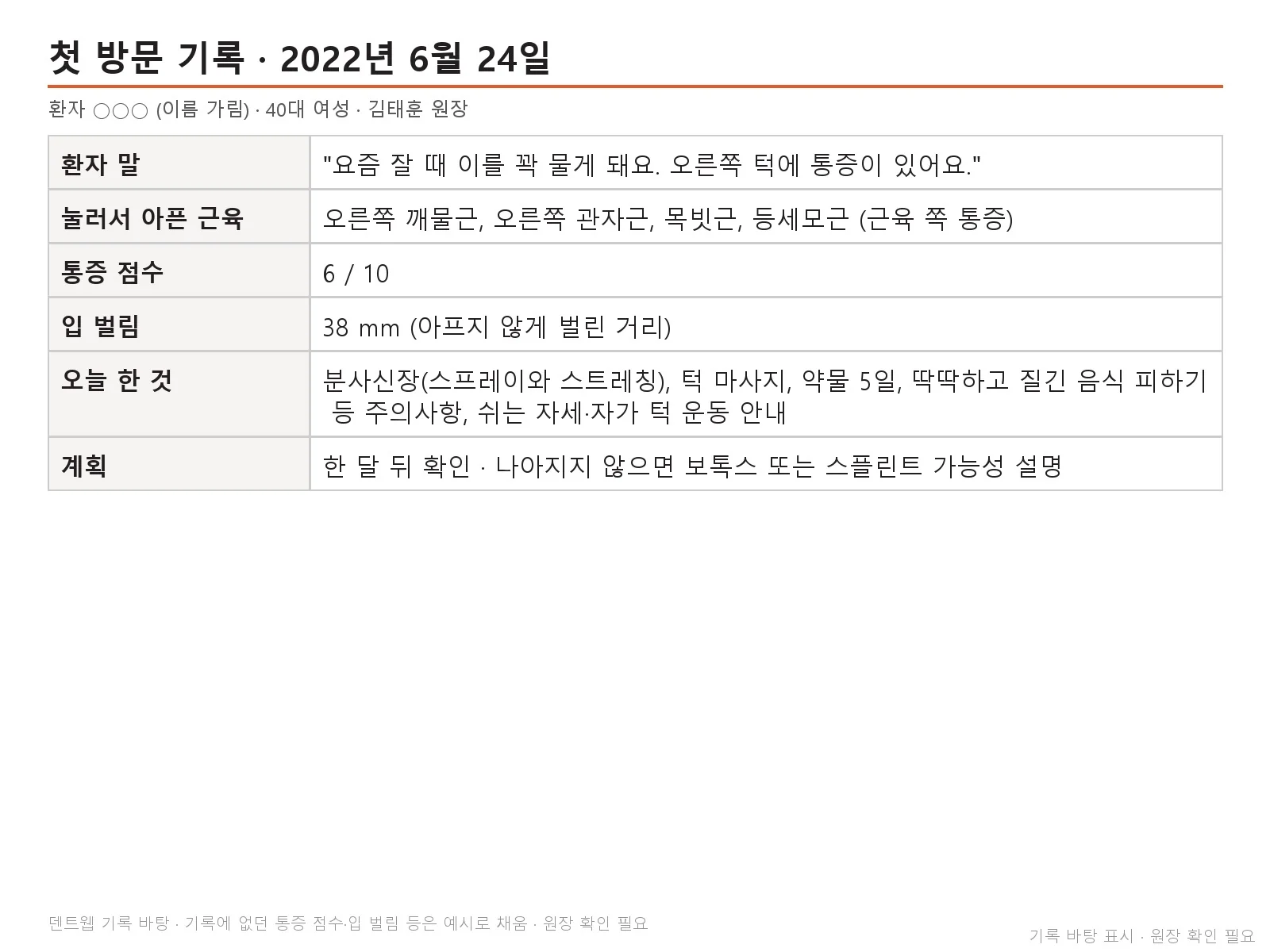
First-visit record. We noted the pain score, mouth-opening distance, and muscles that hurt when pressed.
Reassessment
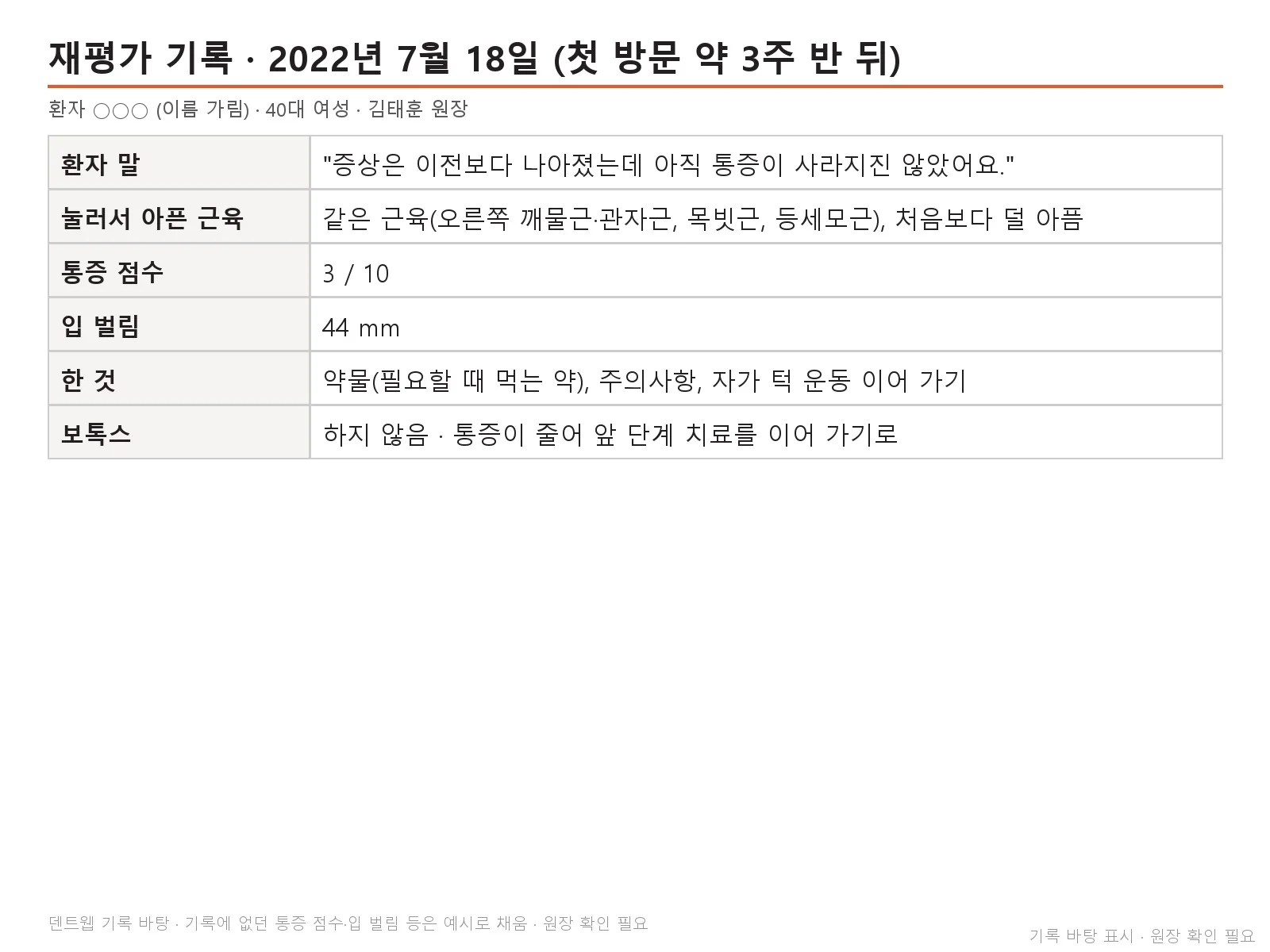
Reassessment record. We measured again the same way and compared with the first visit.
Condition
Morning jaw stiffness, pain when chewing, daytime clenching habit
Chosen
Resting-position guidance, home jaw exercises, medication and physical therapy for 2 weeks
Not done
Botox (the reassessment showed enough improvement)
Record
Pain 6/10 → 3/10, mouth opening 38mm → 44mm
Note
If the habit returns, the pain can come back too, so we advised continuing the home exercises.
CASE02
Muscle pain remaining even after the earlier steps and a splint
Muscle-related pain and strong clenching · Botox after explanation and consent, checked 2–4 weeks later
Illustration
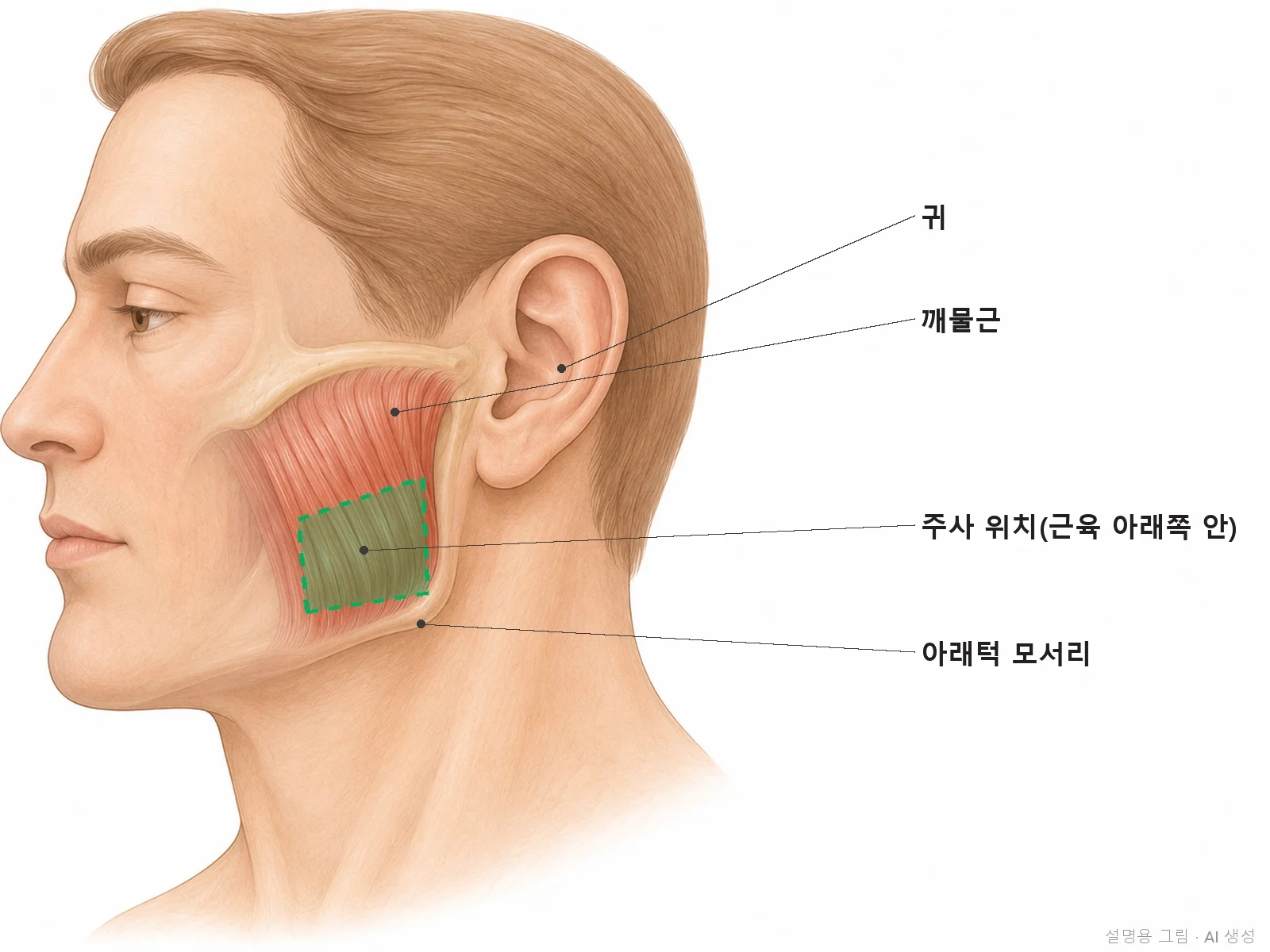
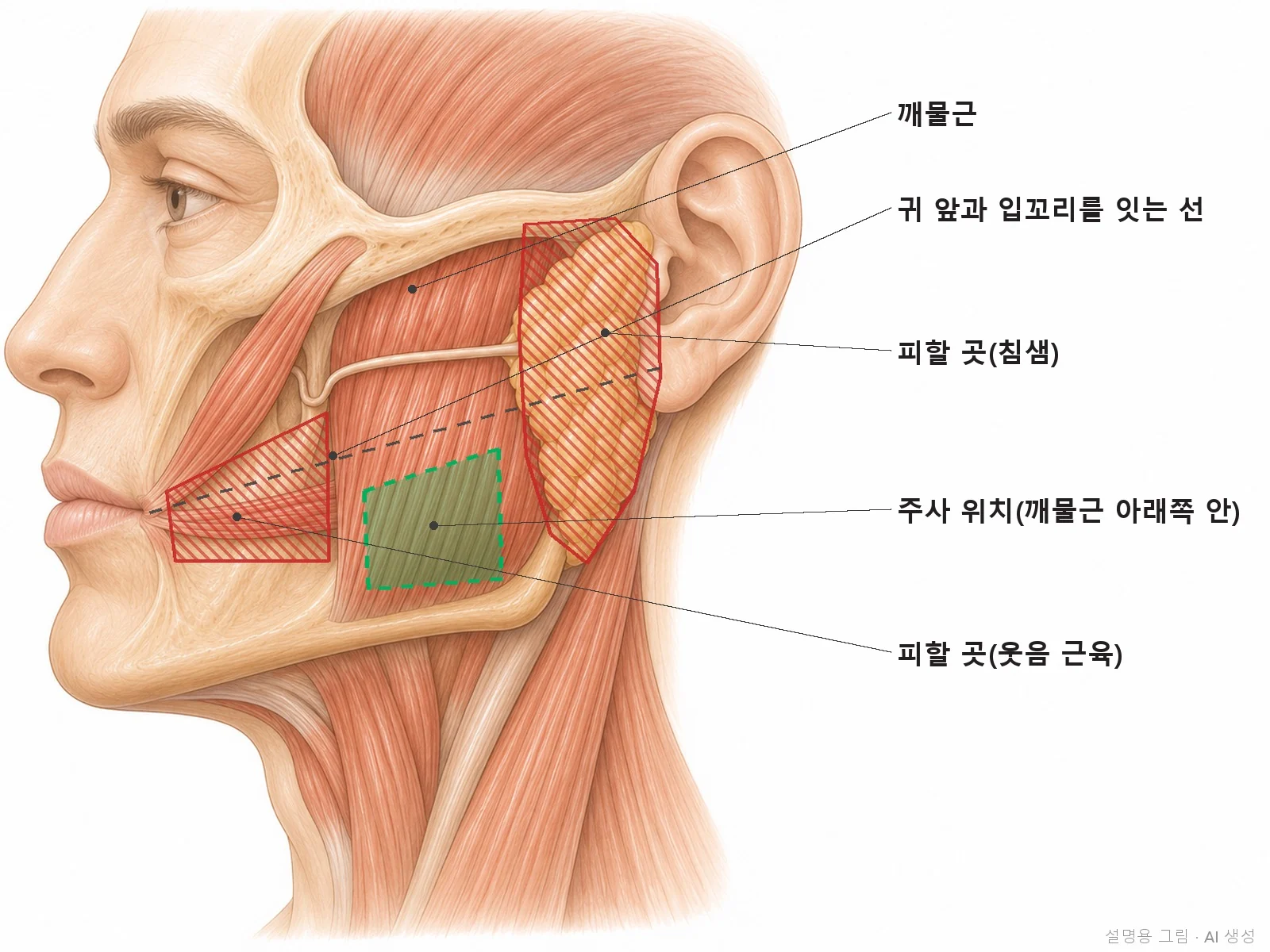
Injection site illustration. We feel the masseter muscle, which hardens when you bite, with our hands before choosing the sites.
Progress record
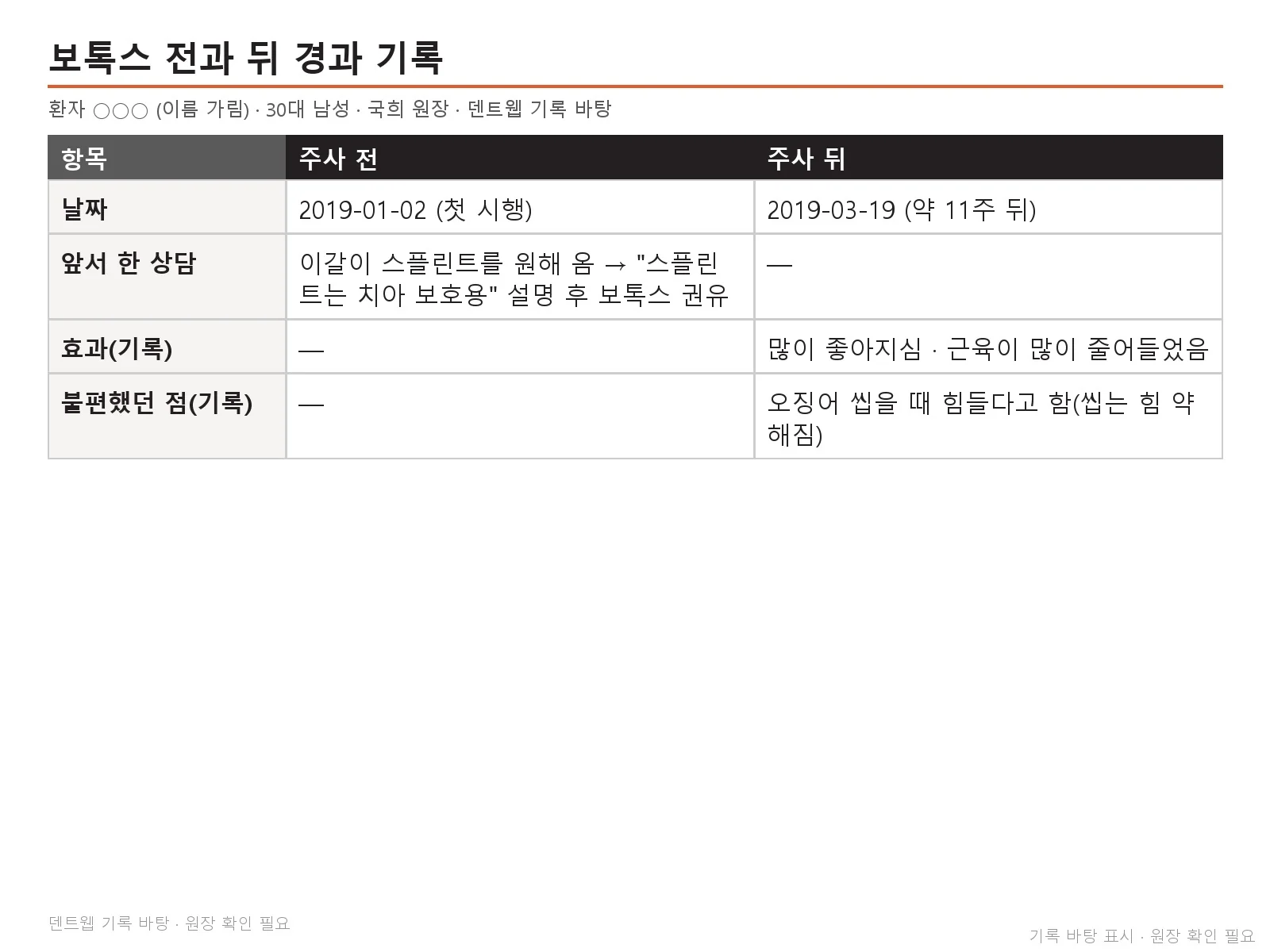
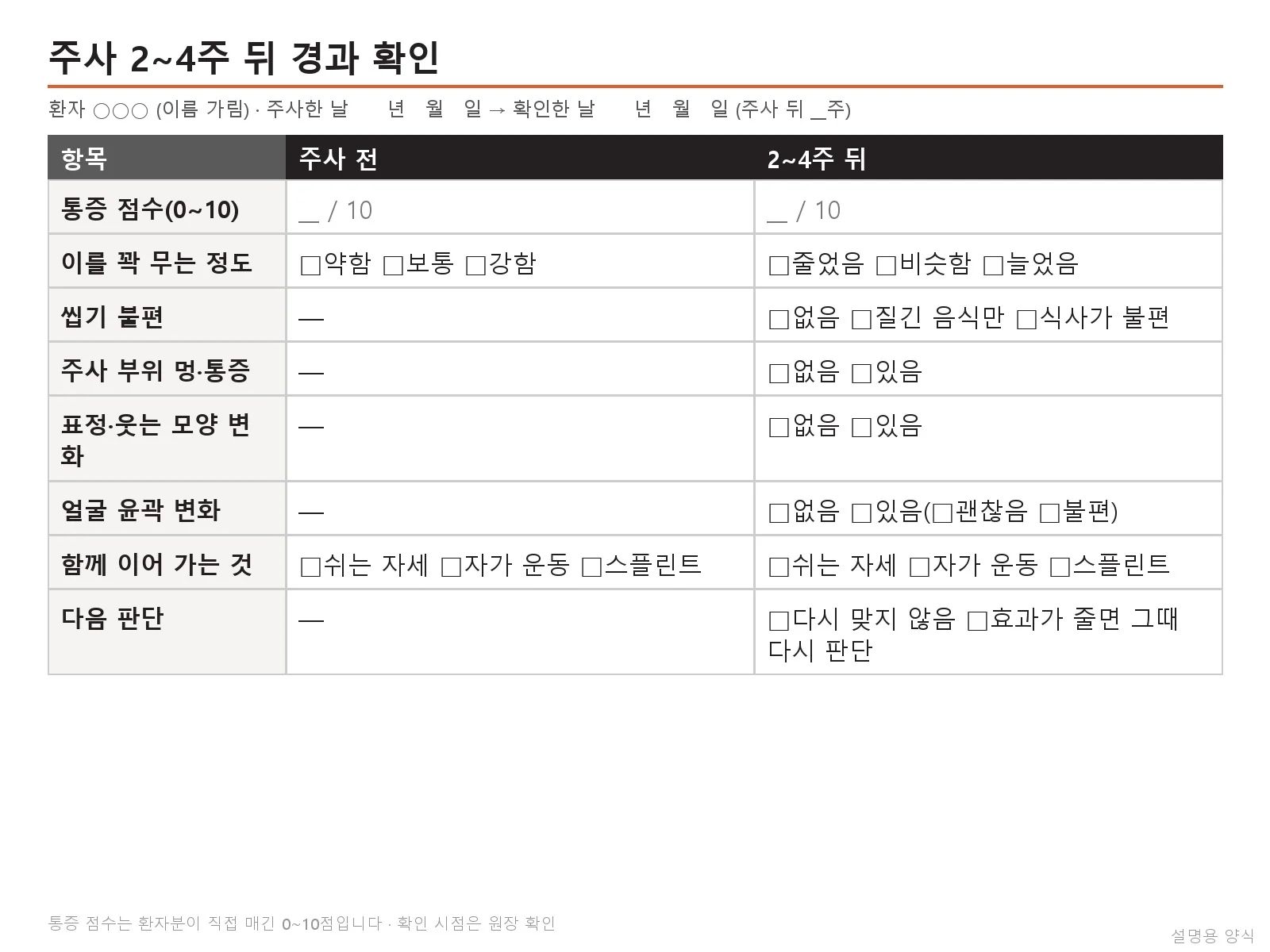
Progress record before and after the injection. We note both the effect and any discomfort to decide whether to inject again next time.
Condition
Masseter pain and strong clenching remaining after the reassessment at about 2 months and splint use
Chosen
After explaining limits and side effects and obtaining consent, Botox injection in the masseter area (usually 50 units)
Not done
Stopping the splint (kept using it along with Botox)
Record
The muscle shrank a lot and things improved; chewing tough food is harder
Note
The effect wears off after a few months, so we will decide then whether to inject again, based on the effect and side effects.
CASE03
Wanted Botox, but the cause was in the joint
Joint disc symptoms · Botox not recommended; step-by-step treatment and monitoring
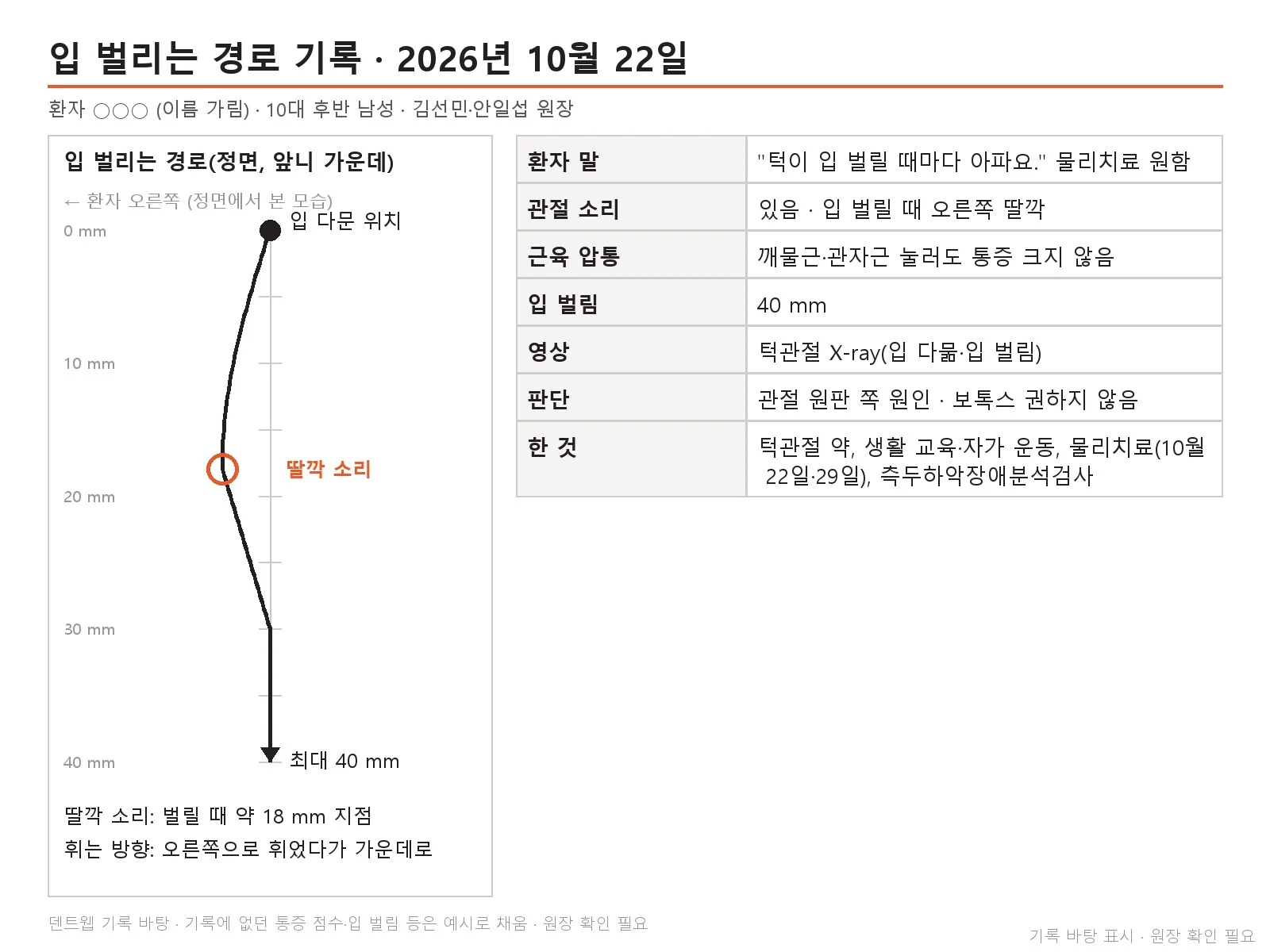
Movement record
Mouth-opening path record. There was a click when opening and the jaw shifted to one side, while pain on pressing the muscles was not significant.
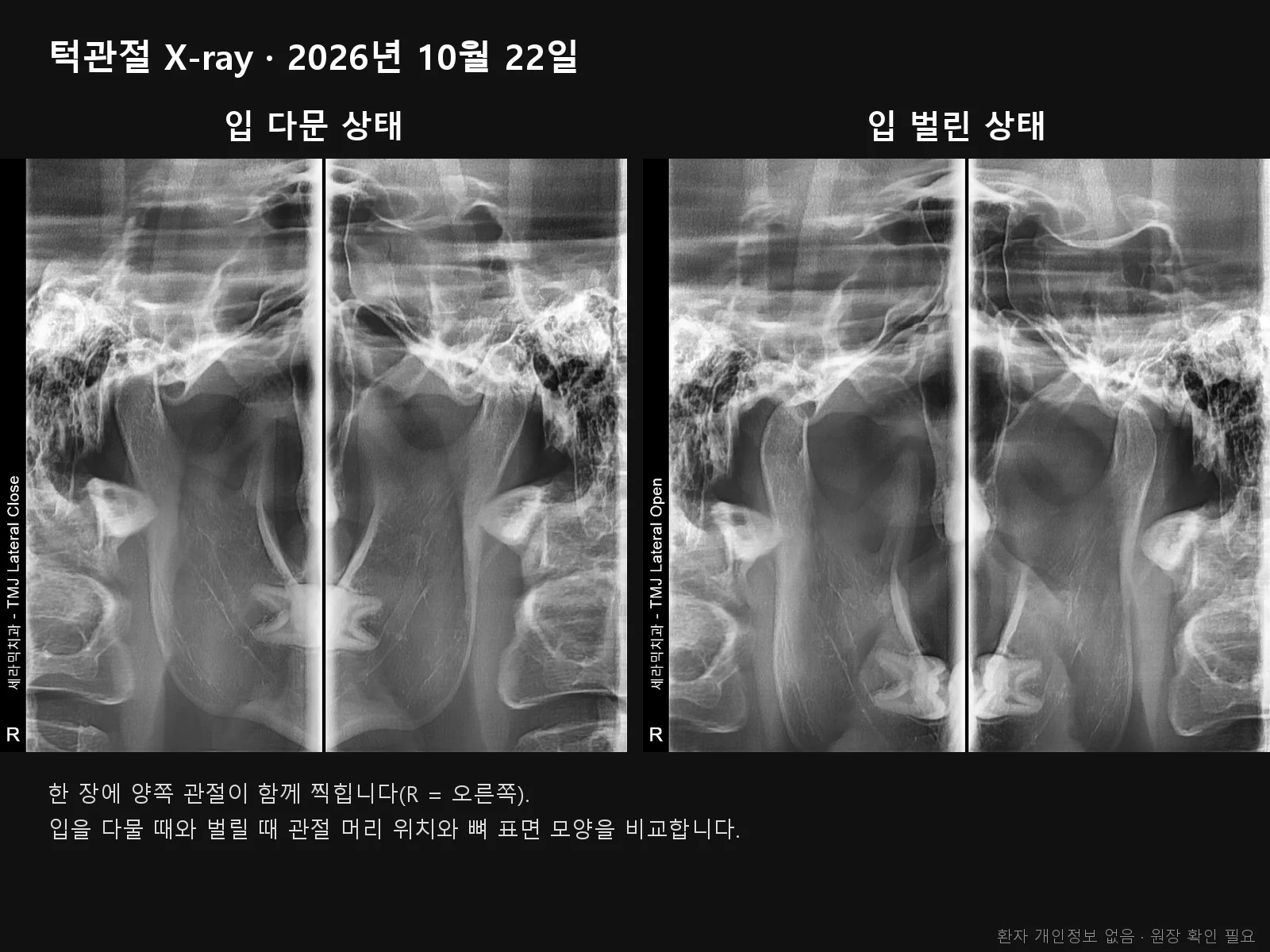
Jaw joint X-ray
Jaw joint X-ray (closed and open). We checked the position of the joint head and the bone shape with the mouth closed and open to decide the treatment direction.
Condition
Sound and catching when opening the mouth; little muscle tenderness
Chosen
Daily-habit guidance and home exercises, physical therapy, reassessment
Not done
Botox (reducing muscle strength does not change the position of the joint disc)
Duration
Physical therapy and monitoring since October 2026
* Records and photos were published with the patients' consent. Pain scores are rated by the patients themselves from 0–10. Treatment results and side effects may vary from person to person.
02°
What Botox can and cannot do
01What it does
It is injected into a chewing muscle (mainly the masseter) to reduce the force the muscle produces for a few months. The aim is to ease pain from excessive muscle tension and the force of strong clenching.
02What it cannot do
It cannot return the joint disc to its position or repair worn joint bone. It does not stop the grinding habit itself, so when the effect wears off, muscle strength and symptoms can return.
That is why the most important step before considering Botox is to first determine whether the pain comes from the muscles or the joint.
03°
How we proceed when considering Botox
There are five steps, from checking the reassessment record to deciding whether to inject again. For each step, we explain what we look at and why.
Reassessment record
Checking the reassessment record. We compare the pain score and mouth-opening distance before and after the earlier-step treatment.
STEP 01
We first check the earlier-step treatment and reassessment records
We check whether you have tried daily-habit guidance, home exercises, medication, and laser physical therapy, how much you improved at the reassessment at about 2 months, and how well you actually kept up the exercises and habit changes. If you have records of sufficient treatment elsewhere, we review them too.
Why we do thisThe UK NHS GIRFT and Royal College of Surgeons guideline (2025) calls for a reassessment at 6–8 weeks and does not place Botox as a first-line treatment. Injecting someone who could improve with the earlier steps may only cause unnecessary side effects.
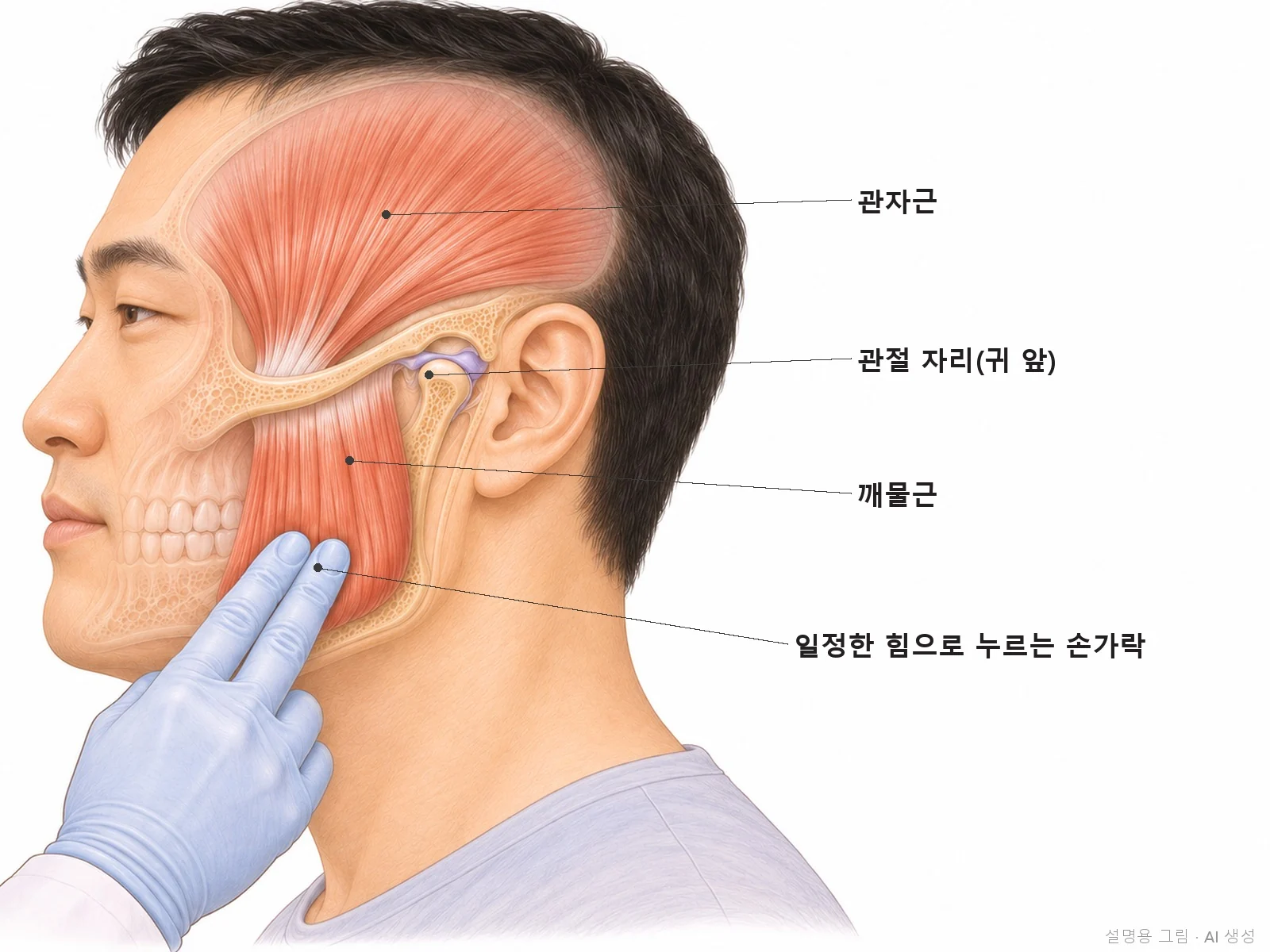
Muscle check
Muscle palpation. We ask you to bite down hard to find where the masseter is and how far it hardens, and check whether pressing reproduces your usual pain.
STEP 02
We check again whether the pain comes from the muscles
We press the masseter and temporalis muscles to see whether your usual pain is reproduced, and check mouth opening, sounds, and pain in the joint area again. If a joint disc or joint bone problem is the main cause, we do not recommend Botox.
Why we do thisBotox is an injection that reduces muscle strength, so it is meaningful only when the muscles are the cause. For pain caused by the joint, it has little effect and may only weaken your chewing force.
Explanation and consent
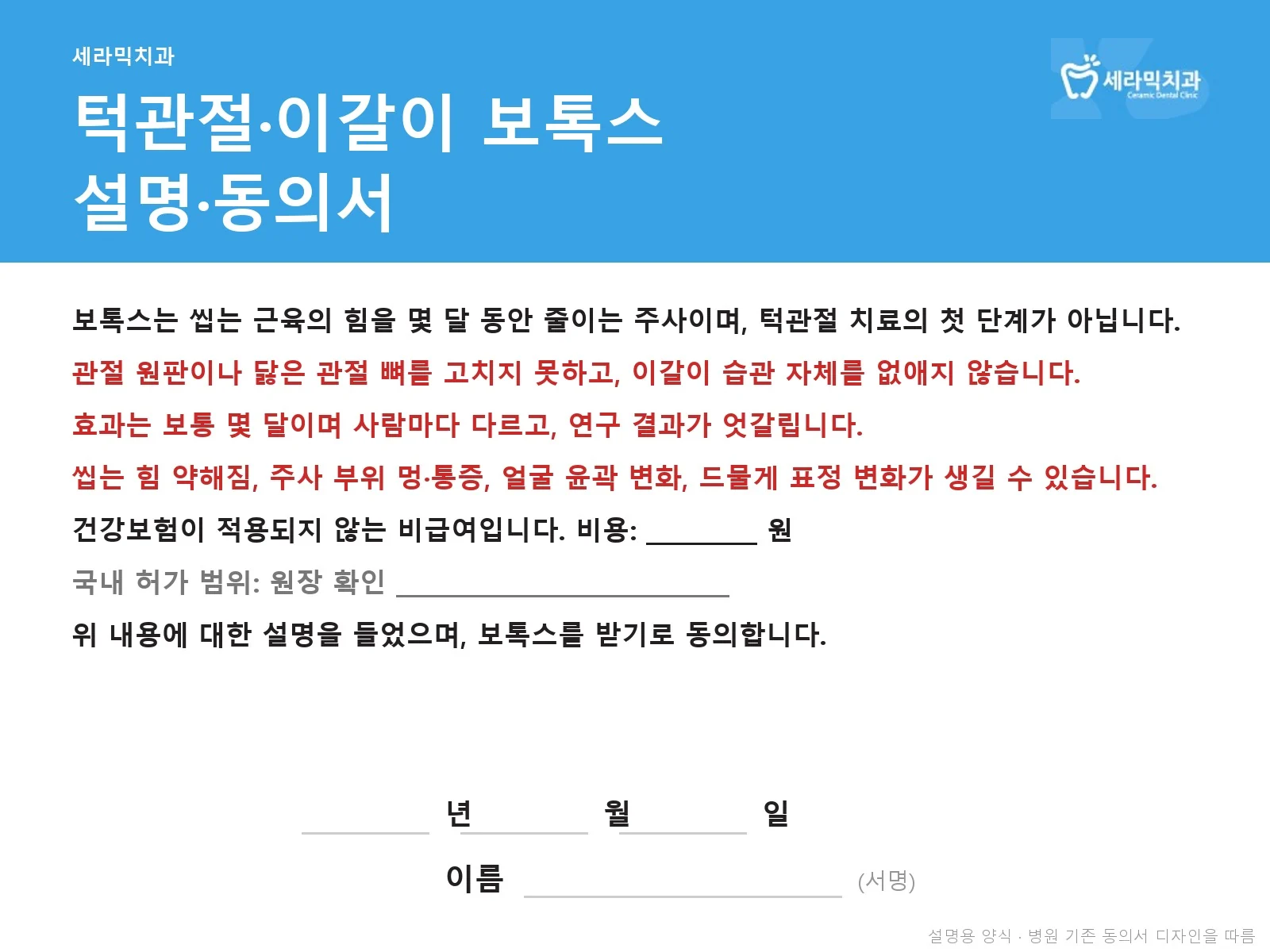
Explanation and consent. We explain the expected effect, duration, side effects, cost, and approval status, and go ahead only with your consent.
STEP 03
We explain the limits and side effects and obtain your consent
We explain that the effect wears off after a few months, that study results are mixed, side effects such as weaker chewing force, and the cost. We also tell you that in Korea, botulinum toxin is not approved for treating TMJ disorder or teeth grinding, so an injection for this purpose is use outside the approved indications (off-label use). After the explanation, we obtain your written consent before proceeding.
Why we do thisThe US National Institute of Dental and Craniofacial Research (NIDCR) states that Botox is not approved by the US FDA for treating TMJ disorder and that study results are mixed. The less certain a treatment's effect, the more the decision should be made by the patient after a full explanation.
Injection
Injection site illustration. We inject at several points within the confirmed muscle area and avoid the facial expression muscles and the salivary gland.
STEP 04
We inject at several points in the confirmed muscle
We inject within the muscle area confirmed in the previous step.
Why we do thisInjecting outside the muscle area can affect unintended muscles and cause side effects such as a change in the shape of your smile. That is why we inject only into the muscle we have checked by hand.
Progress check
Progress check after 2–4 weeks. We record both the change in pain and side effects such as chewing discomfort.
STEP 05
We check after 2–4 weeks and decide then whether to inject again
When the effect appears, we check your pain score and any discomfort. The effect usually wears off after 4–8 months, and whether to inject again is decided then, looking at the effect, side effects, and how well you have managed your habits.
Why we do thisWith repeated Botox, effects on the muscles and chewing force can build up, so we do not recommend it as a treatment repeated on a fixed schedule. We decide again each time, only when needed.
* Clinical photos were published with the patients' consent. Side effects such as temporary pain or discomfort may occur depending on the person.
Even while receiving Botox, you need to keep up the resting position, home exercises, and a splint if needed for the effect to last longer.
04°
Who may consider Botox and who we do not recommend it for
We consider it if all of the following apply
Diagnosed with muscle-related pain or strong clenching or grinding
Tried daily-habit guidance, medication, and laser physical therapy, and did not improve enough at the reassessment at about 2 months
Have used a splint or have a reason a splint is hard to use
Heard that the effect is temporary and the evidence uncertain, and agreed
The earlier steps come first
If you have not yet tried daily-habit guidance, medication, or physical therapy
If you have warning signs (pain after an injury, sudden inability to open your mouth, swelling and fever, unusual sensation): finding the cause comes first
Not recommended, or we check first
If a joint disc or joint bone problem is the main cause
If you are pregnant or may be pregnant, or breastfeeding; have a neuromuscular disease such as myasthenia gravis, Lambert-Eaton syndrome, or ALS (Lou Gehrig's disease); have inflammation at the injection site; or have had a hypersensitivity reaction to Botox ingredients
If you take muscle relaxants or certain antibiotics (such as aminoglycosides): the effect may be stronger, so we check first
If you came wanting a change in facial contour: this page explains treatment for pain and teeth grinding
05°
Comparison of treatment options for TMJ problems and teeth grinding
Good for
How it works
Method and duration
Evidence level
Limits
Cost
Daily-habit guidance and home exercises
Everyone
Rests the muscles and joint
2–3 times a day, from day one
First-line treatment recommended in common by several guidelines
Works only if done consistently
No cost
Laser physical therapy (PHL-15)
Muscle and joint pain
Physical therapy that applies low-level laser and LED light
Usually 2 weeks, 1–2 times a week · about 30 minutes per session
Conditionally suggested by the Japanese Society for Temporomandibular Joint 2023 guideline (very low evidence level); a 2025 systematic review reported pain reduction
Effect varies from person to person
Covered by Korea's National Health Insurance (NHI) when diagnosed with TMJ disorder
Splint
Pain still remaining after about 2 months, with night grinding or clenching
A night appliance that reduces muscle strain and tooth wear
2–3 visits for impressions, fitting, and adjustment
Cochrane review (2024): may reduce muscle pain but the evidence is very uncertain; the UK guideline places it as a supporting treatment
Not a stand-alone treatment; does not stop grinding itself
Muscle-related pain or clenching that has not improved enough with the earlier steps
Temporarily reduces muscle strength
Effect lasts a few months; whether to repeat is decided then
Not first-line in the UK guideline; not FDA-approved in the US and study results are mixed (NIDCR); also not approved in Korea for TMJ disorder or grinding (off-label use)
Effect is temporary; chewing force may weaken, and more
· Chewing force may weaken, making tough foods hard to eat.
· Bruising or pain may occur at the injection site.
· As the muscle shrinks, your facial contour may change, and rarely your facial expression or smile may change.
· The effect wears off after a few months, so a decision on whether to inject again is needed.
· It cannot fix joint disc or joint bone problems.
· Approval status in Korea: in Korea, botulinum toxin is not approved for treating TMJ disorder or teeth grinding. Injection for this purpose is off-label use. It is also a different use from the benign masseteric hypertrophy (square jaw) indication that some products have received.
FAQ
FAQ
Will Botox alone cure my TMJ problem?
Botox is not the first step in TMJ treatment; it is an option we consider only in limited cases of muscle-related pain. It cannot fix the joint disc or bone, so you need to continue daily-habit guidance and home exercises along with it.
How long does Botox for the TMJ last?
The effect of reducing muscle strength usually lasts about 4–8 months and differs from person to person. When the effect wears off, we decide whether to inject again based on your symptoms and side effects at that time.
Do I need to keep getting Botox for teeth grinding?
We do not recommend it as a treatment repeated on a fixed schedule. We decide again only when needed, based on the effect, side effects, and how well you have managed your habits.
Will jaw Botox make my face look smaller?
As the masseter muscle shrinks, the shape of your face may change, but the purpose of this treatment is to relieve pain and clenching. If you do not want a change in facial contour, we explain it to you in advance as a side effect.
Can I have Botox and a splint at the same time?
If you need to protect your teeth from night grinding, you often keep using a splint even while receiving Botox. The two treatments have different purposes, so we decide whether to use both based on your symptoms and how worn your teeth are.
Can I get jaw Botox right away at my first visit?
At the first visit, we first do exams to find the cause and start the earlier-step treatments, and we discuss Botox after the reassessment at about 2 months. If you have records of sufficient treatment elsewhere, we review them too. However, if you are already receiving Botox or we judge at the consultation that the cause is clear, we sometimes start Botox right away.
Is Botox for the TMJ covered by health insurance?
Botox for TMJ problems and teeth grinding is not covered by Korea's National Health Insurance (NHI). The cost is listed under TMJ and teeth grinding in the treatment cost guide.
Evidence and references
UK NHS GIRFT and Royal College of Surgeons guideline on TMJ disorders (2025): Botox is not a first-line treatment; see a specialist if there is no improvement after 6–8 weeks. View the source
US National Institute of Dental and Craniofacial Research (NIDCR) information on TMJ disorders: Botox is not approved by the US FDA for treating TMJ disorder, and study results are mixed. View the source
Questions from international patients who live in Korea.
Can I use Korean National Health Insurance?
If you are enrolled in Korea's National Health Insurance, insured treatments are billed under the same insurance rules as for other enrollees. Whether a treatment is covered depends on the treatment and the insurance rules, and we tell you before treatment starts. If you are not enrolled, you pay the full fee.
Can I be seen in English?
Yes. The doctor in charge of each field consults with you directly in English, so you do not need an interpreter.
I am in Korea only for a short trip. Can I have this treatment?
It depends on how many visits the treatment needs. Tell us your travel dates when you contact us, and we will tell you after the examination whether the schedule is realistic.
Results, the number of visits and schedules vary from person to person. More questions: Visiting from abroad.


 First visit
 Reassessment
 Illustration
 Progress record
 Movement record
 Jaw joint X-ray
 Reassessment record
 Muscle check
 Explanation and consent
 Injection
 Progress check