Last reviewed Oct 29, 2026 · Dr. Ilseop Ahn (board-certified periodontist and board-certified specialist in advanced general dentistry)
At a glance
Good for
Front teeth with a large cavity or filling, cracked front teeth, or old crowns that need replacing
Treatment flow
Check how much tooth is left → choose a veneer or a crown → plan the color and gum line
Duration and limits
If the tooth is healthy and you only want to change color or shape, a veneer removes less tooth
Details
Porcelain veneers cover only a thin layer on the outer surface of a front tooth. A front-tooth crown wraps around the whole tooth. If the tooth is healthy and you only want to change its color or shape, a veneer removes less tooth. A crown may suit a tooth with a large cavity or filling, a cracked or broken tooth, a tooth worn down on the inner surface, or an old crown that needs replacing. Not every front tooth with a root canal treatment needs a crown; we decide by how much tooth is left. At Ceramic Dental Clinic, we often combine one crown with veneers on the teeth next to it, so we plan the color, translucency and gum line height together.
01°
Why did this tooth get a crown and the one next to it a veneer?
The reason for choosing a crown was different for each tooth. Here are three typical real cases.
CASE01
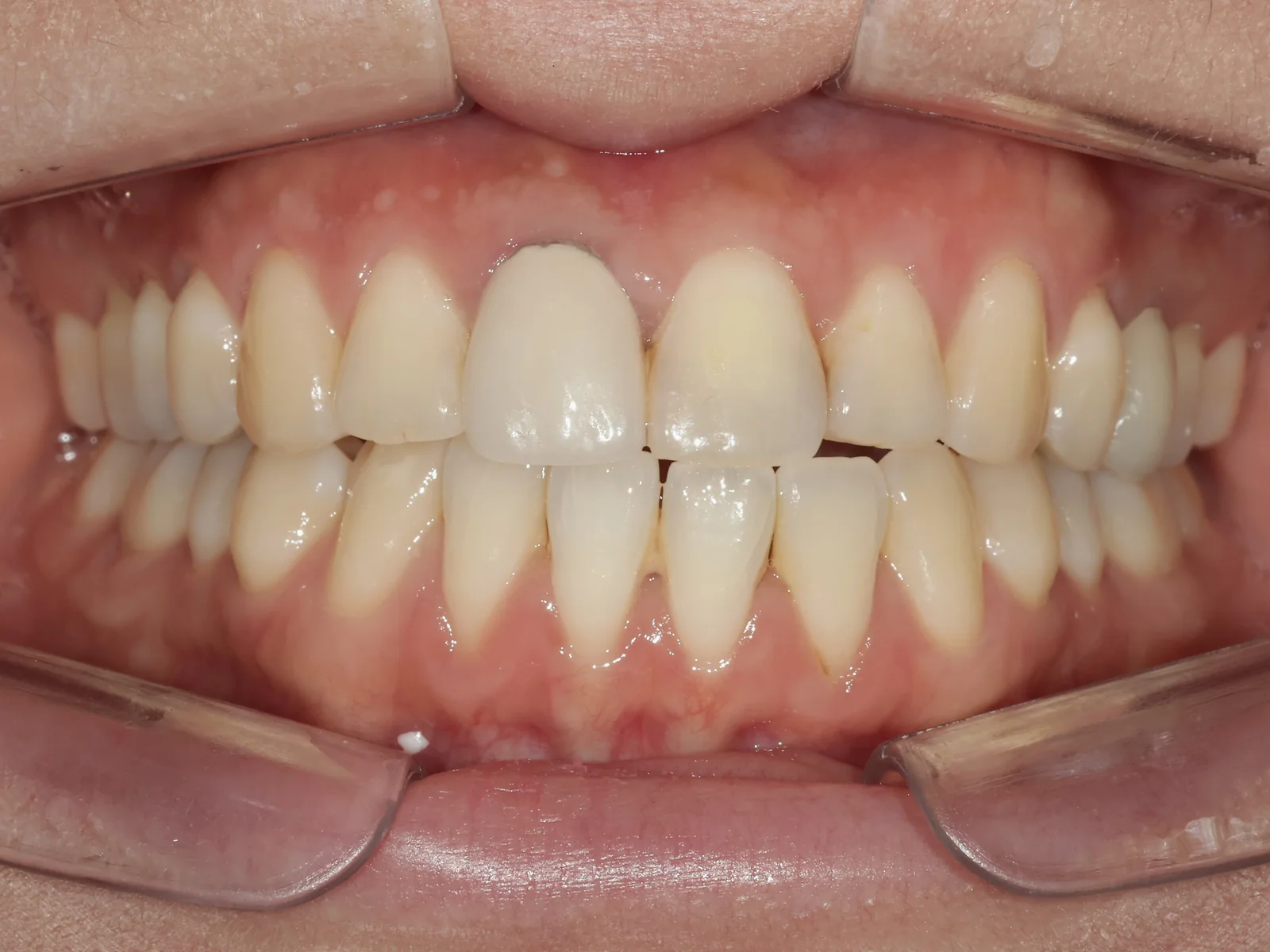
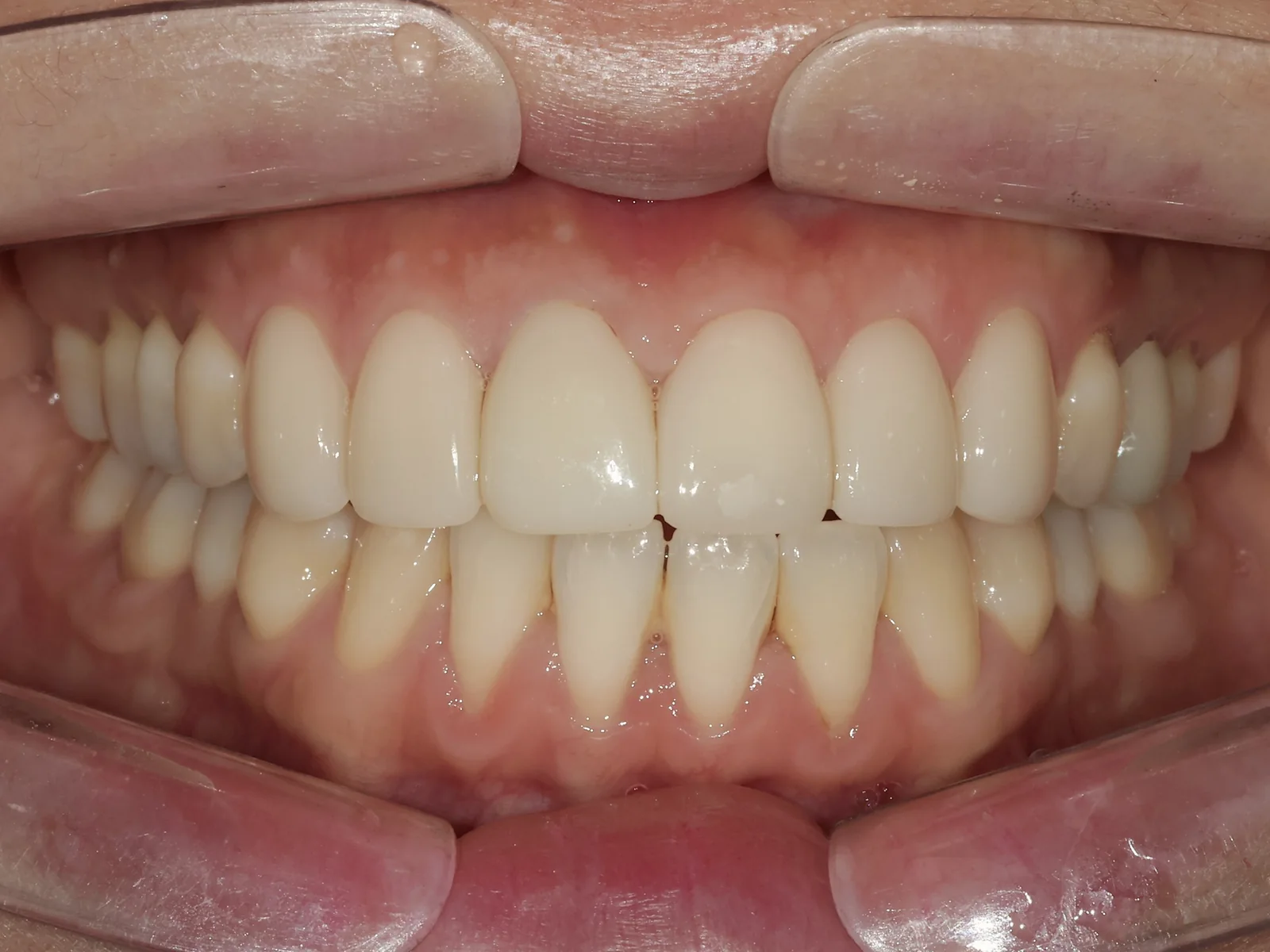
A front-tooth crown that stood out in color and stuck out
Only 1 front tooth replaced with an all-ceramic crown, the other 5 done with CERANATE, gum contouring on 2 lateral incisors
Before · March 2026
Before. The old porcelain-fused-to-metal crown on the right central incisor differed in color from the teeth next to it and was bulky, so it stuck out. Its edge also did not fit well.
After · March 2026
After. The right central incisor got an all-ceramic crown, and the other 5 upper front teeth got CERANATE at the same time, so the color and translucency match.
Condition
Old porcelain-fused-to-metal crown with a poorly fitting edge and a different color, inflammation at the root tip of the same tooth (no symptoms), decay around old fillings, off-center midline, uneven gum heights on the left and right lateral incisors (woman in her 30s)
Chosen
All-ceramic crown on the right central incisor, CERANATE on the other 5 upper front teeth, gum contouring on both lateral incisors
Planning
The gums were on the thin side, so the crown edge was placed 0.5 mm below the gum line
Duration
22 days and 3 visits from preparation to final bonding
Remaining points
We monitor the root-tip inflammation with X-rays at regular checkups.
CASE02
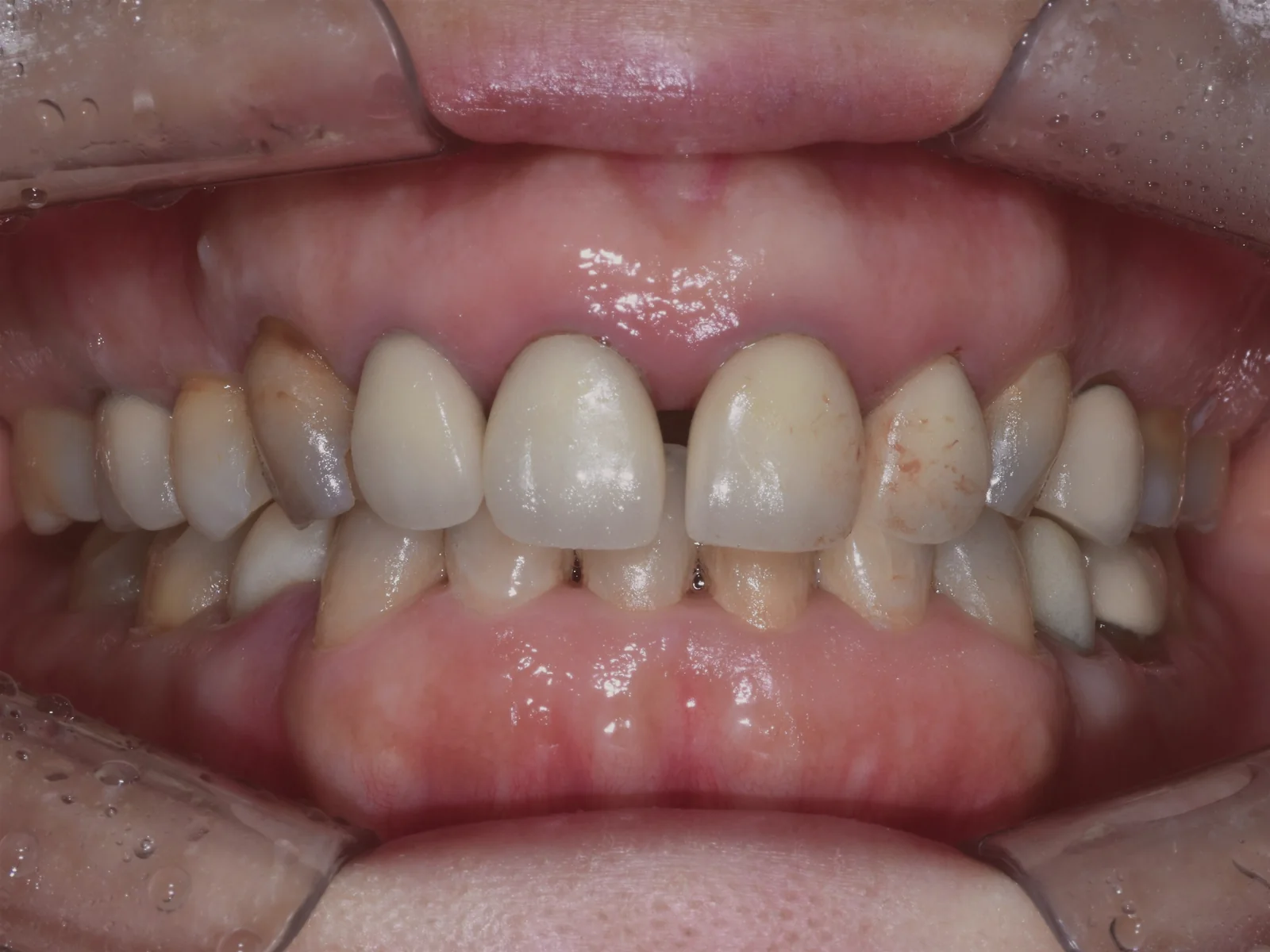
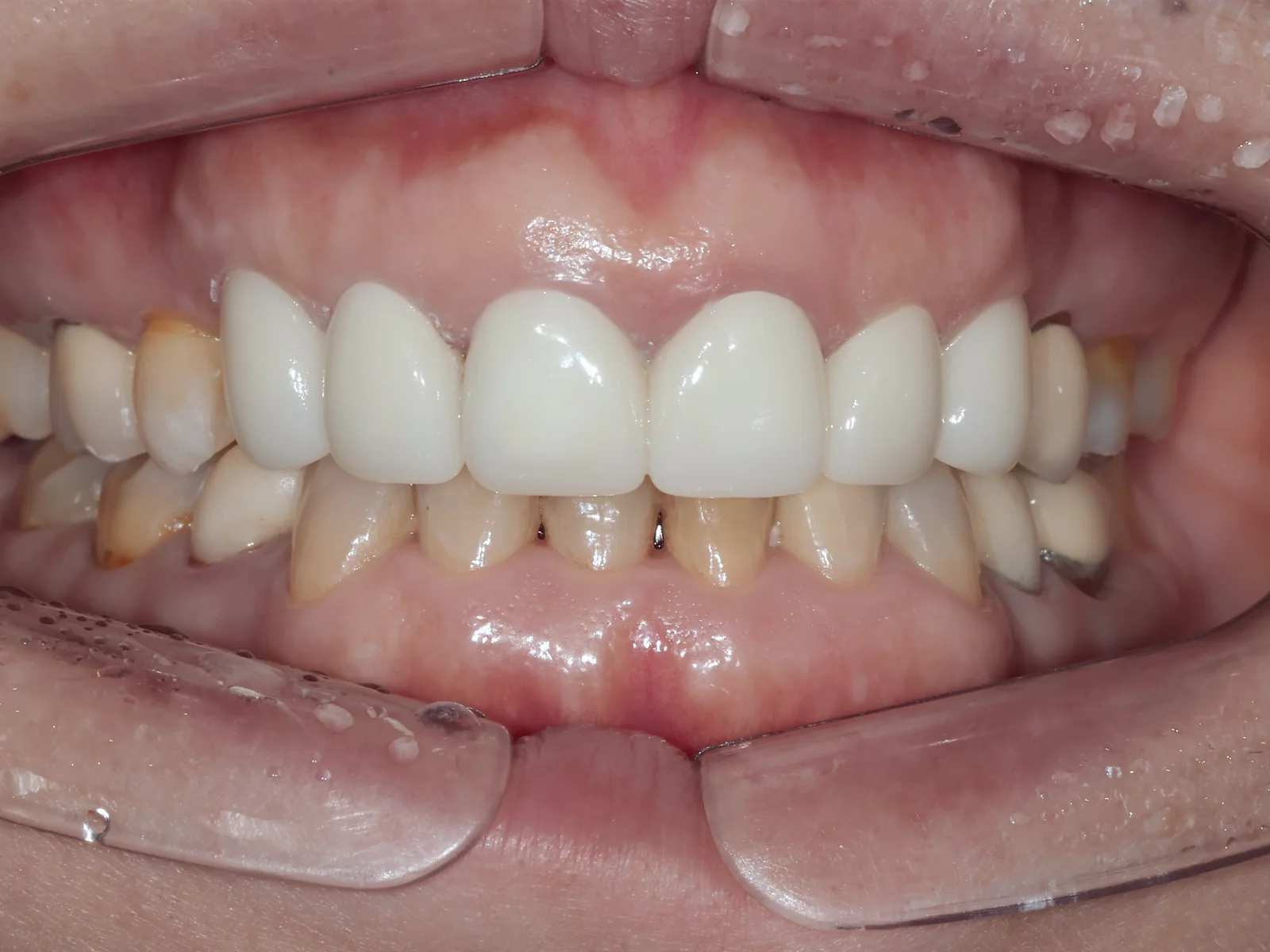
Replacing 6 crowns, including front teeth with root canal treatment
6 crowns from canine to canine · the middle two are joined so the gap does not open again
Before · December 2025
Before. The old porcelain-fused-to-metal crowns, placed over root canal treatment and posts (post and core), were discolored and uneven, with gaps and black triangles between the teeth.
After · March 2026
After. We fitted new crowns on the 6 teeth from canine to canine and joined the middle two crowns so the gap does not open again.
Condition
4 upper front teeth with root canal treatment, posts and old porcelain-fused-to-metal crowns; right canine with root canal treatment but no crown; resin filling on the left canine; gaps and black triangles; deep bite (woman in her 50s, living in Japan)
Chosen
6 PFZ crowns (canine to canine), middle two joined
Design goals
Deep bite, prominent upper jaw bone, natural color
Duration
First visit December 2025, temporary crowns in January 2026, final crowns in March (about 3 months in temporary crowns)
CASE03
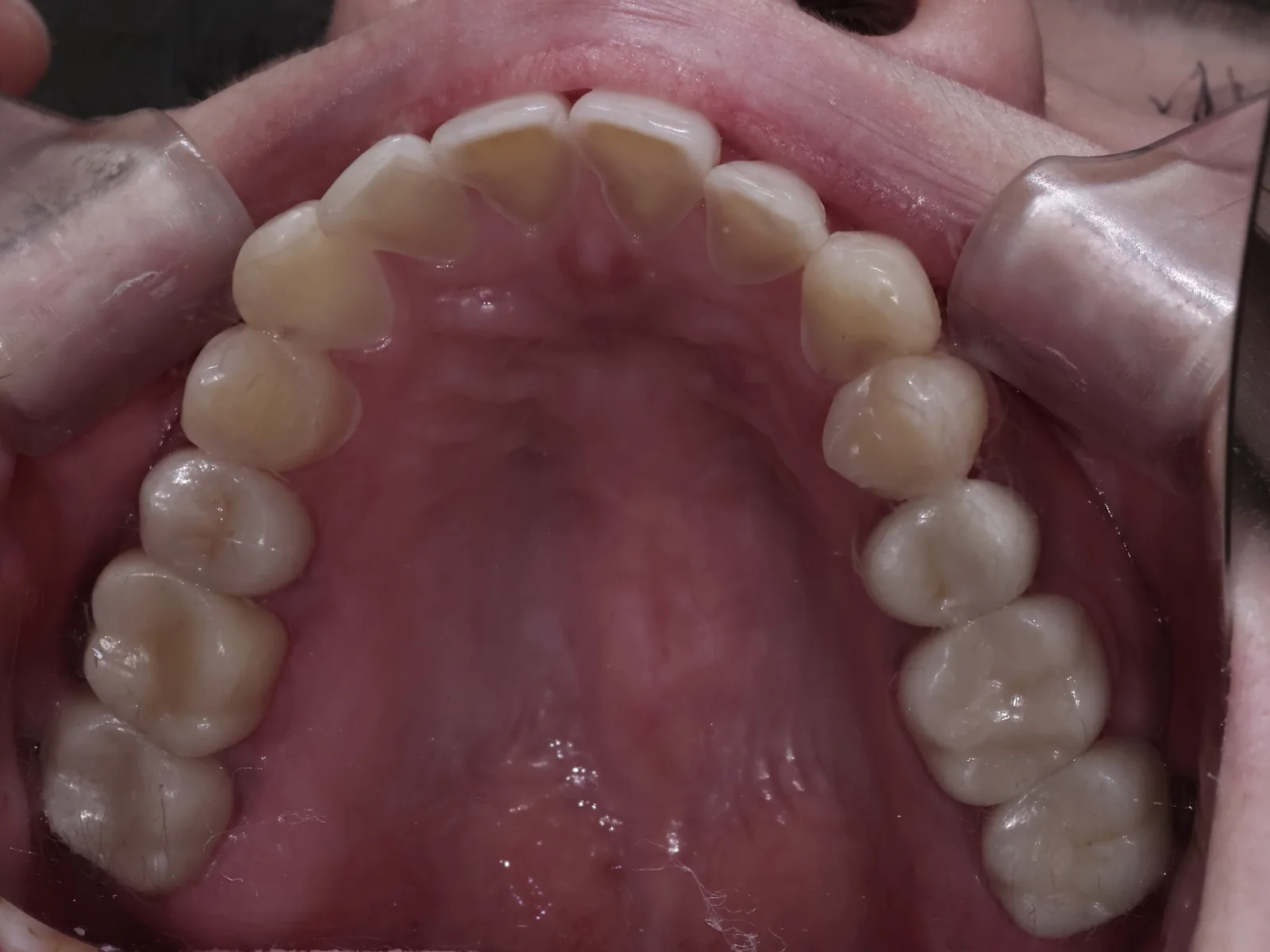
Inner surfaces of the front teeth worn down by acid reflux
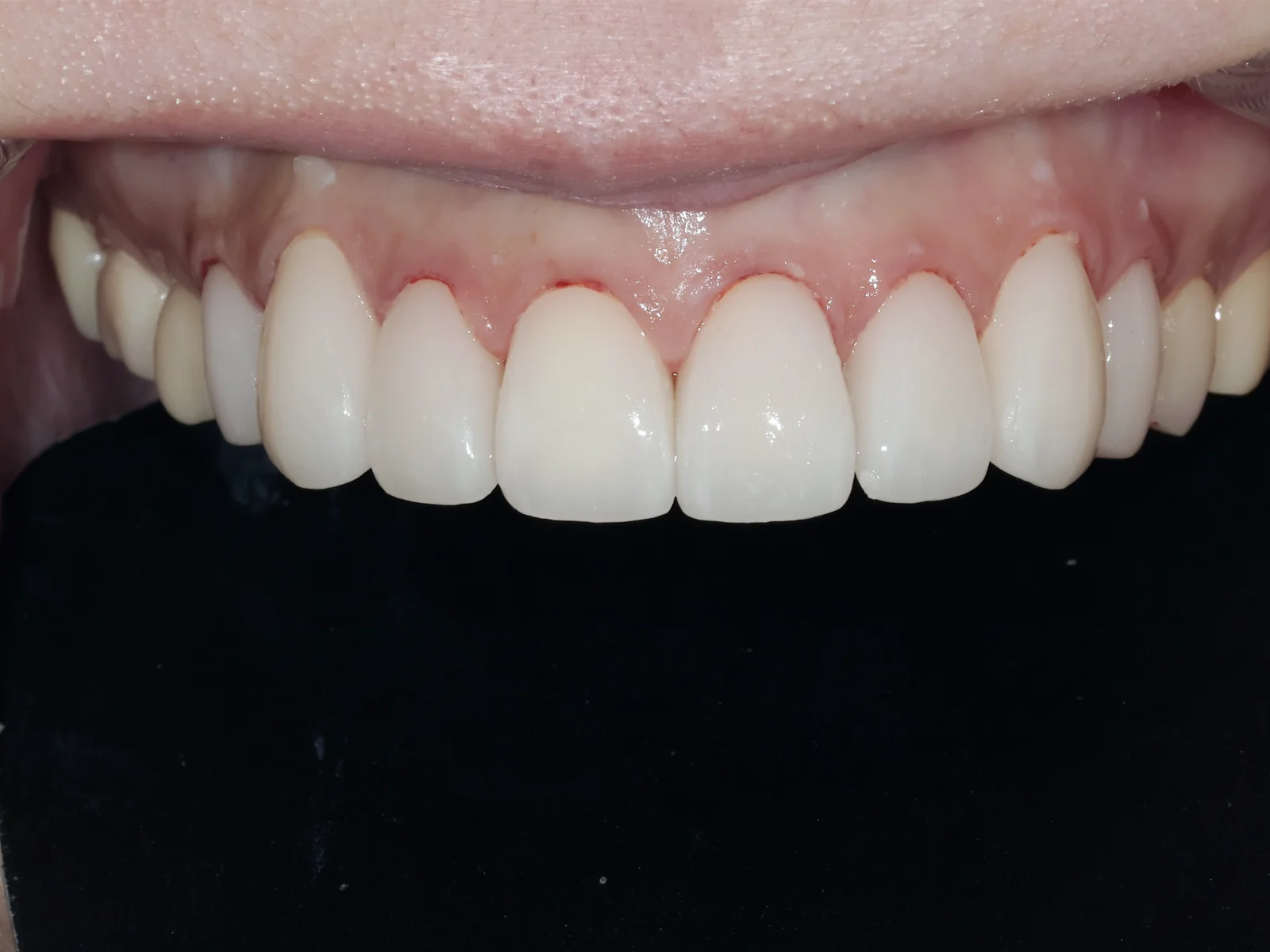
8 upper front teeth with all-ceramic crowns · all 8 teeth kept their nerves
Before · January 2026
Before. Years of acid reflux had dissolved nearly half of the inner surfaces of the upper front teeth, exposing the dentin. The edges of the front teeth had thinned and broken.
After · February 2026
After. A veneer covers only the outer surface and could not protect the worn inner surfaces, so we used crowns that wrap around the whole tooth. We designed the bite so the upper front teeth overlap the lower front teeth by about 1 mm.
Condition
Long-term acid reflux, about half of the inner surfaces of the upper front teeth eroded, thin and broken edges, mild open bite, protruding right canine (woman in her late 30s)
Chosen
All-ceramic crowns on 8 upper front teeth (canines, lateral incisors, central incisors)
Not done
Root canal treatment (all 8 teeth kept their nerves), veneers (they cannot protect the inner surfaces)
Duration
2 visits over 2 weeks
* Photos were taken under the same conditions and published with the patients' consent. Treatment results and side effects may vary from person to person.
02°
Teeth that suit a crown, teeth where a veneer is enough, and teeth that need neither
01When a crown suits
A tooth where a large cavity or filling takes up much of the surface, a cracked or broken tooth, a tooth worn down on the inner surface, a tooth greatly weakened after root canal treatment, or an old crown that needs replacing.
02When a veneer is enough
The remaining tooth is healthy and your concern is color, shape or a small gap. A front tooth with a root canal treatment can also get a veneer if enough tooth remains and the discoloration is not severe.
03When you need neither
A small cavity may need only a resin filling, and if color is the only issue, whitening may be enough. For a single tooth that darkened after a root canal treatment, we may first consider whitening from inside the tooth.
04When we combine them
We often put a crown on one badly damaged tooth and veneers on the healthy teeth next to it. We plan them together so the two materials do not look different in color and translucency.
03°
How a front-tooth crown is done
Five steps: check the remaining tooth, set the gum line edge, and match the color to the teeth next to it.
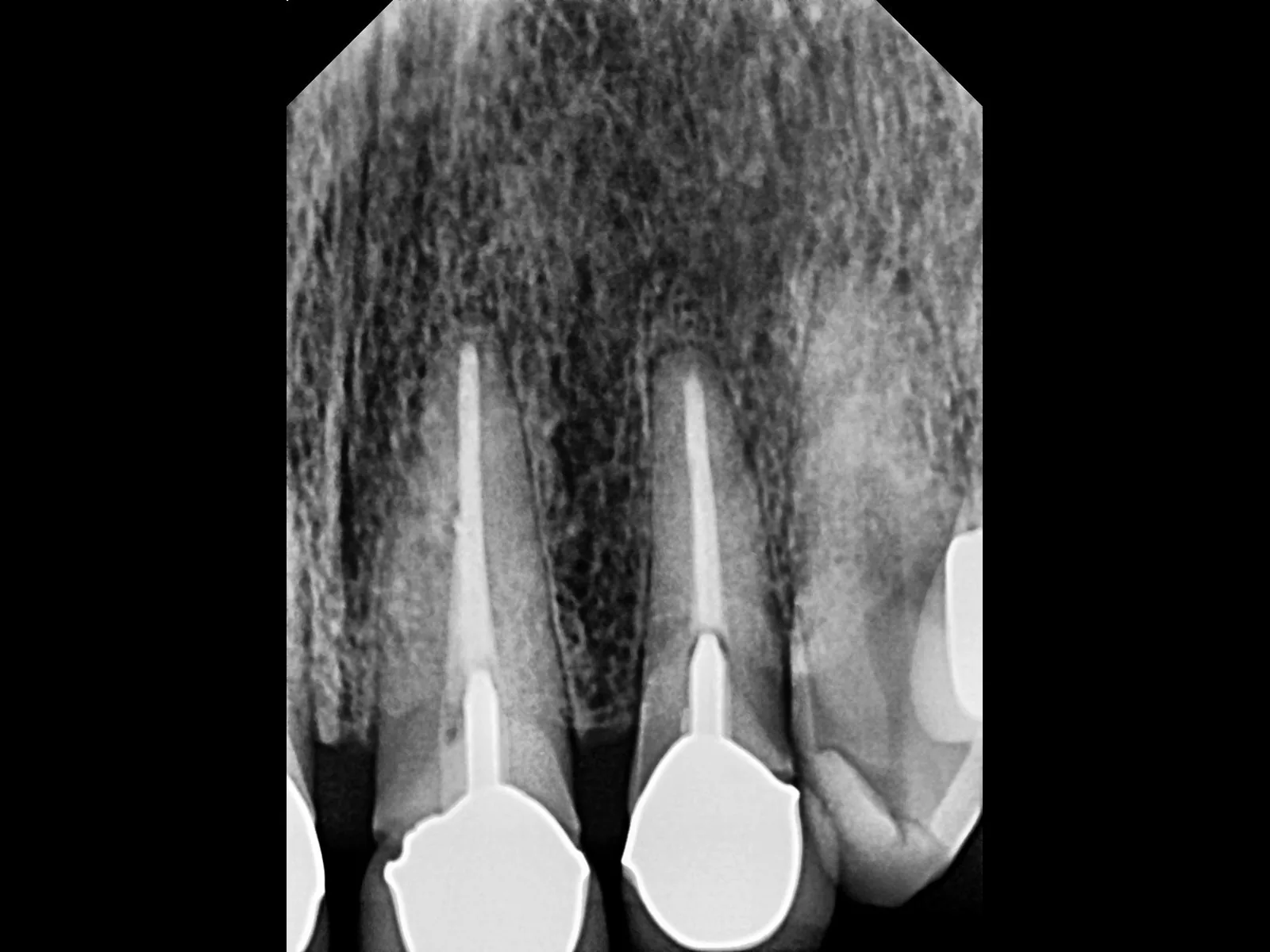
X-ray
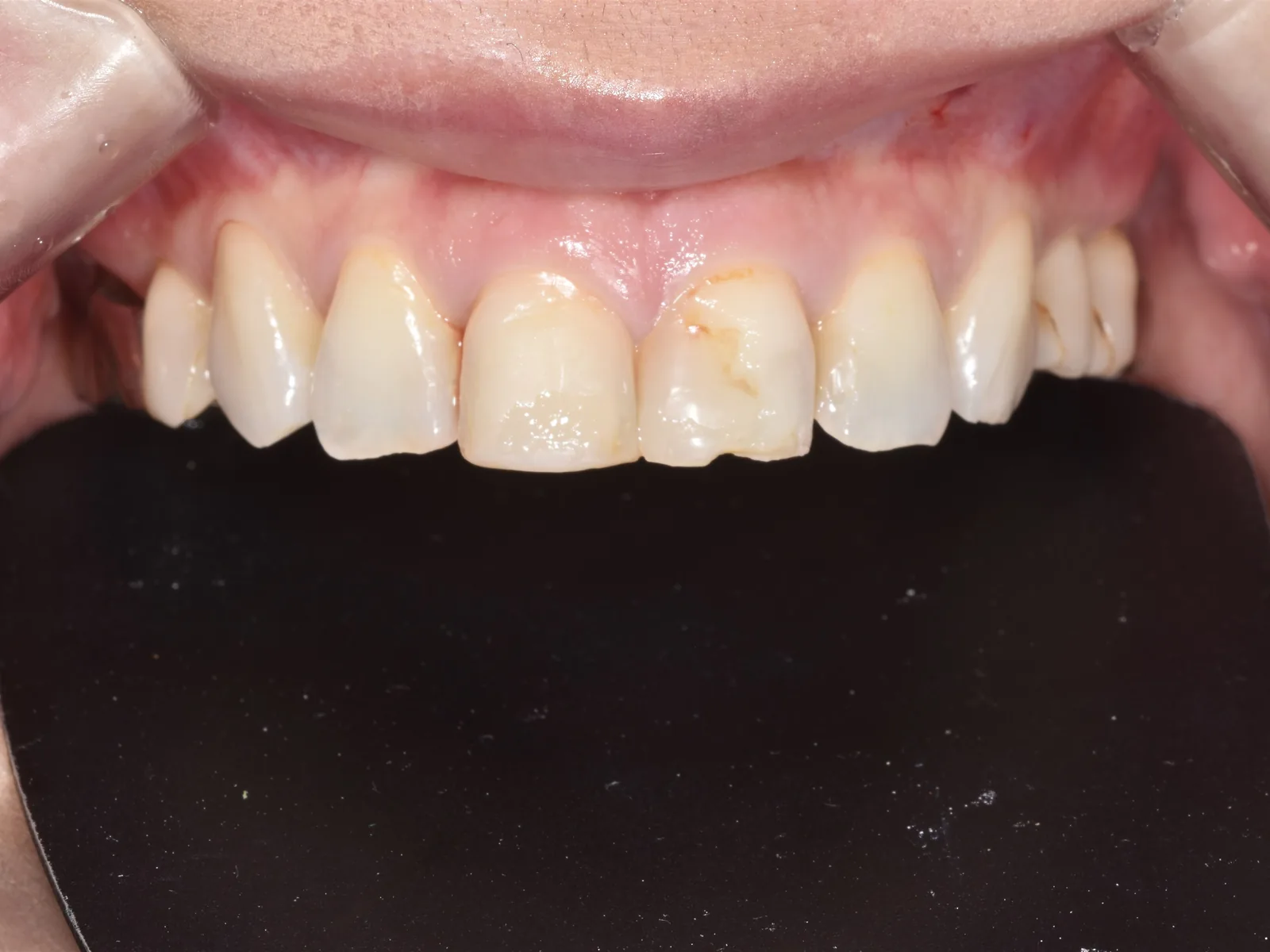
Remaining tooth
Checking the remaining tooth and root. We look at how far decay and fillings reach, any cracks, inflammation at the root tip, and the state of the nerve. The X-ray and the close-up photo are from different patients.
STEP 01
We first check how healthy the remaining tooth is
We use X-rays and, if needed, a 3D CT to check how much of the tooth decay and old resin fillings take up, whether there are cracks, whether a root canal treatment is needed, and whether there is inflammation at the root tip.
Why we do thisA crown means trimming all around the tooth, so it costs a healthy tooth a lot. This step gives us the rule: a veneer if enough tooth remains, a crown if not.
Gum line edge
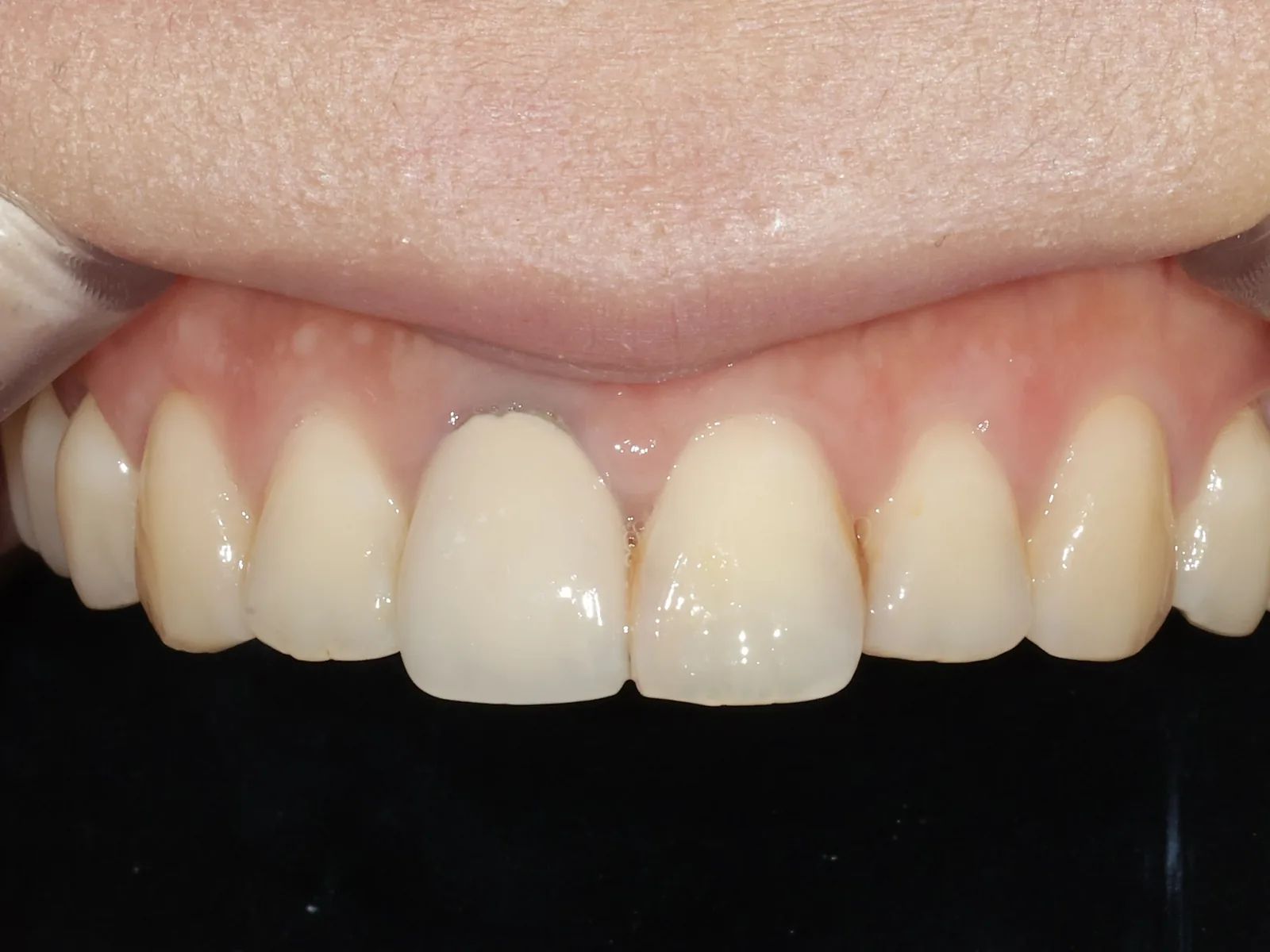
Checking the gum line. We look at gum thickness and height to decide where on the gum line to place the crown edge.
STEP 02
We set the crown edge position based on gum thickness and height
If your gums are thin, the edge can show through easily, so we place it slightly below the gum line (0.5 mm in the case above). If the gum heights on the left and right differ a lot, we decide on gum contouring before the crown.
Why we do thisAn old crown edge usually looks dark because the gums receded and exposed the edge, or because thin gums let it show through. Matching the edge position to your gums can reduce this.
Crown preparation
Temporary crown
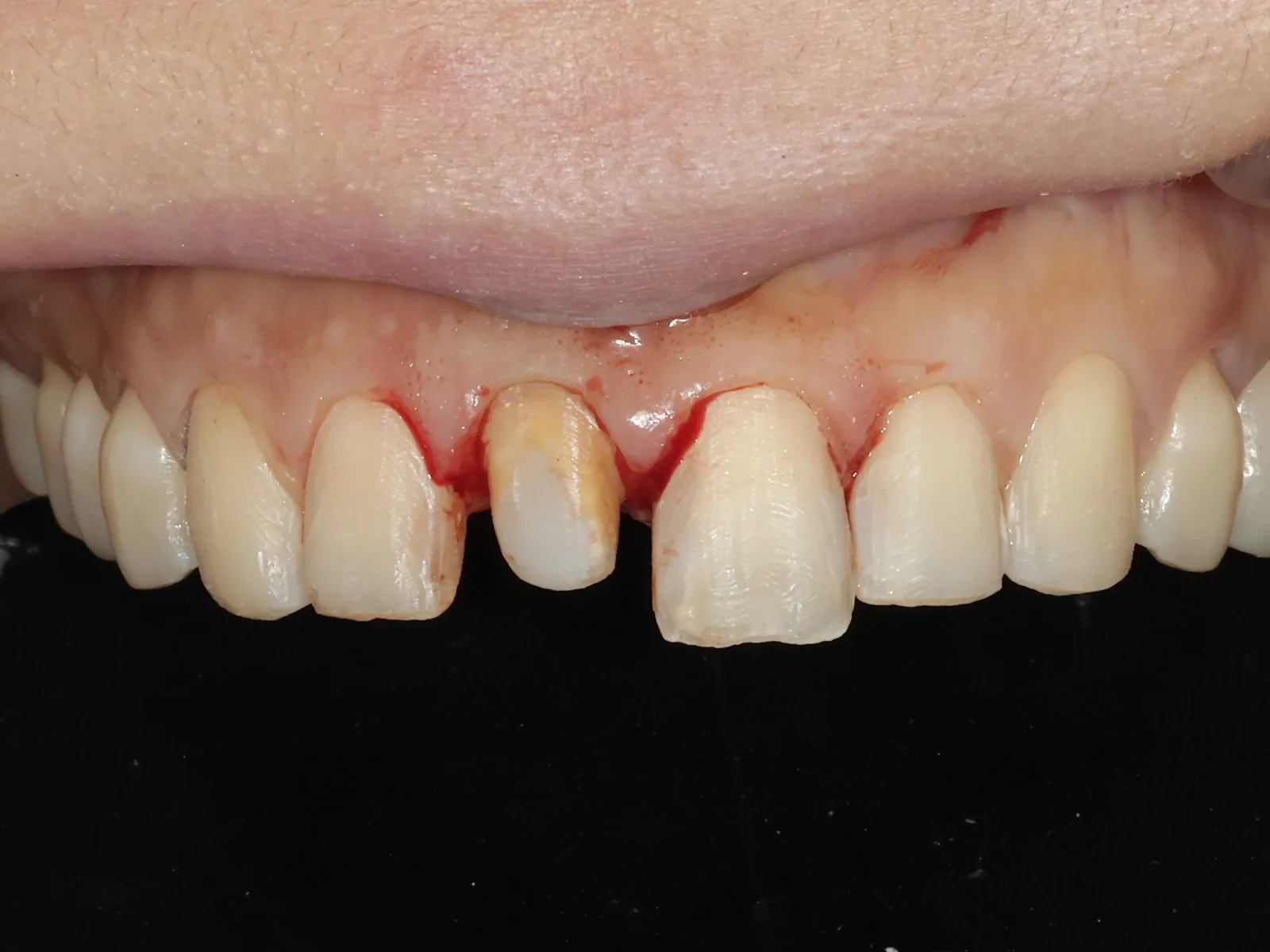
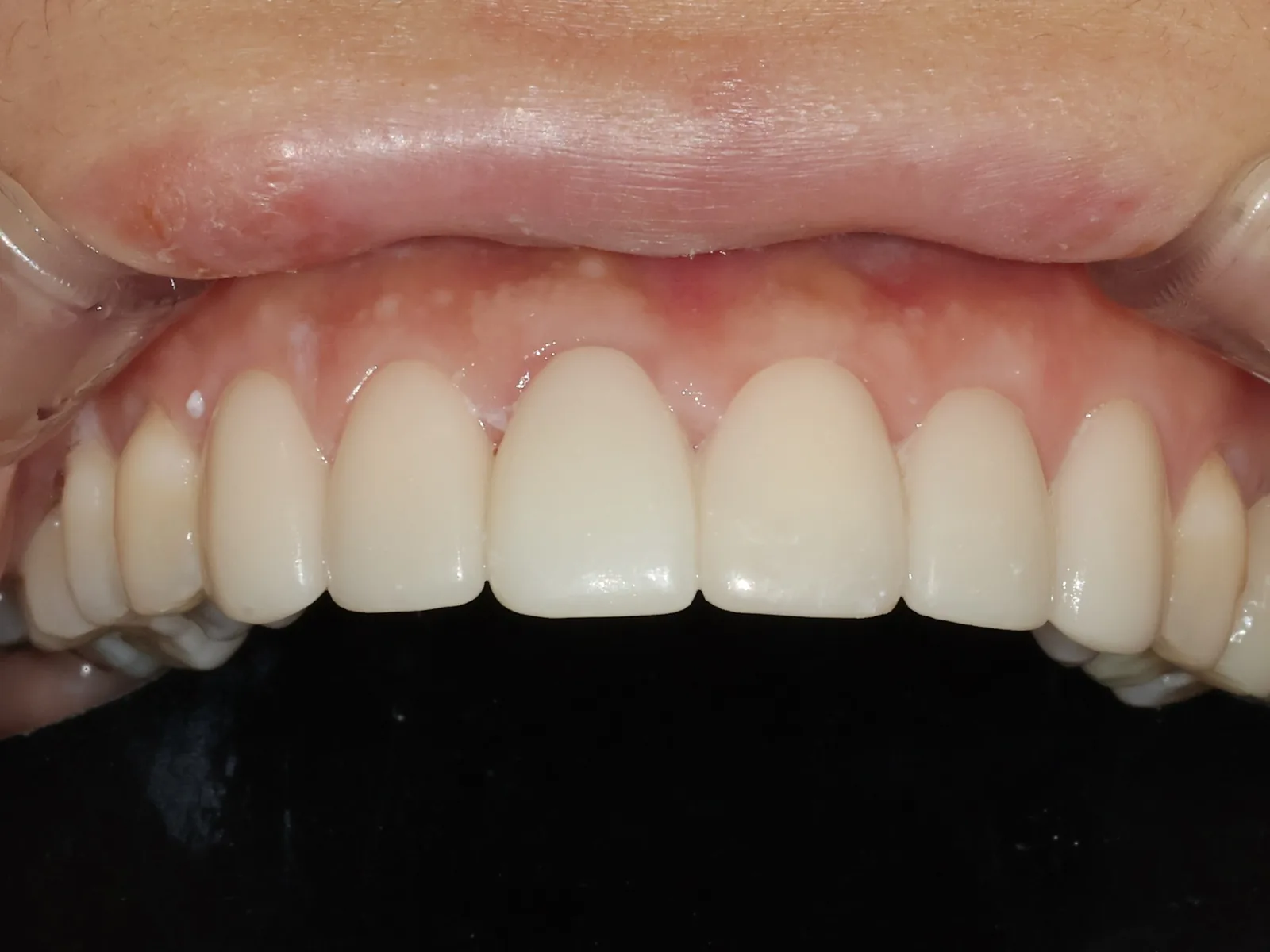
Tooth preparation and temporary crown. We trim evenly all around and check the shape and length first with a temporary crown.
STEP 03
We trim all around and try the shape first with a temporary crown
For a ceramic crown, we usually trim about 1 mm around the tooth and about 1.5–2 mm at the edge to make room. After trimming, we place a temporary crown so you can first try the length, shape, speech and bite. When replacing several old crowns, we sometimes keep the temporary crowns longer.
Why we do thisAfter a few days to a few weeks in a temporary crown, any discomfort with the length or shape becomes clear. We can apply this directly to the final crown, which means fewer remakes.
Color matching
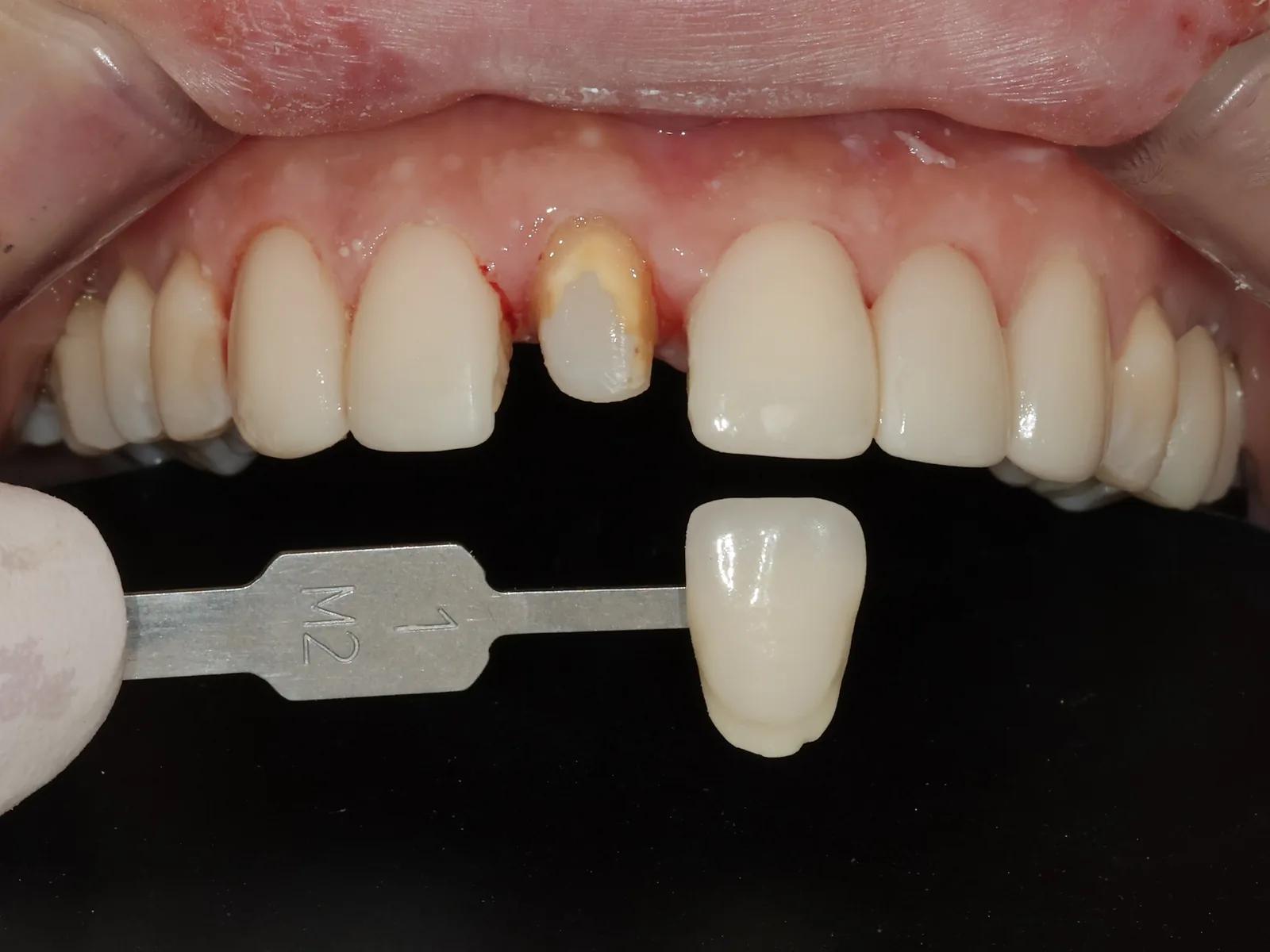
Color matching with the teeth next to it. When we do crowns and veneers together, we place the two materials side by side to match their brightness and translucency.
STEP 04
We choose the material and match color and translucency to the teeth next to it
If the remaining tooth is dark or has a metal post, we choose a material that hides color well. If it is fairly light, we choose a material that lets light through. When crowns and veneers are done together, we match their color and translucency in the same lab process. Materials include all-ceramic, zirconia and PFZ (porcelain layered on zirconia). We choose based on the color of the remaining tooth, chewing force and the translucency needed.
Why we do thisA crown is thick and hides the color of the tooth underneath well. A veneer is thin, so the color underneath shows through. Even with the same shade number, the actual color can look different, so we match the two while looking at them together.
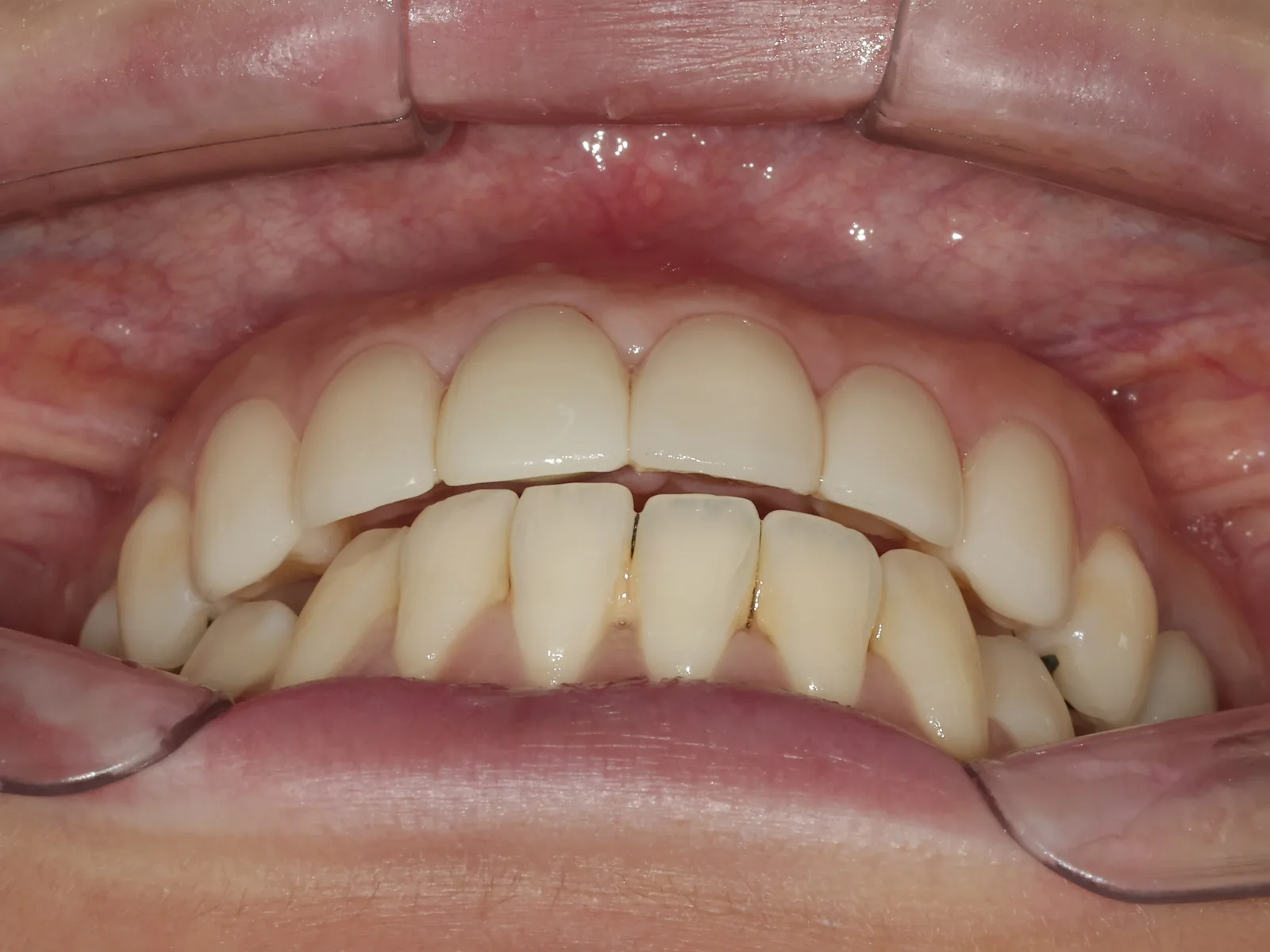
Bonding and bite
Bonding and bite adjustment. We adjust how deeply the upper front teeth overlap the lower front teeth and how they touch.
STEP 05
After bonding, we adjust the bite and check the edges regularly
We bond the final crowns and adjust how the upper and lower front teeth touch. At later regular checkups, we check the gum line edges and the root tips.
Why we do thisIf the front teeth hit too hard or bite too deep, the ceramic breaks more easily. For a deep bite, we design the overlap separately. If you grind your teeth, we also consider a night guard.
* Clinical photos were published with the patients' consent. Side effects such as temporary pain or discomfort may occur depending on the person.
The number of visits and the time needed depend on how many teeth are treated and whether root canal treatment is needed. In the cases above, it ranged from 2 visits over 2 weeks to about 3 months (including temporary crowns). Usually it takes 2–3 visits, with temporary crowns worn for about 1–2 weeks. It can take longer depending on the number of teeth and root canal treatment.
04°
Porcelain veneers vs. front-tooth crowns
Porcelain veneers
Front-tooth crown
Area covered
Outer surface (including part of the edge)
The whole tooth, all around
Amount trimmed
From no trimming to about 0.3–0.7 mm
About 1 mm around, 1.5–2 mm at the edge
Suitable teeth
Color, shape or small gaps on healthy teeth
Large cavities or fillings, cracked teeth, teeth worn on the inner surface, teeth weakened by root canal treatment
Hiding color
Moderate (the color of the tooth underneath shows through)
Strong
Visits and time
About 1 week, 2 visits (one-day option: 1–2 days)
Usually 1–2 weeks, depending on how long temporary crowns are worn
Limits
Cannot cover large damage or damage to the inner surface
In these cases, other treatment comes first, or you may not need treatment
Good for you if
You have a large cavity or filling in a front tooth
You have a cracked or broken front tooth
You are bothered by the color or edge of an old crown
You have a front tooth worn down on the inner surface
Other treatment comes first
A tooth with nerve symptoms or inflammation at the root tip: root canal treatment first
Gum inflammation: gum treatment first
Front teeth that are badly out of position: an orthodontic assessment first
You may not need it now
Healthy teeth where only color or shape is the concern: veneers or whitening
A small cavity or a small chipped edge: resin filling
06°
Side effects and limits
Please read
· A lot is trimmed all around the tooth, so a tooth with a living nerve may become sensitive or develop nerve symptoms.
· If the gums recede, the crown edge may show.
· Ceramic can break. Avoid biting through hard foods with your front teeth.
· After long use, the crown may need replacing. Depending on the remaining tooth at that time, a new post may be needed.
· A tooth that had inflammation at the root tip still needs regular X-rays after the crown.
FAQ
FAQ
Which lasts longer, a front-tooth crown or a veneer?
How long a front-tooth crown or a veneer lasts depends on the tooth, your bite and your habits, so it is hard to say one always lasts longer. If the tooth is healthy, a veneer removes less tooth. If the damage is large, a crown may protect that tooth for longer.
Does a front tooth with a root canal treatment always need a crown?
Even after a root canal treatment, a veneer or resin filling may be enough if enough tooth remains and the discoloration is not severe. Front teeth take less chewing force than back teeth, so we decide by how much tooth is left.
If only one front tooth gets a crown, will its color look different?
When we crown a single front tooth, we match it to the color and translucency of the teeth next to it. If those teeth are darker than you want, we whiten them first and match the crown after the color settles.
The edge of my old front-tooth crown looks dark. Can it be replaced?
An old crown edge often looks dark because the gums have receded and exposed the metal or the edge, or because thin gums let it show through. We find the cause, then replace the crown and set the edge position and material to suit your gums.
Can a front-tooth crown also change a tooth's position?
A front-tooth crown can make a tooth look slightly realigned, but this means removing more tooth. If the position problem is large, a board-certified orthodontist first checks whether partial orthodontics is the better choice.
Is a front-tooth crown covered by health insurance?
No. For people enrolled in Korea's National Health Insurance (NHI), regular crowns are not covered, whether on front or back teeth. A crown is covered only in cases set by law, such as insured implants for people aged 65 or older.
Will I have a gap while my front-tooth crown is being made?
We place a temporary crown on the day we prepare the tooth, so you will not go without a tooth. You try out the length and shape with the temporary crown, and we use that in the final crown.
Questions from patients who travel to Seoul for treatment.
How much does a crown cost?
Ceramic crowns and zirconia crowns are KRW 600,000 per tooth. A core (KRW 100,000) or post (KRW 150,000) costs extra if needed. International and Korean patients pay the same fees. The number of teeth and the method are decided at diagnosis, so we tell you the total after the examination. See our fee schedule.
How many visits do I need, and how long should I stay in Korea?
Usually 2–3 visits. At the first visit, we prepare the tooth, scan it with an intraoral scanner (iTero) and place a temporary crown. At a later visit, we check the color and bite, then bond the crown. All-ceramic crowns take 7 to 10 days and zirconia crowns 1 to 2 weeks. If root canal treatment is needed, the schedule can be longer.
Can I have my consultation in English?
Yes. The doctor in charge of your treatment consults with you directly in English. Before you travel, you can send photos of your teeth on WhatsApp or by email. An accurate diagnosis is made after we examine you in person.
What if a crown comes off after I go home?
Keep the crown and send us a photo on WhatsApp. We check it and decide whether it can be bonded again or needs to be remade. Bonding again or remaking needs a visit.
Results, the number of visits and schedules vary from person to person. More questions: Visiting from abroad.


 Before · March 2026
 After · March 2026
 Before · December 2025
 After · March 2026
 Before · January 2026
 After · February 2026
 X-ray
 Remaining tooth
 Gum line edge
 Crown preparation
 Temporary crown
 Color matching
 Bonding and bite