Last reviewed October 29, 2026 · Dr. Sunmin Kim (board-certified orthodontist, Certified Orthodontist of the Korean Association of Orthodontists)
At a glance
Good for
Tipping teeth or moving them a little, such as crowded front teeth, gaps, or minor relapse
Treatment flow
Sort out the movements needed → decide on clear aligners or auxiliaries → change aligners stage by stage
Duration and limits
Wear 20–22 hours a day; visit usually once every 2–3 months
Details
Clear aligners work well for tipping teeth or moving them a little, such as crowded front teeth, gaps between front teeth, or minor relapse after earlier braces. We also use Invisalign for extraction cases and for moving the whole dental arch back. Movements that push a tooth into the gum, move a tooth bodily with its root, or rotate it a lot can be harder than with brackets or may need auxiliaries. You need to wear the aligners 20–22 hours a day for the teeth to move as planned, and you usually visit once every 2–3 months. At Ceramic Dental Clinic, a board-certified orthodontist first sorts out the movements your teeth need, then tells you whether clear aligners will do, whether auxiliaries should be added, or whether another appliance would work better.
01°
Even with clear aligners, we chose different appliances and stages depending on the movement needed
When only the front teeth need aligning and when extraction spaces must be closed, the type of appliance, the number of stages and the auxiliaries all differ. Here are three typical situations shown with real cases.
CASE01
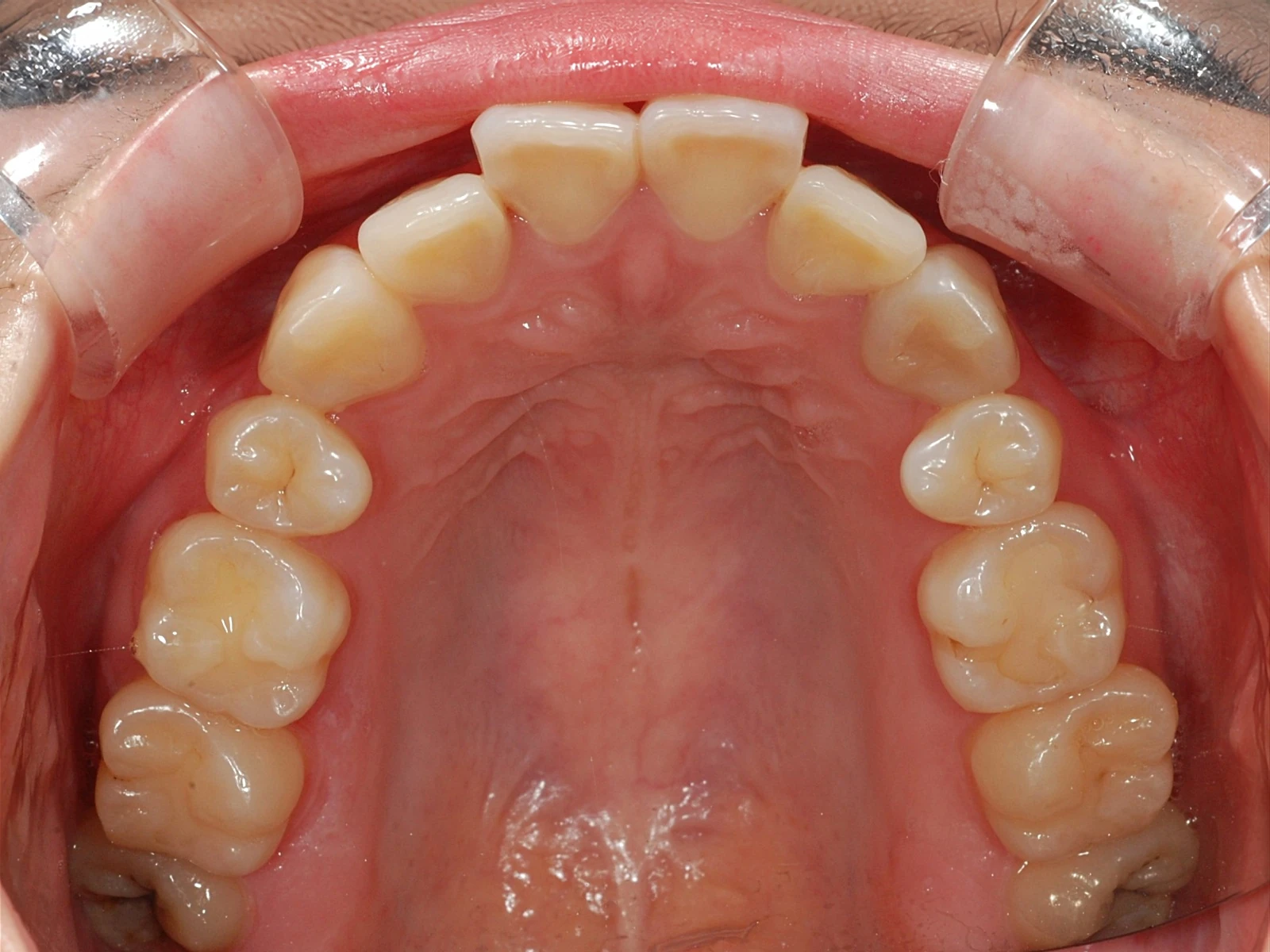
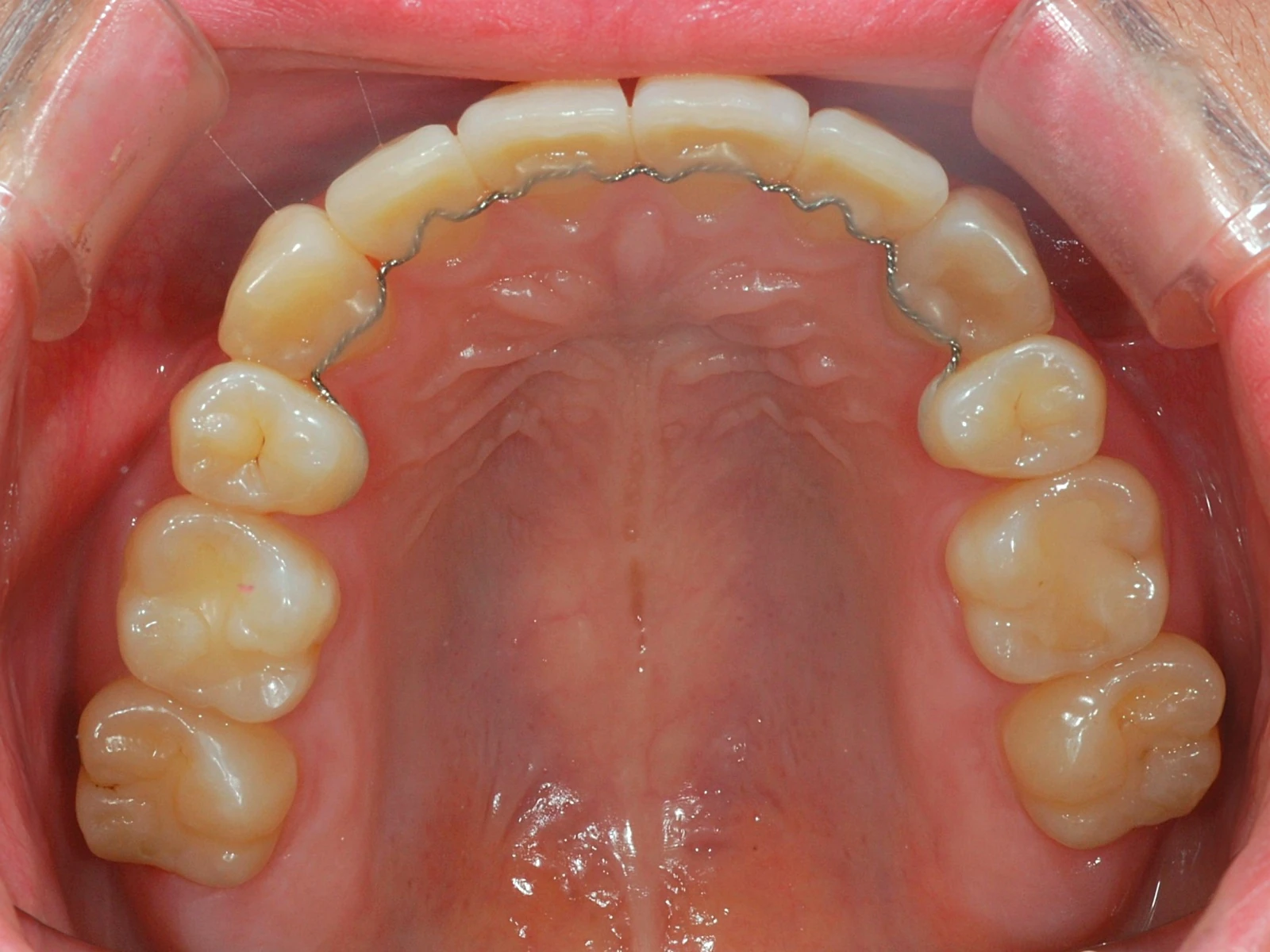
Front teeth crooked again after earlier braces
Clear aligners · upper front teeth only, with slight reshaping between teeth to make space
Before · Feb 2018
Upper teeth before treatment. The front teeth had become crooked again after earlier braces.
After · Jan 2019
Upper teeth after treatment. We aligned the crooked front teeth using space made by slightly reshaping between the teeth.
Condition
Crooked upper front teeth from relapse after braces; stable bite on the back teeth
Chosen
Invisalign, reshaping between the front teeth
Not done
Full orthodontics (there was no need to change the back-tooth bite)
Duration
About 6 months
Note
Without retainers, the teeth can become crooked again.
CASE02
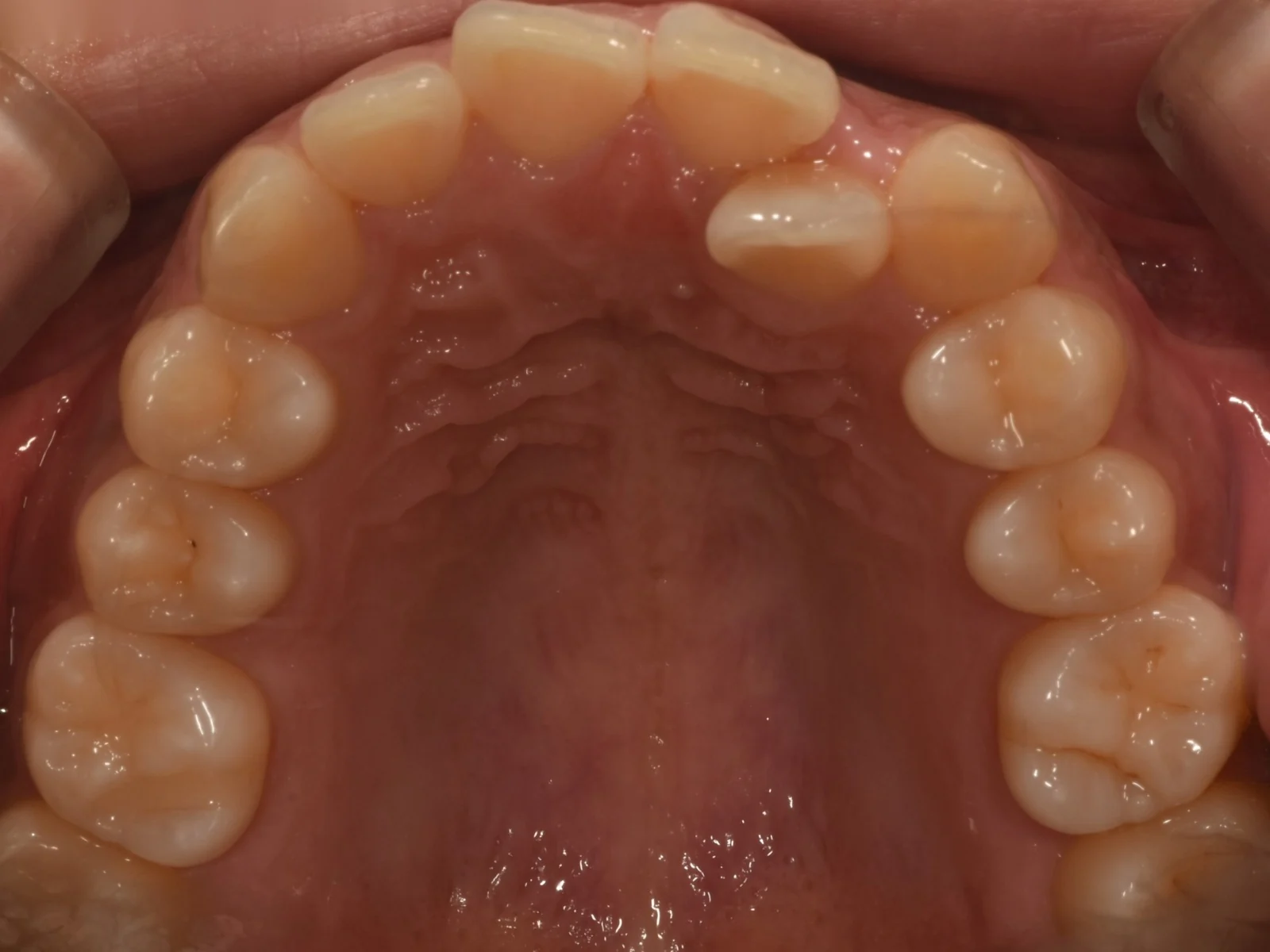
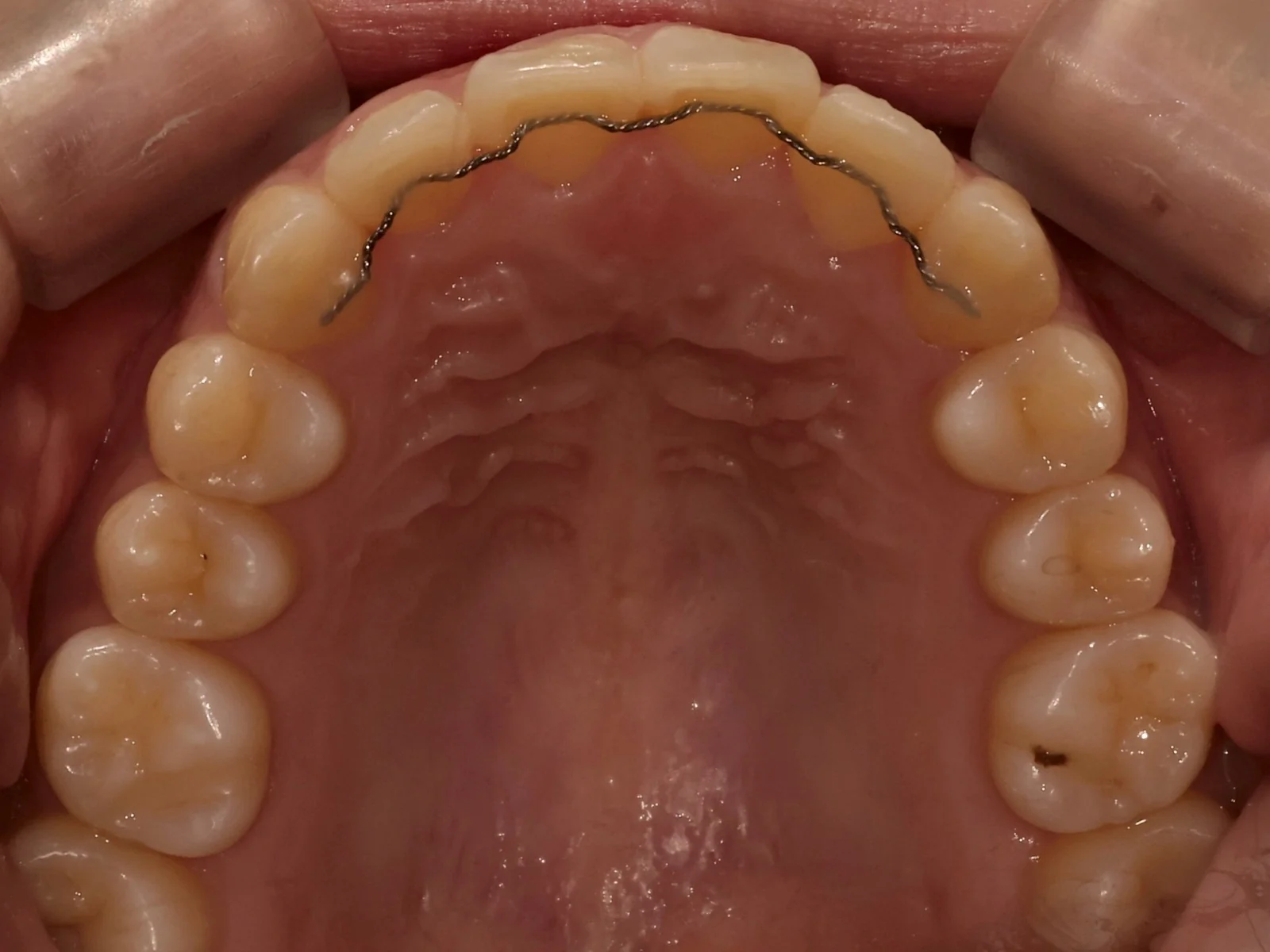
Snaggletooth together with rotated front teeth
Invisalign · attachments to let the aligners grip the teeth, and arch widening to make space without extraction
Before · Jul 2024
Upper teeth before treatment. The canine stood out, and the lateral incisor was rotated at an angle.
After · Jul 2026
Upper teeth after treatment. The rotated front tooth was turned step by step using a small bump (attachment) bonded to the tooth.
Condition
Snaggletooth and rotated front teeth without a large lack of space
Chosen
Invisalign, attachments, arch widening and reshaping between teeth
Not done
Extraction (the lack of space was only a few mm)
Duration
About 14 months
CASE03
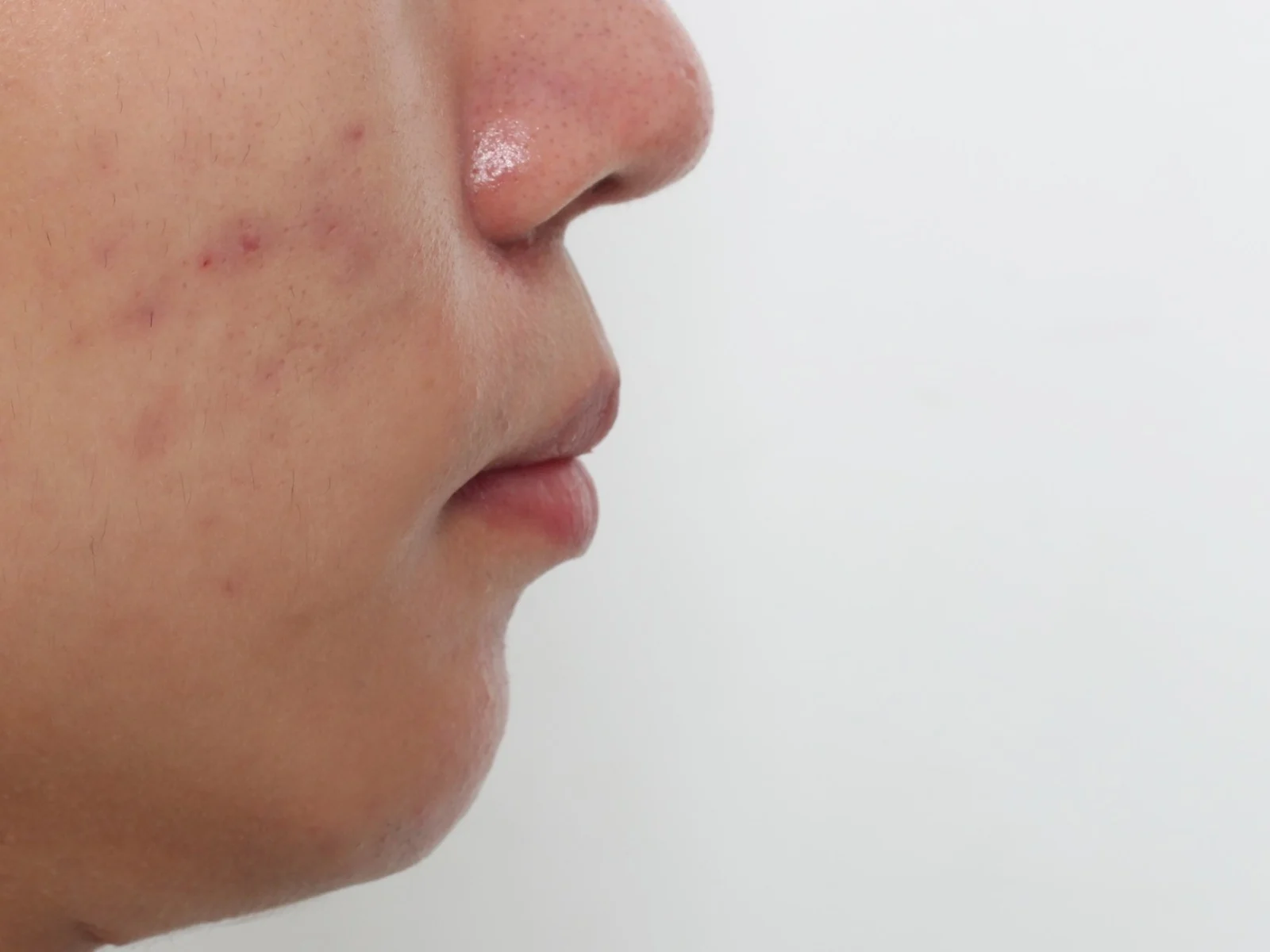
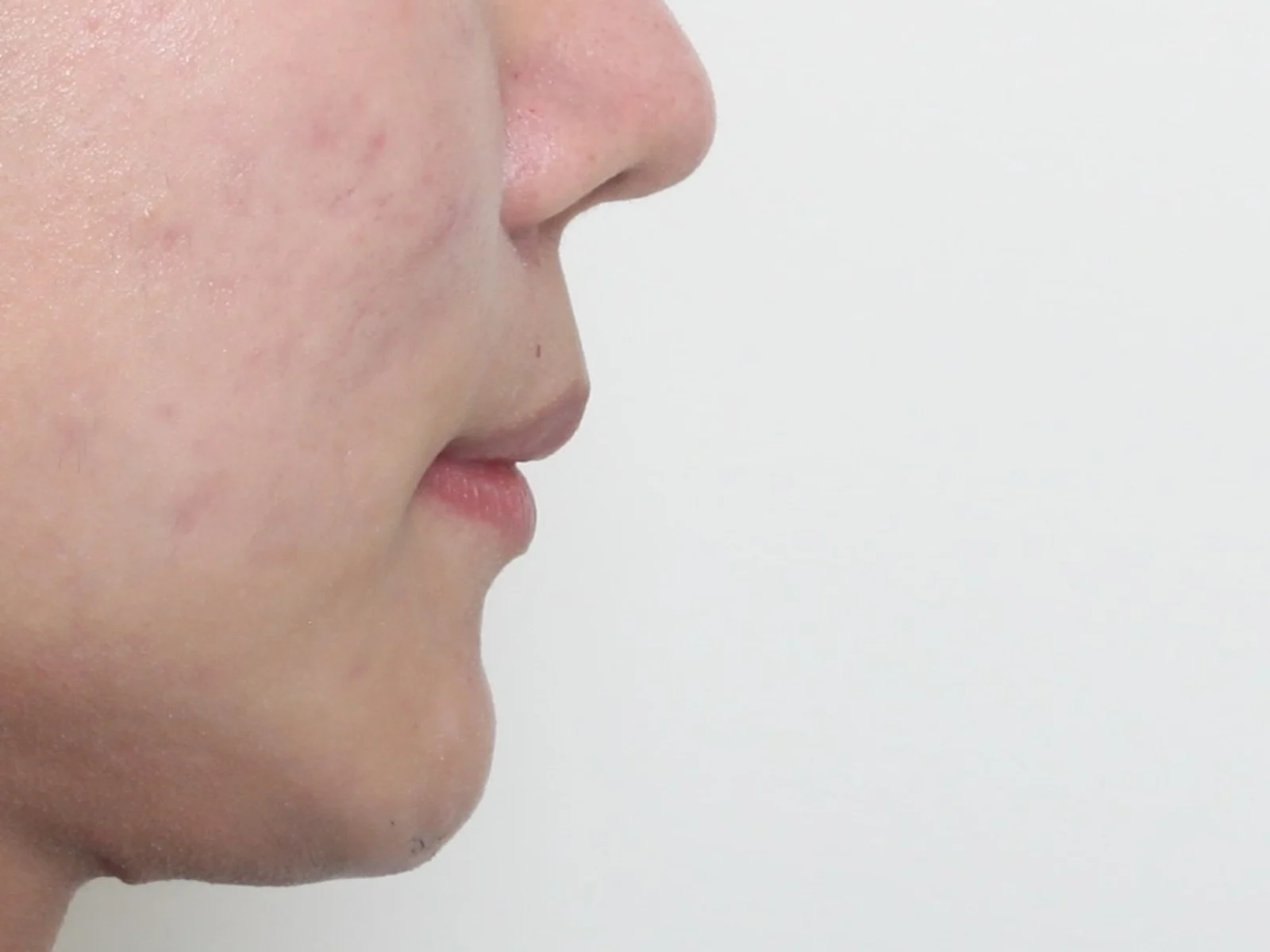
Protruding mouth needing extraction, but visible braces were a concern
Invisalign extraction treatment · checking the root angle of the front teeth throughout space closure
Before · Apr 2023
Before treatment. The front teeth were tipped forward and the mouth looked protruding, so premolar extraction was needed.
After · Nov 2025
After treatment. We moved the front teeth back while closing the extraction spaces and re-planned partway through to keep the front teeth from tipping back.
Condition
Dental protrusion; wanted to avoid visible braces
Chosen
Premolar extraction, Invisalign, mini-screws, elastics if needed
Duration
About 2.5 years
Note
In extraction cases with clear aligners, the front teeth tend to tip back if wearing time is short, so several mid-course rescans may be needed.
Key point
While closing spaces, we must keep checking how the tooth axes move. That is why the design of the first plan matters most.
* Photos were taken under the same conditions and published with the patients' consent. Treatment results and side effects may vary from person to person.
02°
Clear aligners handle some movements well and others with difficulty
Clear aligners move teeth by wrapping around them and pushing from the outside. So they are good at tipping the crown of a tooth, but moving a tooth farther out of the gum (extrusion) or moving it bodily with its root needs help such as small bumps bonded to the teeth (attachments) or elastics.
01Movements they handle well
Tipping front teeth into line, closing gaps between front teeth, fixing mild crowding, widening the arch a little, and moving the back teeth a few mm back. They also suit fixing minor relapse after earlier braces.
02Difficult movements
Pulling a short tooth out of the gum, rotating round canines or premolars a lot, and moving teeth bodily while closing extraction spaces. These may need auxiliaries, or brackets may work better.
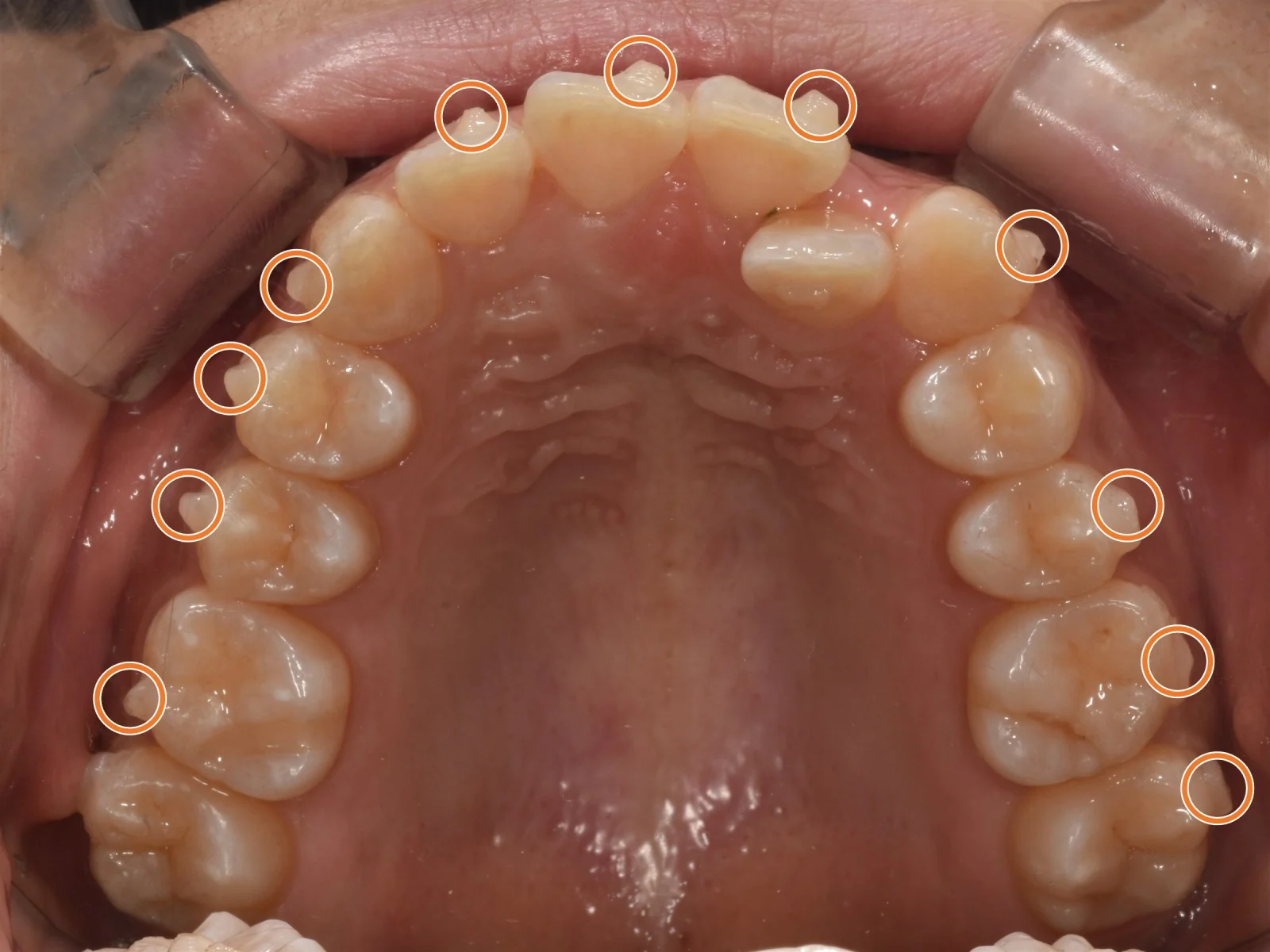
Attachments
Attachments bonded to the teeth (circled). They keep the clear aligner from slipping on the teeth so it can apply rotating or extruding forces.
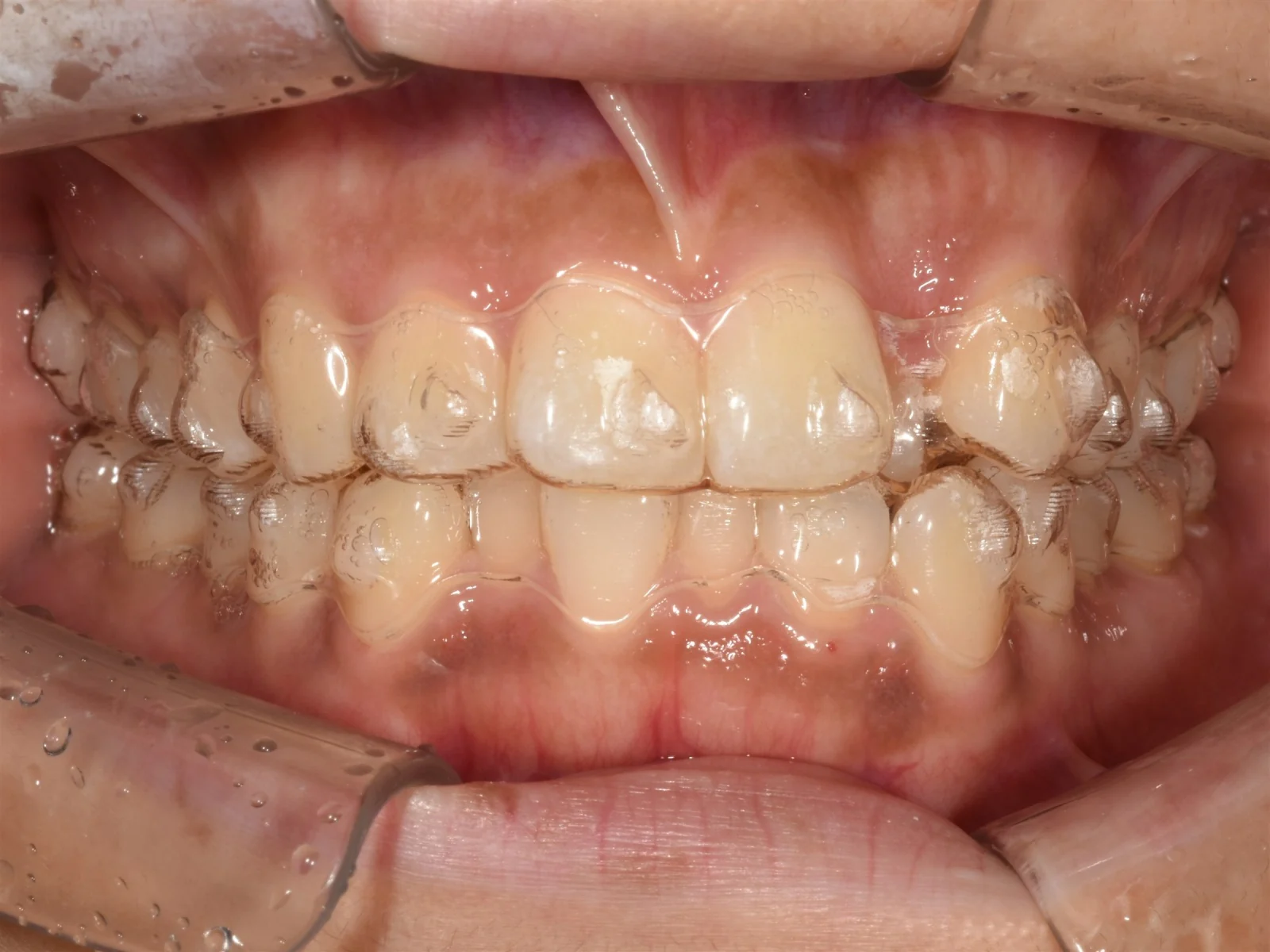
Wearing the aligners
Wearing clear aligners. Up close you can see the edges, but they are hard to notice at a normal talking distance.
The first thing to check when choosing clear aligners is how many difficult movements are mixed into the movements your teeth need.
03°
How clear aligner treatment works
There are six steps, from the examination to retainers. For each step, we explain what we check and why, with real clinical photos.
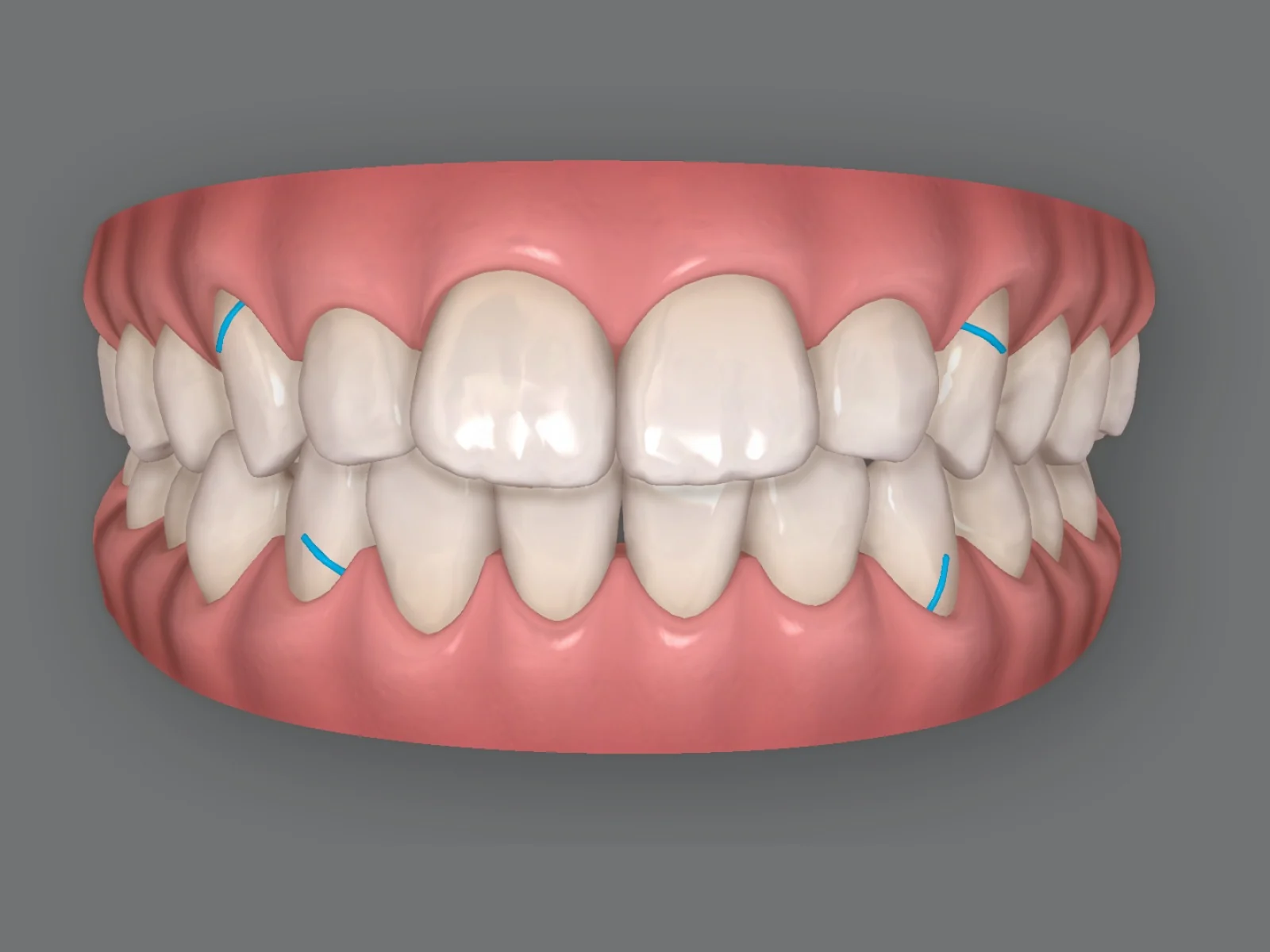
3D model before treatment
A 3D model of the teeth before treatment, made with the iTero intraoral scanner. Instead of taking impressions, we scan the mouth for a few minutes.
STEP 01
We sort out the movements needed with a full examination and 3D scan
We take facial and intraoral photos, a side-view X-ray of the face (cephalogram) and a panoramic X-ray, and if needed, a 3D CT to see the roots and bone thickness. The tooth model is made with the iTero intraoral scanner.
Then, for each tooth, we decide which movement is needed: tipping, rotating, extruding or bodily movement.
Why we do thisWhether clear aligners suit you depends less on how many teeth are crooked and more on what kind of movement is needed. If many difficult movements are needed, we plan auxiliaries from the start or recommend a different appliance.
Plan
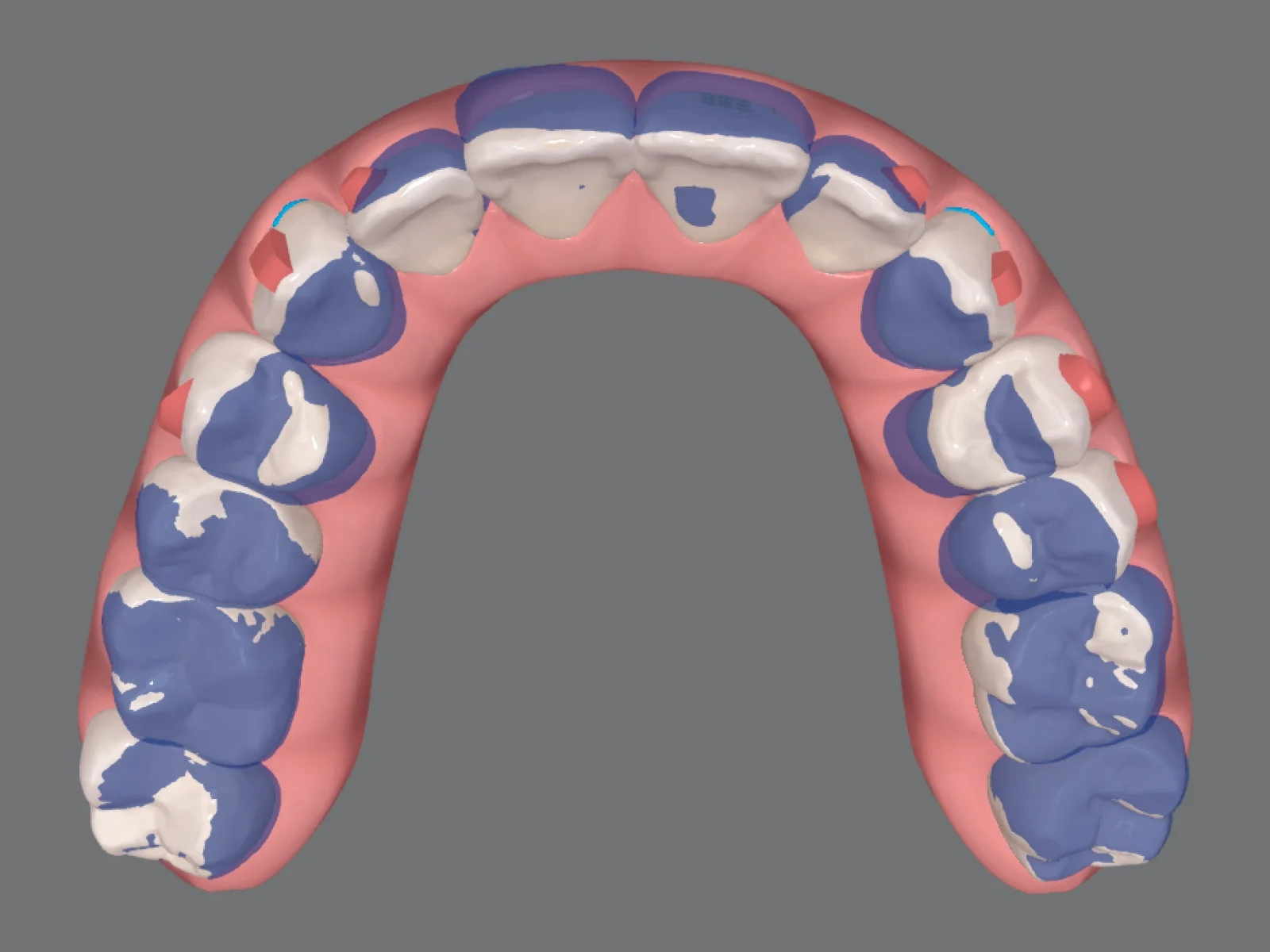
Tooth movement planning screen. We overlay the starting (blue) and target (white) arches and check how many mm and degrees each tooth will move.
STEP 02
We decide the number of stages and auxiliaries while reviewing the planning screen
The doctor personally checks and corrects the tooth movement plan, making sure no tooth moves too much in one stage and the attachments are in the right places. We go through the planning screen with you during the consultation.
We mainly use Seraphin clear aligners when only the front teeth need aligning, and Invisalign when the target is far away, such as extraction cases or moving the whole arch back.
Why we do thisOn the planning screen every tooth seems to move exactly, but real teeth sometimes follow less than planned. We plan difficult movements slowly over more stages and build in a little extra movement in advance.
Aligners fitted · May 2024
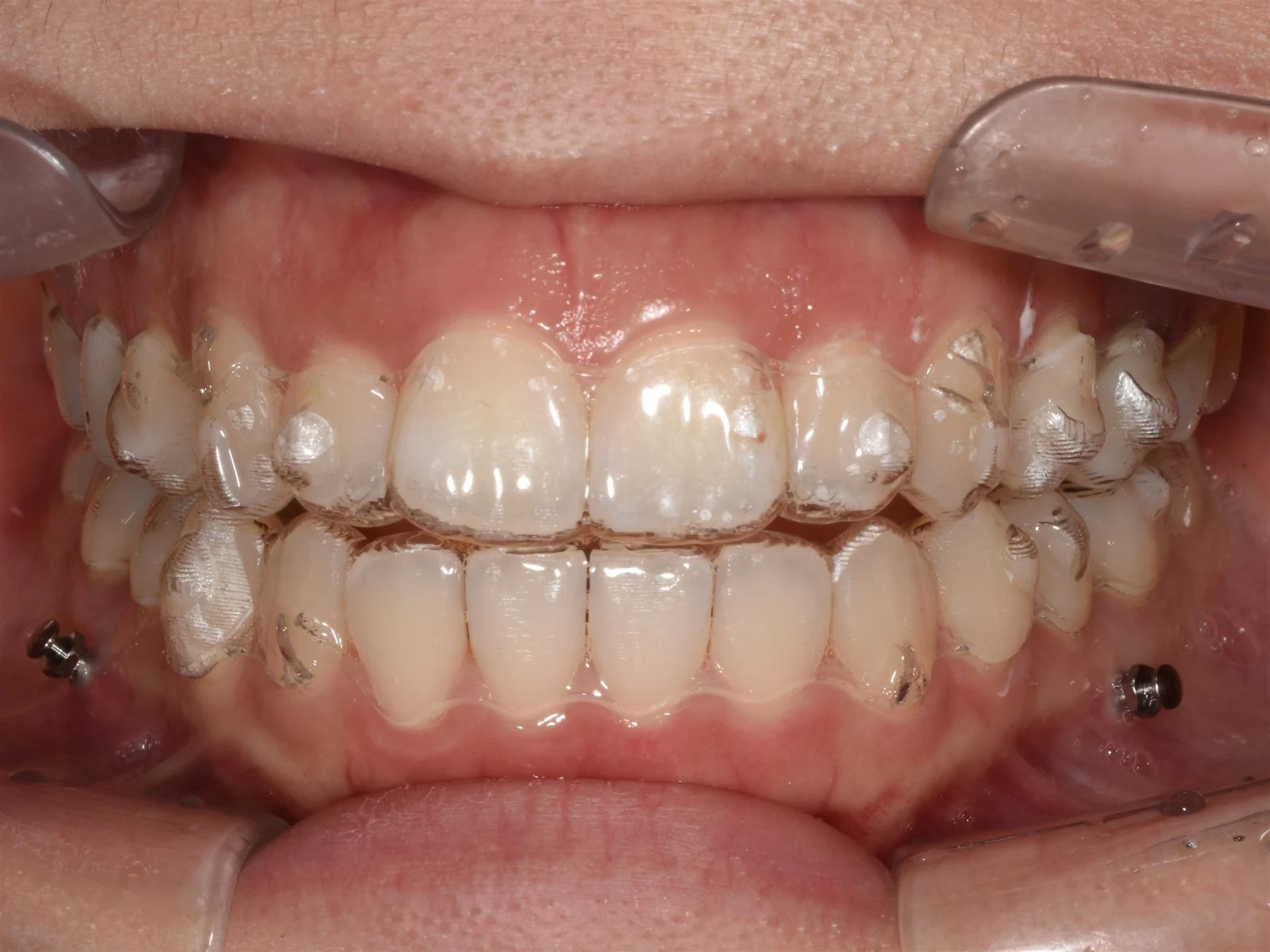
On the day you get your first aligner, we bond attachments with tooth-colored material. When you finish all the aligners, we remove them and polish the tooth surface smooth.
STEP 03
We bond attachments and fit your first aligner
We bond tooth-colored bumps to the planned teeth and, if needed, reshape between the teeth by about 0.1–0.5mm to make space. We show you how to put the aligners in and take them out, and the order for eating and brushing.
You usually move to the next aligner every 1–2 weeks.
Why we do thisClear aligners slip easily on smooth tooth surfaces. The attachments must act as handles for rotating or extruding forces to work properly. Reshaping between teeth is done only within the thickness of the enamel, and the reshaped surfaces are finished smooth.
Regular check-up · Dec 2024
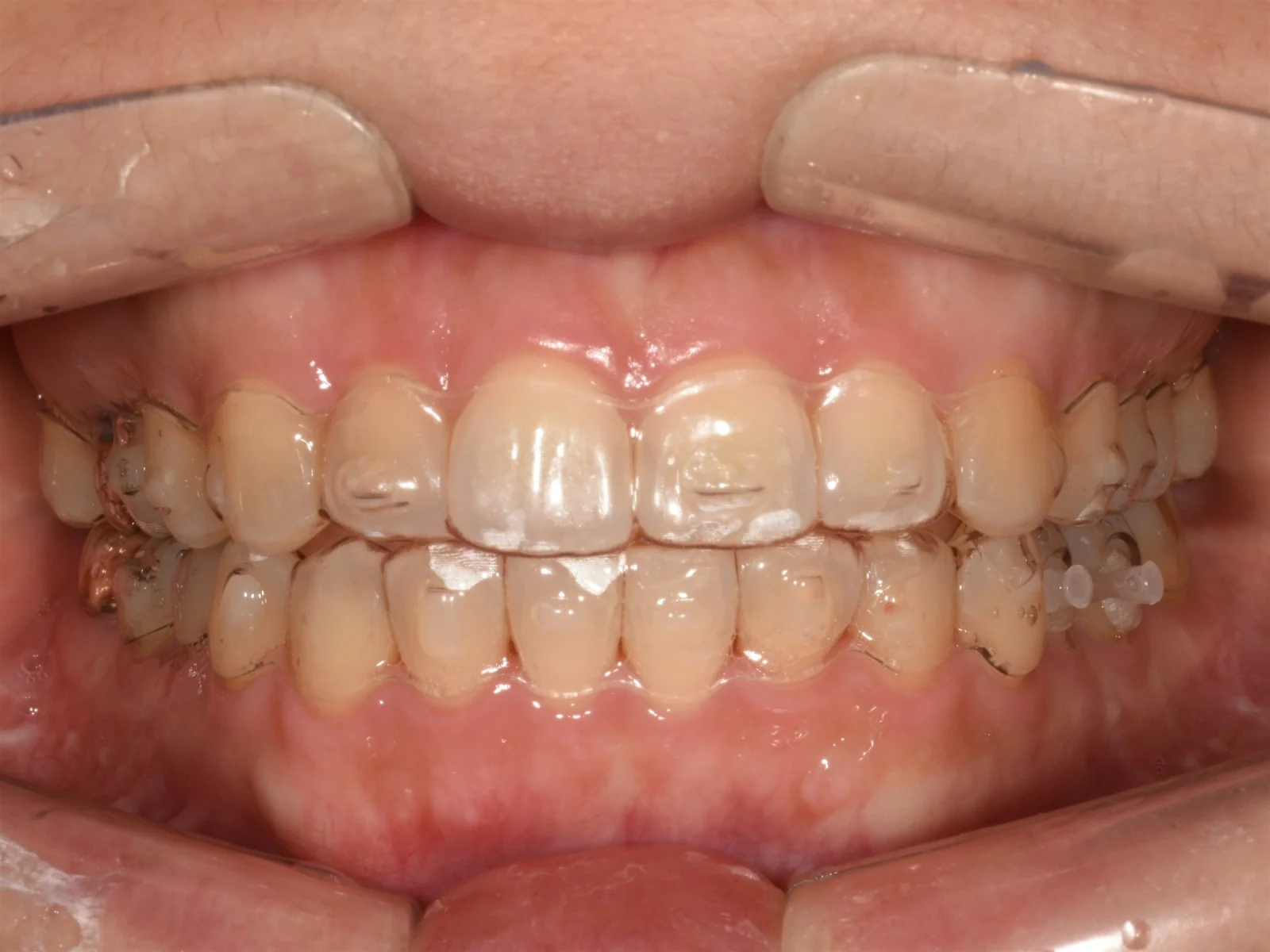
Regular check-up. We check that the aligners fit the teeth snugly and whether any tooth is not following the plan.
STEP 04
Every 2–3 months we check that the aligners fit your teeth
Visits are usually once every 2–3 months. We look for gaps between the aligner and the teeth, attachments that have come off, and teeth moving more slowly than planned.
Why we do thisWith clear aligners, the time you wear them is the time orthodontic force is applied. If you wear them less than 20 hours a day, the teeth cannot keep up and the aligners start to lift off. Spotting this sign early lets us decide whether you can move on to the next aligner.
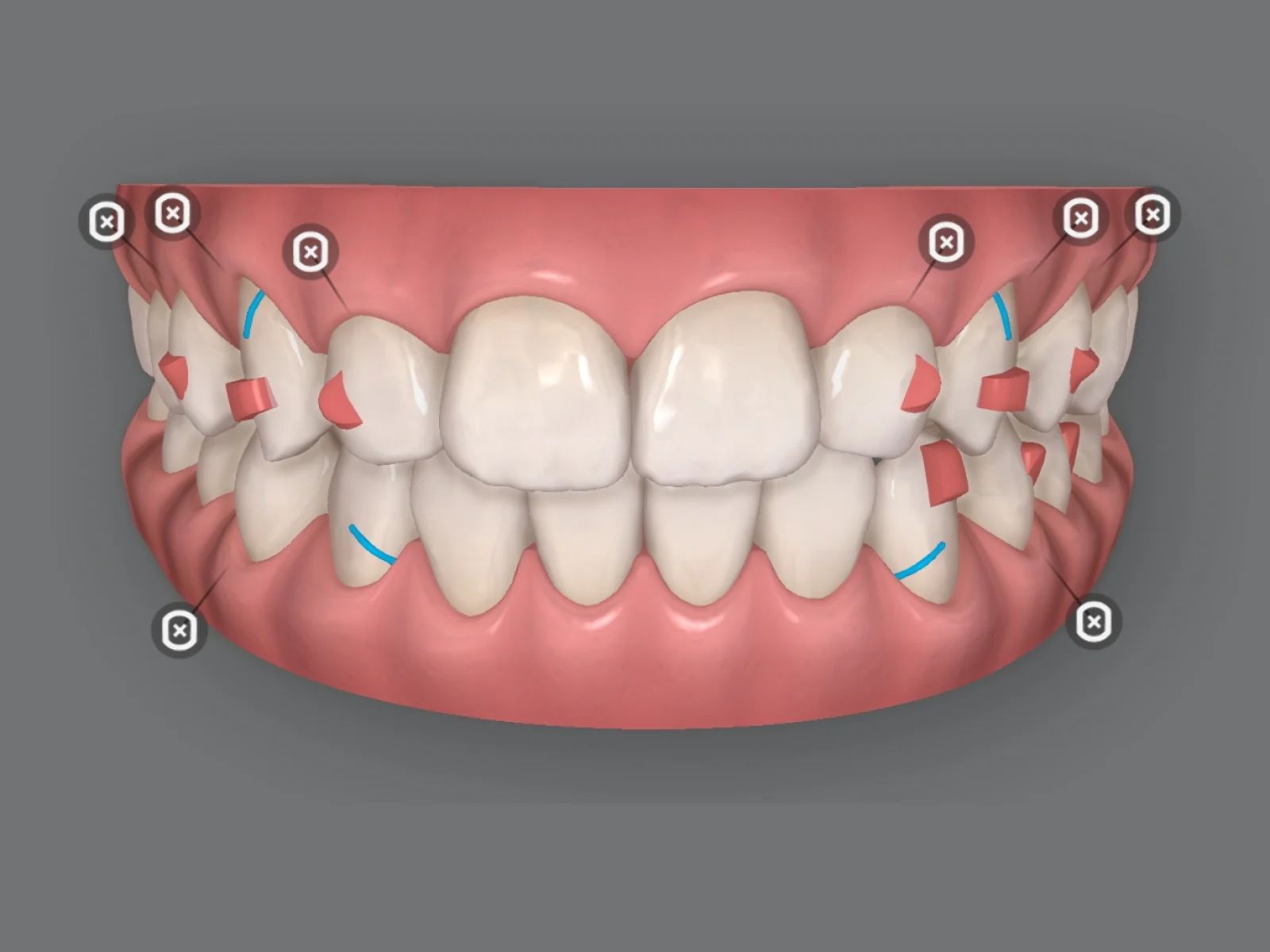
Additional scan · Oct 2024
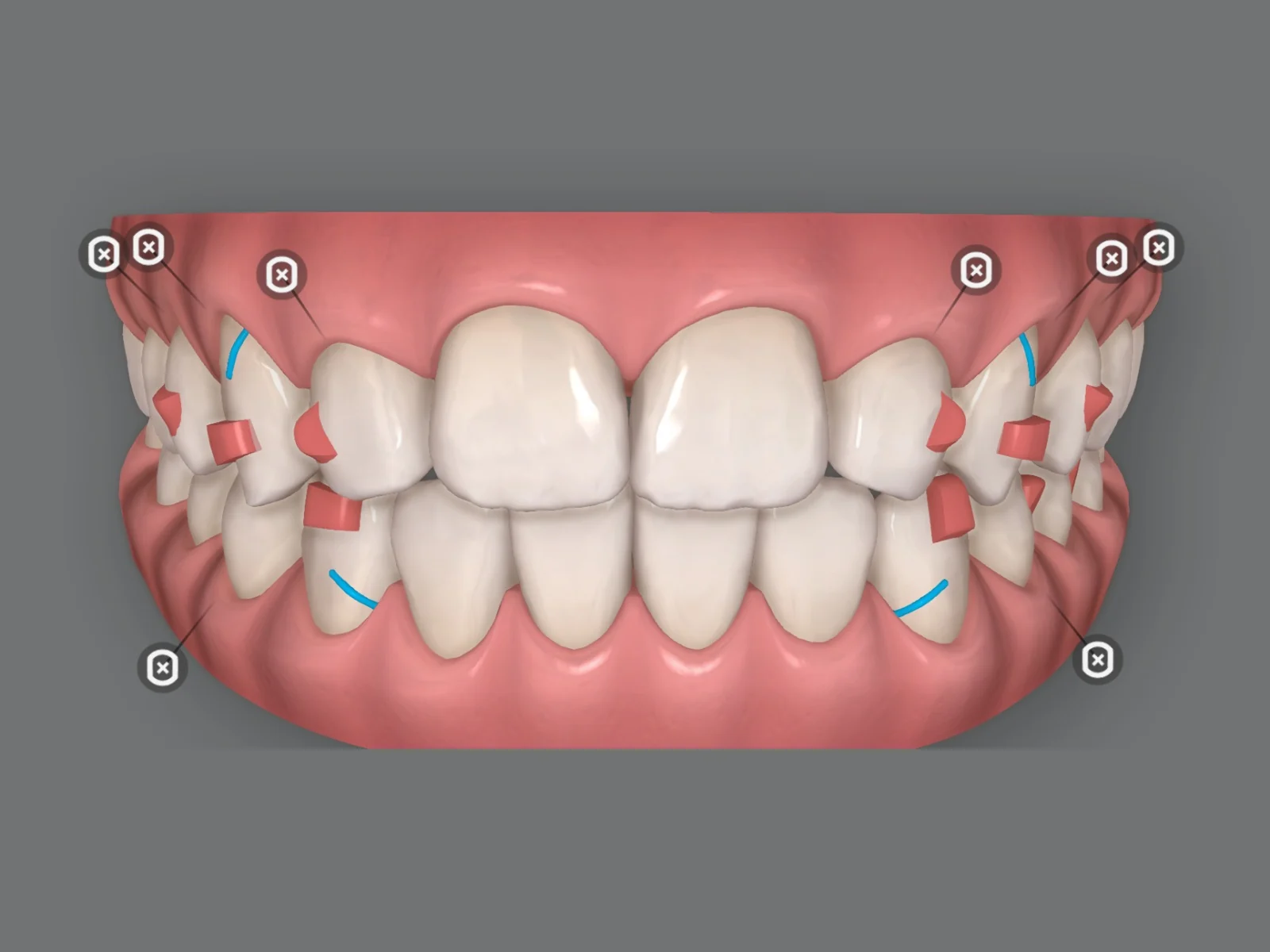
Target for additional aligners
Mid-course rescan. From the actual tooth positions in the new scan (left), we plan only the remaining movement (right).
STEP 05
If the teeth differ from the plan, we rescan and make additional aligners
If the teeth do not follow the plan, we rescan partway through and make a new plan for the remaining movement. In extraction cases or cases with many rotations, one or two re-plans like this are common.
Why we do thisIf you push the first plan through to the end, teeth that are off track get further off track. Resetting to the actual positions partway through shortens the overall treatment time.
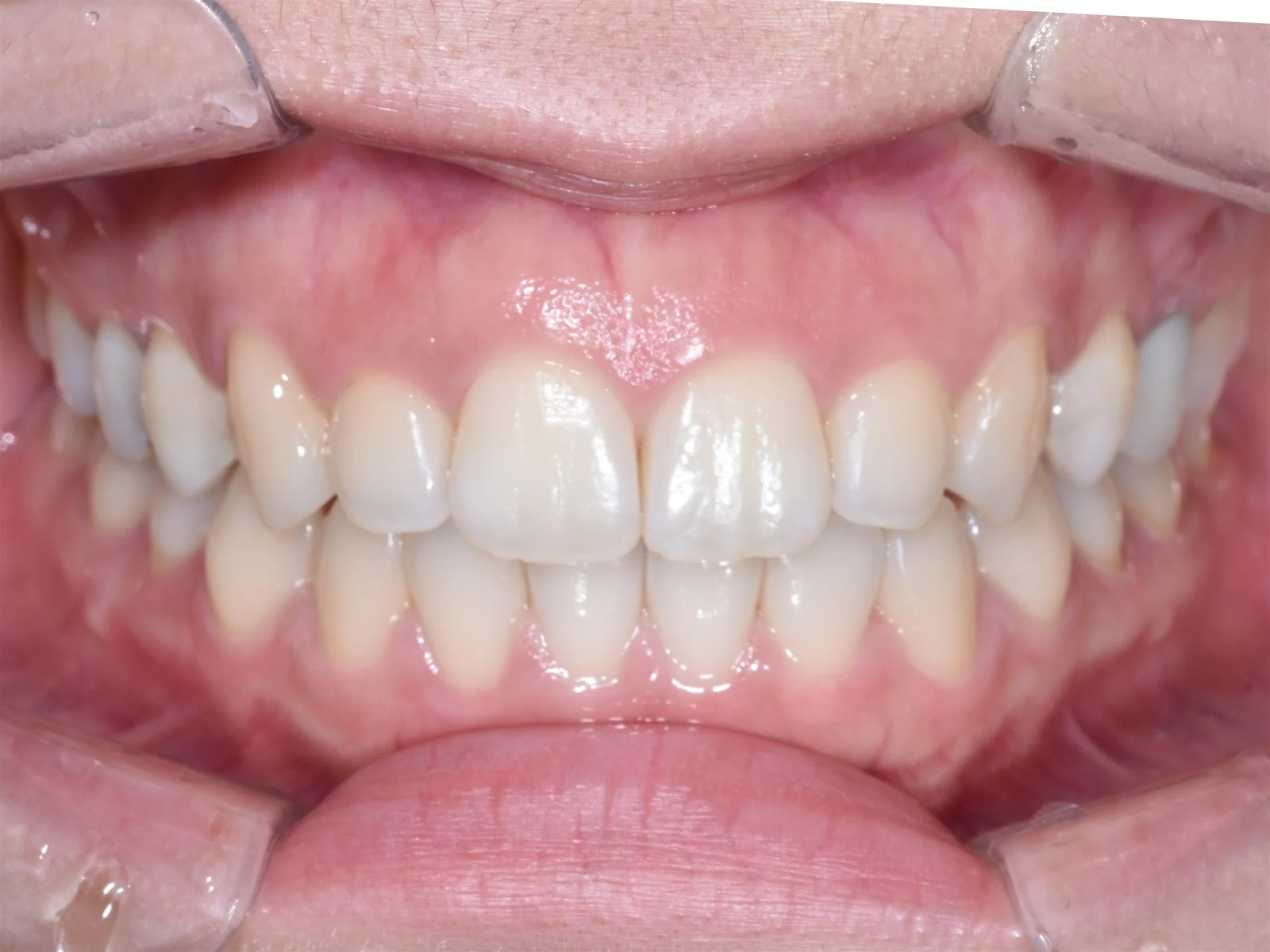
Appliance removal day · May 2025
The day the attachments were removed and the tooth surfaces polished. After this, we use clear retainers and a thin wire behind the front teeth as the situation requires.
STEP 06
We remove the attachments and hold the result with retainers
When the teeth reach the planned positions, we remove the attachments, polish the tooth surfaces and give you retainers. For 2 years after treatment, retainer check-ups and adjustments are included in the orthodontic fee.
Why we do thisTeeth moved with clear aligners tend to move back, just like teeth moved with brackets. Teeth that were rotated a lot keep this pull for a long time, so you need to wear your retainers consistently.
* Clinical photos were published with the patients' consent. Side effects such as temporary pain or discomfort may occur depending on the person.
For 1–2 days after your first aligner or after moving to the next stage, your teeth may feel sore and you may lisp slightly.
04°
How do we decide whether clear aligners suit you?
We look at the five points below together. If even one applies, we add auxiliaries or compare with other appliances and explain.
Type of movement needed · Mostly tipping suits aligners well; a lot of extruding, heavy rotation or bodily movement makes it harder.
Size of extraction spaces · Treatment that closes extraction spaces is possible, but frequent re-planning is needed to keep the front teeth from tipping back.
Skeletal difference · If the difference between the upper and lower jaws is large, orthodontic treatment alone can change only a little, whatever the appliance.
Wearing time · We check whether your lifestyle allows 20–22 hours of wear a day.
Teeth grinding and gum condition · Heavy grinding wears the aligners quickly, and gum inflammation is treated first.
05°
Comparing orthodontic appliances
Invisalign
Seraphin clear aligners
Ceramic braces
Lingual braces
Visibility
Clear aligners; only the edges show up close
Clear aligners; only the edges show up close
Tooth-colored brackets, less noticeable than metal
Bonded behind the teeth, almost invisible from outside
Works well for
Distant targets, such as extraction cases or moving the whole arch back
Aligning only the front teeth
Most movements, including heavy rotation and bodily movement
Most movements, when the braces must not be seen
Difficulties
Extruding, heavy rotation and bodily movement may need auxiliaries
Not suited to moving the whole arch toward a distant target
The braces show a little
Tongue discomfort and speech changes in the first few weeks; harder to clean
Your part
Wear 20–22 hours a day
Wear 20–22 hours a day
Avoid hard foods; brush carefully
Avoid hard foods; brush carefully
Eating and brushing
Take them out to eat; put them back in after brushing
Take them out to eat; put them back in after brushing
Who clear aligners suit, and when another appliance is better
Good for you if
You have crowded front teeth, gaps between front teeth, or minor relapse after braces
Visible braces are a big concern for you
You live abroad or outside Seoul and want longer visit intervals
You can wear the aligners 20–22 hours a day
Other treatment comes first
Gum inflammation: we treat the gums first
Jaw joint pain: we manage the pain first
Cavities: we scan after treating them (if a filling changes the tooth shape, the aligners will not fit)
Another appliance may be better
When short teeth need substantial extrusion (movement farther out of the gum) or round teeth need substantial rotation
When extraction spaces are large and the front teeth must move back a lot, but keeping to the wearing time is difficult
When the skeletal difference is large and surgical orthodontics should also be considered
07°
Self-check
If most of these apply, clear aligners are likely to suit you. You can also send us photos of your teeth first.
08°
Side effects and limits
Please read
· If you do not wear the aligners long enough, the teeth will not move as planned, and you will need more aligners and more time.
· It is common for the actual tooth positions to differ from the plan, so that we rescan partway through and make additional aligners.
· For the first few days and for 1–2 days after each aligner change, you may feel pressure and notice changes in your speech.
· Drinking sugary drinks often with the aligners in raises the risk of cavities. Take the aligners out for anything other than water.
· Attachments may come off or become discolored.
· Shortening of tooth roots or gum recession can occur with orthodontic treatment regardless of the appliance type.
· If you lose or break an aligner, it must be made again.
FAQ
FAQ
Can clear aligners be used for extraction cases?
Yes, Invisalign can be used for extraction cases. But to keep the front teeth from tipping back while the extraction spaces close, you must wear the aligners as instructed, and a mid-course re-plan is often needed. After the examination, we explain how this compares with bracket braces.
How many hours a day do I need to wear clear aligners?
20–22 hours a day. Take them out only to eat and brush. If they are out for longer, the teeth cannot keep up with the aligners and treatment takes longer.
What is the difference between Invisalign and Seraphin clear aligners?
We usually use Seraphin clear aligners when only the front teeth need to be aligned, and Invisalign when the target is far away, such as extraction cases or moving the whole arch back. The visit interval is similar, the cost is different, and both are listed on our fee schedule.
Treatment time depends on how much the teeth need to move and how long you wear the appliance, not on the type of appliance. Aligning only the front teeth can take a few months, but extraction cases take about 2 years with clear aligners, similar to brackets.
Do clear aligners hurt?
For 1–2 days after switching to a new aligner, your teeth may feel sore and tight. Irritation of the cheeks is less common than with bracket-and-wire braces.
Can I have clear aligner treatment if I live abroad?
The visit interval is usually once every 2–3 months. We give you several stages of aligners in advance, and if a problem comes up, we first check it by photo. If you can come once every 2–3 months, you can have treatment even if you live abroad.
Why do I need small bumps (attachments) bonded to my teeth?
Attachments are handles that let the clear aligner grip the tooth. They are needed to apply forces that rotate a tooth or move it farther out of the gum (extrusion). When treatment is finished, we remove them and polish the tooth surface.
What if my teeth do not move as planned with clear aligners?
We rescan your teeth partway through, make a new plan for the remaining movement based on the actual tooth positions, and make additional aligners. If not wearing the aligners long enough is the cause, we first go over your wearing habits with you.
Can I have clear aligner treatment if I grind my teeth?
Yes, but the aligners can wear out or crack quickly, so we check them more often. If you also have jaw pain, we check your jaw joint first.
Evidence and references
Kim S, et al. Influence of different ligation methods on force and moment generation in a simulated condition of the maxillary crowded anterior dentition with linguo-version and rotation. Bio-Medical Materials and Engineering, 2022. doi:10.3233/BME-211288 (This study measured the force and rotational moment on teeth with bracket-and-wire braces. It did not measure the force of clear aligners.)
Ceramic Dental Clinic's 12-step orthodontic examination and diagnosis: Orthodontics main page
Questions from patients who travel to Seoul for treatment.
How much does Invisalign cost?
Invisalign is KRW 8,500,000. The fee may be lower depending on the number of steps, and an extra fee may apply if ceramic brackets are added for fine bite adjustment. The orthodontic fee includes the orthodontic diagnosis, extraction (except wisdom teeth), mini-screws, basic retainers and retention care for 2 years. If you have only the diagnosis and do not start treatment, it is KRW 50,000 (KRW 100,000 if a CT scan is needed). If a retainer breaks or is lost later, remaking it costs extra. International and Korean patients pay the same fees. We explain the total before treatment starts. See our fee schedule.
How often do I need to visit if I live abroad?
After you receive your aligners, you visit once every 2–3 months. Between visits, we check by photo only if something comes up. The total treatment time depends on your bite and whether teeth are extracted, and we explain it after the examination.
Can I have my consultation in English?
Yes. The doctor in charge of each field consults with you directly in English. For orthodontics, this is Dr. Sunmin Kim, a board-certified orthodontist. Before you travel, you can send photos of your teeth on WhatsApp or by email. An accurate diagnosis is made after we examine you in person.
What happens after treatment?
You need retainers after treatment, because teeth tend to move back. Retention care for 2 years is included in the orthodontic fee. If you lose or break an aligner, message us on WhatsApp early, because remaking takes time.
Results, the number of visits and schedules vary from person to person. More questions: Visiting from abroad.


 Before · Feb 2018
 After · Jan 2019
 Before · Jul 2024
 After · Jul 2026
 Before · Apr 2023
 After · Nov 2025
 Attachments
 Wearing the aligners
 3D model before treatment
 Plan
 Aligners fitted · May 2024
 Regular check-up · Dec 2024
 Additional scan · Oct 2024
 Target for additional aligners
 Appliance removal day · May 2025