Last reviewed October 29, 2026 · Dr. Ilseop Ahn (board-certified periodontist and board-certified specialist in advanced general dentistry)
At a glance
Good for
More than 3–4 mm of upper gums showing in a relaxed smile
Treatment flow
Find the cause (gums, front-tooth height, lips) → gum contouring, or orthodontics or lip repositioning
Duration and limits
Two or more causes are often mixed. If only the gums are reshaped, most people can go about daily life the same day
Details
When more than about 3–4 mm of the upper gums shows in a relaxed smile, it is called a gummy smile. There are three causes: the gums cover the teeth so the teeth look short; the front teeth have come down too far or the upper jaw has grown long vertically; or the upper lip rises a lot when you smile. Two or more causes are often mixed. If the gums are the cause, gum contouring (crown lengthening) can reduce it. If the height of the front teeth is the cause, orthodontics with mini-screws can move the front teeth up. To avoid gums that still show after only trimming them, a board-certified periodontist measures down to the bone under the gums, and a board-certified orthodontist checks the height of the front teeth.
01°
Different causes, different treatments
When the height of the front teeth is the cause, treatment is completely different from when the gums are the cause. Here are real cases.
CASE01
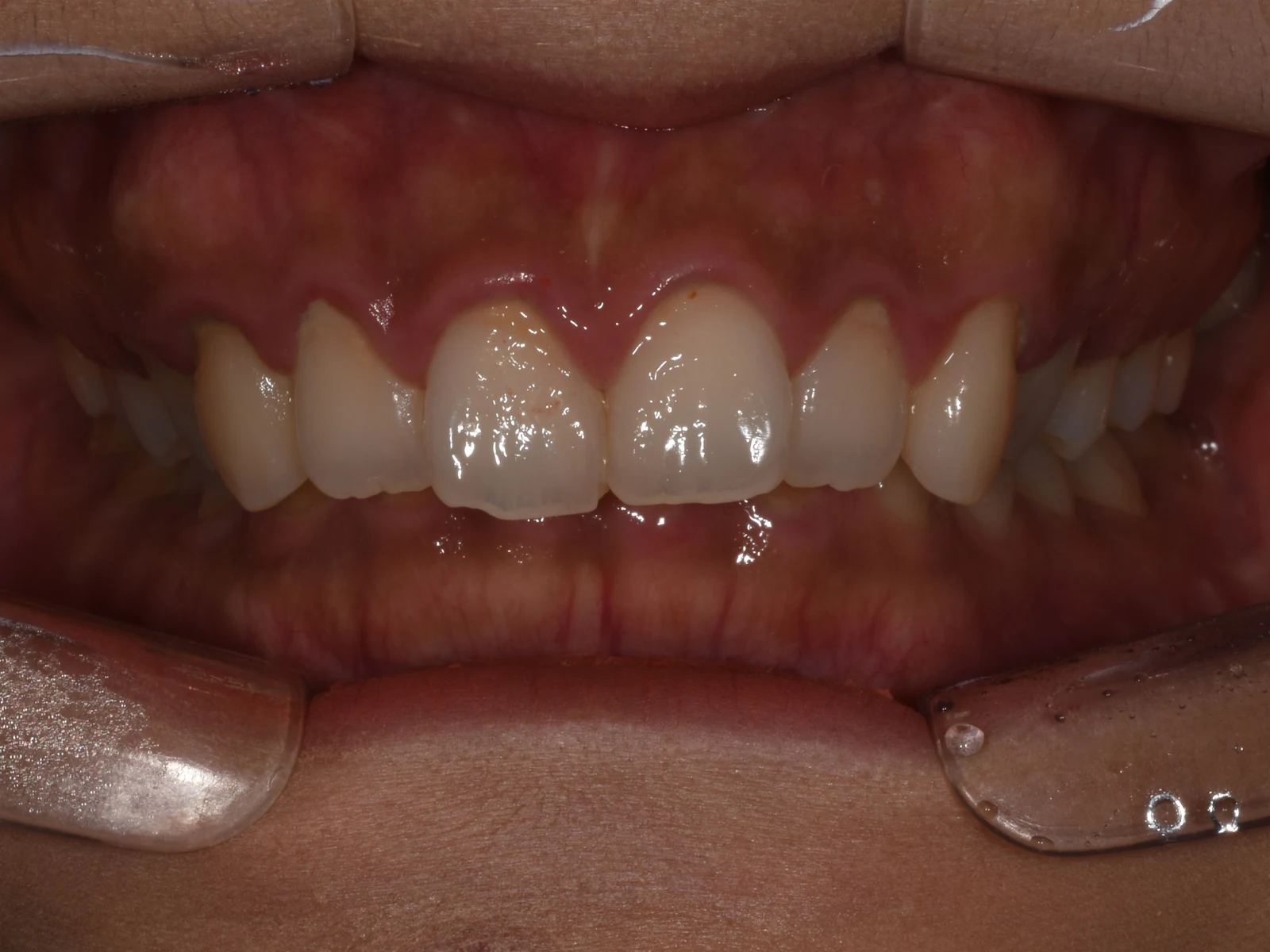
Front teeth that stuck out with a deep bite and a lot of gum display
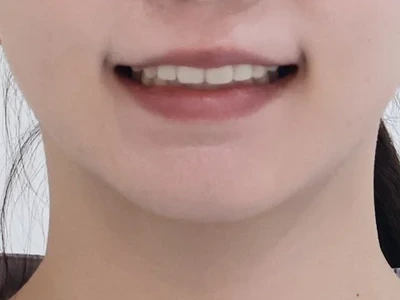
Orthodontics without surgery · upper mini-screws moved the front teeth up, and premolar extraction let them move back
Before · April 2021
Front view inside the mouth before treatment. The upper front teeth stuck out and came down deeply, almost covering the lower front teeth.
After · October 2026
Smiling face after treatment. Mini-screws moved the upper front teeth up and back, so less gum shows when smiling.
Condition
Severe deep bite with the upper front teeth almost covering the lower front teeth, protruding front teeth, crowding, narrow upper dental arch (woman in her 20s)
Cause
Front-tooth height (tooth position)
Chosen
Upper and lower orthodontics, upper mini-screws to move the front teeth up, upper premolar extraction, upper wisdom tooth extraction
Not done
Jaw surgery, gum removal
Duration
Planned 20–24 months, finished in about 2 years (visits about every 4 weeks)
Treated by
Dr. Sunmin Kim (board-certified orthodontist)
CASE02
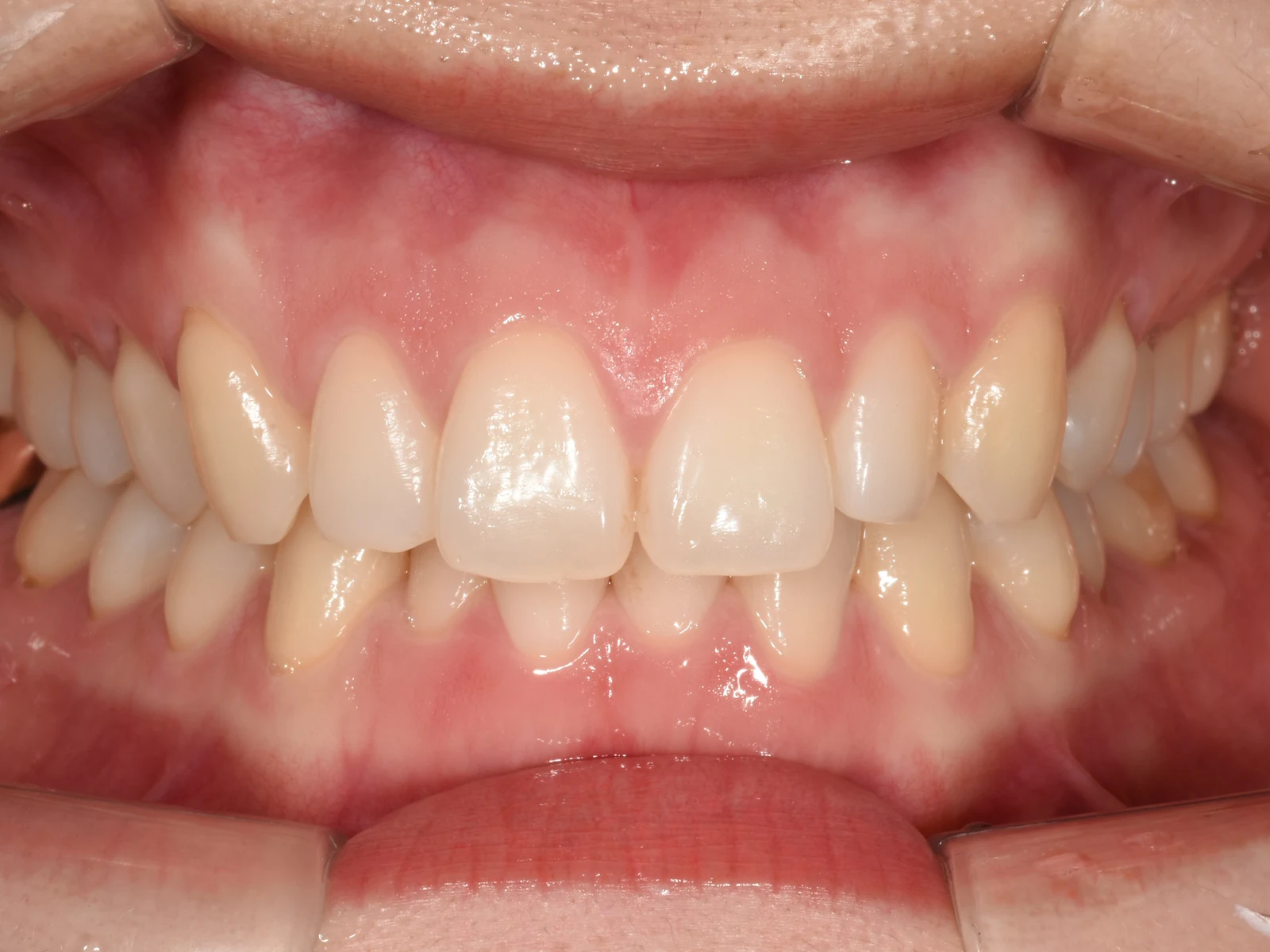
Uneven gum heights
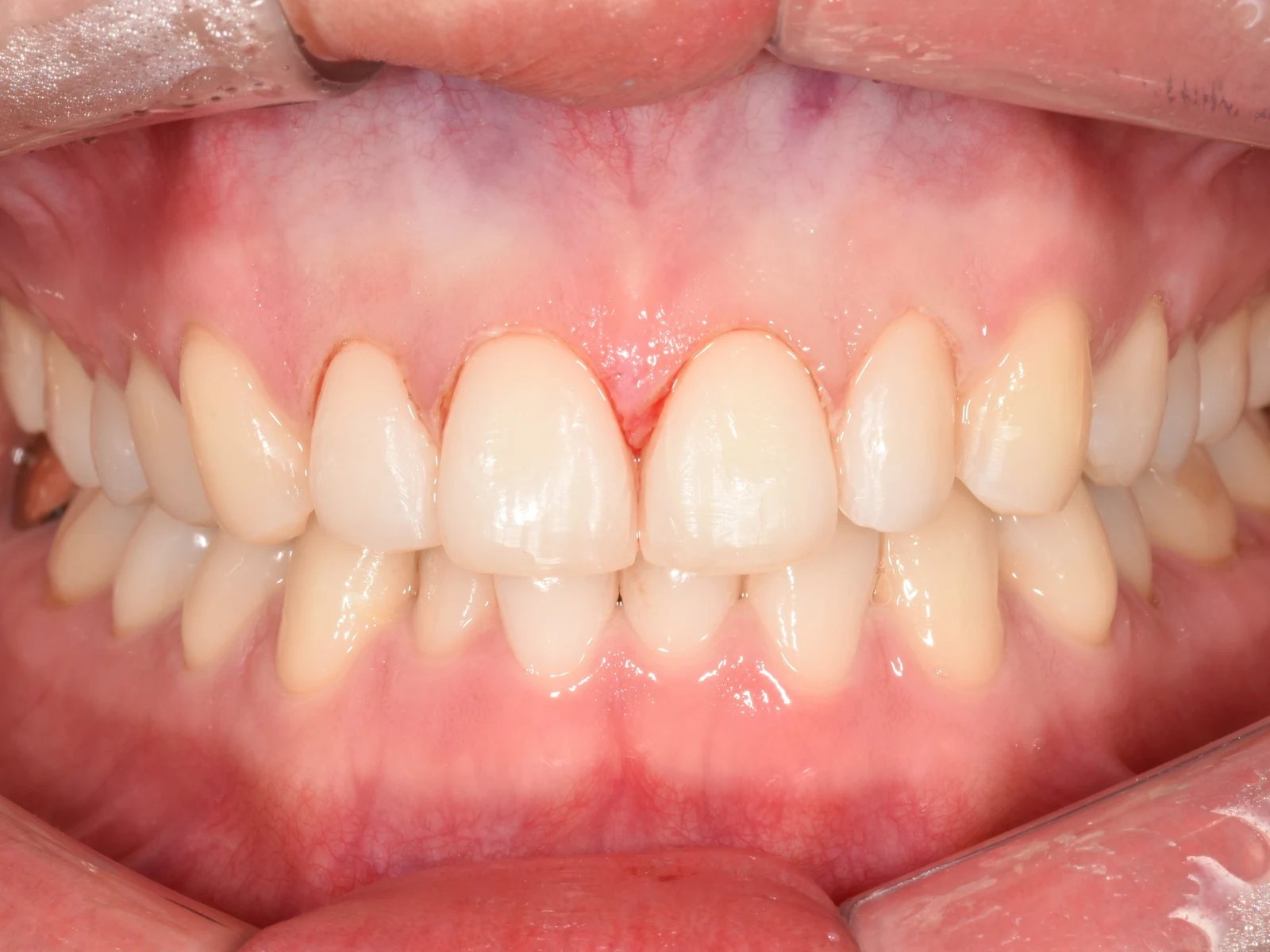
Gum contouring on 4 upper front teeth first, then 8 CERANATE veneers matched to the gum line
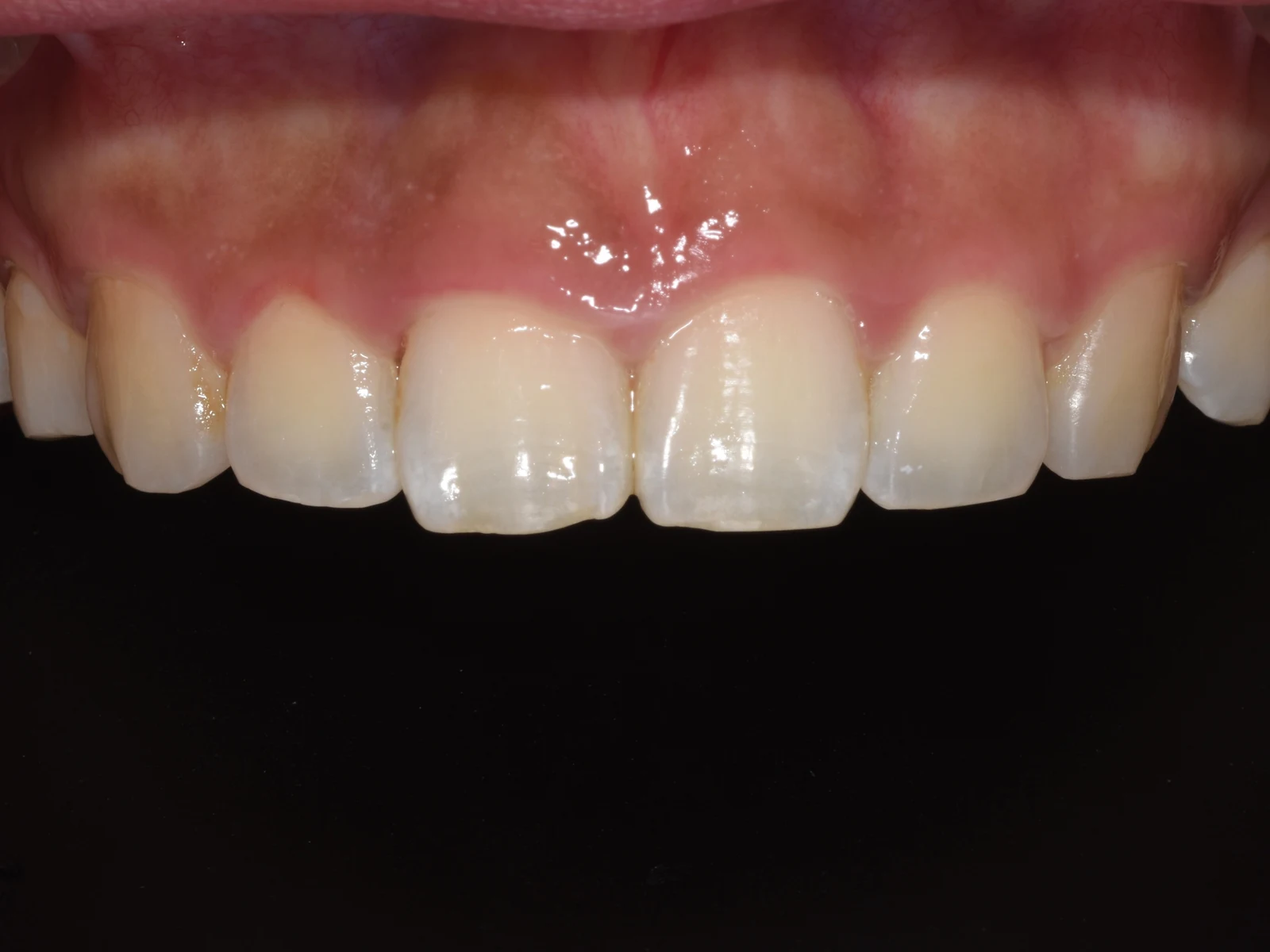
Before · October 2024
Before. Each front tooth had a different gum height, so the teeth also looked different in length.
Right after gum contouring · October 2024
Right after gum contouring. We evened out the gum heights of 4 upper front teeth and prepared the teeth the same day.
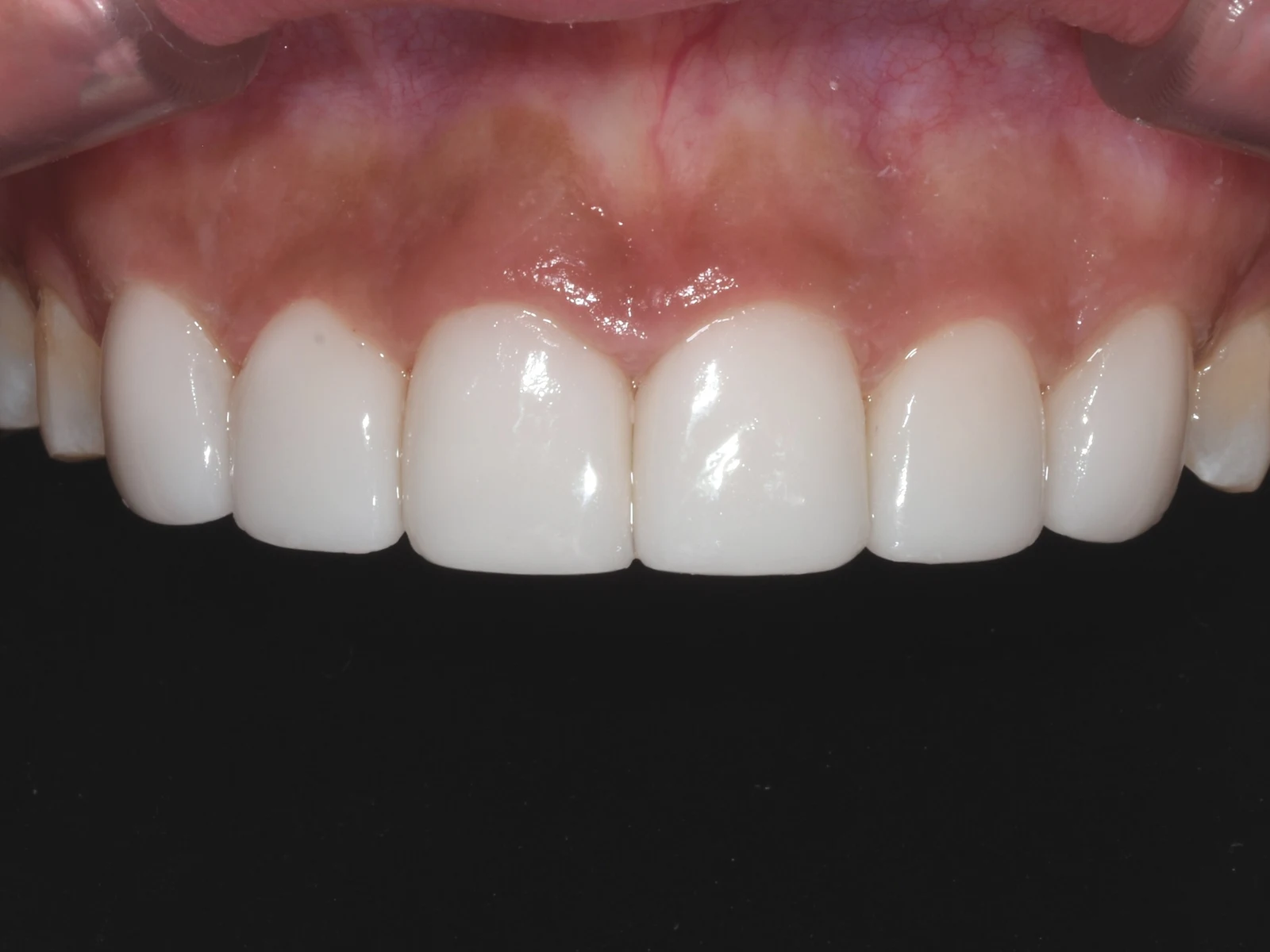
After CERANATE bonding · November 2024
After CERANATE bonding. We set the length of the CERANATE veneers to match the evened gum line.
Condition
Different gum heights and tooth lengths on each front tooth, small lateral incisors (woman in her 20s)
Cause
Gum height
Chosen
Gum contouring on 4 upper front teeth (#12–22), then 8 CERANATE veneers (#14–24)
Duration
2 weeks from the first consultation to the first bonding (gum contouring and tooth preparation on the same day). The patient wanted a design that filled the spaces between the teeth more tightly, so the central incisors were remade and treatment finished in about 7 weeks
Treated by
Dr. Ilseop Ahn
CASE03
Gums covering the teeth, making the front teeth look short and square
Wide gum contouring over the front teeth, then porcelain veneers
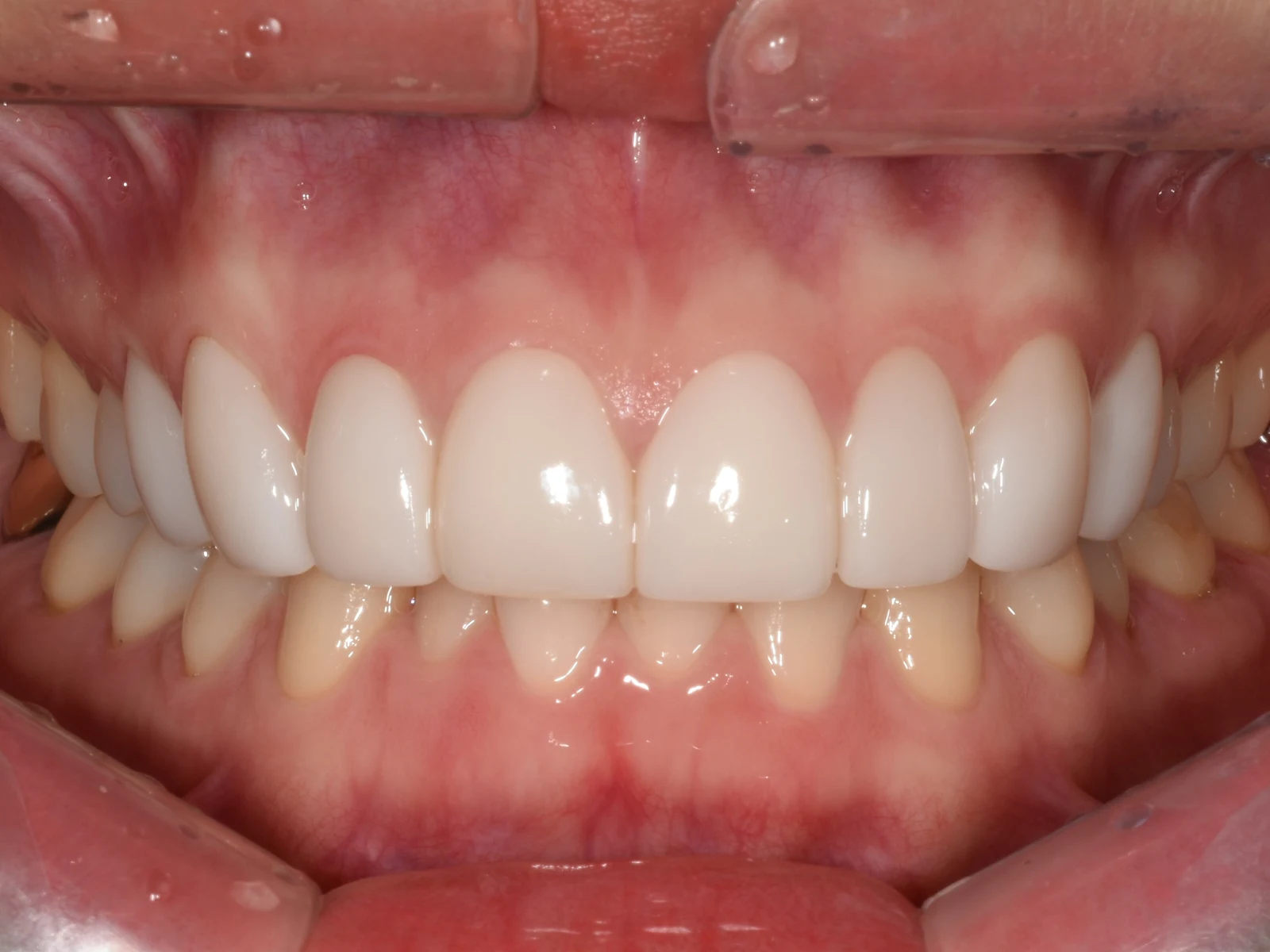
Before · December 2025
Front view inside the mouth before treatment. The gums cover the upper part of the teeth, so the front teeth look short and square.
After · December 2025
Front view inside the mouth after treatment. We reshaped the covering gums to restore tooth length, then bonded CERANATE veneers to match that line.
Condition
Gums widely covering the front teeth, making them look short and square (woman in her 30s)
Cause
Gums and teeth (gums covering the teeth)
Chosen
Gum contouring on the upper front teeth (gums only), then 6 CERANATE veneers (#13–23)
Not done
Orthodontics
Duration
7 days from gum contouring and tooth preparation to bonding
Note
Some gum shows in a big smile. But cutting away too much gum for a gummy smile makes the teeth look long, so both the smile and the tooth proportions need to be checked.
* Photos were taken under the same conditions and published with the patients' consent. Treatment results and side effects may vary from person to person.
02°
A gummy smile has three causes
Two or more causes are common. If gum still shows after trimming only the gums, another cause remains.
01Gums and teeth
The gums cover the upper part of the teeth, so the teeth look short and square. After checking where the bone sits under the gums, we consider gum contouring (crown lengthening: reshaping the gums and, if needed, the bone).
02Tooth position and jaw
The front teeth have come down too far (deep bite) or the upper jaw has grown long vertically. Orthodontics moves the front teeth up. We consider surgery as well only when, given your facial proportions, shortening the lower face is truly necessary.
03Lips
The upper lip rises a lot when you smile, the philtrum (the groove above the upper lip) is short, or the muscle that lifts the upper lip moves too strongly. If the lips are the cause, we tell you so and explain lip repositioning or botulinum toxin (Botox) injection for a gummy smile.
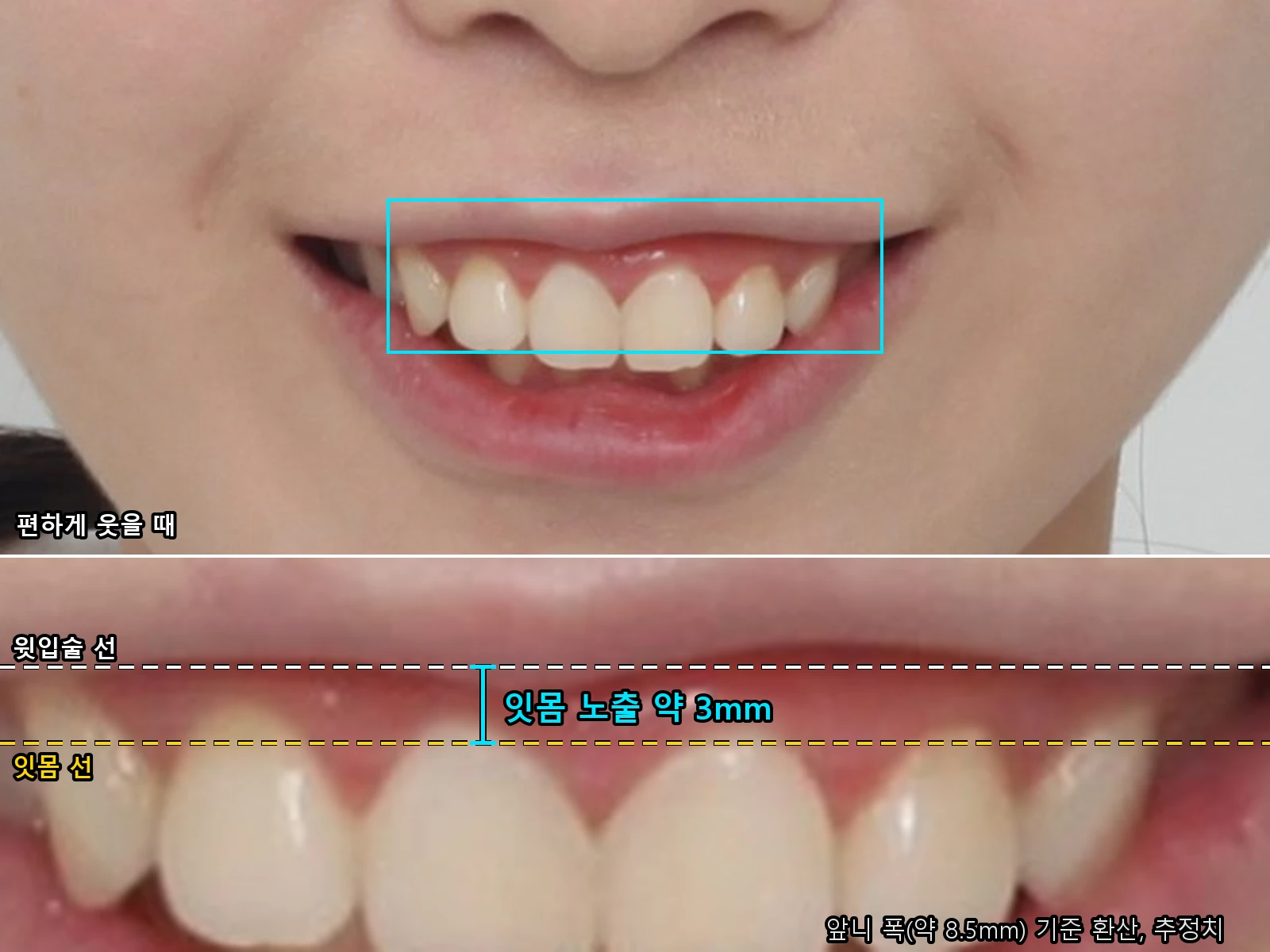
Gum display
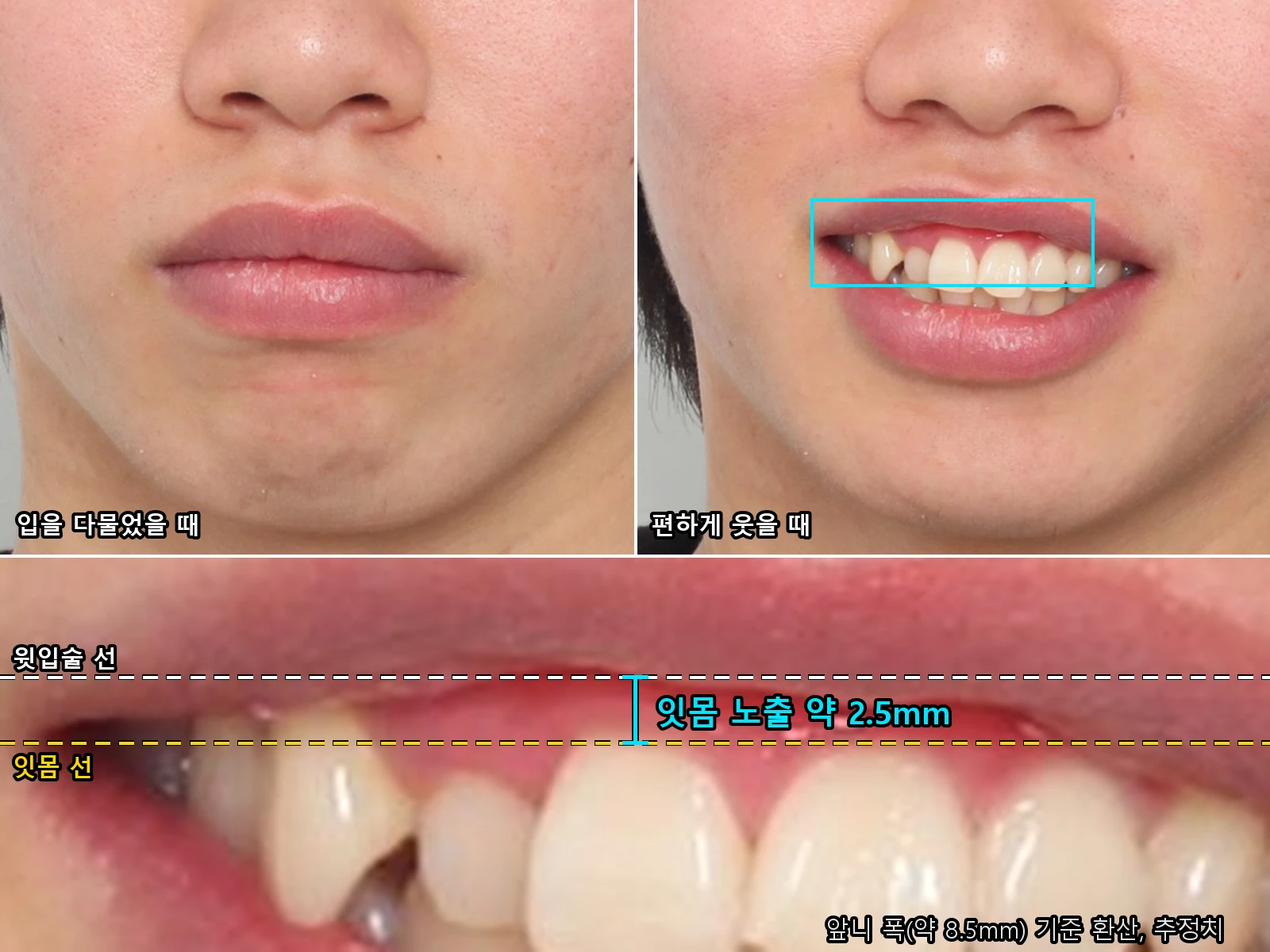
Measuring how much gum shows when smiling. We measure how many millimeters show from the upper lip line to the gum line, in both a relaxed smile and a big smile. The numbers in the photo are estimates converted from the width of the front teeth.
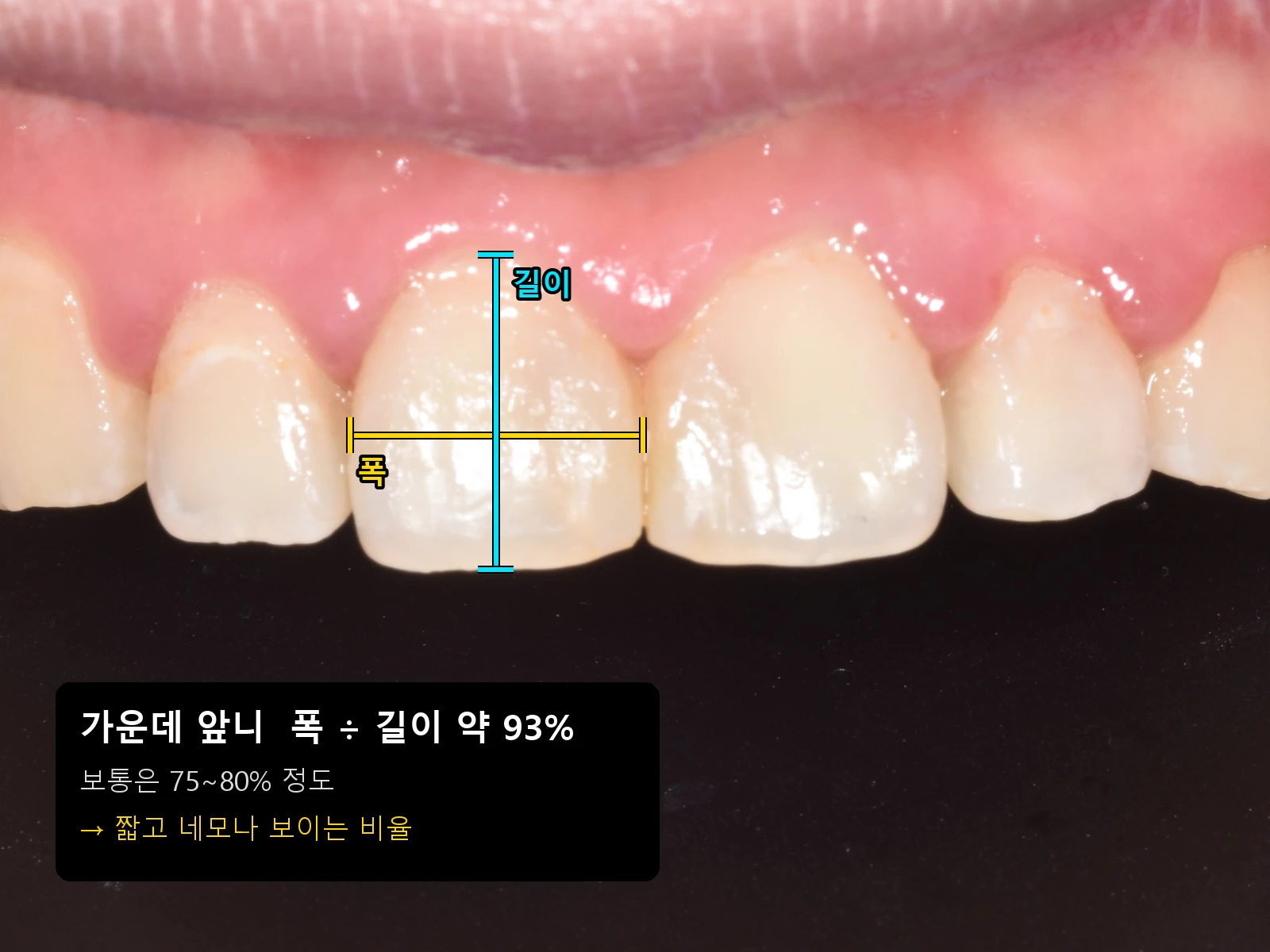
Tooth proportions
Width-to-length ratio of the front teeth. A central incisor is usually about 75–80% as wide as it is long. If it is squarer than this, we consider that the gums may be covering the tooth. The front tooth in the photo is about 93%.
03°
How gummy smile treatment is done
We sort out the causes, set the order and treat. For each step, we explain what we measure and why.
Smile analysis
Smile records. We compare the lips closed and smiling to measure how far the upper lip rises and how much gum shows from the upper lip line to the gum line. The numbers are estimates converted from the width of the front teeth.
STEP 01
We record your smile in photos and video and measure gum display
We take a relaxed smile and a big smile separately to see how many millimeters of upper gum show, how far the upper lip rises, and whether the gum heights differ between left and right.
Why we do thisA single photo cannot show whether lip movement is the cause. If the amount of gum showing changes a lot with how widely you smile, the lips often play a large role.
Gum chart
Panoramic X-ray
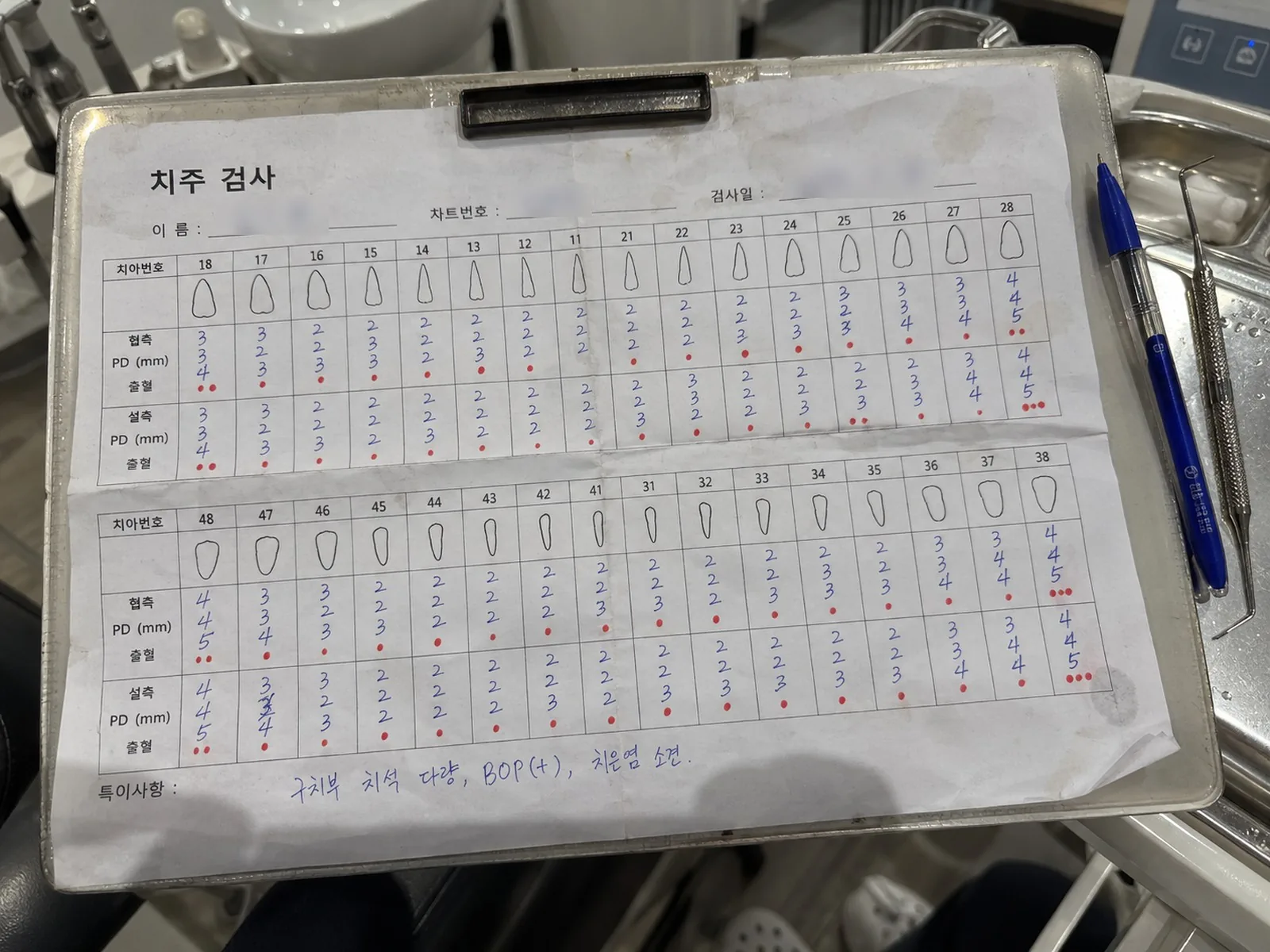
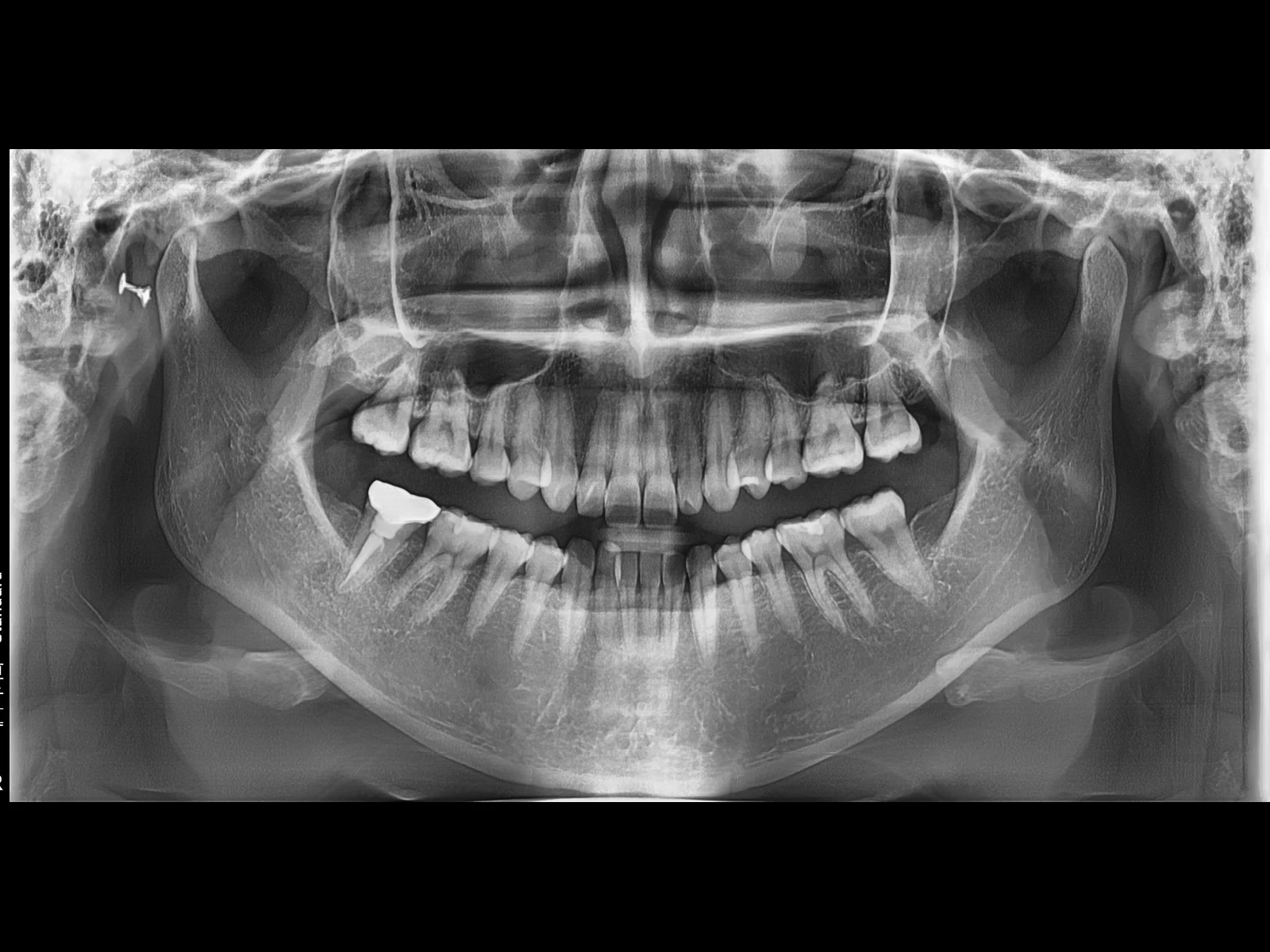
Gum exam and panoramic X-ray. We measure and record the gum depth of each tooth and look at the tooth roots and bone height on a panoramic X-ray. If a closer look is needed, we check the border between tooth and bone with a 3D CT. The two photos are from different patients.
STEP 02
We measure gum depth and check where the bone sits under the gums
Before reshaping the gums, I measure the gum depth and first check where the border between tooth and bone is. There usually needs to be about 3 mm between the gum line and the bone, so if the bone is too close, the bone needs reshaping as well as the gums.
Why we do thisIf the gums are trimmed without checking the bone position, they can grow back to their original height within a few months. Whether gum contouring results last depends on this check.
Front-tooth height
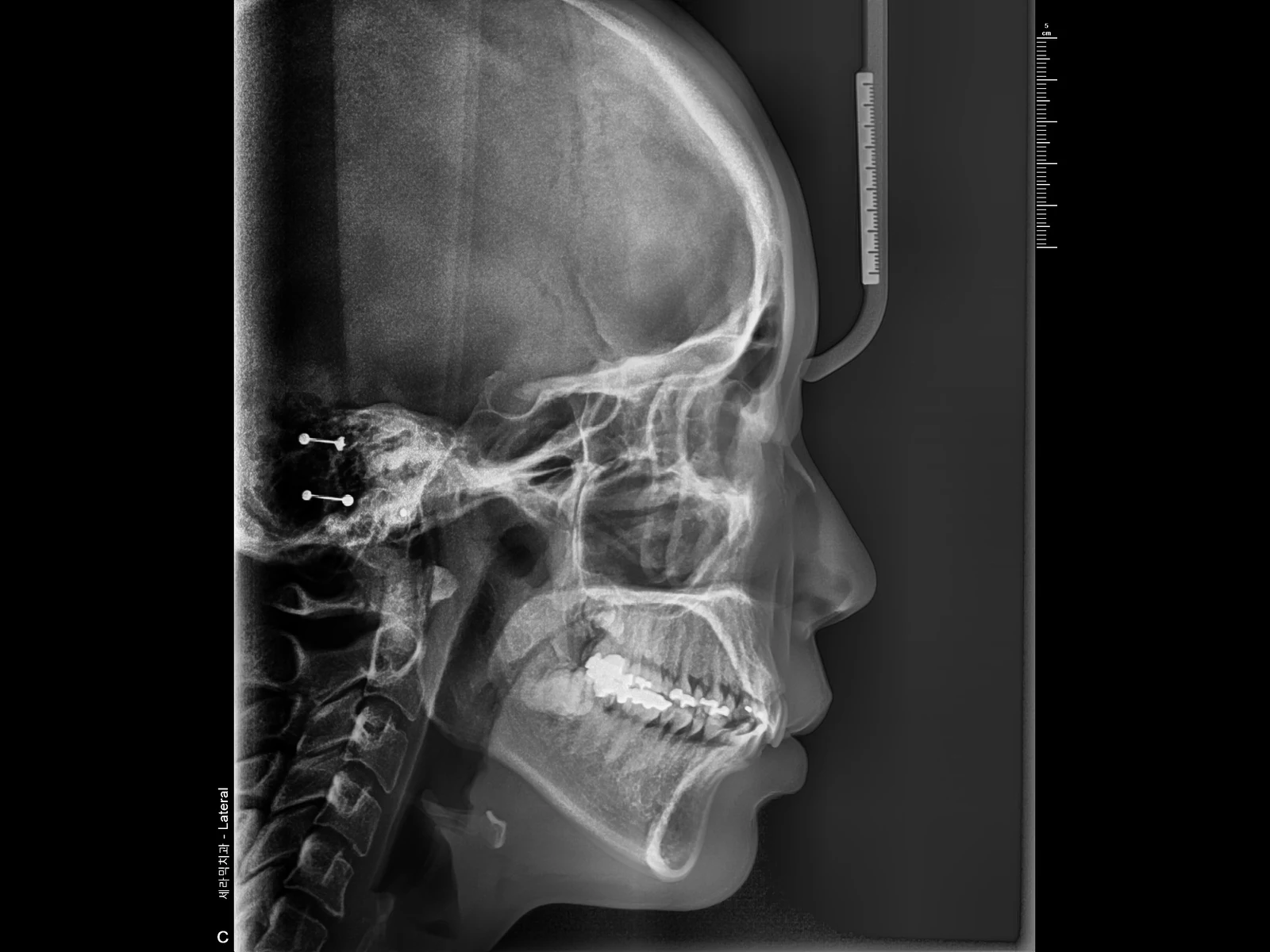
Front-tooth height check by a board-certified orthodontist. A side-view X-ray shows how far the upper front teeth have come down and whether the upper jaw is long vertically.
STEP 03
A board-certified orthodontist checks the height of the front teeth and the length of the upper jaw
Dr. Sunmin Kim (board-certified orthodontist) uses a side-view X-ray to see how far the upper front teeth have come down and whether the upper jaw has grown long vertically. If front-tooth height is the cause, we consider orthodontics that moves the front teeth up with mini-screws.
Why we do thisIf the front teeth have come down but only the gums are reshaped, the tooth roots can be exposed or the teeth can look too long. If tooth position is the cause, moving the teeth up is the right approach.
Before gum contouring
Right after the 1st
Right after the 2nd (7 days later)
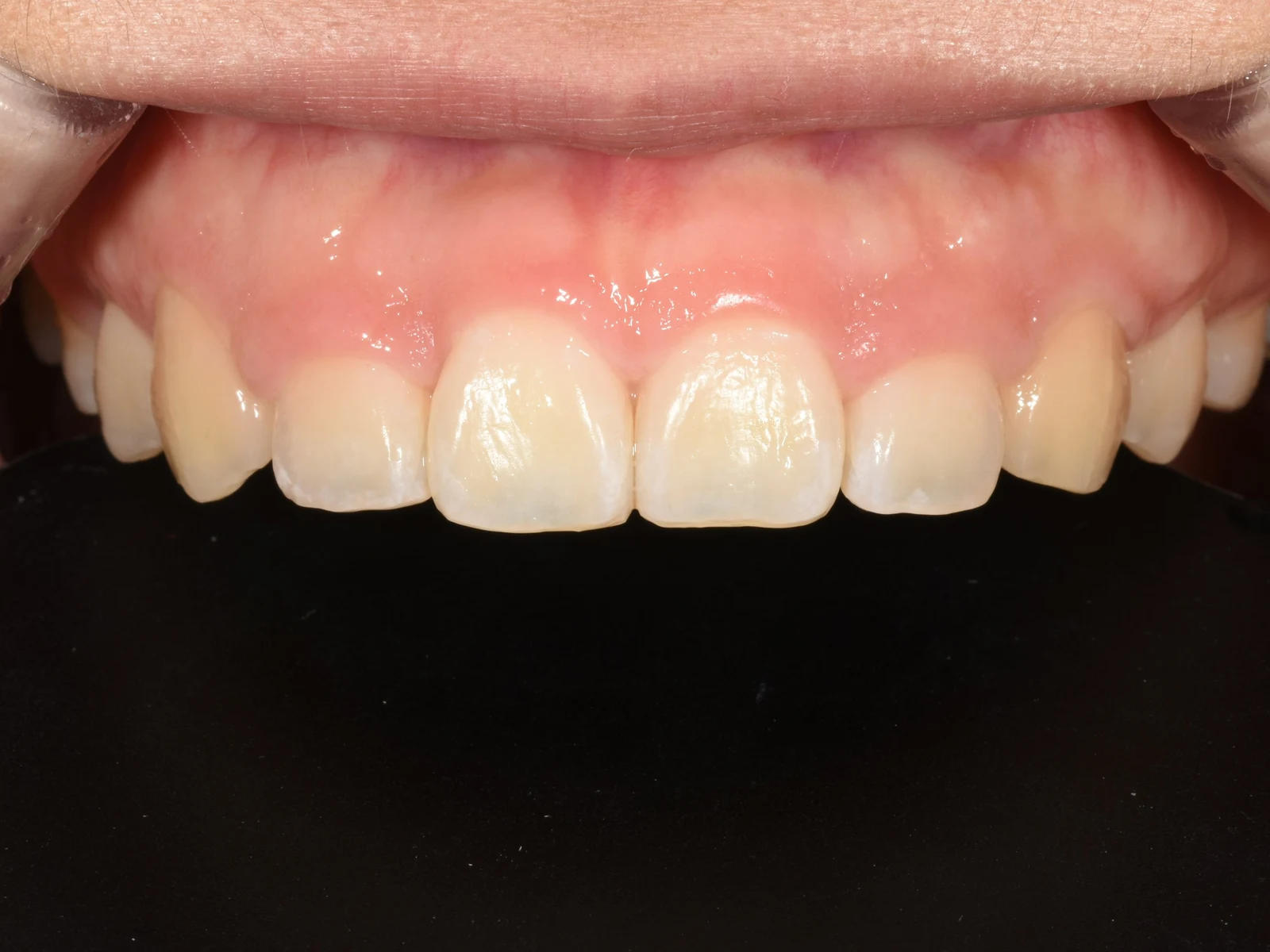
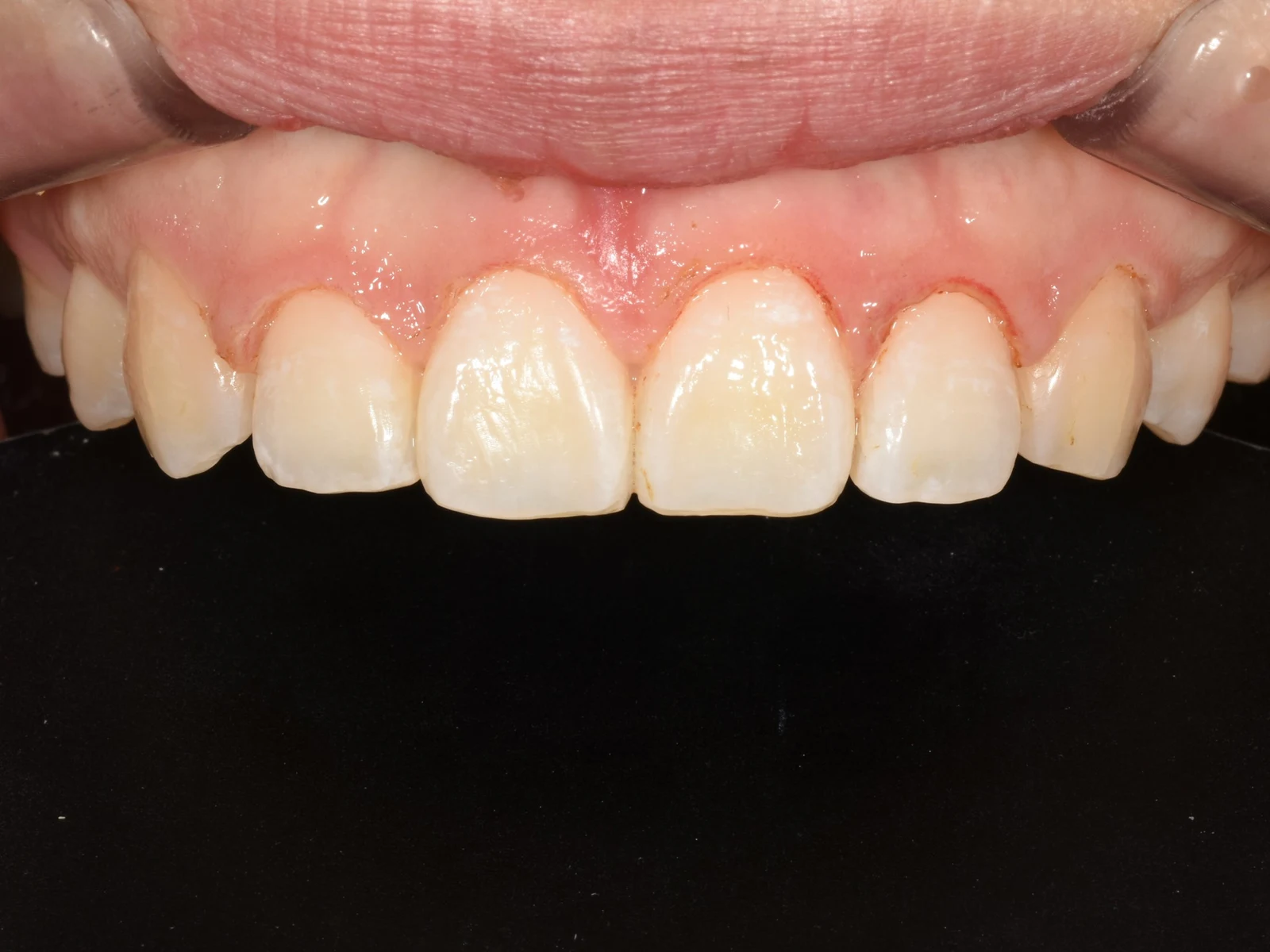
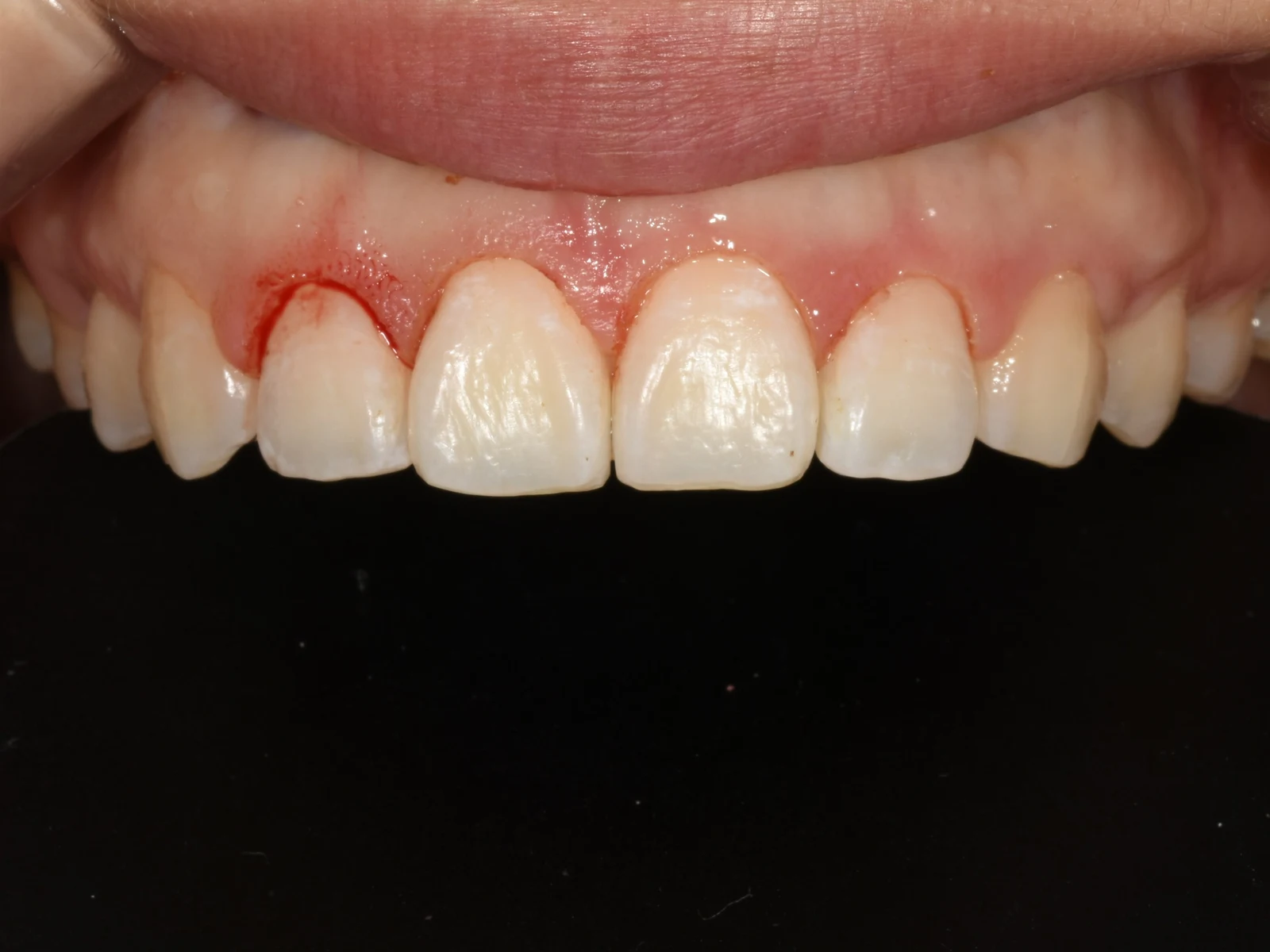
Gum contouring and recovery. Before gum contouring, right after the gums were reshaped, and right after one more touch-up 7 days later. Only the gums were reshaped, so no stitches were placed and none had to be removed.
STEP 04
We treat according to the cause and wait for the gums to settle
If the gums are the cause, we reshape them to the planned gum line. Reshaping the bone is rarely needed. It is done under local anesthesia. When only the gums are reshaped, no stitches are needed, so there are none to remove. The procedure usually takes about 30 minutes, and you can go about daily life the same day. In the rare cases where the bone is also reshaped, the gums are stitched, the stitches are removed 1–2 weeks later, and you wait a little longer before the next treatment.
Why we do thisThe gum line sets the length of the veneers. If veneers are bonded while the gums are still moving, the edge may later show, or the gums may cover the tooth and throw off the length.
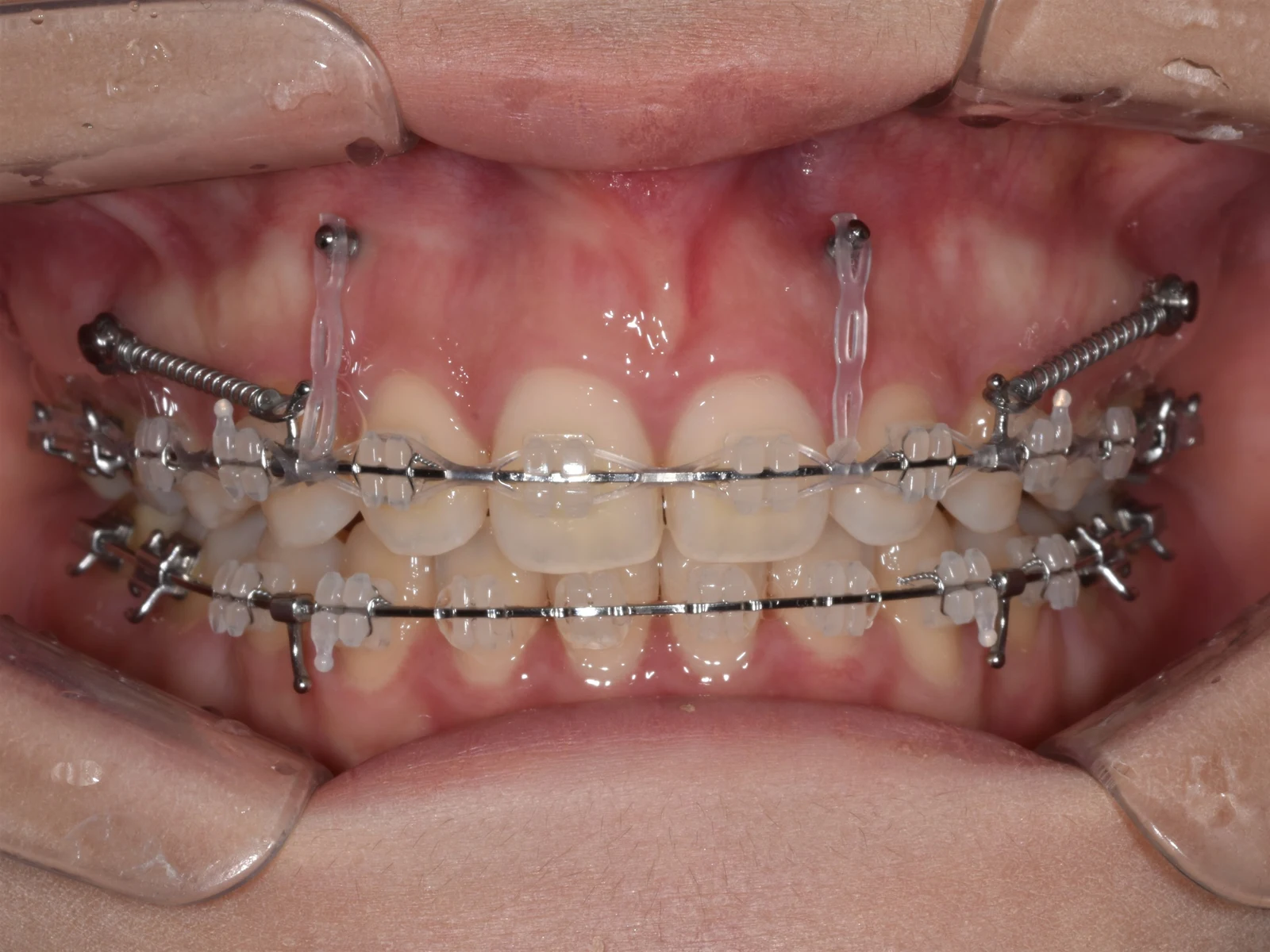
During orthodontics · February 2025
Moving the front teeth up with orthodontics. Mini-screws are placed in the gums on both sides of the front teeth, and clear elastic chains (power chains) hooked on the wire pull the upper front teeth up.
STEP 05
If there are several causes, we set the order and treat them one at a time
If orthodontics is needed, we first set the front-tooth height with orthodontics, then reshape the gum line, and design the veneers last. Looking at the exam screens together, we explain the order and the change you can expect at each step.
Why we do thisWhen orthodontics moves the front teeth up, the gum line moves too. If gum contouring is done first, the gum line may become uneven again after orthodontics, so the order matters.
* Clinical photos were published with the patients' consent. Side effects such as temporary pain or discomfort may occur depending on the person.
04°
Treatments by cause
Gum contouring (crown lengthening)
Orthodontics (moving the front teeth up)
Lip treatment
Jaw surgery (referral)
Suitable causes
Gums covering the teeth
Front teeth that have come down
Upper lip rising a lot
Upper jaw much longer vertically
What it does
Reshapes the covering gums to restore tooth length, and the bone if needed
Moves the front teeth up with mini-screws
Ties the lip and gums together more firmly so the lip rises only a set amount (lip repositioning)
Surgery to reduce the height of the upper jaw
Time and recovery
Same-day procedure. No stitches if only the gums are reshaped. If the bone is also reshaped, stitches are placed and removed 1–2 weeks later
Several months for front-tooth height only; usually 1.5 years or more for full orthodontics
About 1 week
Includes orthodontics before and after surgery
Doctor
Dr. Ilseop Ahn
Dr. Sunmin Kim
Dr. Ilseop Ahn
Oral and maxillofacial surgery (we can recommend a partner hospital, but you may choose another)
Limits
Without checking the bone, the gums can grow back
Cannot change the length of the jaw itself
The effect may be temporary or may wear off
Surgery requires general anesthesia and a hospital stay
In these cases, other treatment comes first, or you may not need treatment
Good for you if
Your gums cover your front teeth, making them look short and square
Your left and right gum heights differ, so your teeth look different in length
Your front teeth have come down with a deep bite and a lot of gum shows
Other treatment comes first
Gum inflammation: gum treatment first
If orthodontics is planned: the gum line is finalized after orthodontics
If you are getting porcelain veneers: the gum line is set first, then the veneers are designed
You may not need it now
1–3 mm of gum showing in a relaxed smile can be within the range of a natural smile. What looks natural is judged differently depending on age.
06°
Self-check
We look at the items that apply to you when we sort out the causes in the consultation.
07°
Side effects and limits
Please read
· You may have swelling and pain for a few days after gum contouring.
· The root side of the teeth exposed by reshaping the gums may feel sensitive.
· Some of the gum may grow back. That is why we check the bone position first before planning.
· If there are several causes, one treatment will not be enough.
· Moving the front teeth up with orthodontics can shorten the roots, and a mini-screw can loosen and need to be placed again.
FAQ
FAQ
Can a gummy smile be fixed just by trimming the gums?
Gum contouring solves a gummy smile only when the cause is gums covering the teeth. If the front teeth have come down or the upper lip rises a lot, trimming the gums alone will still leave your gums showing when you smile.
Can orthodontics reduce a gummy smile?
If the cause is upper front teeth that have come down too far, orthodontics that moves the front teeth up with mini-screws can reduce it. We have a case where a patient with a deep bite and a lot of gum display was treated with about 2 years of orthodontics, without surgery.
Do the gums grow back down after gum contouring?
If the gums are trimmed without enough distance between the gum line and the bone below, the gums can grow back and cover the teeth again. So we first measure gum depth and bone position, and reshape the bone too if needed.
Does gum contouring hurt? How long do I need to rest?
Gum contouring is done under local anesthesia, so there is usually little pain during the procedure. You may have swelling and pain for a few days. If needed, prescribed painkillers can help, and when only the gums are reshaped, most people can go about daily life the same day.
Do I need porcelain veneers along with gummy smile treatment?
We add porcelain veneers when you also want to change the shape or color of your teeth after the gum line is reshaped. The gums come first. Once the gums are stable, we set the veneer length to match that line.
Can a gummy smile be treated with Botox?
Yes. Botulinum toxin (Botox) injection weakens the muscle that pulls the upper lip up when you smile, so less gum shows. The effect fades over time, so injections need to be repeated. If the cause is in the gums or jawbone, we look at other treatments as well.
When more than about 3–4 mm of the upper gums shows in a relaxed smile, it is called a gummy smile. But whether it bothers you and whether the two sides differ matter more than the number, so we look at both in the consultation.
Can I come from abroad and finish gummy smile treatment in one trip?
Yes. Most cases only need the gums reshaped, so porcelain veneers can also be finished in a short stay. Reshaping the bone is rarely needed. Only then do the gums need time to settle, and the schedule may be split.
Questions from patients who travel to Seoul for treatment.
How much does CERANATE cost?
CERANATE is KRW 550,000–770,000 per tooth including VAT, depending on the material and fabrication method. International and Korean patients pay the same fees. During promotional events, the same discounted price applies to everyone; ask us on WhatsApp about current events. The tax refund for foreign medical tourists has ended in Korea, so no refund applies. The number of teeth is decided at diagnosis, so we tell you the total after the examination. See our fee schedule.
How many visits do I need, and how long should I stay in Korea?
CERANATE One-Day takes 2 visits over 1–2 days. The Art and The Petit take 2 visits over about 1 week. If orthodontics, whitening or gum treatment comes first, that time is added. If gum contouring is done first, the gums need time to heal, so the schedule depends on how they heal. We suggest leaving 1–2 spare days after the final bonding before your flight. The check-up about 2 weeks after bonding can be done by photo on WhatsApp, and we see you in person on your next visit to Korea.
Can I have my consultation in English?
Yes. The doctor in charge of your treatment consults with you directly in English. Before you travel, you can send photos of your teeth on WhatsApp or by email. An accurate diagnosis is made after we examine you in person.
What if a veneer chips or comes off after I go home?
Send us a photo on WhatsApp first. If a veneer comes off, keep it. We check it and tell you what to do. Repairing or remaking a veneer needs a visit. How breakage is handled, and what it costs, depends on the CERANATE option, and we explain this before treatment.
Results, the number of visits and schedules vary from person to person. More questions: Visiting from abroad.


 Before · April 2021
 After · October 2026
 Before · October 2024
 Right after gum contouring · October 2024
 After CERANATE bonding · November 2024
 Before · December 2025
 After · December 2025
 Gum display
 Tooth proportions
 Smile analysis
 Gum chart
 Panoramic X-ray
 Front-tooth height
 Before gum contouring
 Right after the 1st
 Right after the 2nd (7 days later)
 During orthodontics · February 2025