Last reviewed October 29, 2026 · Dr. Ilseop Ahn (board-certified periodontist and board-certified specialist in advanced general dentistry)
At a glance
Good for
The gum between your teeth is missing, leaving a dark triangular gap
Treatment flow
Find the cause (gums, tooth shape, root direction) → Choose treatment that fits the cause
Duration and limits
Depending on the cause, the treatment differs: orthodontics, veneers or resin, or gum treatment. Causes are often mixed
Details
A black triangle is a dark triangular gap that forms when the gum between the teeth (interdental papilla) does not fill the space up to the point where the teeth touch. There are three causes: the gums and bone have receded, the teeth are triangle-shaped and narrow toward the gums, or the tooth roots angle away from each other. One study found them between the upper central front teeth in about 38% of adult orthodontic patients. Depending on the cause, we align the root direction with orthodontics, change the tooth shape with veneers or resin to move the contact point toward the gums, or treat the gums first. Causes are often mixed, so a board-certified periodontist and a board-certified orthodontist examine you together.
01°
The same dark gap was filled differently depending on the cause
Treatment differs depending on whether the cause is tooth shape, gum height or root direction. These real cases show typical examples.
CASE01
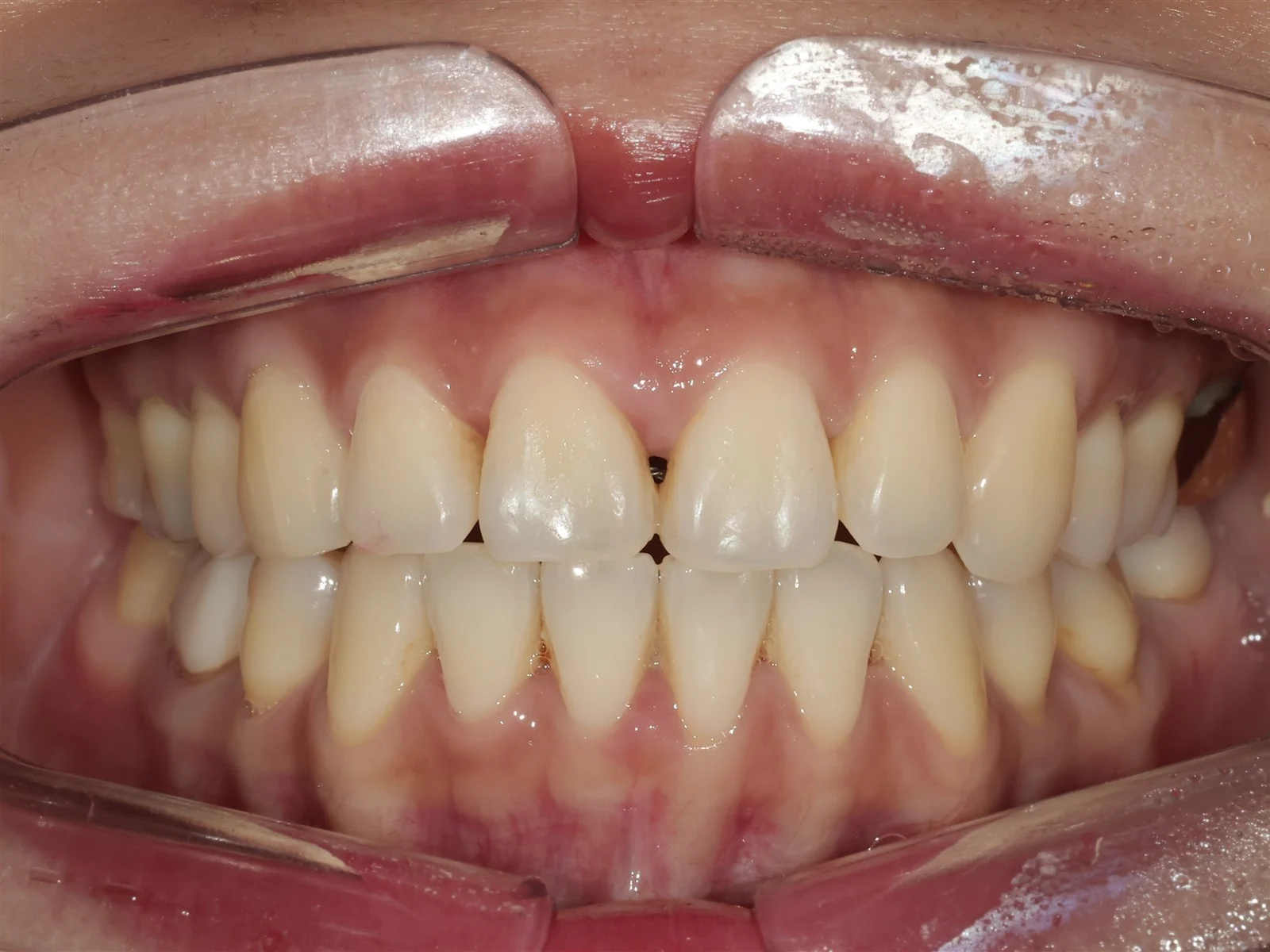
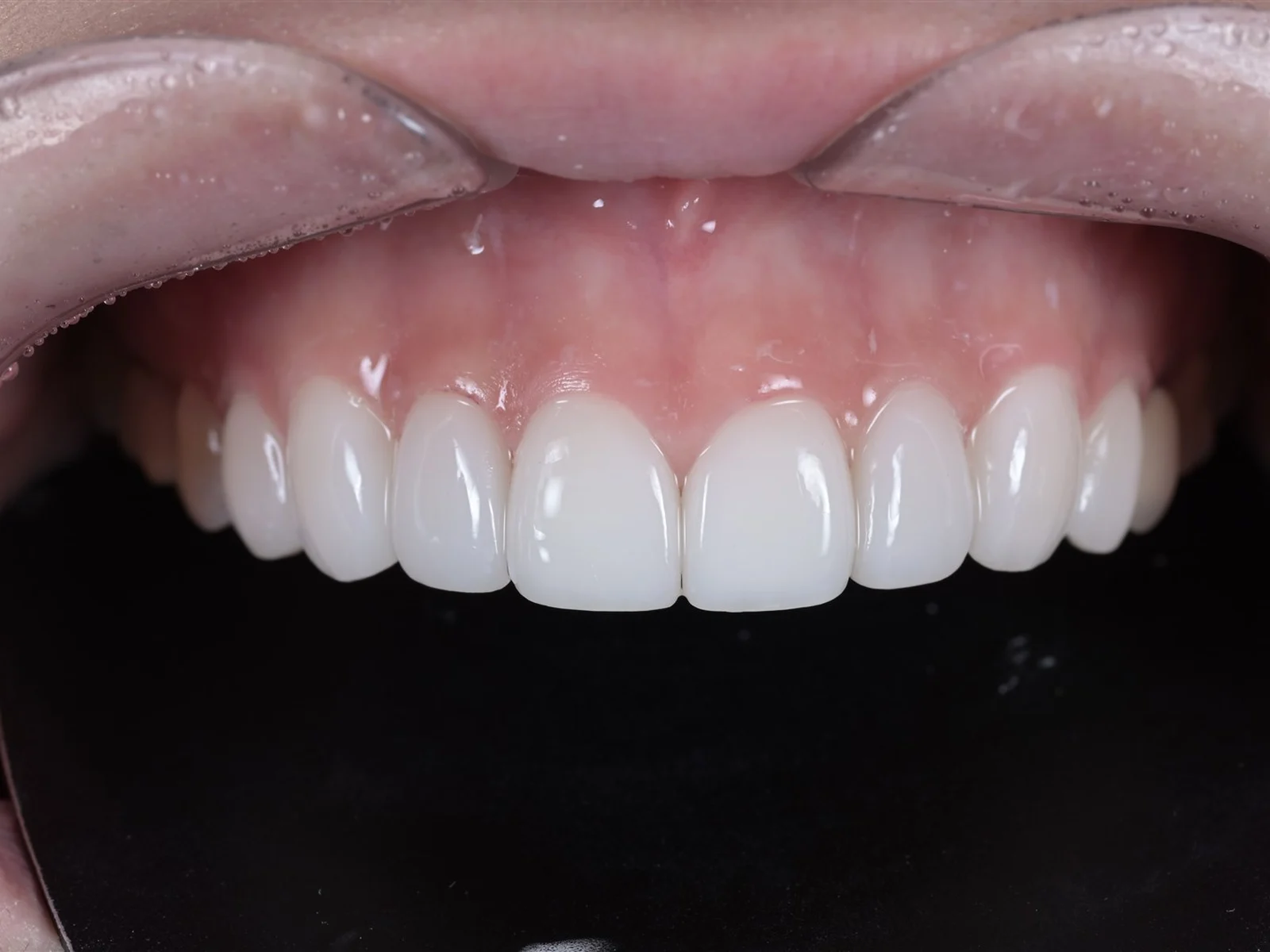
Black triangles that remained after two rounds of orthodontics
8 upper CERANATE veneers instead of a third round of orthodontics · Contact points moved toward the gums and front-teeth proportions changed
Before · May 2026
Before. There was a dark triangular gap below the gum between the upper central front teeth, and the retainer wire behind the front teeth was visible through it. The front teeth looked short and wide.
2-week checkup after treatment · May 2026
After. CERANATE veneers were placed on 8 teeth, from the first premolar to the first premolar on the other side, to move the contact points toward the gums and to match the length-to-width proportions and canine length.
Condition
Black triangle between the central front teeth remaining after two rounds of orthodontics, short and wide front teeth, a bite where the front teeth do not touch, worn and short right canine (woman in her 30s)
Causes
Tooth shape (triangle narrowing toward the gums) was a major factor
Chosen
8 upper CERANATE veneers (#14–#24, e.max), changes to length-to-width proportions and color, bite adjustment
Not done
A third round of orthodontics
Shaving
5 teeth: 0.2mm or less without anesthesia; left canine: about 0.7mm to fit the design (local anesthesia)
Duration
Prepared on the day of consultation, placed the next day (2 visits over 2 days)
CASE02
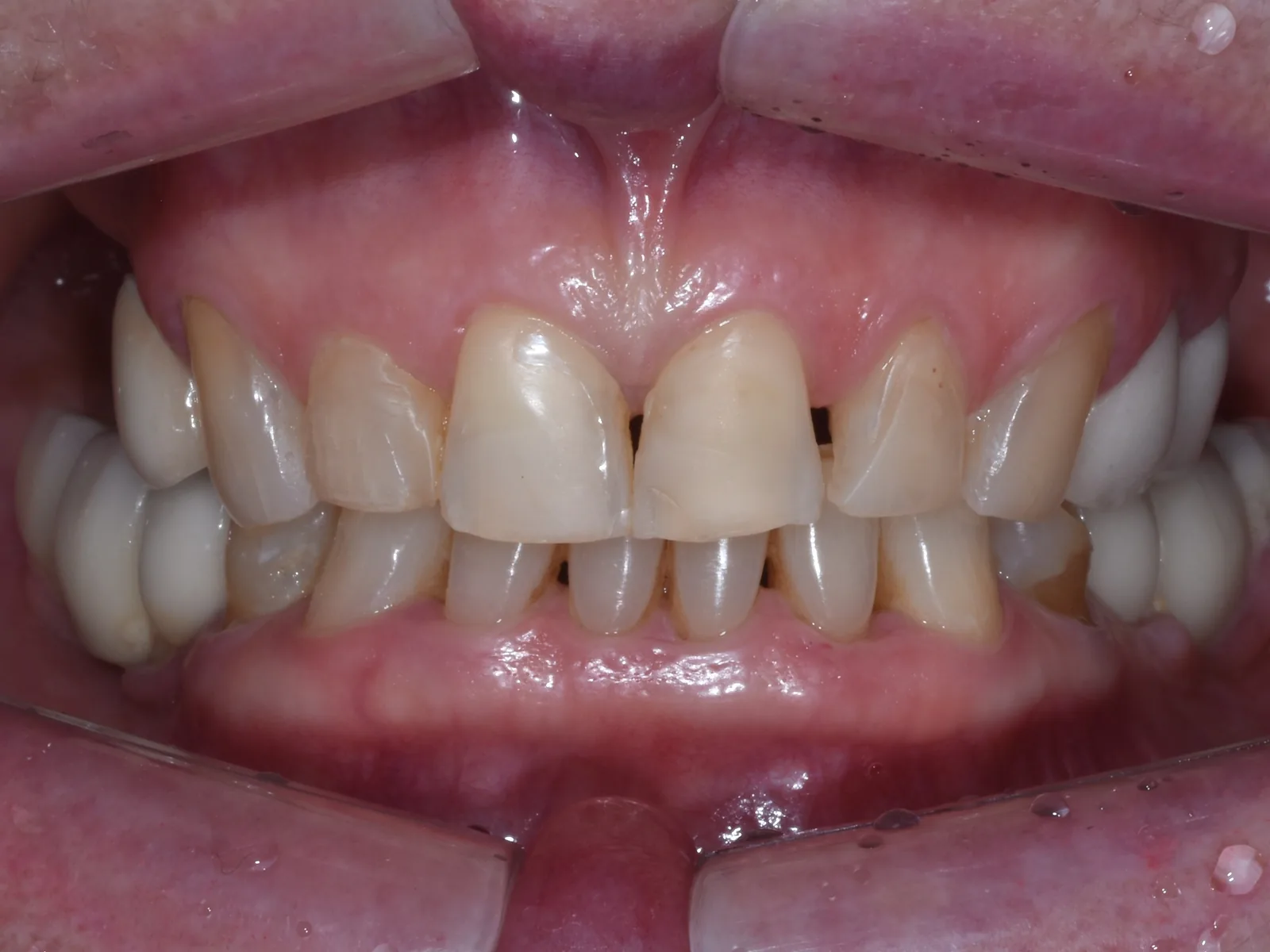
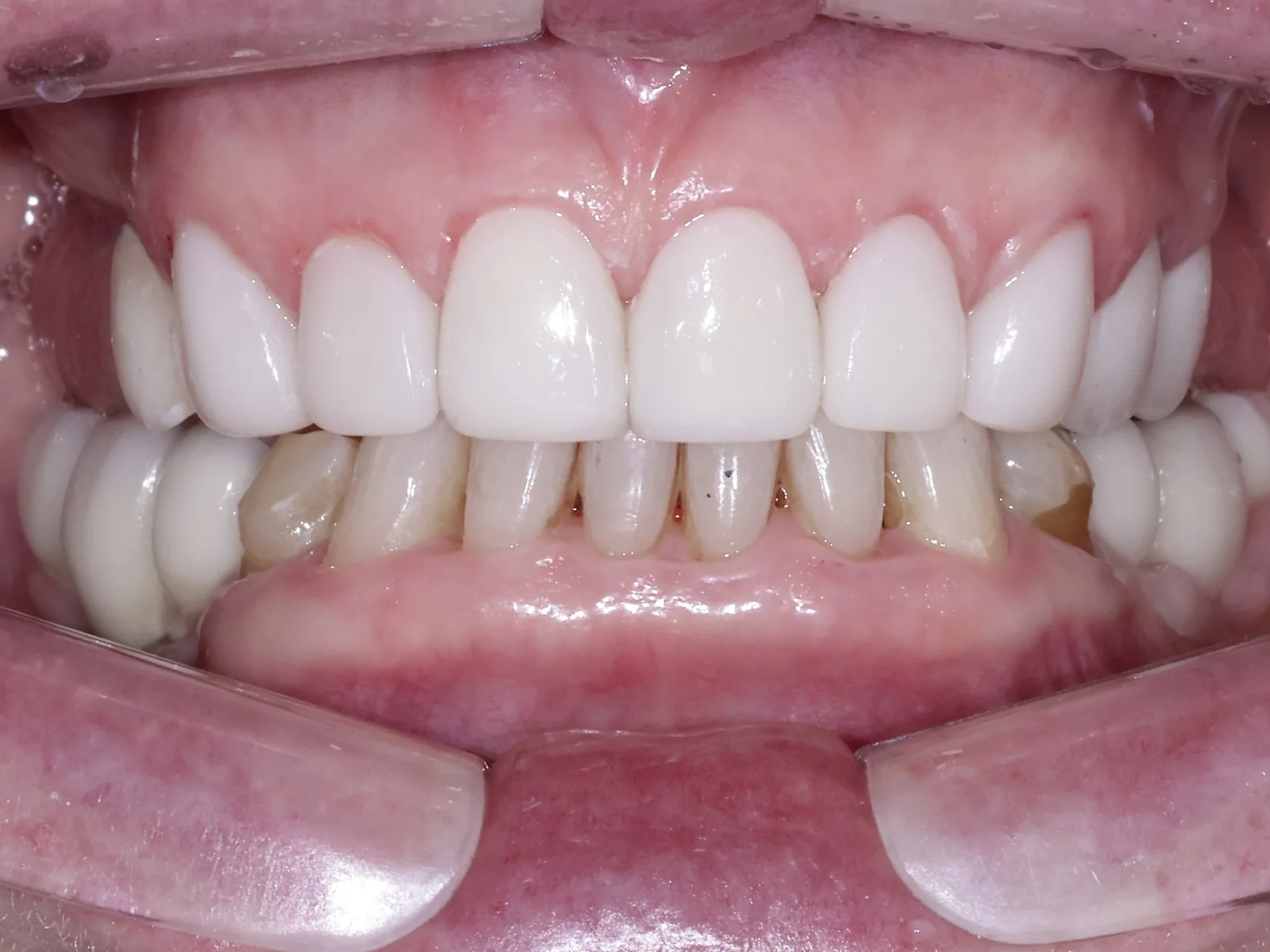
Black triangles and gaps with uneven gum heights in a patient in her 70s
Gum contouring on 4 front teeth first, then 6 CERANATE veneers from canine to canine
Before · Jan 2026
Before. There is a dark gap between the central front teeth and an open gap on the left, and the gum height differs from tooth to tooth.
After · Jan 2026
After. We first evened out the gum heights, then designed the CERANATE veneers using tooth width-to-length proportions to reduce the gaps and matched them to the color of the existing crowns.
Condition
Two large central front teeth, a small and worn right side tooth, a black triangle in the center, a gap on the left, uneven gum heights, old resin that did not match in color (woman in her 70s, living abroad)
Chosen
Gum contouring on 4 upper front teeth, then 6 CERANATE veneers (canine to canine), bite adjustment
Not done
Filling the gaps just by widening the teeth (the front teeth would have looked too wide)
Duration
17 days from the first visit to final placement, 3 or more visits
Treated by
Dr. Ilseop Ahn (board-certified periodontist and board-certified specialist in advanced general dentistry)
CASE03
A dark gap between the central front teeth caused by a tilted front tooth (tooth axis)
Instead of filling it with veneers, orthodontics straightened the tooth axis and closed the gap
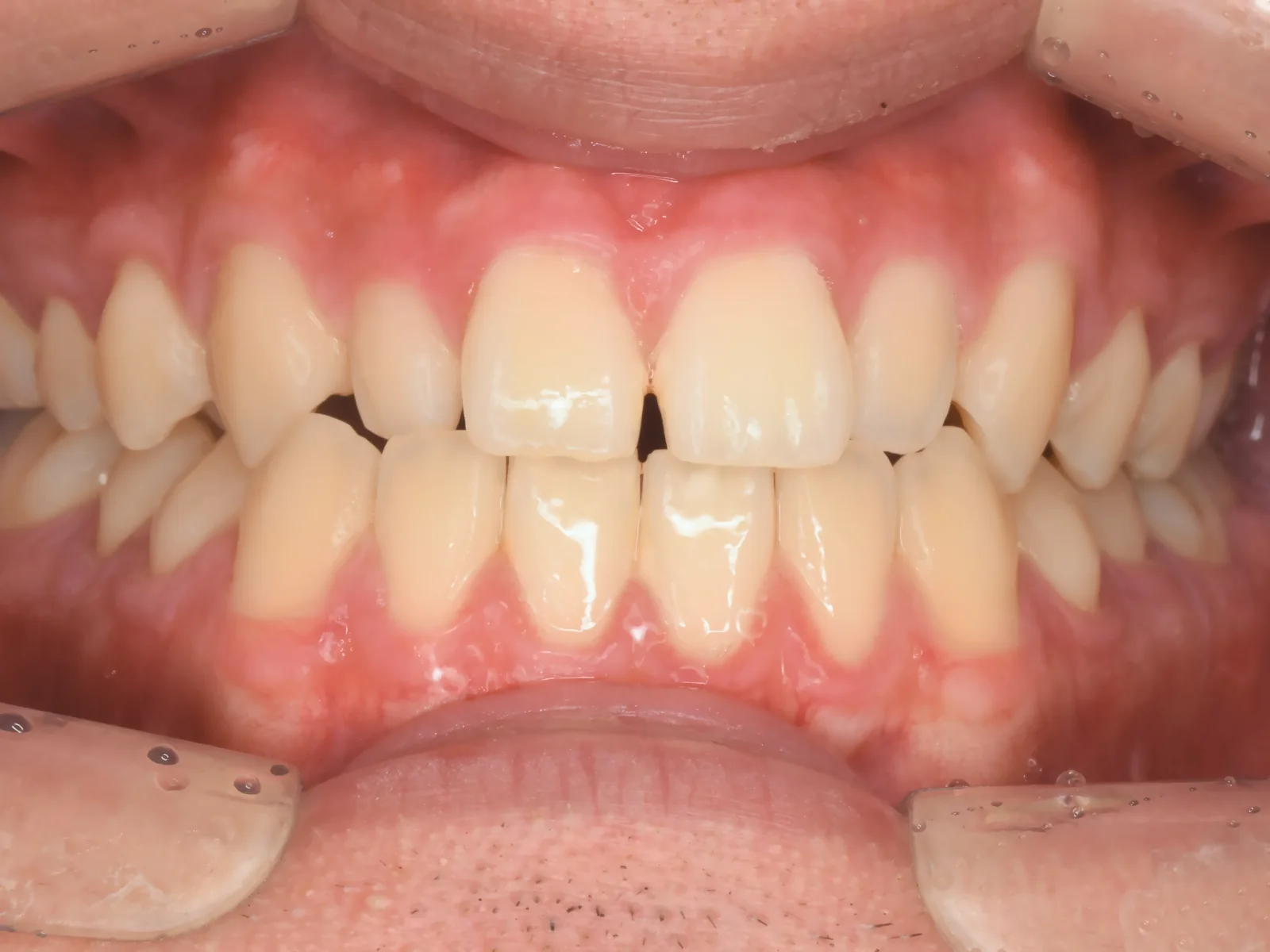
Before orthodontics · Dec 2022
Before orthodontics. The axis (the direction a tooth stands) of the right central front tooth was tilted, leaving a dark gap and a small space between the central front teeth.
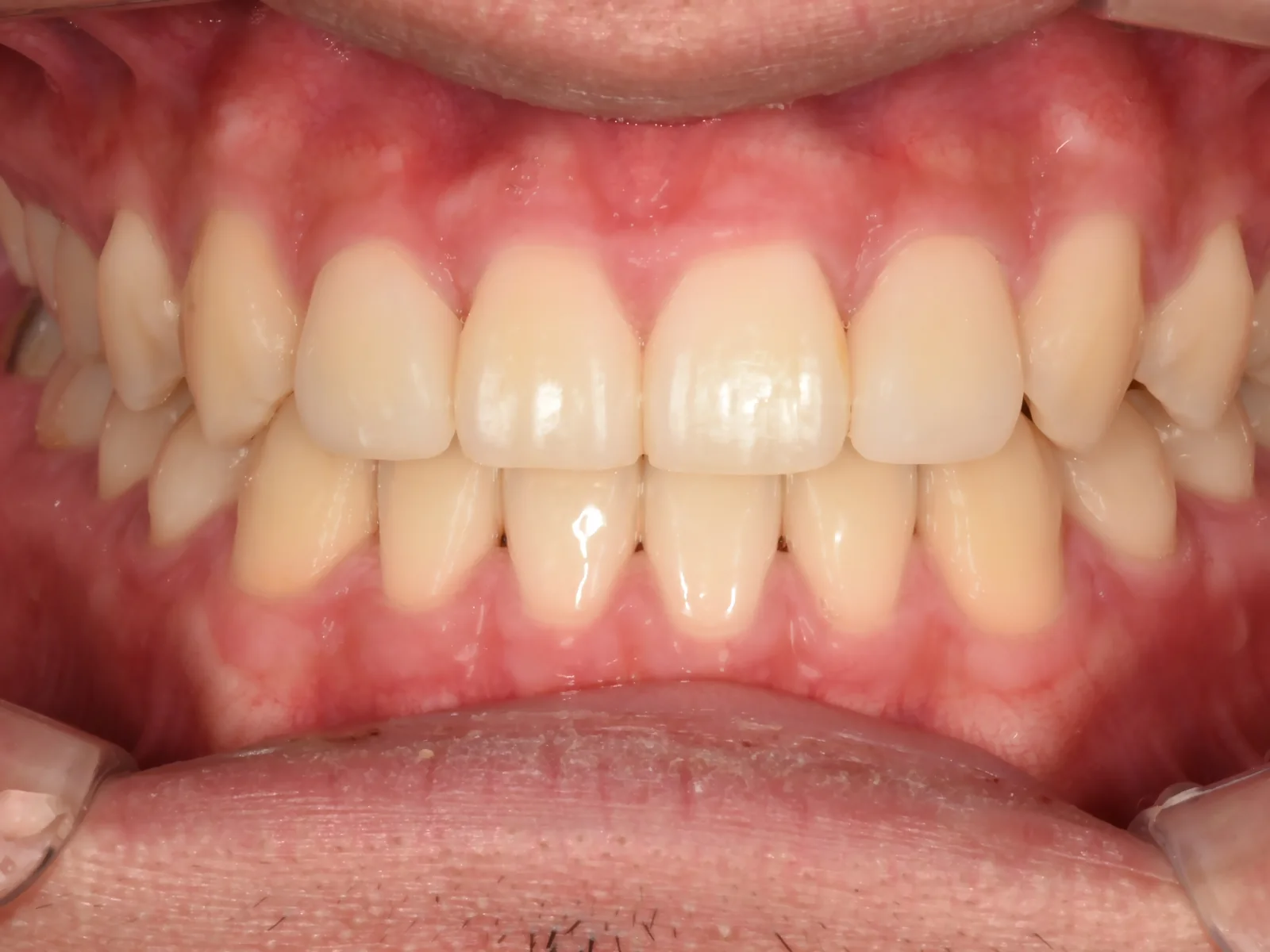
After orthodontics · Jun 2024
After orthodontics. Once the tooth axis and space were corrected, the gap between the central front teeth was filled by gum. No veneers were placed on the central front teeth; only the two small side teeth received separate CERANATE veneers.
Condition
Dark gap and small space between the central front teeth, tilted axis of the right central front tooth, small side teeth (man in his 20s)
Causes
Tooth tilt (tooth axis)
Chosen
Orthodontics to correct the axis of #11 and the space; CERANATE veneers only on the small side teeth #12 and #22
Not done
Filling the gap by widening the central front teeth with veneers or resin
Duration
Orthodontics about 1.5 years (before photo Dec 2022, orthodontics finished Jun 2024)
Treated by
Orthodontics by Dr. Sunmin Kim (board-certified orthodontist)
* Photos were taken under the same conditions and published with the patients' consent. Treatment results and side effects may vary from person to person.
02°
Why do black triangles appear? There are three causes
Many people have two or three causes at once. Treatment differs depending on which one plays the bigger role.
01Gums and bone have receded
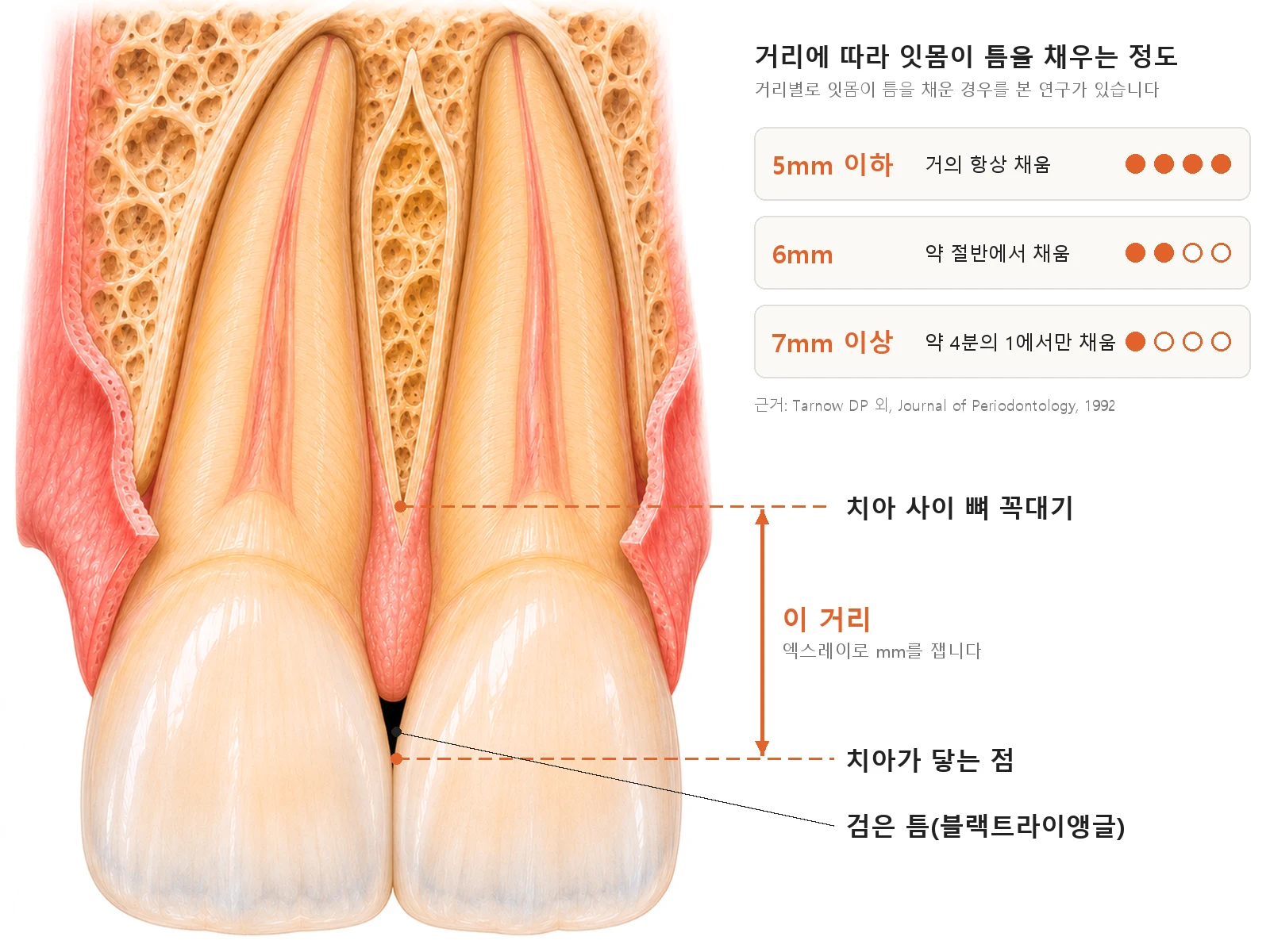
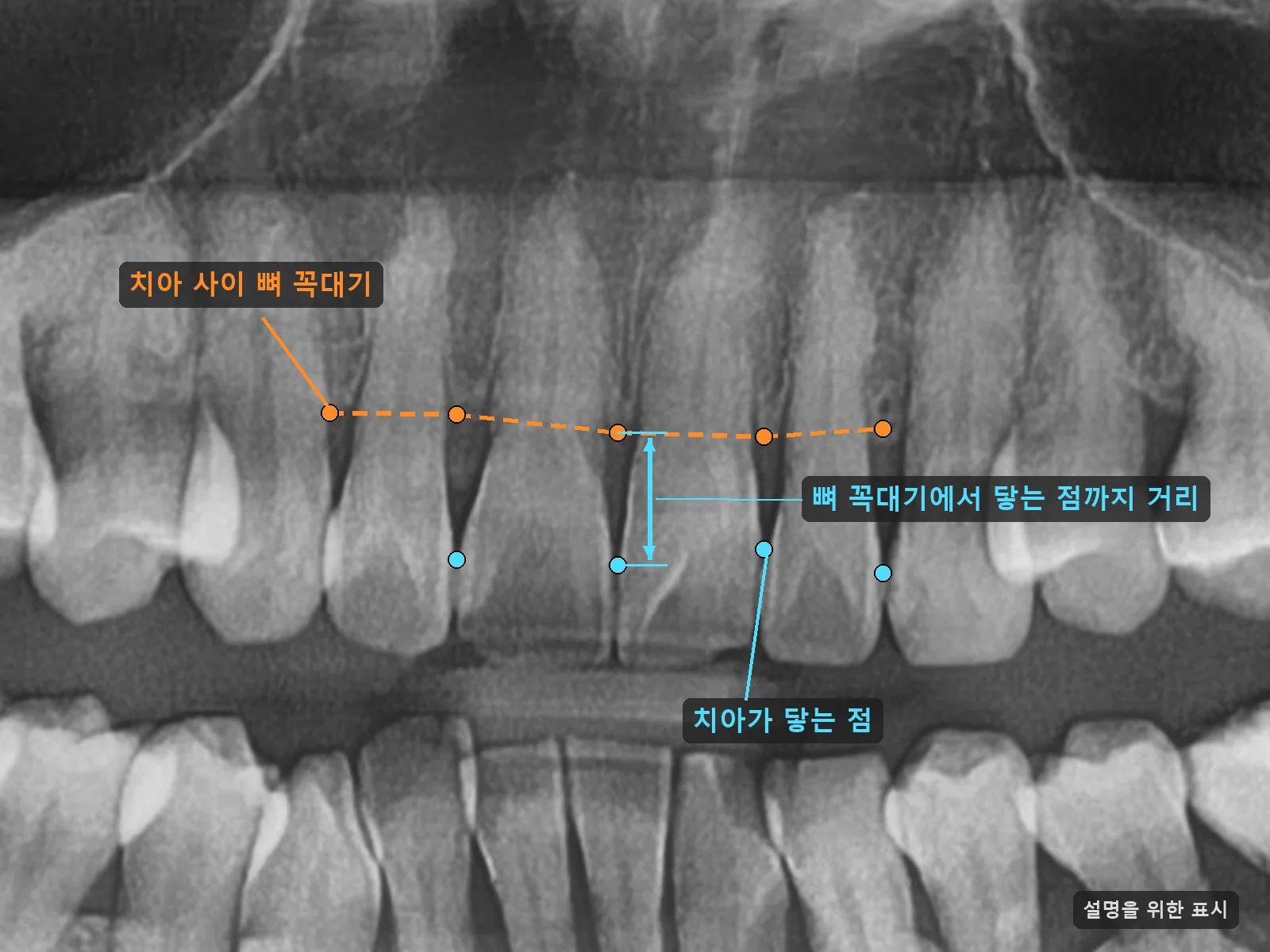
This is when the gum between the teeth and the bone beneath it have receded because of gum disease, age or brushing too hard. Studies show that when the distance from the top of the bone between the teeth to the contact point is 5mm or less, the gum almost always fills the gap; at 6mm it fills about half the time; and at 7mm or more, only about a quarter of the time.
02Tooth shape
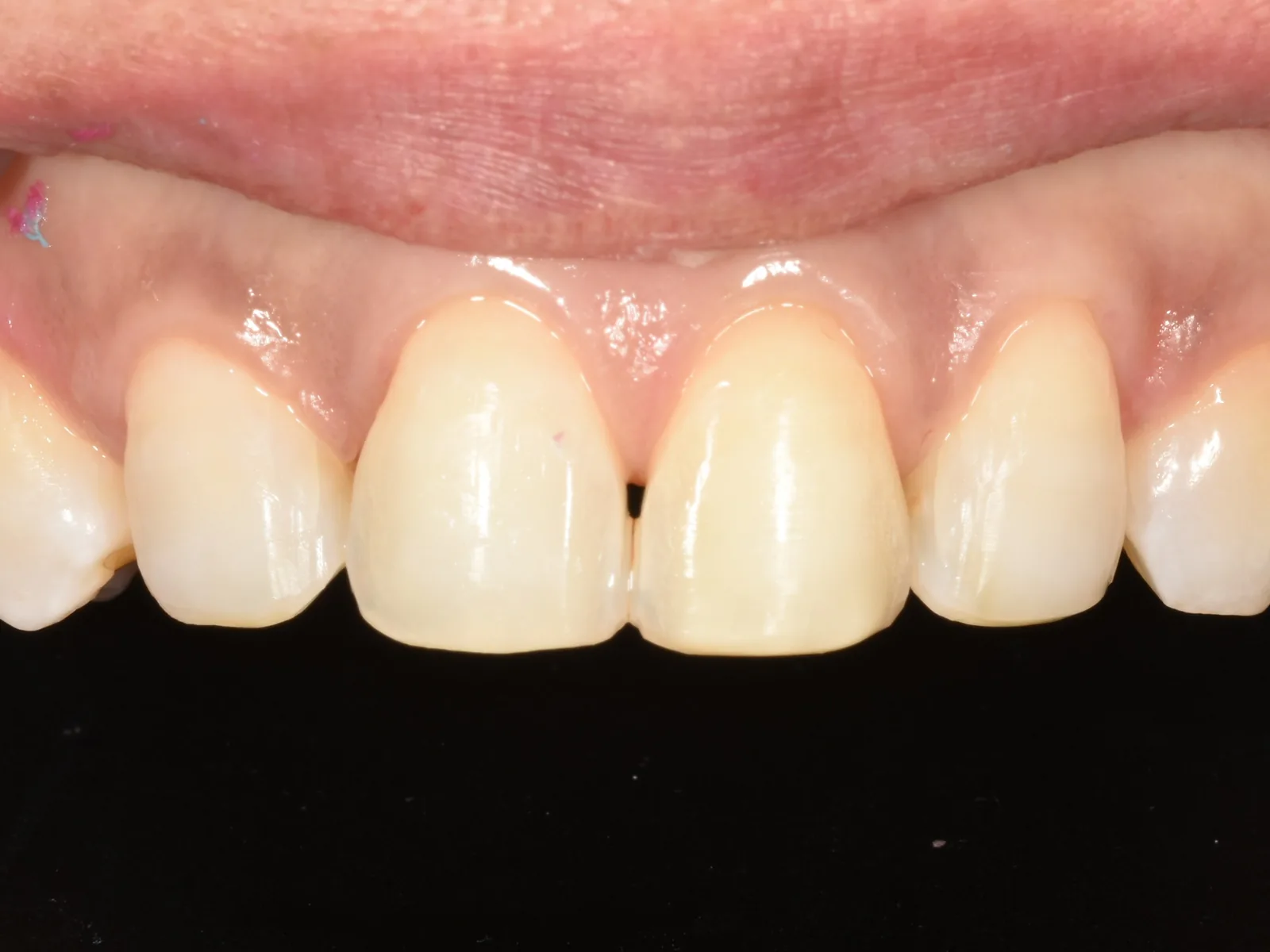
This is when the tooth is wide at the top and narrows toward the gum like a triangle, so the contact point sits high, near the tooth edge. The distance between the contact point and the bone becomes larger, and the gum cannot fill all of it.
03Tooth position and root direction
This is when the teeth are spaced apart or the roots angle away from each other. When overlapping front teeth are straightened with orthodontics, hidden gaps can also be revealed.
04Mixed causes
Black triangles that appear after orthodontics are often caused by both tooth shape and root direction, and those that appear with age often involve a mix of gums and bone with tooth shape.
Measuring distance
The distance from the top of the bone between the teeth to the contact point. The longer this distance, the harder it is for the gum to fill the gap.
Triangle-shaped teeth
Triangle-shaped front teeth narrowing toward the gums. The contact point sits high, near the tooth edge, so a dark gap forms below it.
03°
How black triangle treatment works
We separate the causes, decide the order, and then fill the gaps. We explain what we look at in each step and why.
Bone height
Checking the bone height between the teeth. On the X-ray, we look at the distance (blue arrow) between the top of the bone between the teeth (orange dotted line) and the point where the teeth touch (blue dot). The markings were added for explanation on a panoramic X-ray of a different patient with black triangles.
STEP 01
We first measure gum inflammation and the bone height between the teeth
We check gum pocket depth and bleeding, and use X-rays (and a 3D CT if needed) to see where the top of the bone between the teeth is. The number of mm from the top of the bone to the contact point becomes the basis for deciding further treatment.
Why we do thisIf gum disease is progressing, the gums keep receding even after the gap is filled, and the gap comes back. Only after calming the inflammation and knowing the bone height can we decide how much can be filled.
Shape and root direction
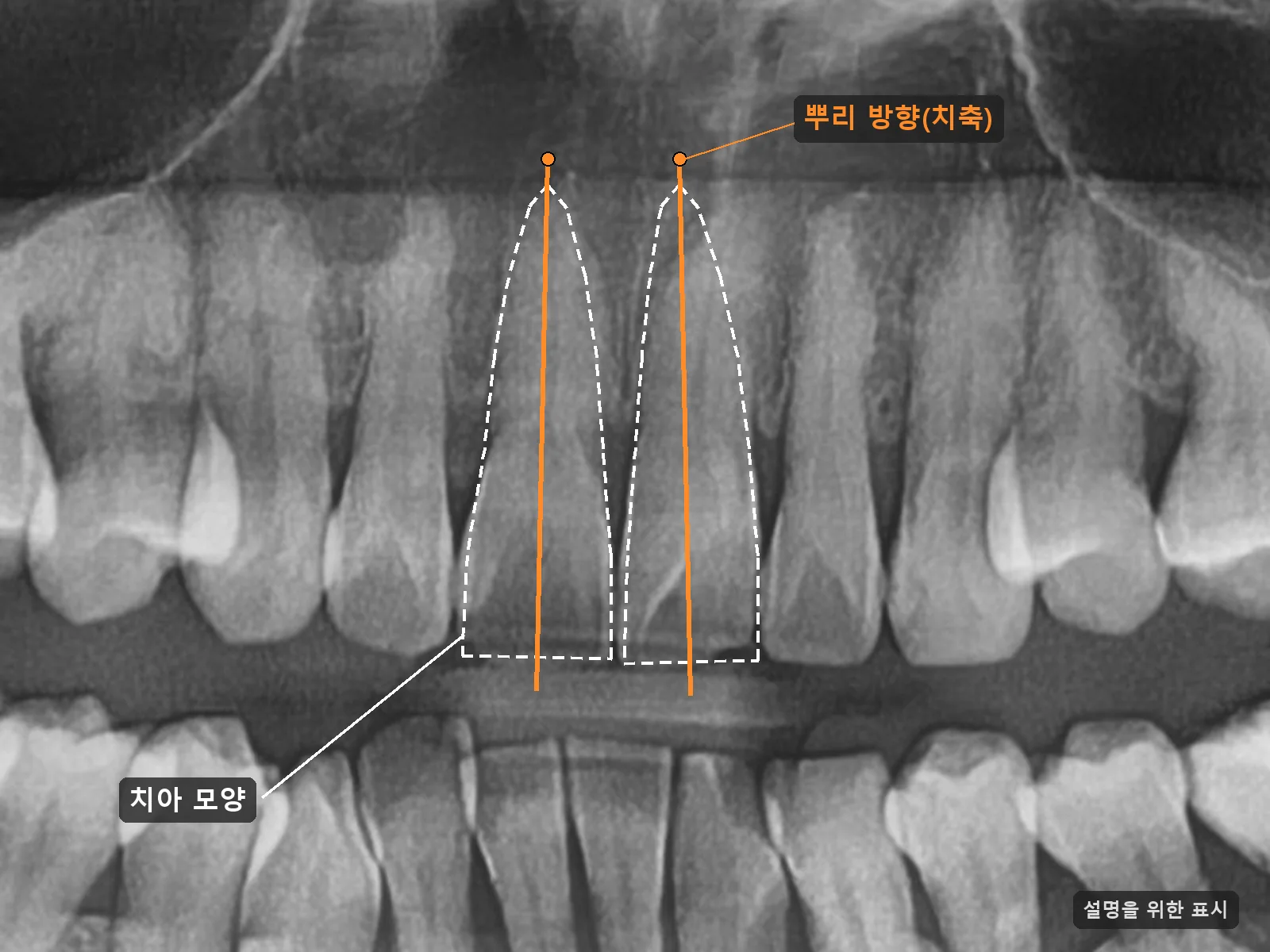
Checking tooth shape and root direction. On the same X-ray, we look at the shape (white dotted line) and root direction (orange line) of the central front teeth. The markings were drawn for explanation.
STEP 02
An orthodontist checks tooth shape and root direction
Dr. Sunmin Kim (board-certified orthodontist) uses X-rays and scan models to check whether the teeth are triangle-shaped, whether the roots angle away from each other, and whether the teeth are spaced apart. If root direction is the cause, we tell you whether orthodontics can change it and how long it would take.
Why we do thisIf spread roots are the cause and the gap is filled only with veneers, the teeth look wide. Standing the roots parallel lets the contact point move down naturally, so less filling is needed.
STEP 03
The two specialists decide the order together
We set an order, such as gum treatment → orthodontics → veneers, and tell you our estimate of how much the gap will shrink at each step. Some people need only one treatment, and others need two or three.
Why we do thisIf the order is changed, some work may have to be redone. Veneers placed before orthodontics stop fitting once the teeth move, and designing before the gum height is set leads to the wrong length.
Planning
After placement
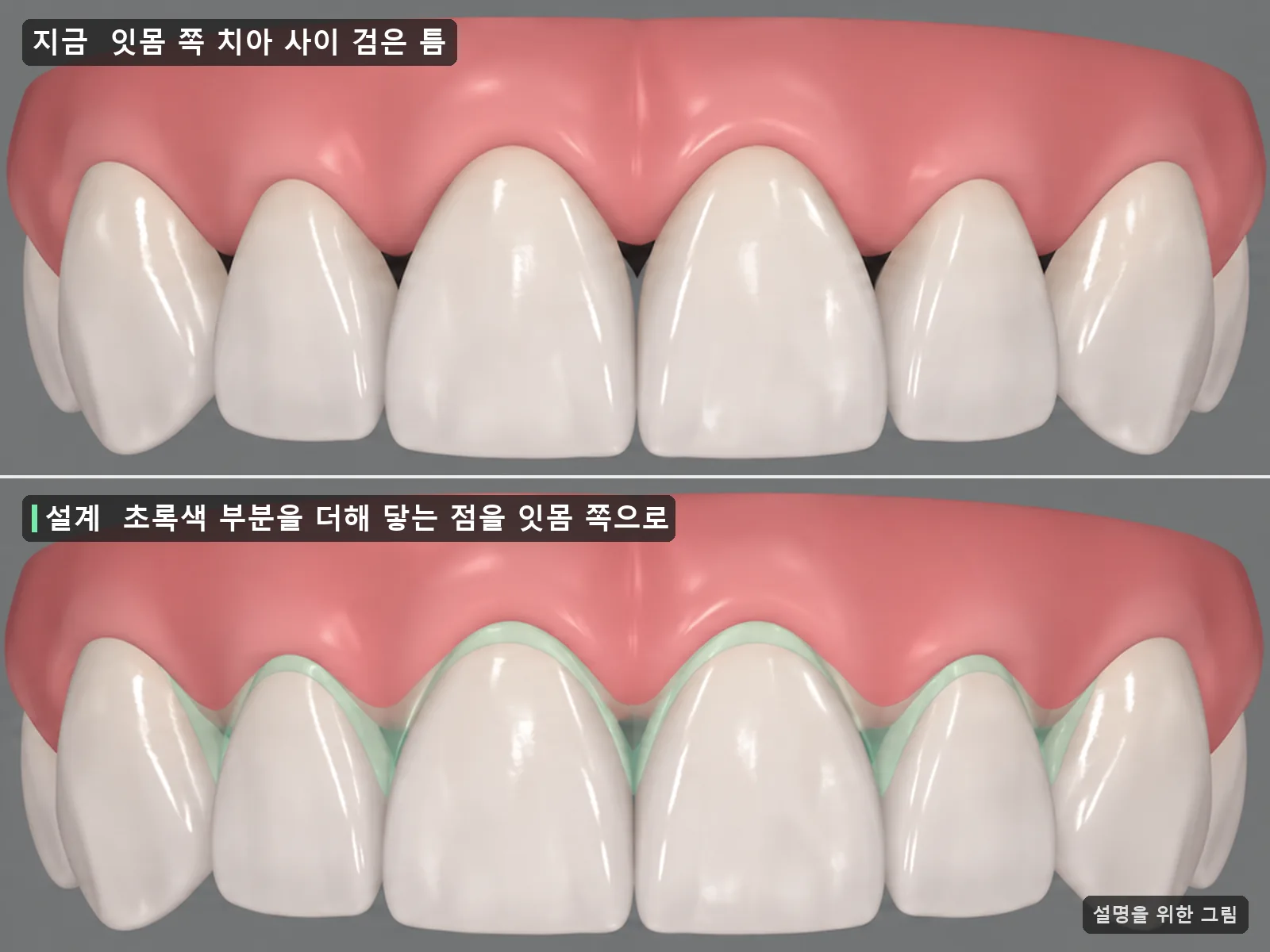
Veneer design and placement. The side shape of the teeth is changed to move the contact point toward the gums, while keeping the width-to-length proportions from becoming too wide.
STEP 04
We change the side shape of the teeth to lower the contact point
Widening the sides of the teeth slightly toward the gums with veneers or resin moves the contact point down and makes the dark gap smaller. We design while checking the width-to-length proportions of the central front teeth, and spread the change across neighboring teeth instead of widening just one tooth.
Why we do thisIf teeth are widened just by looking at the gap, the front teeth look square and wide. It looks natural only when the gum height is set first and the gap is filled within a range that keeps the width-to-length proportions.
Gum height and margins
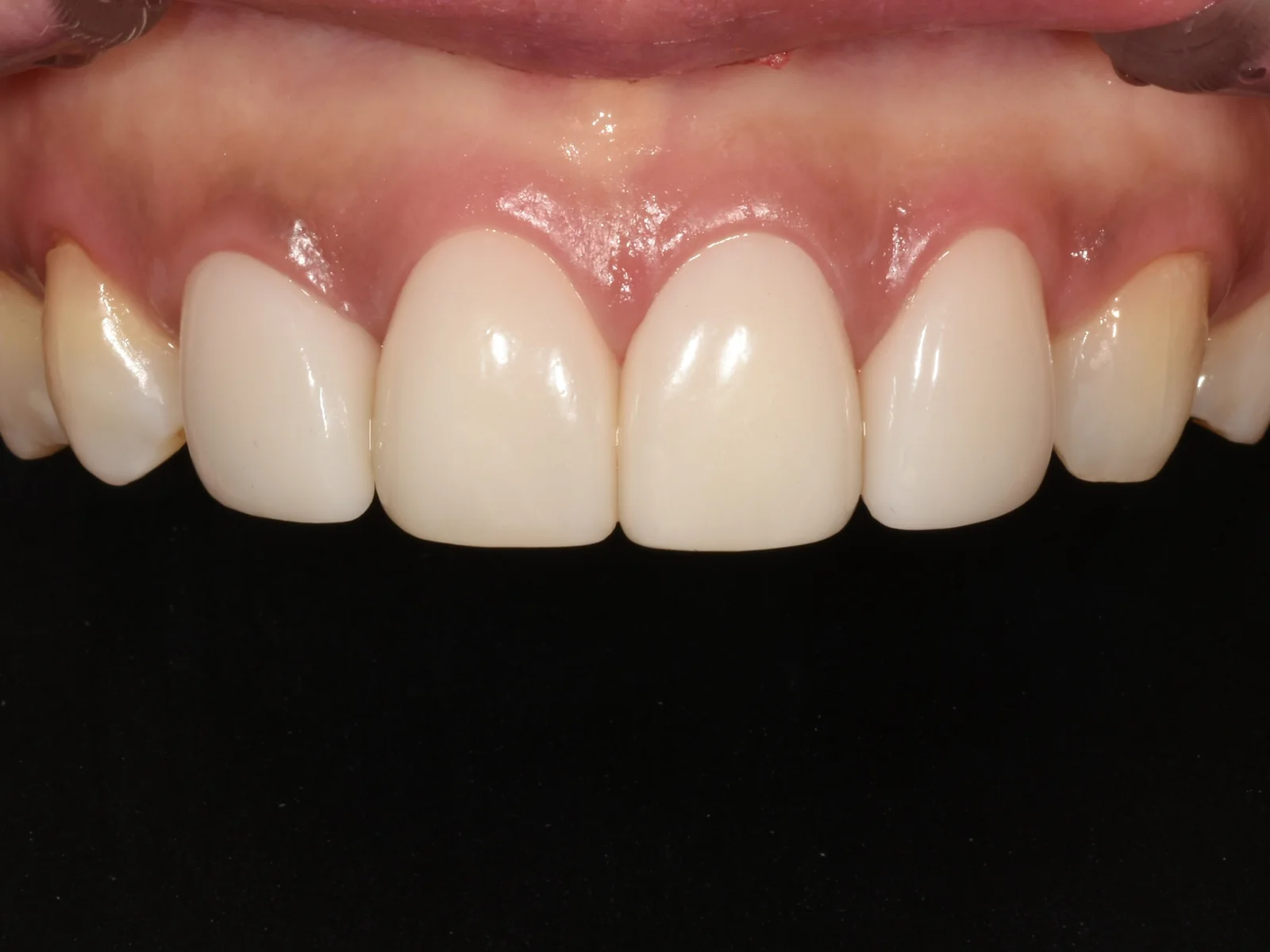
Checkup after treatment. We take photos of gum height (orange dotted line) and the gum line, which is the veneer margin (red line), and compare them at the next checkup to see whether the gums have receded again.
STEP 05
We keep checking gum height after the gaps are filled
We tell you the right interdental brush size for the spaces between your teeth and compare photos of gum height and margins at regular checkups. If you had orthodontics, you keep wearing your retainers.
Why we do thisGums can recede again depending on age and brushing habits. An interdental brush that is too large or brushing too hard presses on the gum between the teeth and makes the gap bigger.
* Clinical photos were published with the patients' consent. Side effects such as temporary pain or discomfort may occur depending on the person.
04°
Comparing treatments by cause
Orthodontics
Porcelain veneers
Resin
Gum treatment
Suitable cause
Root direction and tooth position, some tooth shapes
Tooth shape, when you also want to change color or length
One or two small gaps
Gums and bone receding because of gum disease
What is done
Roots are stood parallel, and if needed the sides of the teeth are trimmed very thinly to close the space
The side shape of the teeth is changed to move the contact point toward the gums
Material is added to the side of the teeth to fill the gap
Inflammation is treated to stabilize the gums; gum reconstruction is considered if needed
Tooth shaving
The sides of the teeth may be trimmed very thinly
No-prep or minimal-prep possible in some cases, under certain conditions
Almost none
None
Duration
Partial orthodontics for the front teeth usually 4–6 months
About 1 week (one-day option: 1–2 days)
Usually 1 visit
Several weeks or more, depending on the inflammation
Limits
If a lot of bone has receded, the gap shrinks less
Ceramic Dental Clinic also performs gum reconstruction such as gum grafts. However, the results of treatments that make gums grow back are relatively hard to predict, so we first explain the possibilities and limits. See gum recession and gum grafts →
05°
For these people, another treatment comes first, or treatment is not needed
Good for you if
You have dark gaps between your front teeth that appeared after orthodontics
Your front teeth are triangle-shaped, so the area near the gums looks empty
You have no gum inflammation, but the gaps make you self-conscious when you smile
Other treatment comes first
Your gums bleed or your teeth are loose: gum treatment first
You are still in orthodontic treatment and your front teeth are still moving: decide after orthodontics is finished
You may not need it now
The gap is very small and does not show when you smile
Food does not get caught, and it does not bother you
06°
Side effects and limits
Please read
· The gap may not disappear completely. If a lot of bone has receded, there is a limit to how much can be filled.
· The more the gap is filled, the wider the teeth may look. That is why we fill within a range that keeps the width-to-length proportions.
· Gums can recede again depending on age and brushing habits, so ongoing care is needed.
· Staining may develop at the margins of veneers or resin.
· Trimming between the teeth during orthodontics may cause temporary sensitivity.
FAQ
FAQ
Black triangles appeared after my orthodontic treatment. Is orthodontics to blame?
When overlapping front teeth are straightened with orthodontics, spaces between the teeth that were hidden until then are often revealed. A study of adult orthodontic patients found black triangles between the upper central front teeth in about 38%, and tooth shape, root direction and gum height were all related.
Will the gums grow back and fill black triangles?
When the distance from the top of the bone between the teeth to the contact point is 5mm or less, the gums often fill the gap. If the bone has already receded a lot, it is hard to expect the gums to grow back on their own, so we also consider changing the tooth shape or the position of the contact point.
Can black triangles be filled with resin?
One or two small gaps can be filled with resin. If the gaps are large or there are several, adding resin alone easily makes the teeth look wide and square, so we also consider veneers or orthodontics.
Can veneers fill black triangles without redoing orthodontics?
If the cause is tooth shape, veneers can lower the contact point and fill the gap. In one actual case, black triangles that remained even after two rounds of orthodontics were filled with veneers on 8 upper front teeth. If root direction is the cause, orthodontics may be a better fit, so we check with X-rays first.
Can black triangles be filled with filler?
Yes. For small gaps caused by slight gum recession, we also consider reducing them by injecting filler into the gums. The effect fades over time, so it may need to be repeated. If the gap is large or the cause is tooth shape or root direction, veneers or orthodontics may be a better fit.
What happens if I leave black triangles alone?
Black triangles themselves do not damage the teeth, but food gets caught easily and you may feel air escaping when you speak. If gum disease is the cause, gum disease treatment is needed before dealing with the gap.
Which doctor treats black triangles?
Dr. Ilseop Ahn, a board-certified periodontist and board-certified specialist in advanced general dentistry, first checks the gums and bone height. If tooth shape or root direction is the cause, Dr. Sunmin Kim, a board-certified orthodontist, joins in. The two doctors look at the same test results and decide the treatment order.
How should I care for my teeth after black triangle treatment?
It is important to use an interdental brush that fits the space between your teeth and not to brush too hard. At regular checkups, we compare photos of gum height and the margins to see whether the gums are receding again.
Evidence and references
Tarnow DP, Magner AW, Fletcher P. The effect of the distance from the contact point to the crest of bone on the presence or absence of the interproximal dental papilla. Journal of Periodontology, 1992. (When the distance from the contact point to the bone crest was 5mm or less, the interdental papilla was almost always present)
Kurth JR, Kokich VG. Open gingival embrasures after orthodontic treatment in adults: prevalence and etiology. American Journal of Orthodontics and Dentofacial Orthopedics, 2001. (38% between the upper central front teeth among 337 adult orthodontic patients)
Questions from patients who travel to Seoul for treatment.
How much does CERANATE cost?
CERANATE is KRW 550,000–770,000 per tooth including VAT, depending on the material and fabrication method. International and Korean patients pay the same fees. During promotional events, the same discounted price applies to everyone; ask us on WhatsApp about current events. The tax refund for foreign medical tourists has ended in Korea, so no refund applies. The number of teeth is decided at diagnosis, so we tell you the total after the examination. See our fee schedule.
How many visits do I need, and how long should I stay in Korea?
CERANATE One-Day takes 2 visits over 1–2 days. The Art and The Petit take 2 visits over about 1 week. If orthodontics, whitening or gum treatment comes first, that time is added. We suggest leaving 1–2 spare days after the final bonding before your flight. The check-up about 2 weeks after bonding can be done by photo on WhatsApp, and we see you in person on your next visit to Korea.
Can I have my consultation in English?
Yes. The doctor in charge of your treatment consults with you directly in English. Before you travel, you can send photos of your teeth on WhatsApp or by email. An accurate diagnosis is made after we examine you in person.
What if a veneer chips or comes off after I go home?
Send us a photo on WhatsApp first. If a veneer comes off, keep it. We check it and tell you what to do. Repairing or remaking a veneer needs a visit. How breakage is handled, and what it costs, depends on the CERANATE option, and we explain this before treatment.
Results, the number of visits and schedules vary from person to person. More questions: Visiting from abroad.


 Before · May 2026
 2-week checkup after treatment · May 2026
 Before · Jan 2026
 After · Jan 2026
 Before orthodontics · Dec 2022
 After orthodontics · Jun 2024
 Measuring distance
 Triangle-shaped teeth
 Bone height
 Shape and root direction
 Planning
 After placement
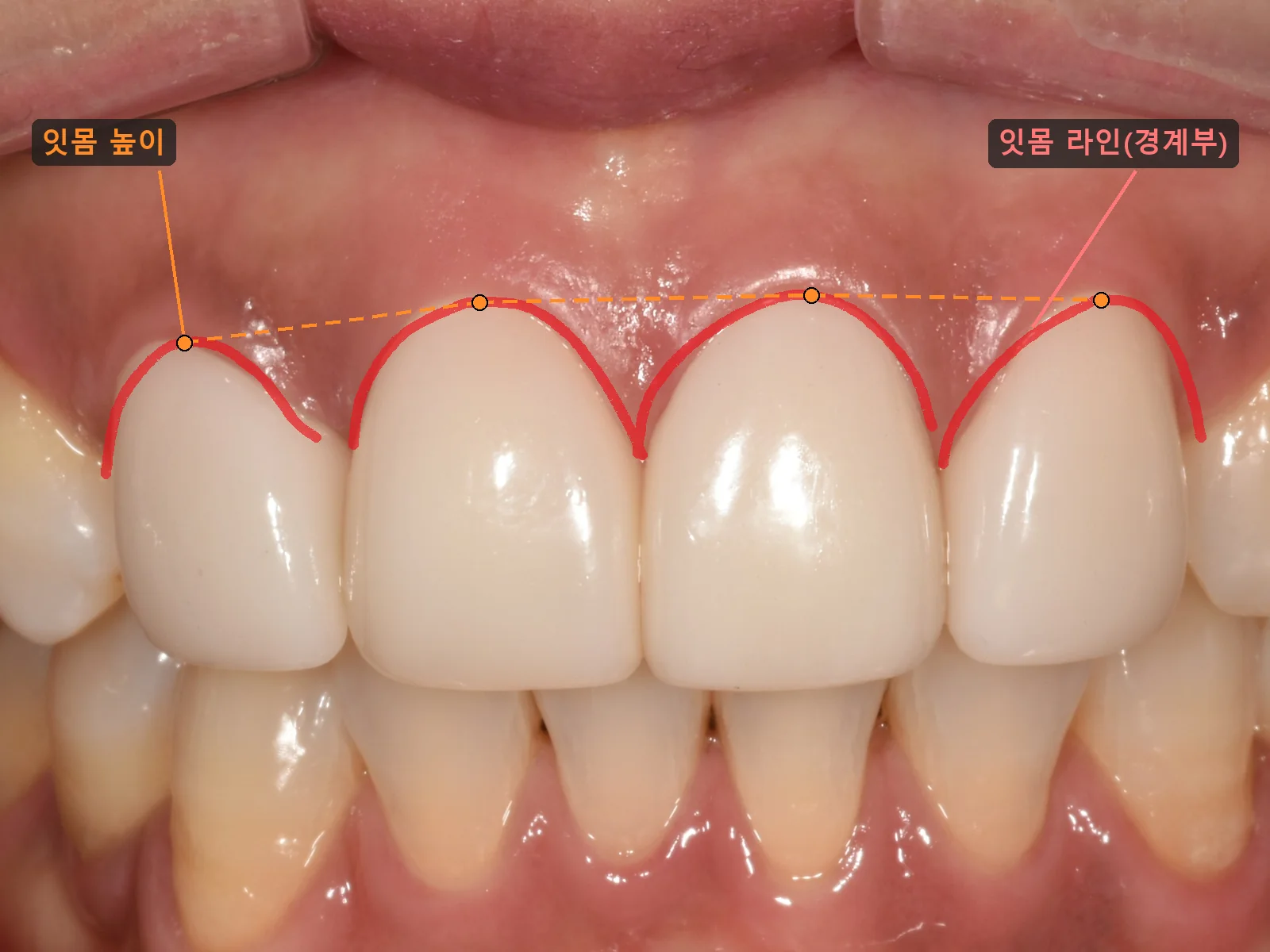 Gum height and margins