Last reviewed October 29, 2026 · Dr. Sunmin Kim (board-certified orthodontist, Certified Orthodontist of the Korean Association of Orthodontists)
At a glance
Good for
When the alignment of your teeth or your bite is the concern, such as protruding mouth, crowding, asymmetry or re-treatment
Treatment flow
12-step examination → decision on extraction and appliance → adjustment once a month → retainer check-ups
Duration and limits
Full treatment usually takes 1.5–2.5 years; partial treatment of the front teeth usually takes 6 months
Details
Orthodontics starts with diagnosis, not with the appliance. At Ceramic Dental Clinic, Dr. Sunmin Kim, a board-certified orthodontist, examines your face, teeth, jaw joints and gums in 12 steps, then explains in one sitting whether teeth need to be extracted, which appliance to use and how care continues after treatment. He treats you himself from the first consultation to retainer check-ups. Full orthodontic treatment usually takes 1.5 to 2.5 years, partial treatment of the front teeth usually takes 6 months, and during treatment you visit once a month. For adults, Dr. Ilseop Ahn, a board-certified periodontist and specialist in integrated dentistry, checks the gums as well, and at the consultation we first explain what orthodontics alone can and cannot change.
01°
The same orthodontics, but a different treatment plan for each person
These are real cases of the three concerns we consult on most at Ceramic Dental Clinic. We describe what we looked at, which method we chose, what we did not do, and what to watch out for.
CASE01
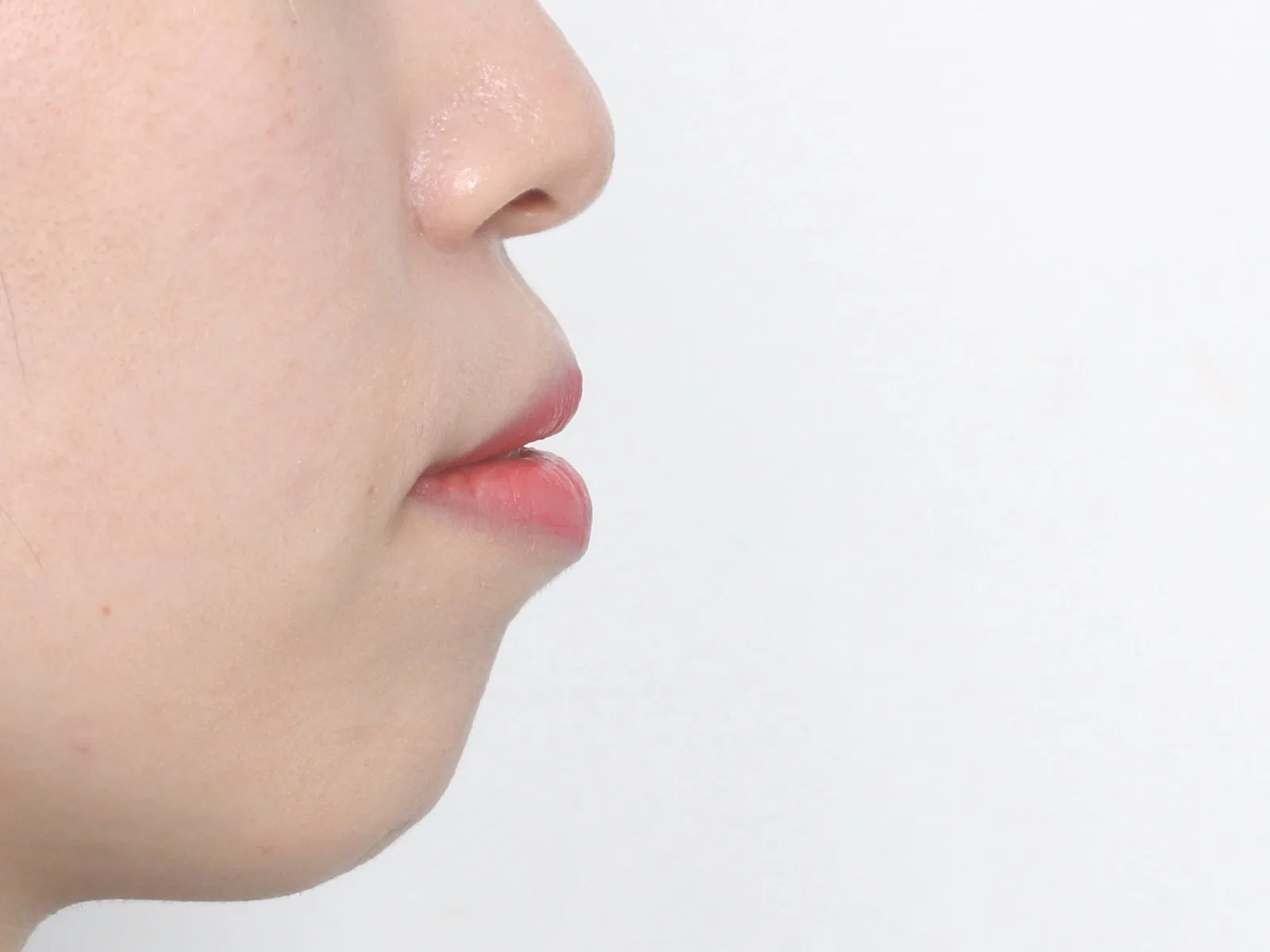
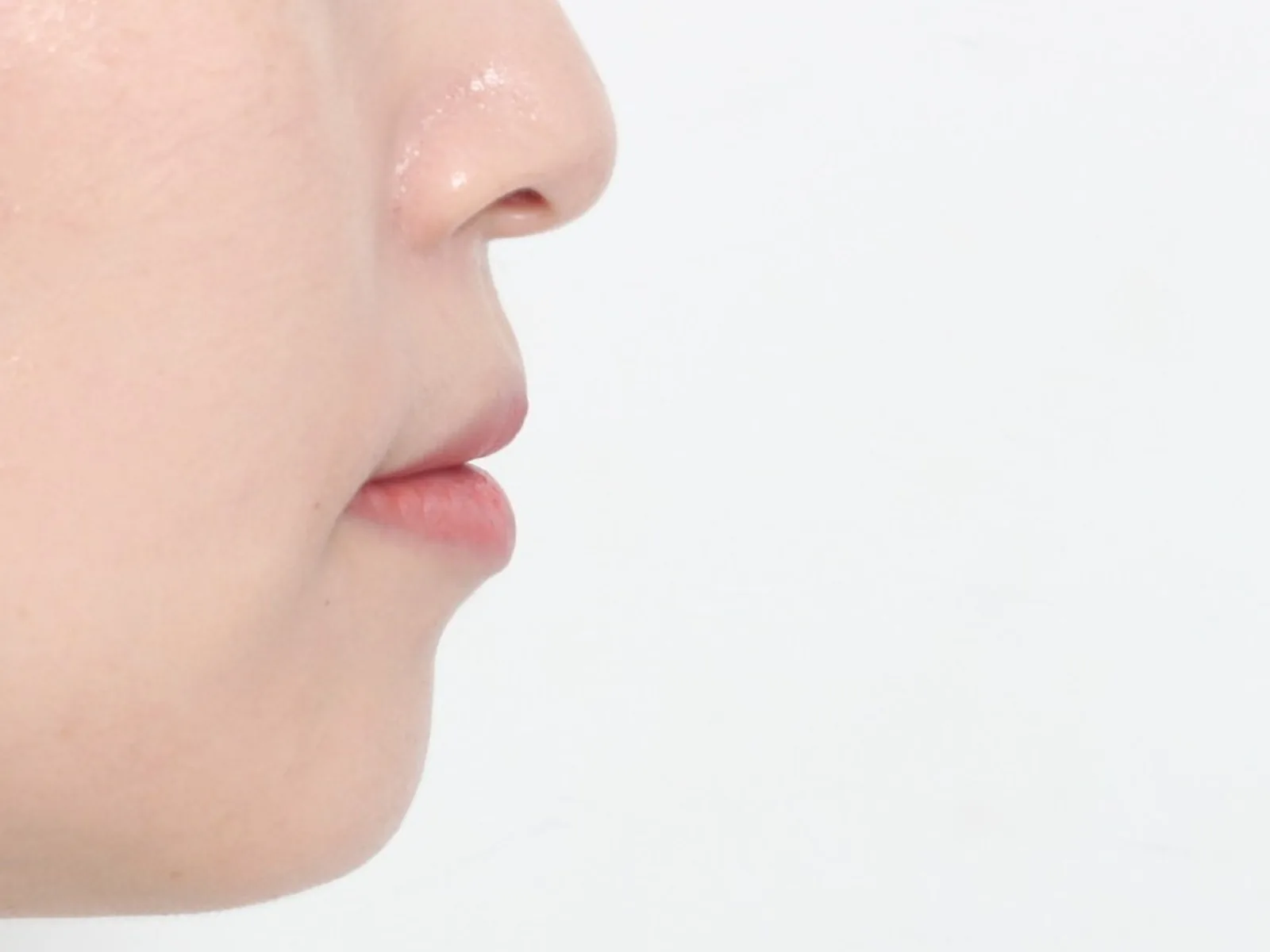
A protruding mouth
Extraction orthodontics · Extraction space divided between the front teeth and the back teeth, planned so the lips do not move back too far
Before · Oct 2021
Side view before treatment. The upper front teeth tilted forward and pushed the lips out, and the chin strained when closing the mouth.
After treatment · June 2024
Side view after treatment. The front teeth moved back as planned, the lips protrude less, and the mouth now closes comfortably.
Condition
Dental protrusion with front teeth tilted forward
Chosen
Premolar extraction, space shared front teeth 8 : back teeth 2
Not done
Chin surgery (because the jawbone was not the cause)
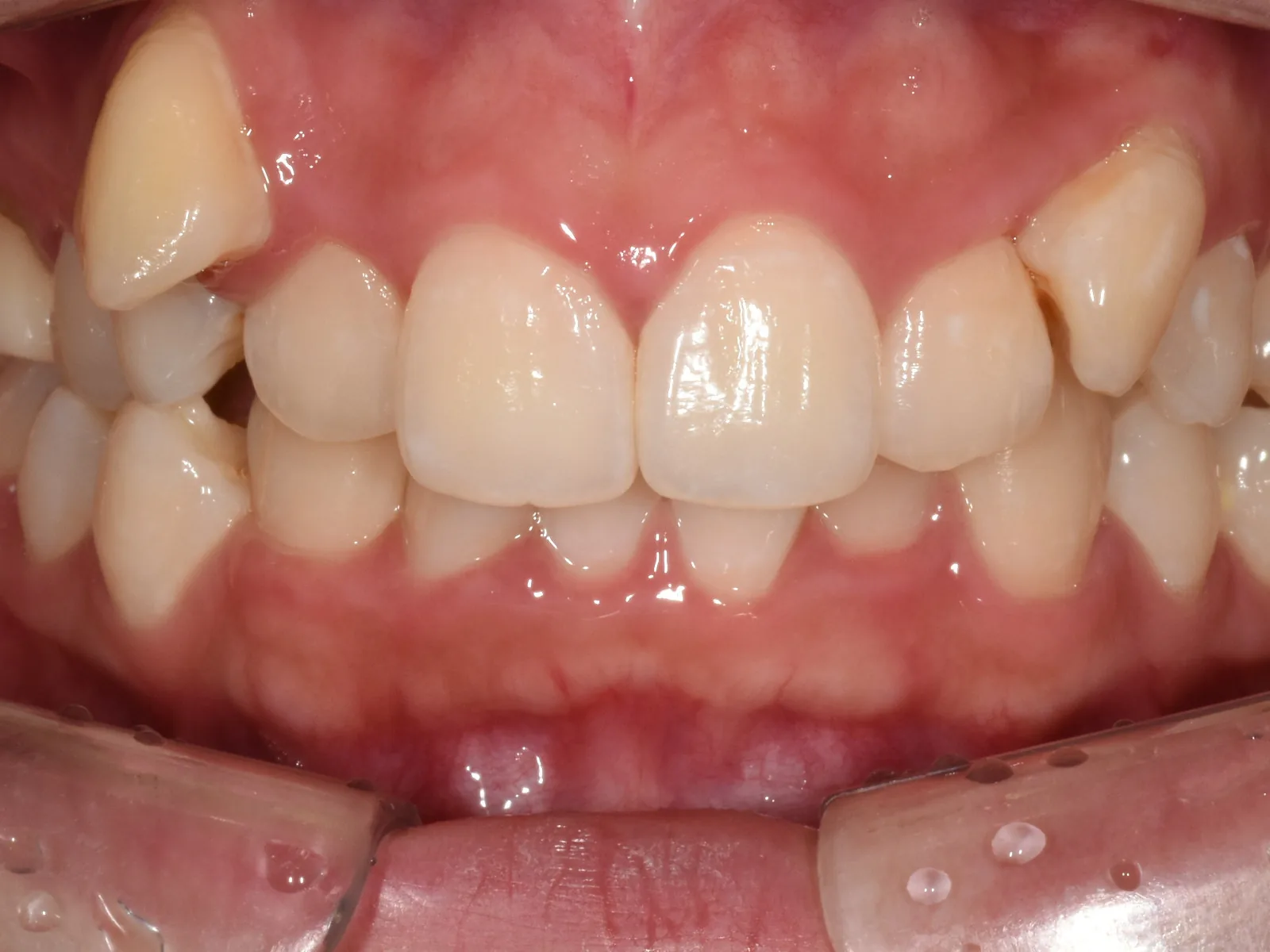
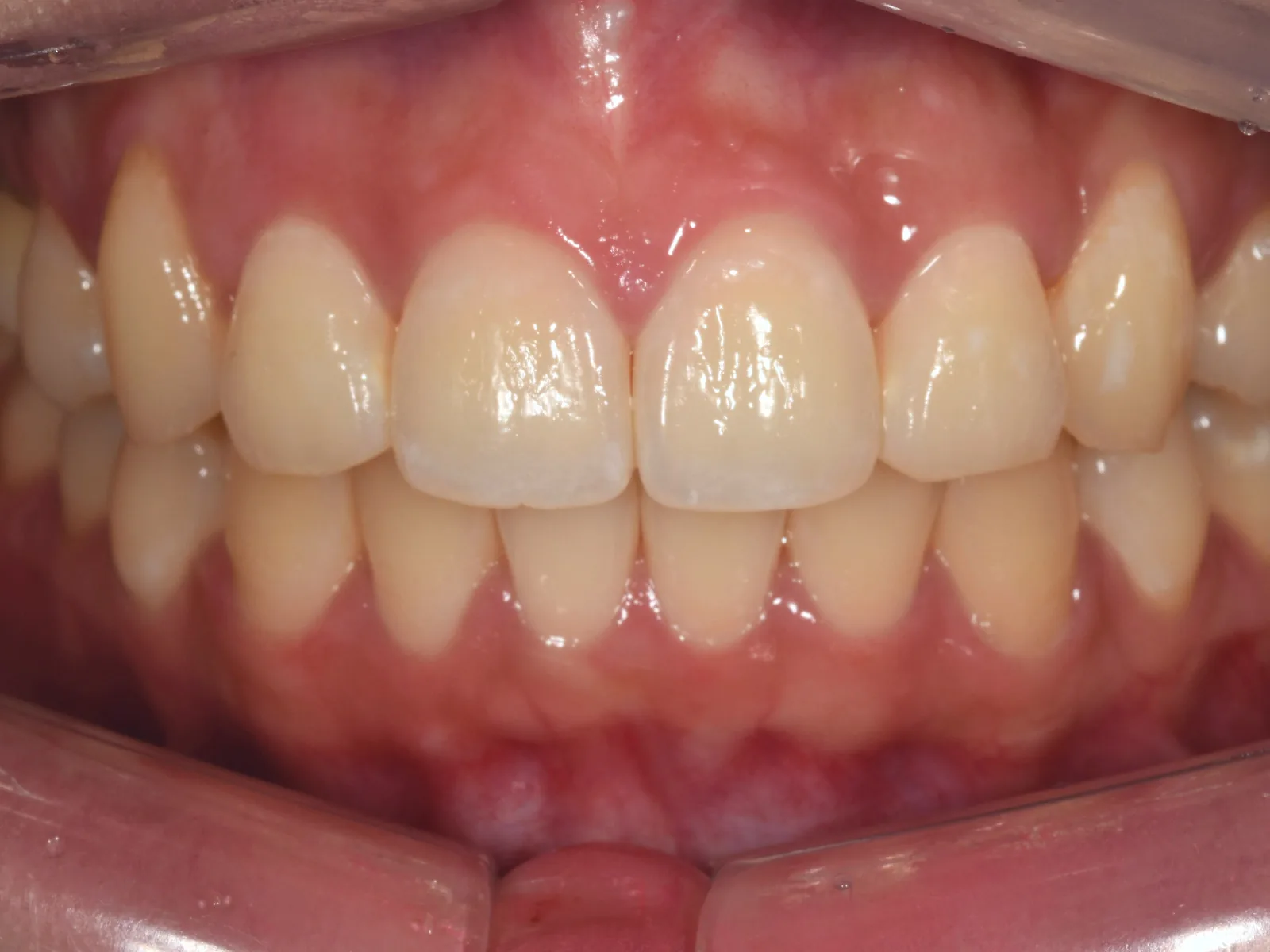
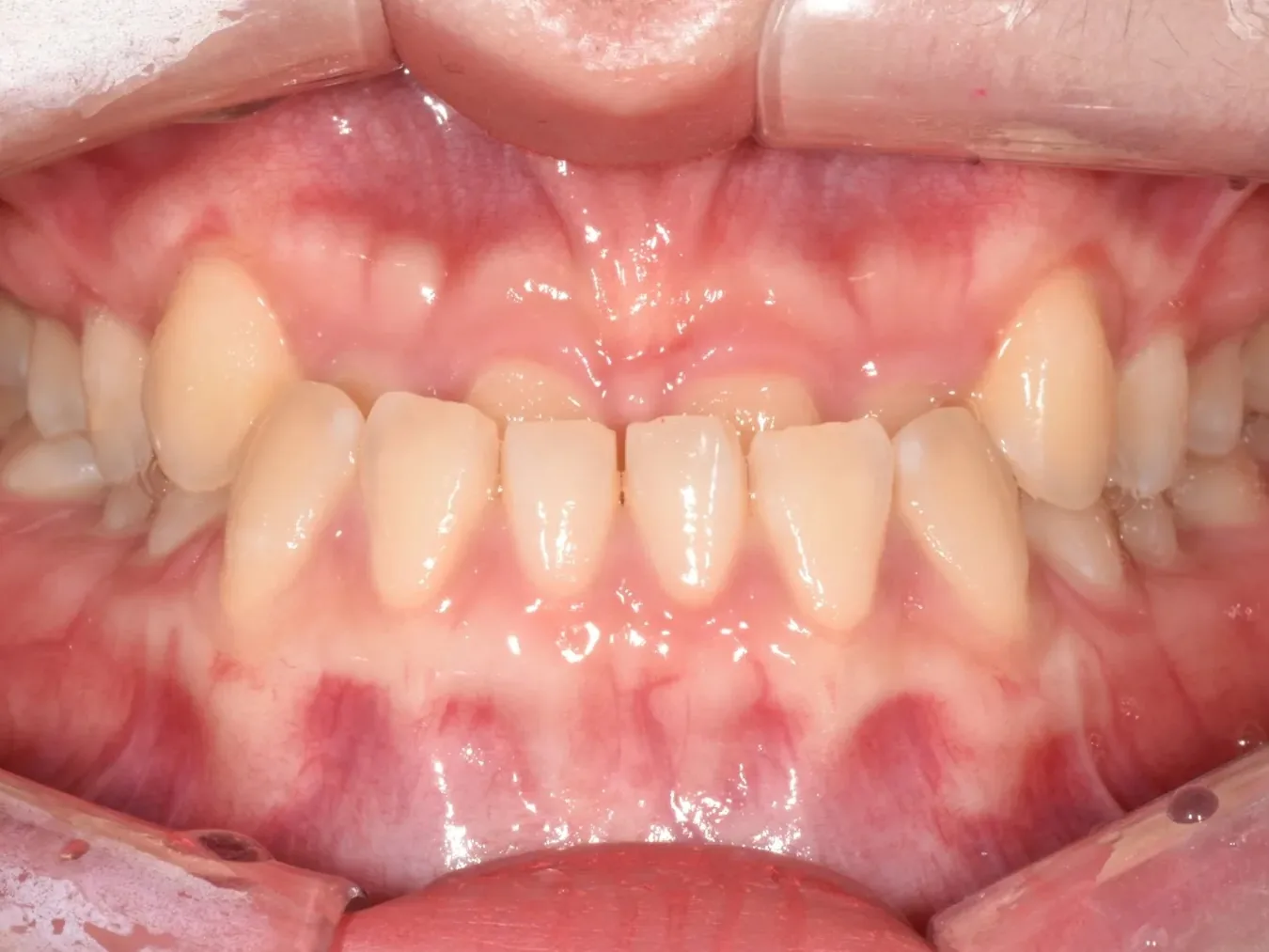
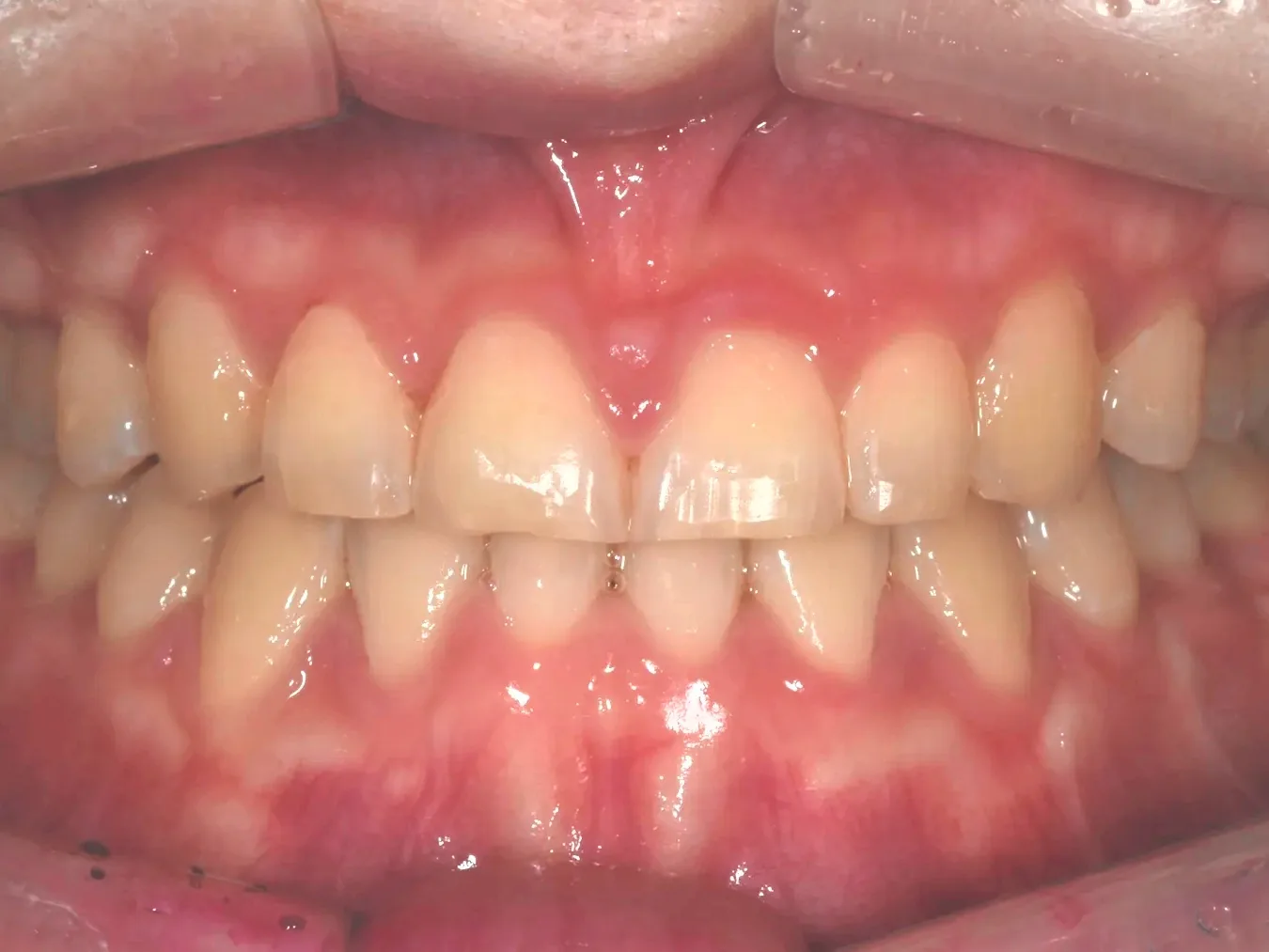
Crossbite with the lower teeth biting in front of the upper teeth
Orthodontics · Confirmed that the front teeth meet edge to edge when the jaw is moved back, and corrected the front bite without surgery
Before treatment
Front view inside the mouth before treatment. The lower front teeth bit in front of the upper front teeth, and it was hard to bite food with the front teeth.
After treatment · about 1 year 6 months
Front view inside the mouth after treatment. Correcting the tilt of the front teeth brought the upper front teeth in front of the lower front teeth.
Condition
Dental and functional crossbite, small difference in the jawbones
Chosen
Adjusting the tilt of the front teeth with braces
Not done
Surgical orthodontics (the jaw difference was small)
* Photos were taken under the same conditions and published with the patients' consent. Treatment results and side effects may vary from person to person.
02°
Five principles of orthodontics at Ceramic Dental Clinic
Before choosing an appliance, we explain what can be changed in your teeth and face.
ONE
Board-certified orthodontist · Certified Orthodontist of the Korean Association of Orthodontists · Completed orthodontic residency and earned a Ph.D. in Dental Science at Tokyo Medical and Dental University
TWO
Research measuring the orthodontic force and torque on teeth directly (Biomed Mater Eng 2022 and 6 others)
THREE
12-step diagnosis: lateral and frontal cephalograms, 3D CT, iTero digital models, and jaw joint and gum examinations
Key Point. 1
A board-certified orthodontist sees you himself from the first consultation to the retainer.
The person who makes the diagnosis and the person who adjusts the appliance should be the same, so the plan can be corrected right away during treatment. I treat you myself from the first consultation until the day the appliance comes off and the retainer is checked.
BasisBoard-certified orthodontist · Certified Orthodontist of the Korean Association of Orthodontists · M.S.D., Seoul National University School of Dentistry · Ph.D., Graduate School, Tokyo Medical and Dental University · Completed orthodontic residency at Tokyo Medical and Dental University · Clinical practice permit for foreign dentists, Ministry of Health, Labour and Welfare of Japan · Regular member of the Korean Association of Orthodontists and the Japanese Orthodontic Society (presentation at the 2019 Japanese Orthodontic Society annual meeting) · Former member of the International Committee, Korean Association of Orthodontists (Apr 2022–Mar 2024). We publish credentials and papers with links to the originals, so you can check them yourself.
Key Point. 2
A diagnosis that starts from the face, down to how the extraction space will be used.
If the only goal is straight teeth, the lips or profile can change in ways you did not intend. On a side X-ray of the face we measure the angle of the front teeth and the position of the lips, and if teeth are extracted, we plan how much of that space the front teeth will move back into and how much the back teeth will move forward into.
Basis12-step examination and diagnosis · Lateral cephalometric X-ray measurement
Key Point. 3
We choose appliances and forces based on research that measured the forces on teeth.
Orthodontics moves teeth by applying force to them. At Tokyo Medical and Dental University, I co-developed a device that directly measures the force and torque on teeth, and measured how much the force changes depending on how the wire is tied. That is why, even for the same snaggletooth, the appliance and the order in which force is applied differ.
BasisBiomed Mater Eng 2022 (doi:10.3233/BME-211288) · IEEE EMBC 2018 (PMID 30440743) · IEEE SMC 2019 · IEEE ICIIBMS 2021 · ROBOMECH, Japan Society of Mechanical Engineers 2018·2019·2020 · Presentation at the Japanese Orthodontic Society annual meeting 2019
Key Point. 4
We check the jaw joints and gums before orthodontic treatment.
If orthodontic treatment starts while the jaw joint is painful or changing, the bite can keep shifting and the plan can become unstable. So we check the jaw joints at the examination stage and treat them first if needed. For adults, Dr. Ilseop Ahn, a board-certified periodontist and specialist in integrated dentistry, checks the gums as well and decides whether gum treatment should come first or be managed alongside orthodontics. We do not tell you that orthodontics treats jaw joint problems.
BasisJaw joint examination (pain, sounds, how wide the mouth opens) and 3D CT when needed · Perfect Healing Laser PHL-15 (jaw joint physical therapy) · Gum examination by a periodontist
Key Point. 5
We plan beyond the end of treatment: whether veneers are needed and how retainers will be handled.
Some people consider veneers after orthodontic treatment because of the shape of the front teeth or small gaps. If we look at this when planning orthodontics, we can create spaces in advance that need less reshaping or none at all. Retainer check-ups and adjustments for 2 years after treatment are included in the orthodontic fee.
BasisRetainer check-ups and adjustments for 2 years after treatment included in the orthodontic fee (re-bonding fixed retainers and remaking removable retainers after that are charged)
03°
From the 12-step examination and diagnosis to the retainer: how treatment proceeds
With real clinical photos, we explain what each of the 12 examination steps looks for and what we check after the appliance is placed.
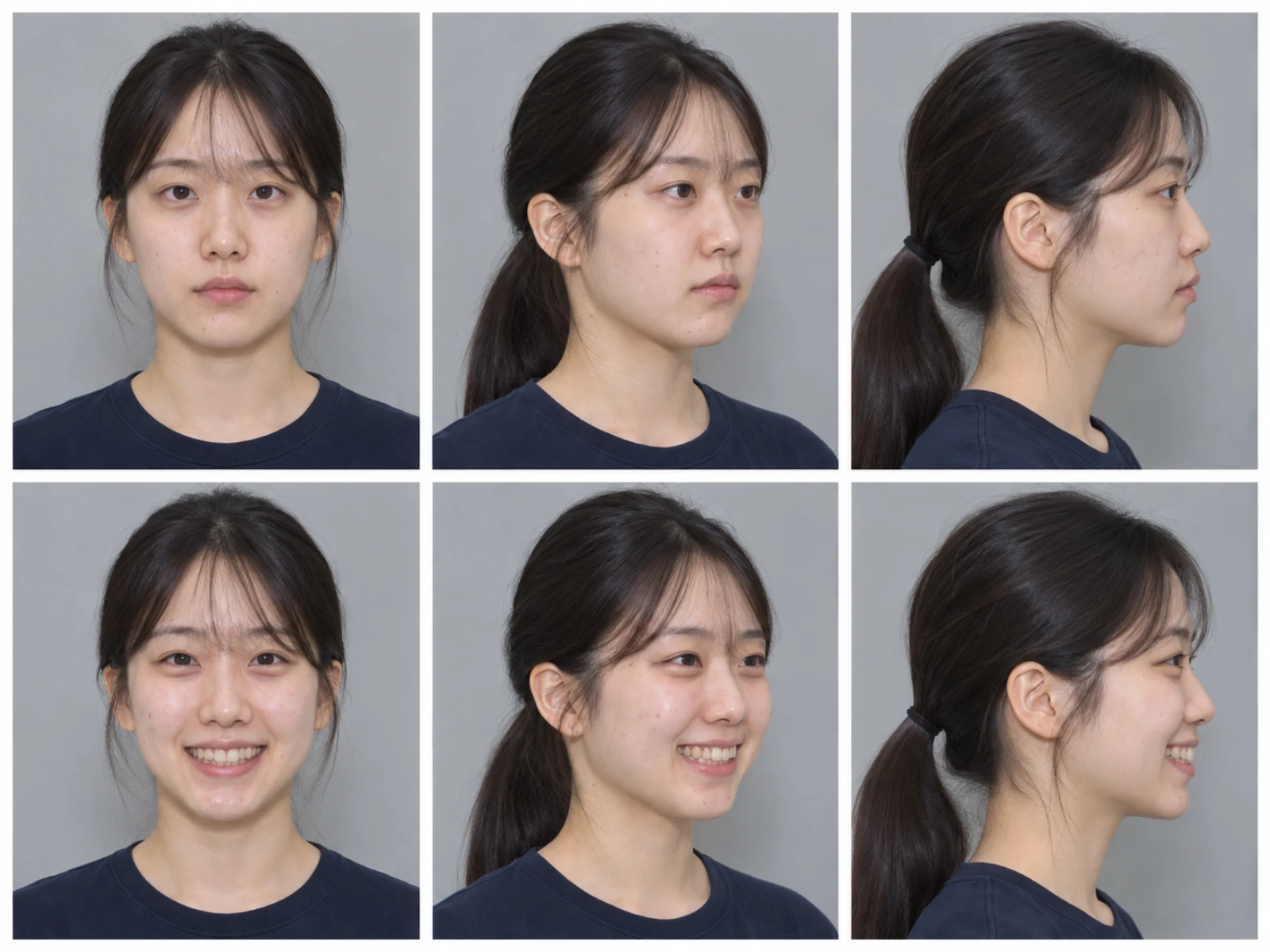
Facial photos · AI illustration
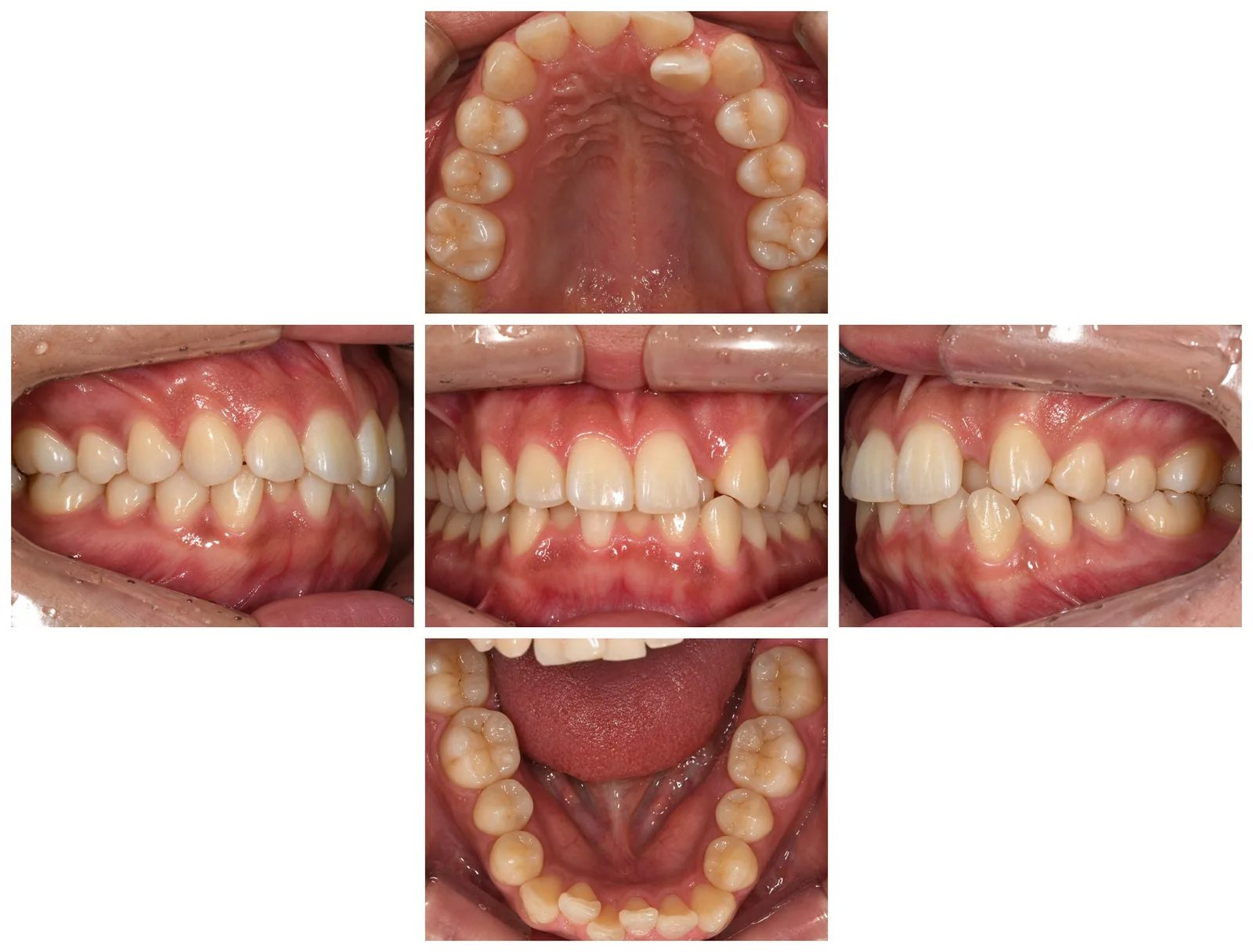
Intraoral photos
Orthodontic diagnosis photos. The face is photographed from the front, at 45 degrees and in profile, relaxed and smiling; inside the mouth, the front, both sides, and the upper and lower teeth. The face photos are AI-generated example illustrations to aid understanding.
STEP 01 · Examination ①–③
We consult and record your face and mouth with photos
① At the consultation and medical history, we ask what you most want to change, your medical history, jaw joint symptoms, and whether you have had orthodontic treatment before. ② Face photos show the position of the lips and chin and how much gum shows when you smile, and ③ intraoral photos record the alignment, bite and gum condition.
Why we do thisThe goal of orthodontics starts from what you most want to change. Even for the same snaggletooth, someone who says "I don't like that my mouth sticks out" and someone who says "I just want the snaggletooth fixed" get different plans.
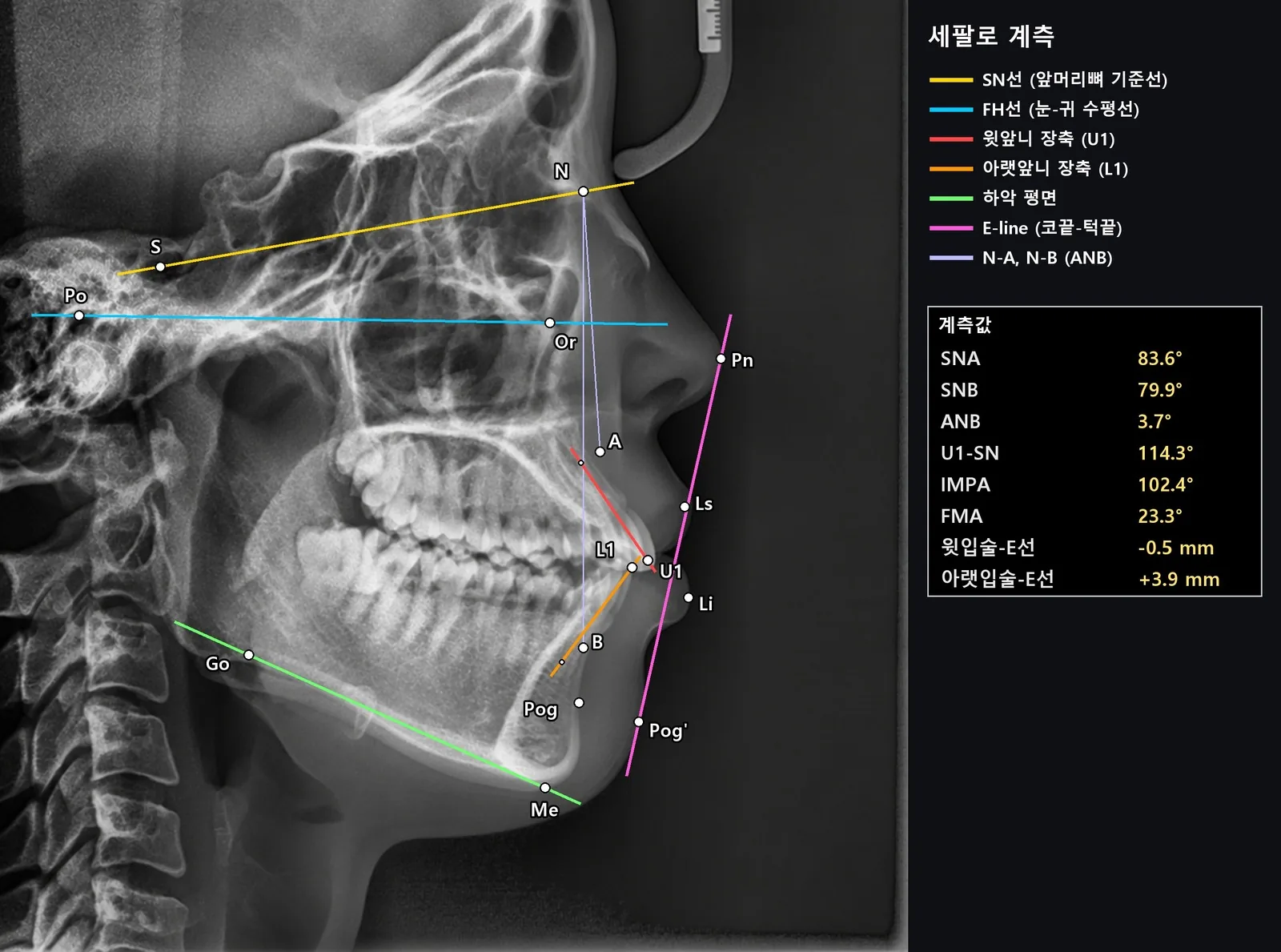
Cephalometric analysis
Lateral cephalometric measurement screen. We measure the position of the teeth and jawbones, the angle of the front teeth and the position of the lips with lines and angles.
STEP 02 · Examination ④–⑦
We take three kinds of X-rays, and a 3D CT when needed
④ A side X-ray of the face (lateral cephalogram) shows the position of the teeth and jawbones, the angle of the front teeth and the position of the lips, and ⑤ a front X-ray of the face (PA cephalogram) shows left–right asymmetry. ⑥ A panoramic X-ray shows the tooth roots, wisdom teeth and the bone around the teeth, and ⑦ when we need a closer look at impacted teeth, root positions, bone thickness or the jaw joints, we take a 3D CT (Vatech).
Why we do thisHow far a tooth can move is decided by the bone around its root. Bone and roots are not visible in face photos, so to avoid an unrealistic plan we first check them with X-rays.
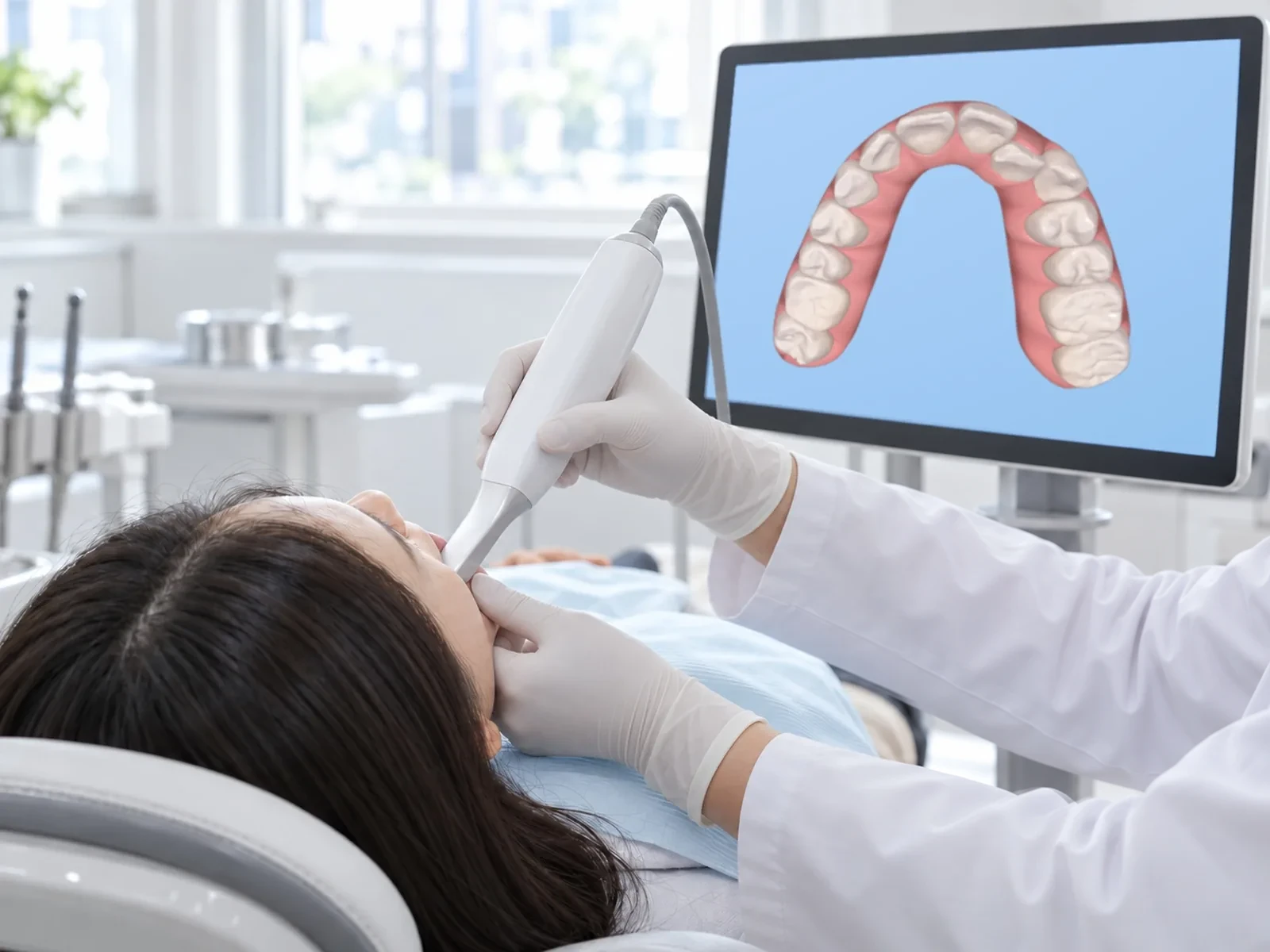
iTero scan
iTero intraoral scan. Instead of taking impressions, we scan inside the mouth to make a 3D digital model of the teeth.
STEP 03 · Examination ⑧
We make a digital model of your teeth without impressions
⑧ We scan inside your mouth with an iTero intraoral scanner to make a 3D digital model of your teeth. With this model we measure, in millimeters, how much room the teeth lack and how the upper and lower teeth meet.
Why we do thisWhether to extract starts from how many millimeters of space are missing. A digital model can be measured again at the same spot many times, and we can rescan partway through treatment to compare with the start.
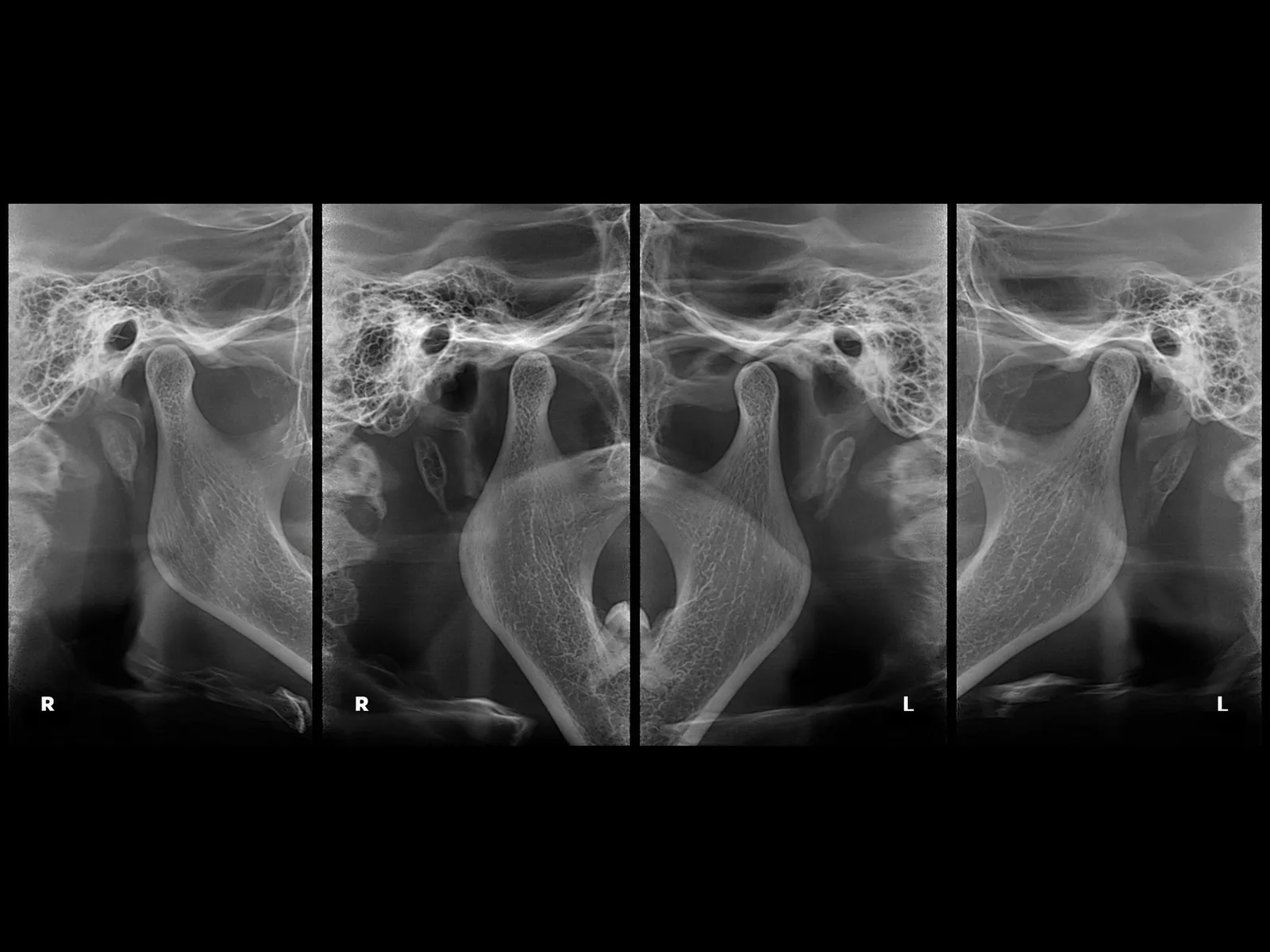
Jaw joint X-ray
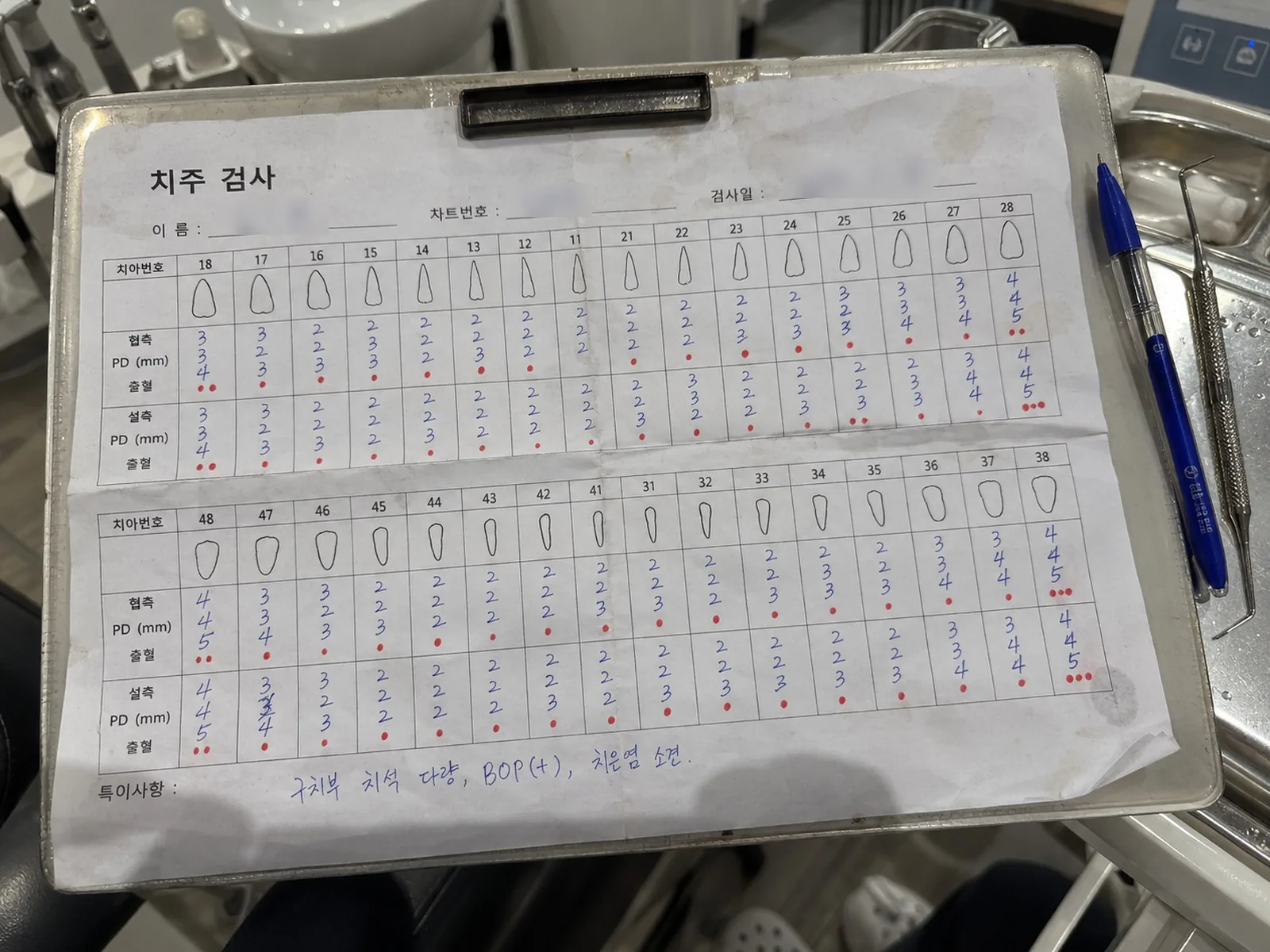
Gum chart
Jaw joint X-rays and gum chart. For the jaw joints, we check pain, sounds and how wide the mouth opens, and look at the position of the joint head on X-rays with the mouth closed and open. For adults, a periodontist measures the depth of the gum pockets.
STEP 04 · Examination ⑨–⑩
We check the jaw joints and gums before orthodontic treatment
⑨ The jaw joint examination checks pain, sounds and how wide the mouth opens. ⑩ For adults, Dr. Ilseop Ahn, a board-certified periodontist and specialist in integrated dentistry, checks the gums with us and decides whether gum treatment should come first or be managed during orthodontics.
Why we do thisMoving teeth while the jaw joint hurts or the gums are inflamed can make the bite keep shifting or further weaken the bone around the teeth. Sorting out these two before starting keeps the plan from becoming unstable during treatment.
Explanation of results
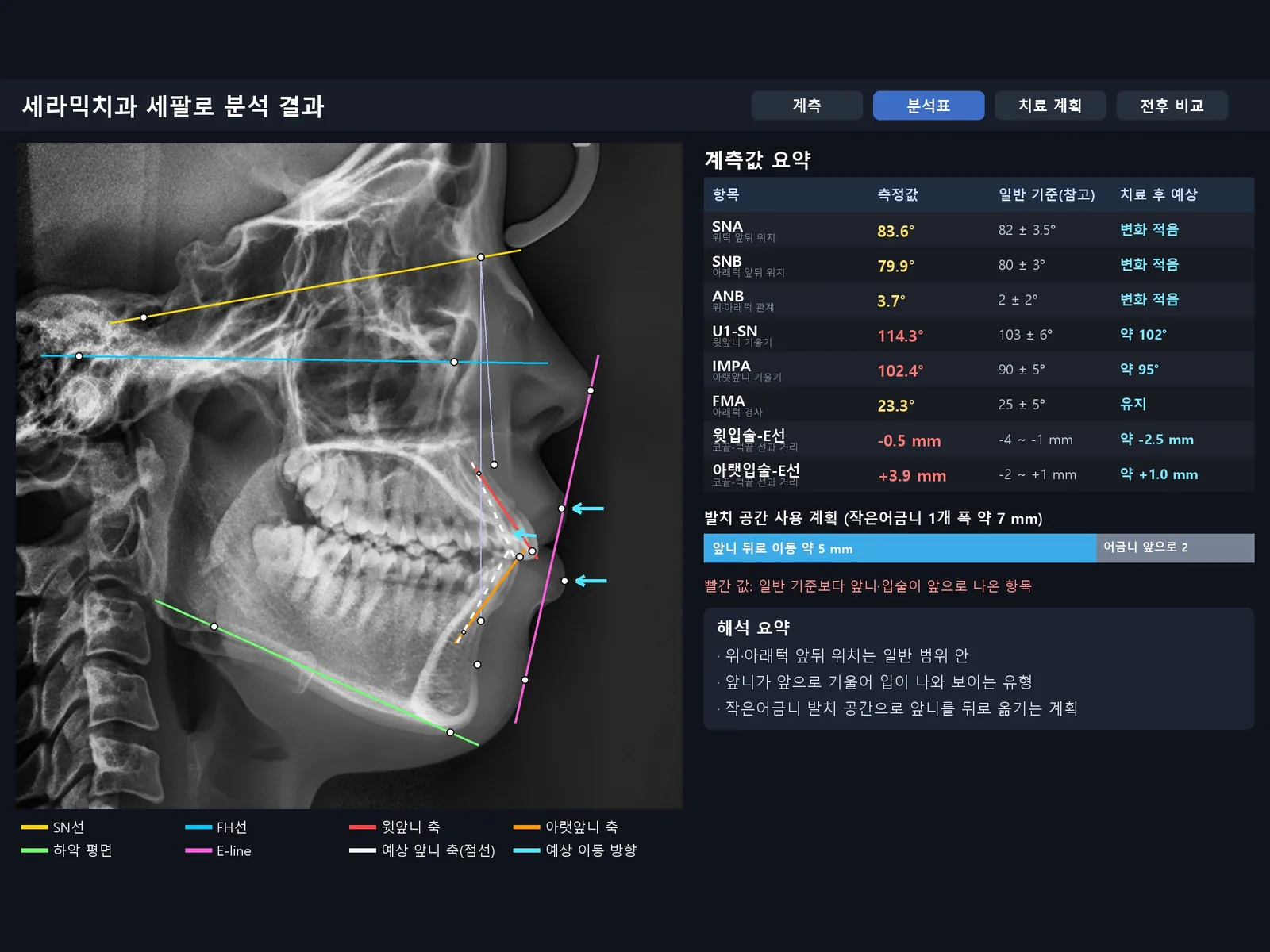
Results explanation screen. We explain the cause, method, duration, limitations and other options while looking at the examination screens.
STEP 05 · Examination ⑪–⑫
We plan from the measured numbers and explain while showing you the screen
⑪ From the measurements we calculate how much the teeth and skeleton will change, the extraction space and the facial midline. ⑫ When explaining the results, we go over the cause, method, duration, limitations and other options while looking at the examination screens. If you do not need orthodontic treatment right now, we tell you that too. The examination takes about 1 hour, and we explain the results the same day. The full examination costs KRW 50,000 (KRW 100,000 if a CT scan is needed), and it is included in the orthodontic fee if you start treatment.
Why we do thisOrthodontic treatment lasts close to 2 years, so you should understand it well before deciding. We compare the duration, advantages and limitations of each option, so you can take your time.
Placing the appliance
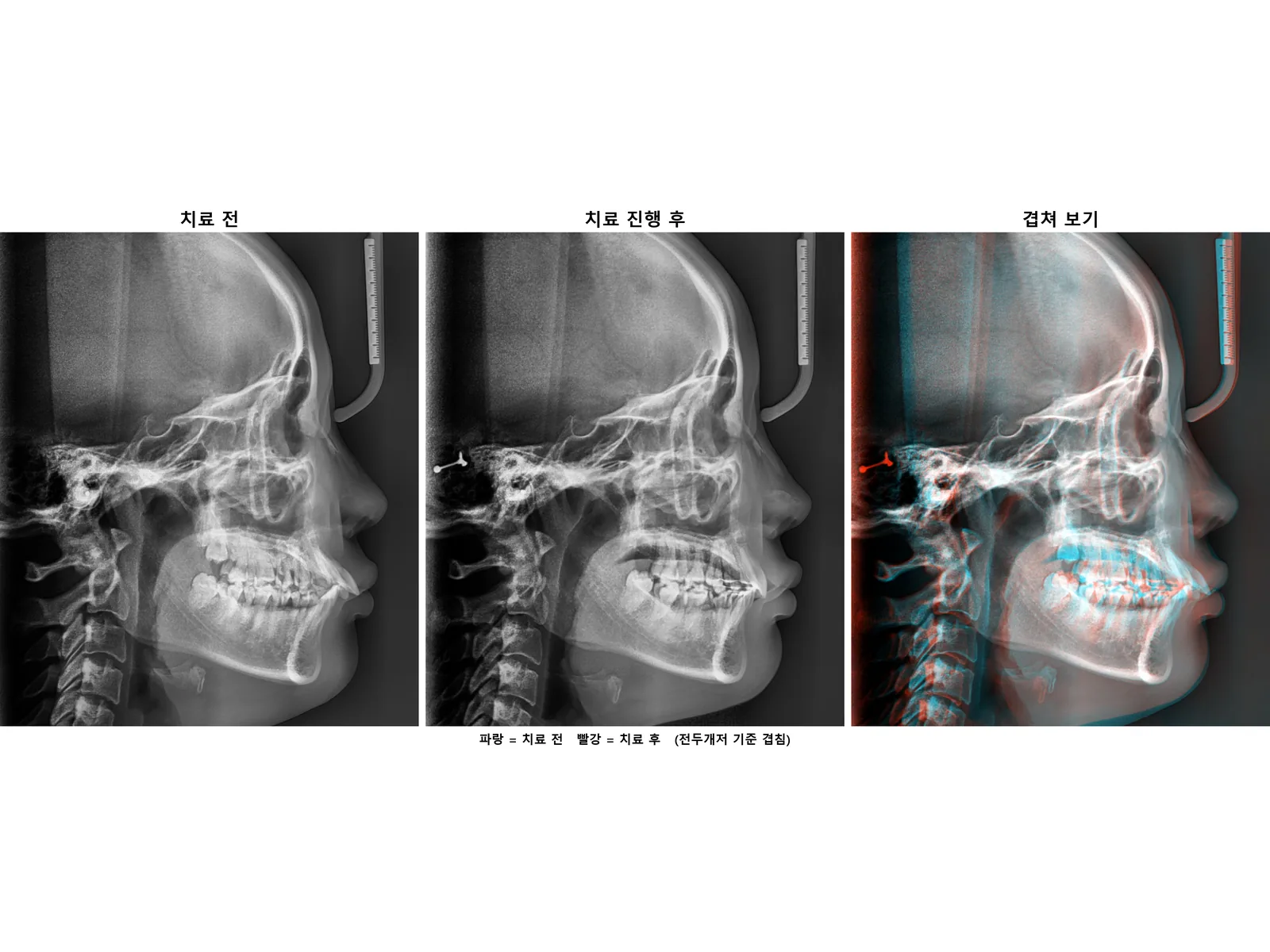
Mid-treatment re-evaluation
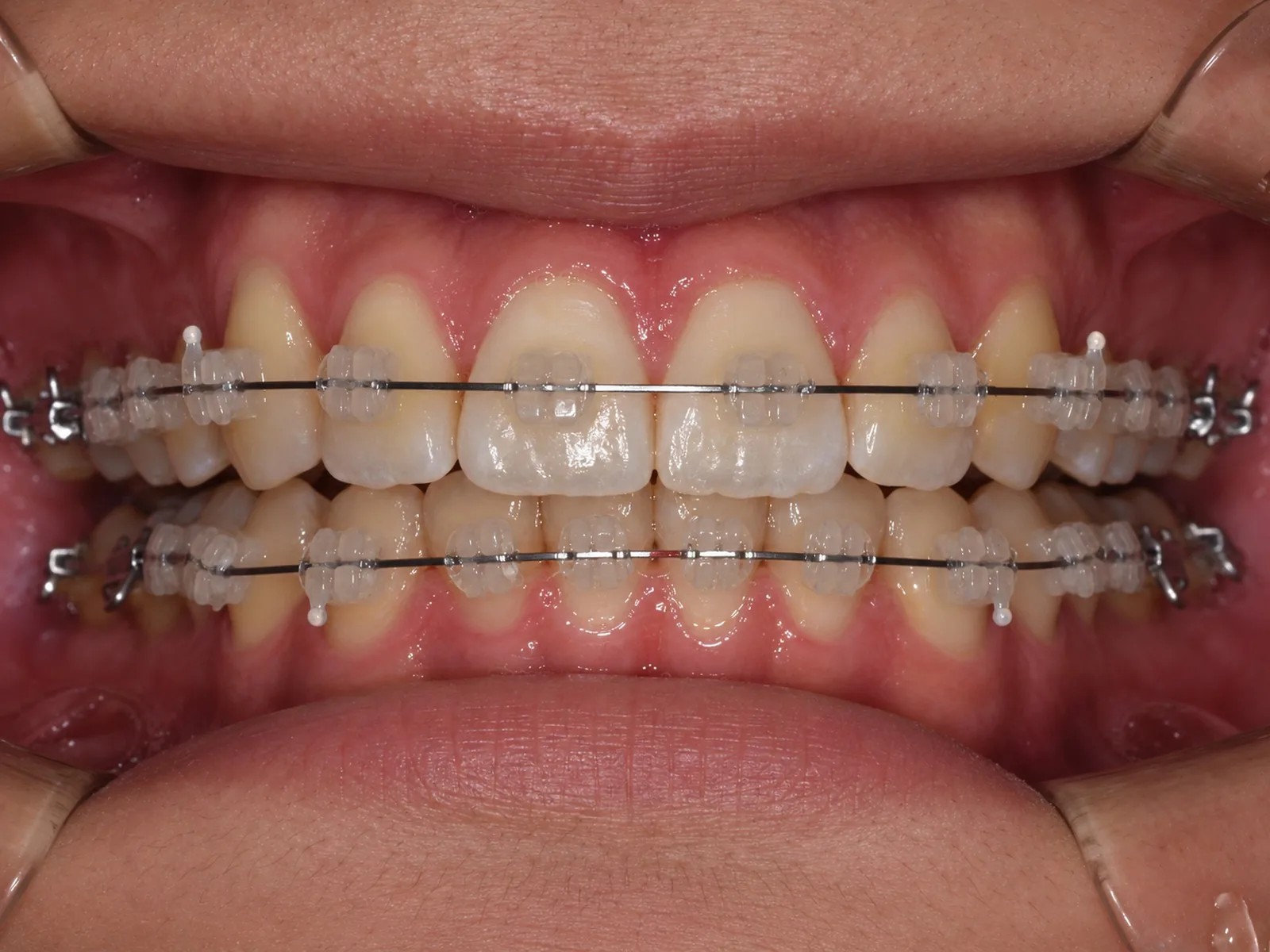
Placing the appliance and mid-treatment re-evaluation. We place the chosen appliance and, partway through treatment, compare the start with now to adjust the plan.
STEP 06
We place the appliance and re-evaluate partway through
After the chosen appliance is placed, it is usually adjusted once a month. Partway through treatment, every 4 to 8 months, we take photos and digital models again, and X-rays if needed, to compare with the start and adjust the rest of the plan.
Why we do thisHow much the teeth and lips move differs from person to person. We do not push the initial plan through unchanged; we decide the final amount after seeing how things have actually changed.
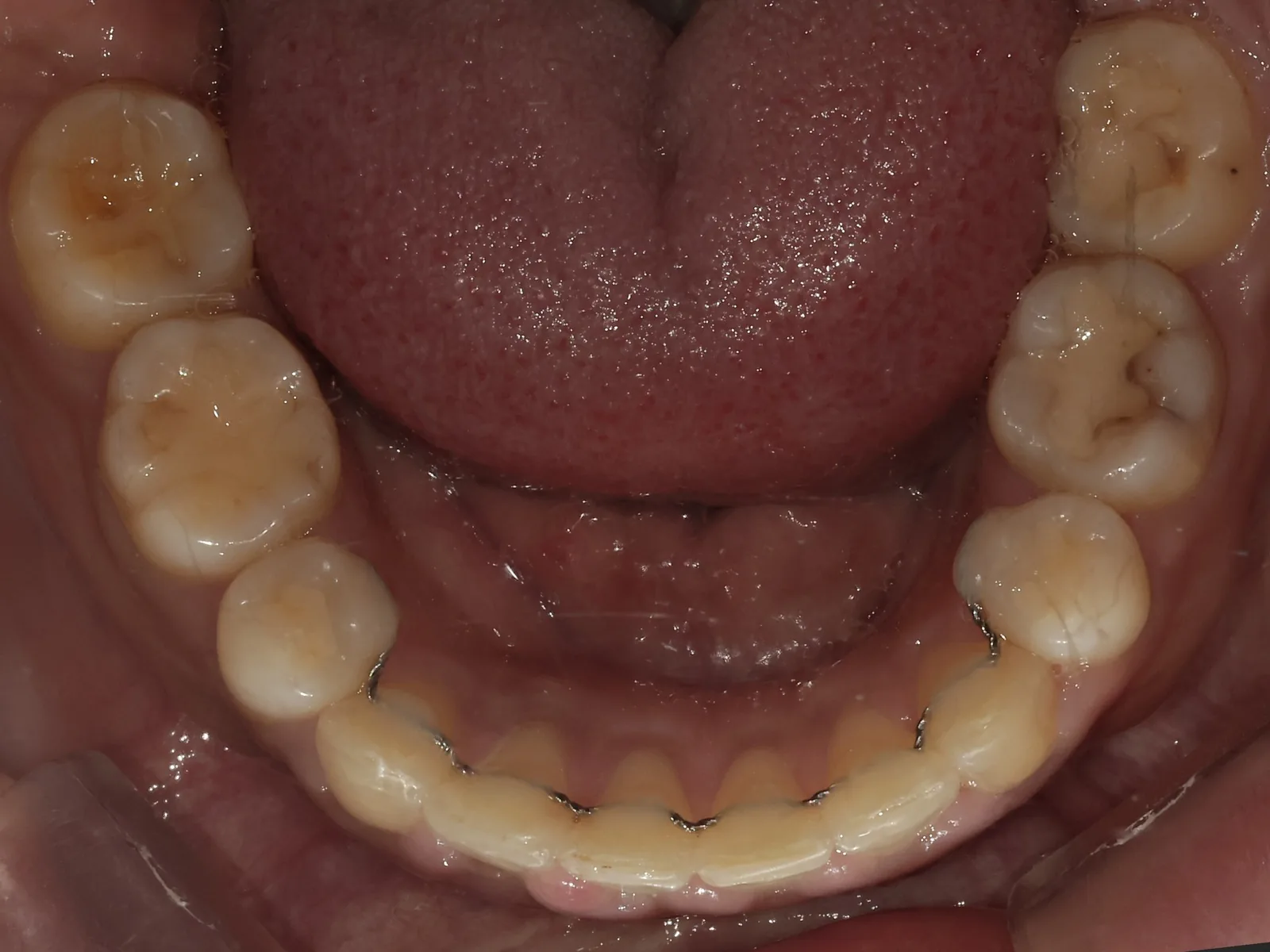
Fixed
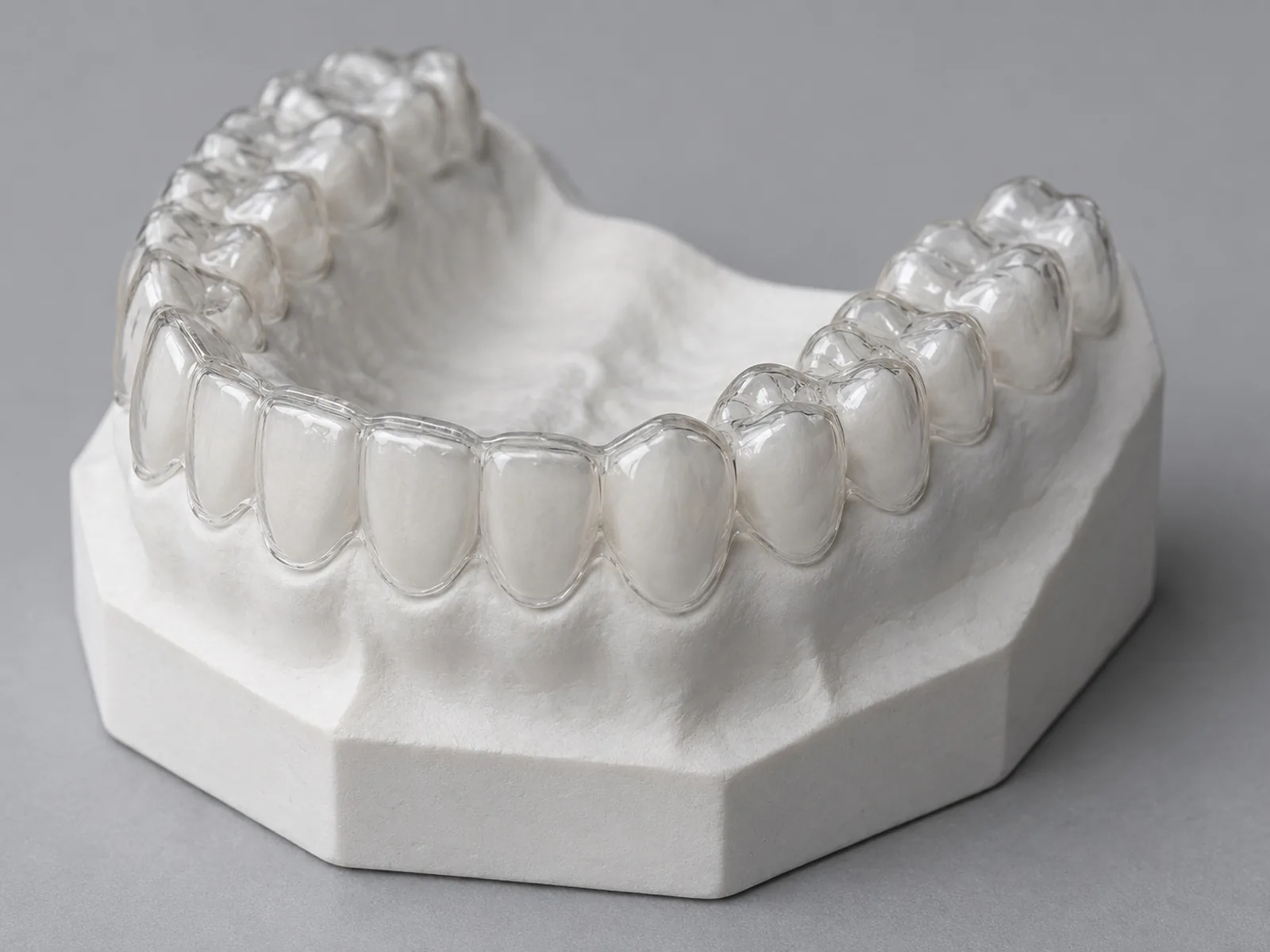
Clear retainer
Retainers used after orthodontic treatment. We use a thin wire bonded behind the front teeth together with a clear retainer.
STEP 07
We remove the appliance and check the retainers for 2 years
When the teeth reach the planned position, we remove the appliance and give you a fixed retainer and a clear retainer. Retainer check-ups and adjustments for 2 years after treatment are included in the orthodontic fee; after that, re-bonding a fixed retainer and remaking a removable retainer are charged.
Why we do thisTeeth tend to move back toward their original position even after orthodontic treatment, and they can move a little throughout life. The first year after treatment is the most important, so we keep the check-up intervals short during this period.
* Clinical photos were published with the patients' consent. Side effects such as temporary pain or discomfort may occur depending on the person.
04°
What is your concern? Detailed explanations by concern
For each concern we have set out the cause, treatment process, real cases and limitations separately.
Concerns caused by the position, tilt or bite of the teeth (crowding, gaps between front teeth, protruding front teeth, deep bite or open bite)
Adults and middle-aged people with healthy gums and bone
People who could have less reshaping if the teeth are repositioned before front-tooth veneers
Other treatment comes first
Severe jaw joint pain right now: treat the jaw joint first
Gum inflammation: gum treatment first
Tooth decay: treat the decay first
A large difference in the jawbones themselves, so surgery should be considered as well
You may not need it now
Small irregularities that cause no functional problem and do not bother you
When color or shape is the concern and whitening or resin is a better fit
06°
How do we decide between extraction and non-extraction orthodontics?
Whether to extract is decided by looking together at the space for the teeth, the tilt of the front teeth, lip thickness and profile, the thickness of the bone supporting the front teeth, and age. Neither avoiding extraction nor extracting is a goal in itself.
How much space is lacking · We measure how many millimeters are missing on the digital model.
Front-teeth tilt · If the front teeth already tip far forward, creating space without extractions can push them out even more.
Lips and profile · Even with the same amount of movement, the mouth looks more set back if the lips are thin and the nose is low.
Thickness of the bone supporting the front teeth · If the bone is thin, there is a limit to how far the front teeth can move.
Age · Lips get thinner with age, so you may look different in 10 years.
Extraction treatment
Non-extraction treatment
Good for
When space is very short, or the front teeth need to move back a lot
When crowding is small and the front teeth are not tilted much
How space is made
Premolar extraction (usually about 7 mm per tooth)
Reshaping between teeth, widening the arch, moving back teeth backward (usually a few millimeters)
Change in lip position
The mouth moves back a lot; the amount is controlled by how the space is shared
Little change around the mouth, and in some cases it may come forward slightly
Points to watch
The mouth may move back too far
The front teeth may come forward more, or the bone around them may become thinner
Duration
Usually 2–2.5 years
Usually 1.5–2 years
Not all of the extraction space is used to move the front teeth back. We explain this in detail on the protruding mouth page.
07°
How do we choose an orthodontic appliance?
We choose an appliance not only by how visible it is and how it fits your daily life, but by whether it can do the movements your teeth need. We decide on the appliance together after the diagnosis.
Ceramic braces
Self-ligation
Lingual braces
Combination braces
Invisalign
Visibility
Tooth-colored, so it is hard to see from a distance but visible up close
Metal or tooth-colored, depending on the product
Bonded behind the teeth, almost invisible from outside
Upper inside, lower outside, so it is hard to see when you smile
Clear, so it is hard to see
Works well for
Most orthodontic treatment, including extraction cases
The stage of lining up the teeth evenly
People who must not have a visible appliance
People whose upper teeth mainly show
Mild to moderate alignment and spacing problems
Difficult cases
Deep bites where the lower teeth hit the upper appliance hard
We do not consider it "always faster"
Deep bites with too little room on the inside for the appliance
Complex plans because the upper and lower appliances behave differently
Closing large extraction spaces or moving teeth bodily over long distances
Inconveniences in daily life
Rubbing on the inside of the lips for the first 1–2 weeks
Similar to standard appliances
Tongue rubbing and awkward speech for the first few weeks
Tongue rubbing on top, lip rubbing on the bottom
Worn 20–22 hours a day, taken out to eat
Care
Brushing around the appliance and interdental brushes
No elastic ties, so food tends to get caught less
Brushing on the inside is harder, so be extra careful
Upper and lower cared for separately
Clean the aligners and brush before putting them in
Self-ligating appliances hold the wire with a small door in the bracket instead of tying it with elastic ties or thin wire. My 2022 paper measured whether the force on rotated and tilted front teeth changes depending on exactly this tying method. That is why we do not say self-ligating is always better, and we choose based on the condition of your teeth.
08°
How long does orthodontic treatment take?
The duration depends on how far and in which direction the teeth need to move, whether teeth are extracted, and your age and gum condition. At the consultation we give you an expected range for your case and re-evaluate partway through.
Protruding mouth / extraction orthodontics · Usually 2 to 2.5 years
Full non-extraction orthodontics · Usually 1.5 to 2 years
Partial orthodontics for the front teeth · Usually 6 months
Retention period · You keep using a retainer for a long time after the appliance comes off. We explain the details on the retainer page.
Reasons treatment takes longer: the appliance comes off, clear aligners are not worn long enough, appointments are spaced too far apart, or force has to be kept light because of the roots or gums.
09°
Adult and middle-aged orthodontics: is it too late?
Adults can have orthodontic treatment too if their gums and bone are healthy. However, from middle age on, the condition of the gums and bone determines the speed and method of treatment, so a periodontist checks the gums first.
Order · Gum examination (periodontist) → decide whether to treat the gums first, manage them during orthodontics, or treat them after orthodontics → orthodontics → implants for missing teeth if needed (after uprighting tilted teeth)
Black triangles may appear in the gums between teeth.
If the gums are thin, the range of movement is small.
Existing crowns and implants do not move.
These are things we tell you before starting adult orthodontics.
10°
Side effects and limits
Please read
· The gums may recede, or black triangles may appear in the gums between teeth.
· The tooth roots may become shorter (root resorption). We check this with X-rays during treatment.
· Without good care, tooth decay or gum inflammation may develop.
· Jaw joint symptoms may change.
· If you do not wear your retainer, the teeth may become crooked again.
· Orthodontics alone can change jawbone differences only to a small extent.
FAQ
FAQ
Can I come just for an orthodontic consultation?
Yes. An opinion based only on photos gives a direction; an accurate orthodontic plan is made after a full examination. You can also send photos of your face and teeth first on WhatsApp or LINE.
Up to what age is orthodontic treatment possible?
The deciding factor is the condition of your gums and bone, not your age. If your gums and bone are healthy, orthodontic treatment is possible in middle age and beyond, and for adults a periodontist checks the gums as well.
How long does orthodontic treatment usually take?
Full orthodontic treatment usually takes 1.5 to 2.5 years, and partial treatment of the front teeth usually takes 6 months. It depends on whether teeth are extracted and how far the teeth need to move, and at the consultation we give you an expected range for your case.
We plan how the extraction space is shared between the front teeth and the back teeth, and we re-evaluate your profile partway through treatment. For people with thin lips, we move the front teeth back less so the area around the mouth does not look sunken.
Does orthodontic treatment hurt?
For 2 to 3 days after the appliance is placed or adjusted, your teeth may feel sore and chewing may be uncomfortable. Most people get used to it within a week, and you can take an ordinary painkiller if needed.
Can I have veneers during orthodontic treatment?
Usually we first move the teeth into position with orthodontics and then decide on veneers. If we look at this together at the planning stage, we can create spaces in advance that need less reshaping or none at all.
Can I have orthodontic treatment while living abroad?
It is possible if you can visit once a month for wire braces or once every 2–3 months for Invisalign. We first ask when and how often you can visit, and then decide on an appliance and plan that fit.
Will my teeth stay straight after treatment?
Teeth can move a little throughout life, so you need a retainer even after orthodontic treatment. At Ceramic Dental Clinic, retainer check-ups and adjustments for 2 years after treatment are included in the orthodontic fee.
I am in orthodontic treatment at another clinic. Can I transfer?
Yes. We also accept patients who are in orthodontic treatment at another clinic. How to continue depends on the appliance currently on your teeth and the stage of treatment. If you have examination records and the treatment plan from your previous clinic, please bring them.
Evidence and references
Kim S, et al. Influence of different ligation methods on force and moment generation in a simulated condition of the maxillary crowded anterior dentition with linguo-version and rotation. Bio-Medical Materials and Engineering, 2022. doi:10.3233/BME-211288 (differences in orthodontic force and torque depending on the tying method)
Development of 6-axis orthodontic force and moment sensing device for decreasing accident of orthodontic treatment. IEEE EMBC 2018. PMID 30440743 (Development of a device that measures orthodontic forces and rotational forces)
Kim S, et al. Characterization of Spheno-occipital Synchondrosis Fusion From Preadolescents to Young Adults Using Age and Cervical Vertebrae Maturation Index. Journal of Craniofacial Surgery 35(2), 2024. (Analysis of when facial bone growth ends)
Questions from patients who travel to Seoul for treatment.
How much does orthodontic treatment cost?
The fee depends on the appliance. For example, metal braces are KRW 4,800,000, ceramic braces KRW 6,000,000, Invisalign KRW 8,500,000 and lingual braces KRW 8,600,000. The orthodontic fee includes the orthodontic diagnosis, extraction (except wisdom teeth), mini-screws, basic retainers and retention care for 2 years. If you have only the diagnosis and do not start treatment, it is KRW 50,000 (KRW 100,000 if a CT scan is needed). If a retainer breaks or is lost later, remaking it costs extra. International and Korean patients pay the same fees. We explain the total before treatment starts. See our fee schedule.
Can I continue treatment after I go home?
Yes, but it needs a plan. Fixed braces need regular adjustment visits: the first two visits are 2 weeks apart, then usually once a month. Clear aligners are easier from abroad: after you receive your aligners, you visit once every 2–3 months, and between visits we check by photo only if something comes up. Your doctor tells you at diagnosis which method fits your case.
Can I have my consultation in English?
Yes. The doctor in charge of each field consults with you directly in English. For orthodontics, this is Dr. Sunmin Kim, a board-certified orthodontist. Before you travel, you can send photos of your teeth on WhatsApp or by email. An accurate diagnosis is made after we examine you in person.
What happens after treatment, and what if something comes off?
You need retainers after treatment, because teeth tend to move back. Retention care for 2 years is included in the orthodontic fee. If a bracket comes off or a wire hurts after you go home, send us a photo on WhatsApp. We check it and tell you what to do. Some repairs need a visit.
Results, the number of visits and schedules vary from person to person. More questions: Visiting from abroad.


 Before · Oct 2021
 After treatment · June 2024
 Before · Mar 2022
 After treatment · June 2024
 Before treatment
 After treatment · about 1 year 6 months
 Facial photos · AI illustration
 Intraoral photos
 Cephalometric analysis
 iTero scan
 Jaw joint X-ray
 Gum chart
 Explanation of results
 Placing the appliance
 Mid-treatment re-evaluation
 Fixed
 Clear retainer