Last reviewed October 29, 2026 · Dr. Sunmin Kim (board-certified orthodontist, Certified Orthodontist of the Korean Association of Orthodontists)
At a glance
Good for
Teeth worn down or chipped from grinding at night, with a stiff jaw in the morning
Treatment flow
Record worn teeth and check muscles → Impressions → Splint fitting → 1–2 adjustments
Duration and limits
A splint protects your teeth but does not stop grinding. For daytime clenching, practicing keeping your teeth apart comes first
Details
A splint does not stop teeth grinding. It keeps your upper and lower teeth from grinding directly against each other while you sleep, protecting your teeth, dental restorations, and jaw muscles. If grinding at night wears down or chips your teeth and your jaw feels stiff in the morning, a custom splint can help. It usually takes 1 impression visit, 1 fitting visit, and 1–2 adjustment visits. A splint cannot stop daytime clenching, so practicing keeping your teeth apart comes first. At Ceramic Dental Clinic, we record worn teeth with photos and check your jaw muscles and joints together to decide whether you need a splint or can wait and watch.
01°
Even with the same grinding, some cases needed a splint and some did not
We chose different treatment depending on whether it was night grinding or daytime clenching, how damaged the teeth were, and whether there were restorations to protect. Here are three typical cases with their progress records.
CASE01
Molars worn and crowns broken from grinding at night
Botox (symptoms were controlled with the splint and habit correction)
Record
Morning jaw pain 5/10 → 2/10
Note
Grinding can get worse again during stressful periods, so we check the splint every 6 months.
CASE02
Jaw muscle pain from a habit of clenching the teeth during the day
Daytime clenching · Teeth-apart practice and self-exercises, physical therapy, no splint
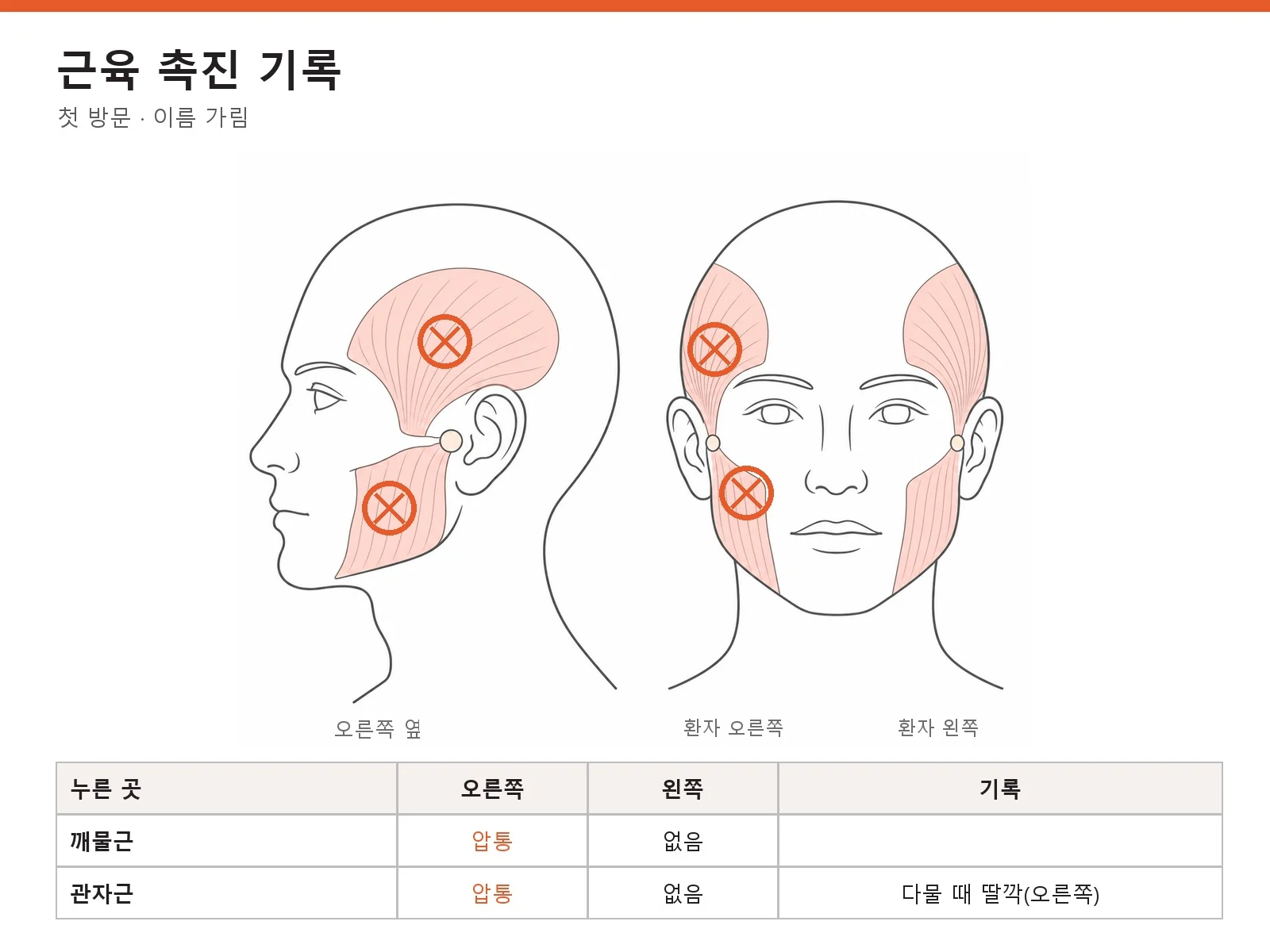
Muscle record
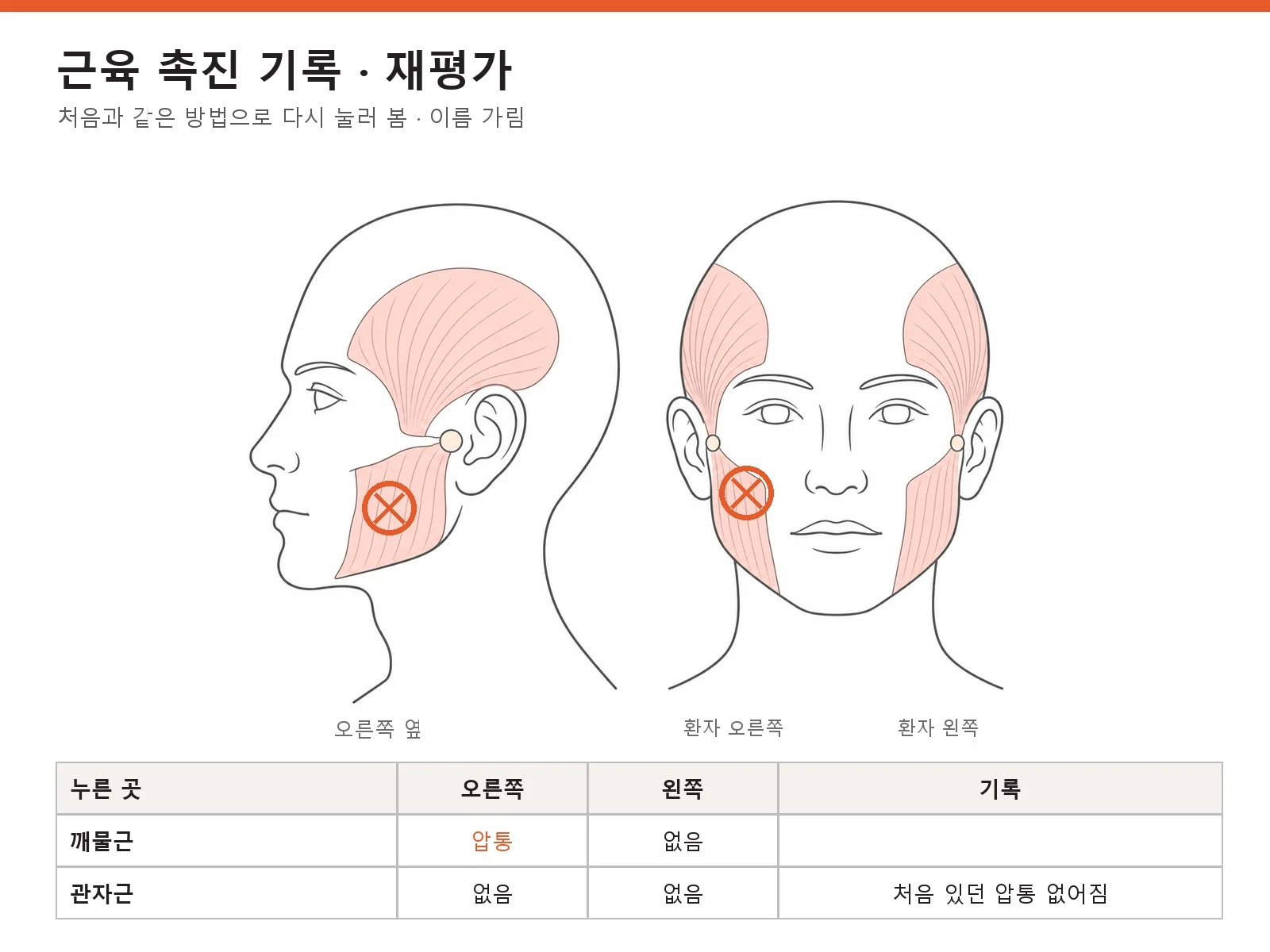
Muscle palpation record. Pressing the masseter muscle reproduced the usual pain.
Habit correction
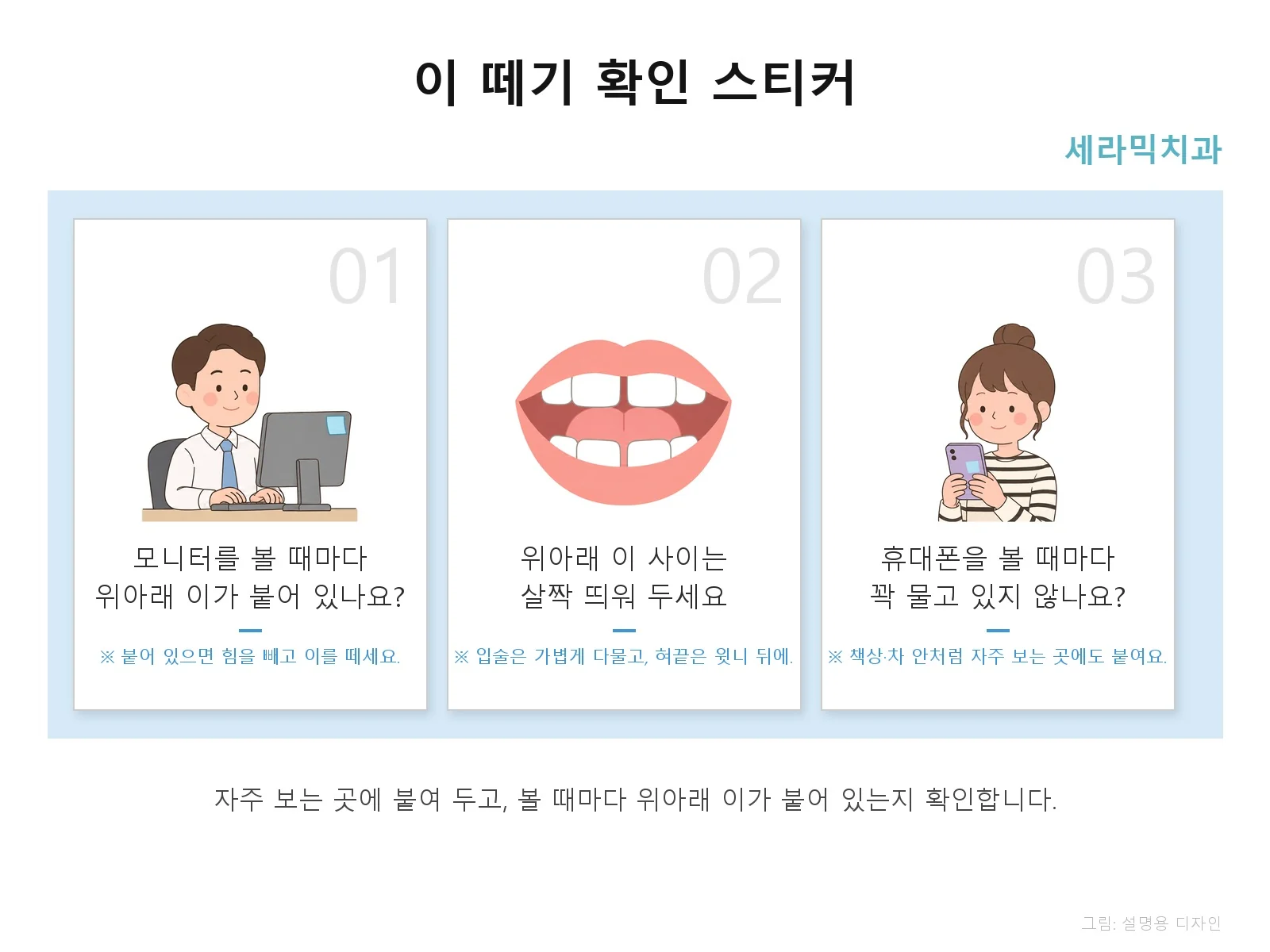
Teeth-apart reminder sticker. Put it where you look often, and each time you see it, check whether your upper and lower teeth are touching.
Re-evaluation
Re-evaluation. Mouth opening and muscle pain were measured again the same way as the first time.
Condition
30s, clenching habit during computer work, jaw muscle pain worse in the afternoon, almost no tooth wear
Chosen
Teeth-apart practice and relaxed position, self jaw exercises, PHL-15 physical therapy
Not done
Splint (almost no signs of night grinding; the daytime habit was the cause)
Record
Pain 6/10 → 1/10
Note
The habit tends to come back during busy periods, so we advised continuing with the stickers and exercises.
CASE03
Worried about grinding after porcelain veneers
Protecting restorations · Custom splint after veneers were completed
Before treatment
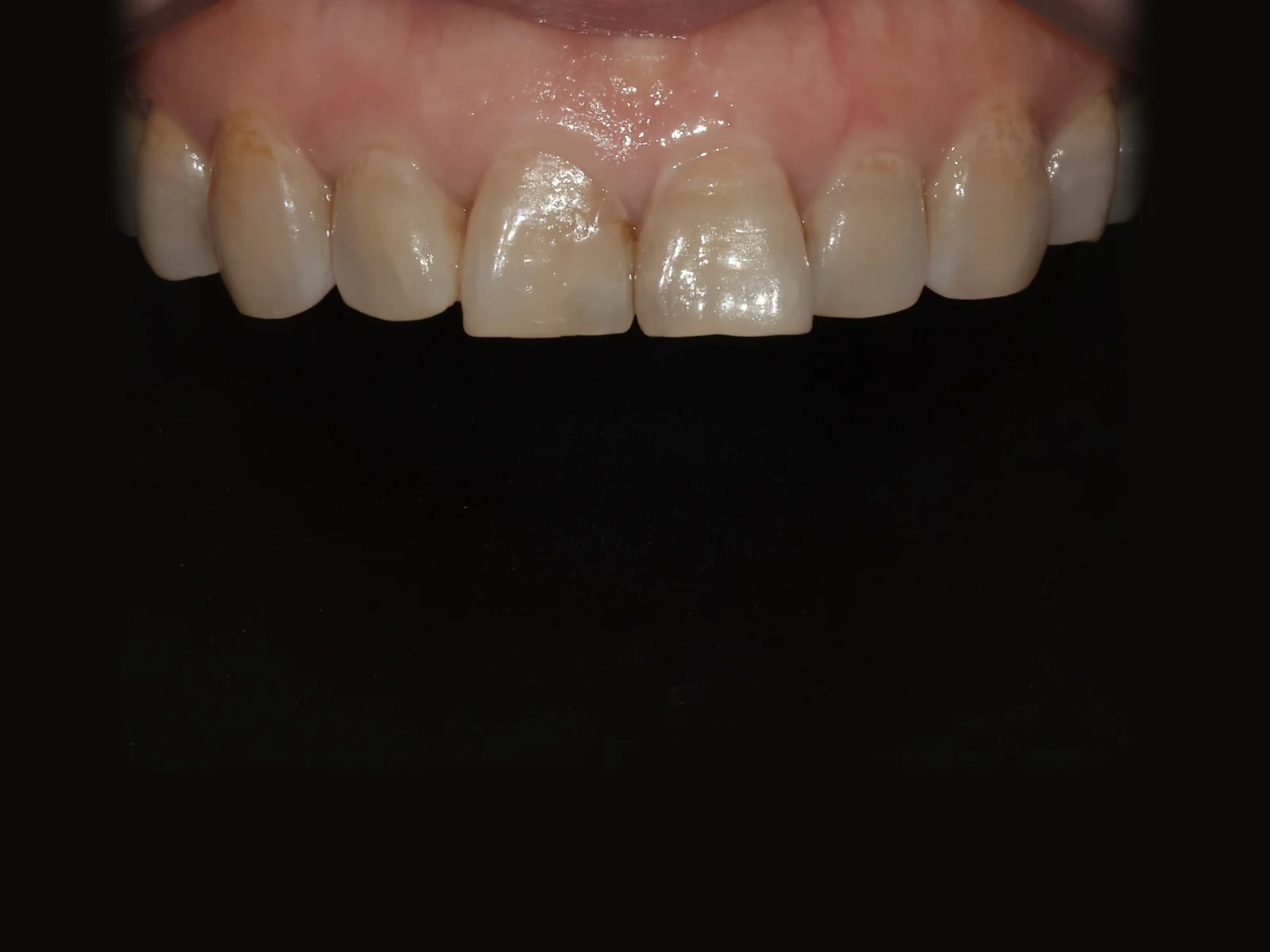
Front teeth before veneers. The edges were unevenly worn, confirming signs of grinding.
After veneers
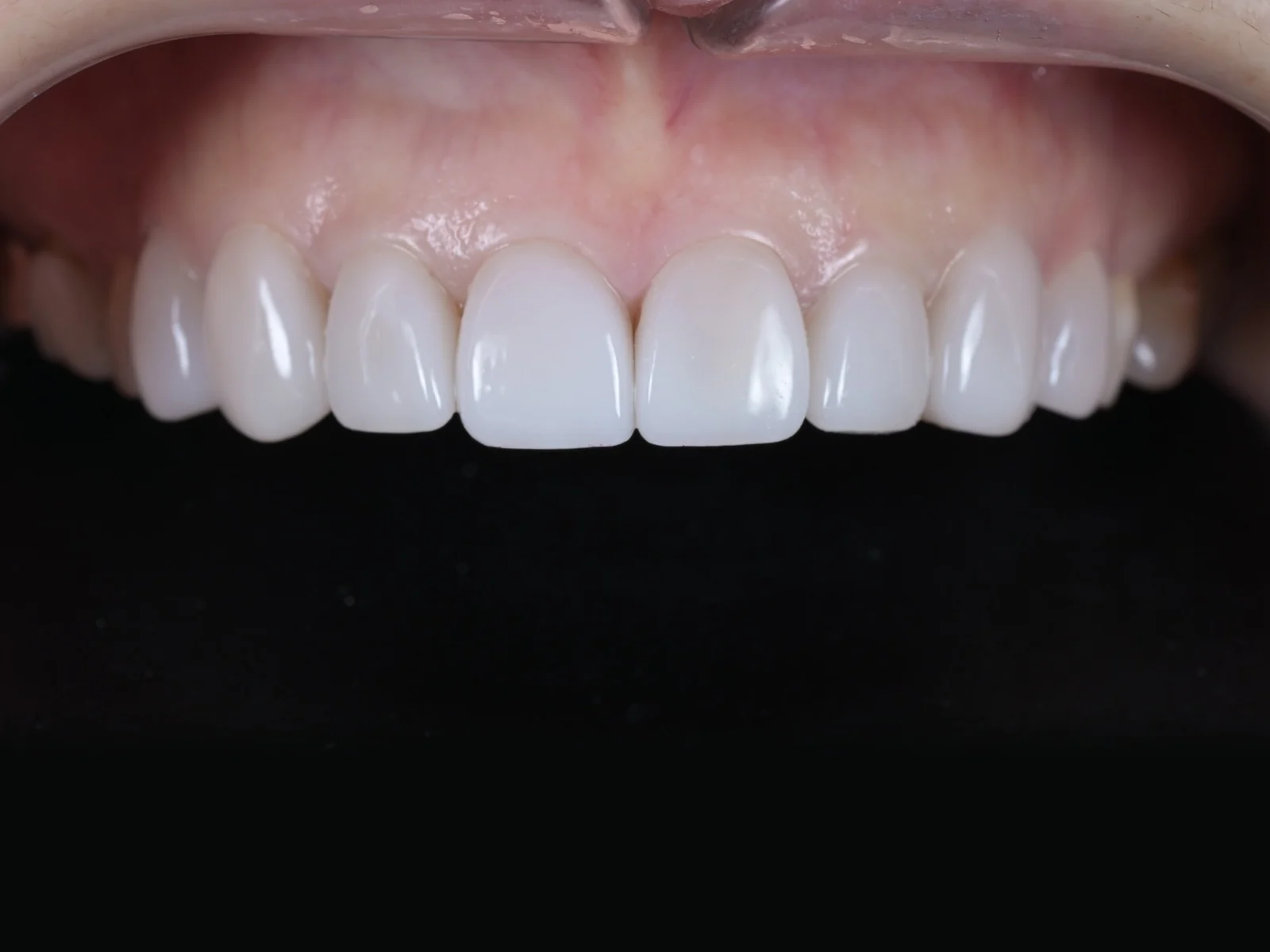
After veneers were completed. The new front teeth needed protection so they would not chip or come off.
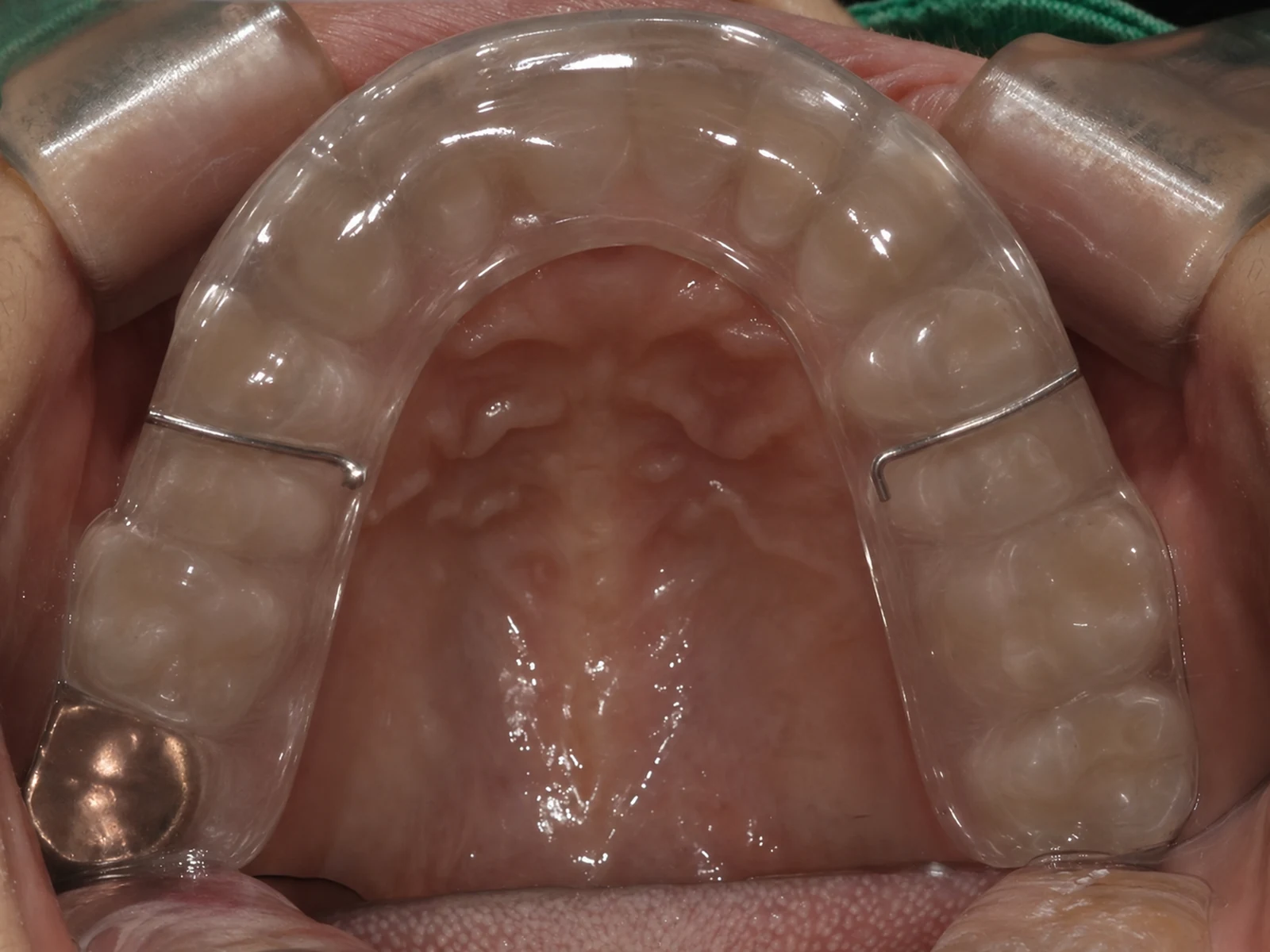
Splint
With the splint in. At night, it keeps the front veneers from hitting the lower teeth directly.
Condition
Worn front tooth edges, veneer treatment planned
Chosen
Custom splint after veneers were completed
Not done
Soft mouthguard from a pharmacy or online store (the bite cannot be adjusted)
Duration
About 1–2 weeks from veneer bonding to splint completion
Note
The splint is not worn during the day, so the daytime clenching habit also needs to be reduced. We need to keep checking that the splint is worn regularly and that wear does not increase at regular check-ups.
* Records and photos were published with the patients' consent. Pain scores are 0–10 ratings given by the patients themselves. Treatment results and side effects may vary from person to person.
02°
Night grinding and daytime clenching are handled differently
Both keep the jaw muscles from resting, but they happen at different times and are corrected in different ways.
01Grinding during sleep
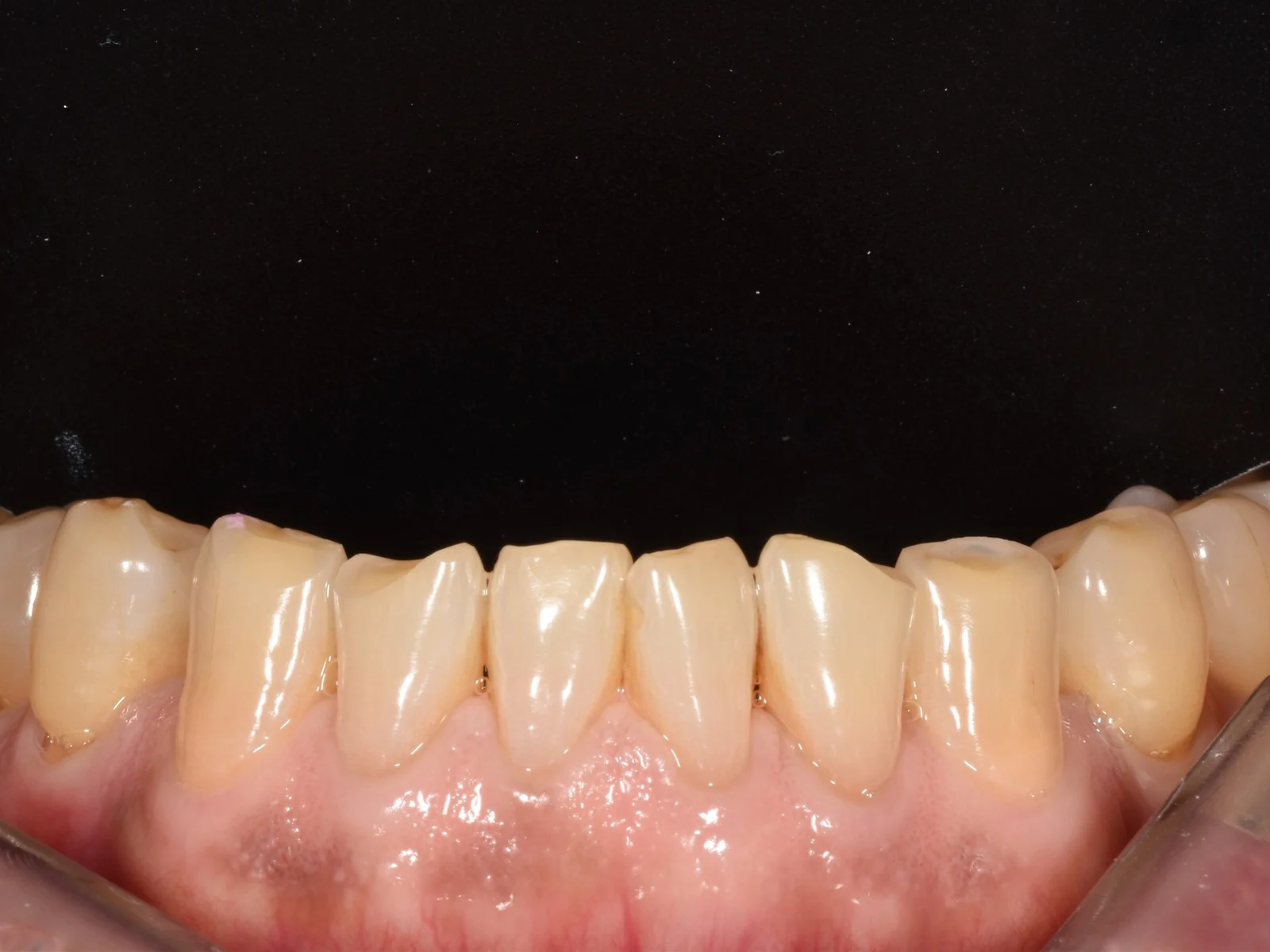
Often you do not notice it yourself, and family members hear the sound. You cannot stop it by will while asleep, so the main approach is protecting your teeth and restorations with a splint. Your jaw may feel stiff in the morning.
02Daytime clenching
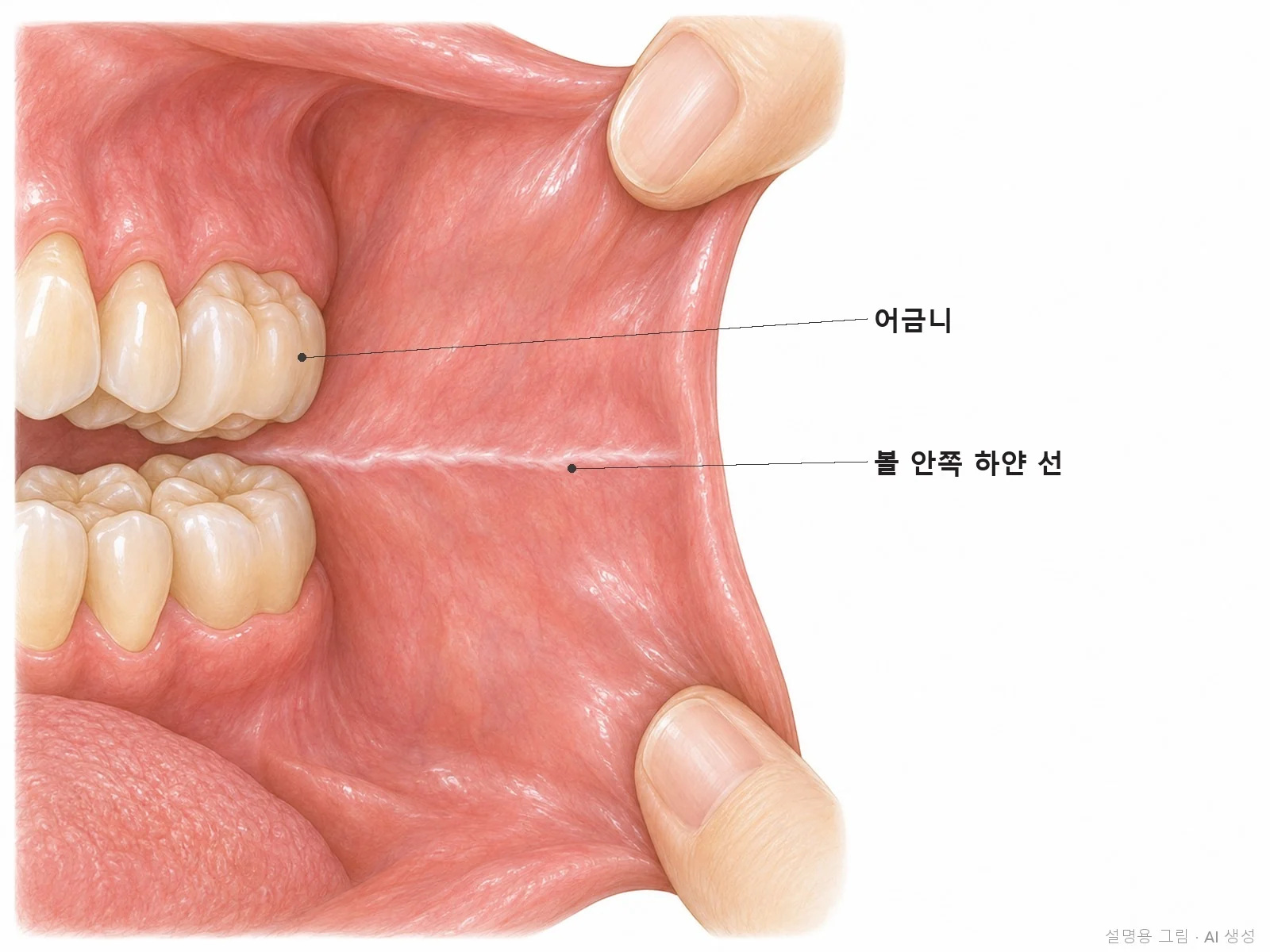
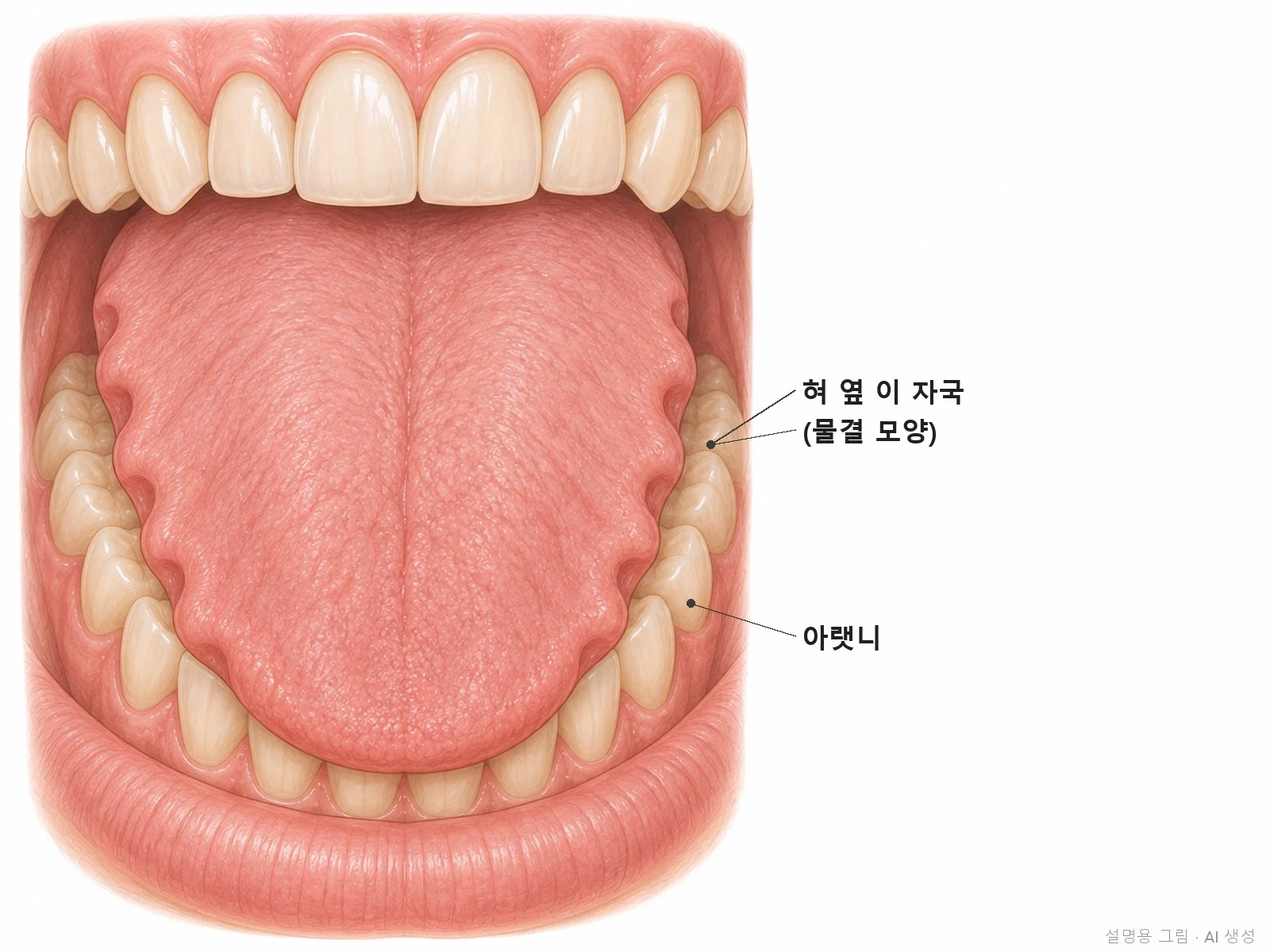
You press your upper and lower teeth together when focusing on work, exercise, or your phone. You can notice and correct it yourself, so practicing keeping your teeth apart matters most. A splint cannot stop it.
Signs of night grinding
Signs of night grinding. Canine and front tooth edges grind sideways and form flat worn surfaces.
Signs of clenching
Signs of clenching. A white line forms on the inside of the cheek at the level where the molars meet.
Signs of clenching
Signs of clenching. Tooth marks are left in a wavy pattern along the side of the tongue.
Stress, tension, and lack of sleep are common causes, and snoring or breathing problems during sleep are sometimes involved. We do not simply conclude that "you grind because your bite is off."
03°
How we make a custom splint
Five steps, from records to regular check-ups. For each step, we explain what we look at and why, with real treatment photos.
Photo records
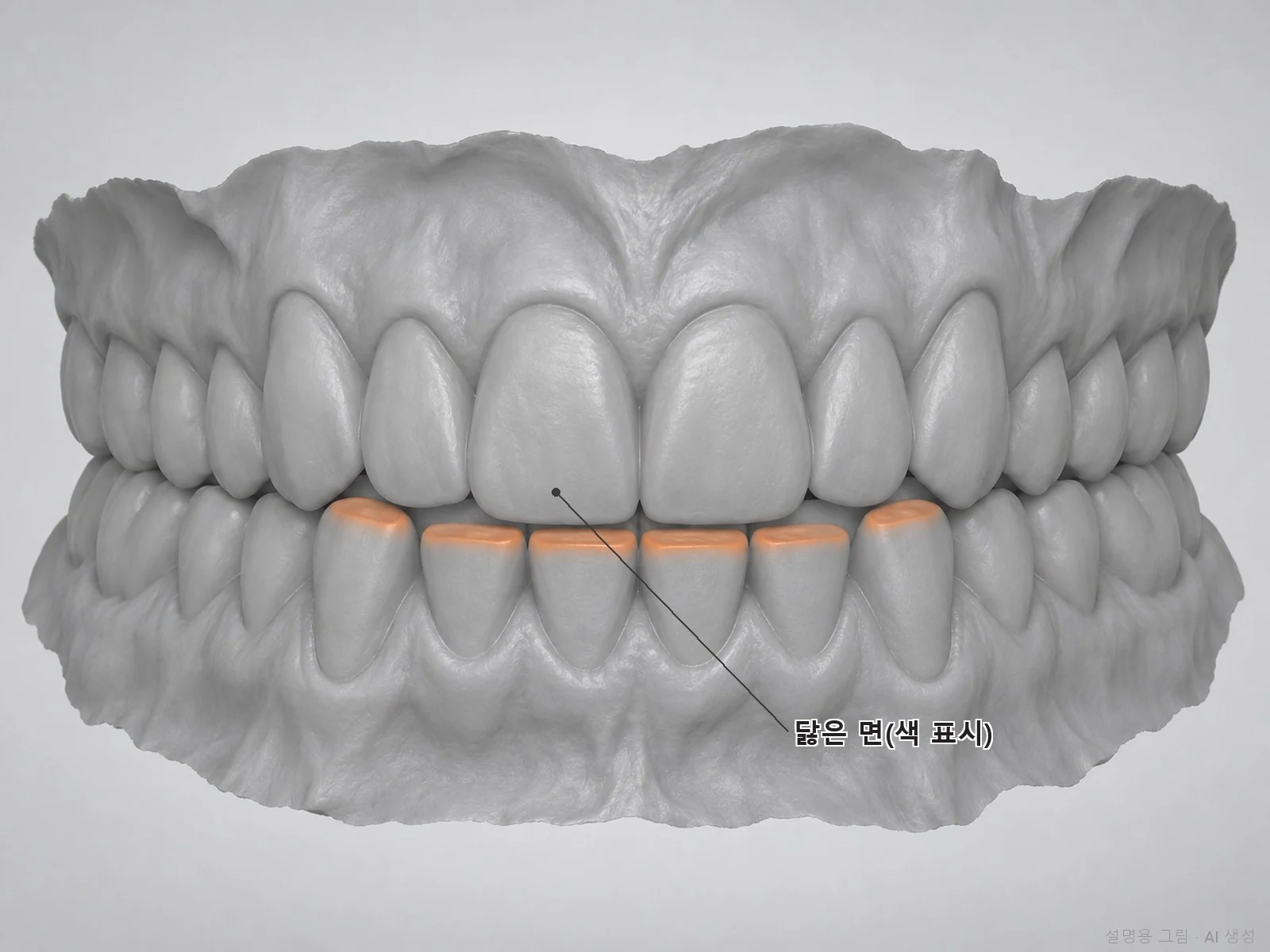
3D scan
Wear records. We photograph where and how much the teeth are worn and compare at the next check-up.
STEP 01
We record worn teeth and broken restorations
We check how worn the canine and front tooth edges and molar biting surfaces are, and whether any teeth or restorations are cracked or broken, and record them with photos. Areas near the roots that are notched and sensitive are also checked by Dr. Ilseop Ahn, a board-certified periodontist and specialist in integrated dentistry.
Why we do thisGrinding is not a problem that appears overnight, so we need to record how far it has progressed now as a baseline. With records, we can compare whether wear has stopped or continues after you start using a splint.
Self-questionnaire
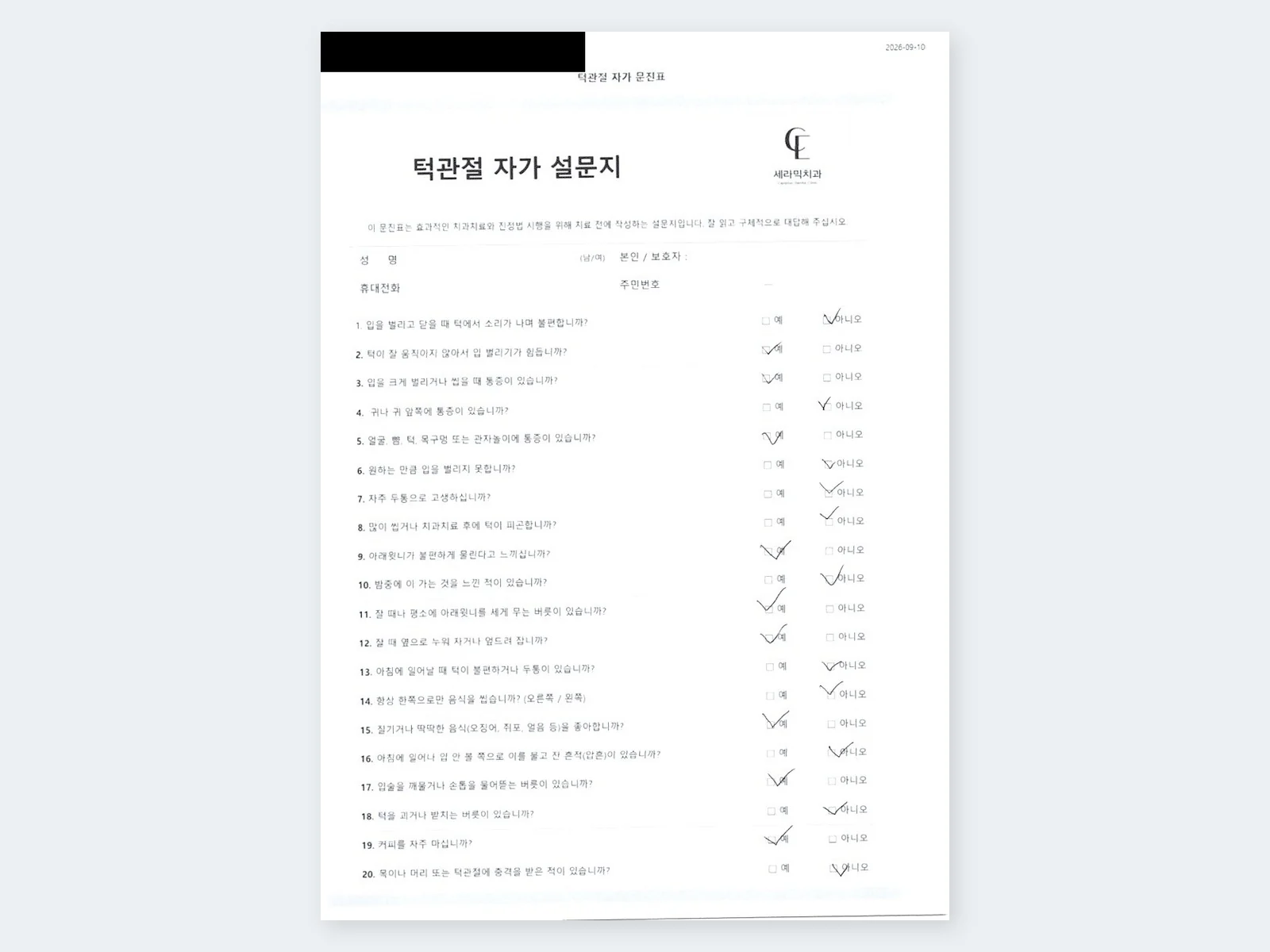
TMJ self-questionnaire (the actual form used at our clinic, name hidden). You first mark clenching habits and jaw pain, then we press the masseter and temporalis muscles and measure how many mm your mouth opens.
STEP 02
We check your jaw muscles and joints together
We check whether the jaw muscles hurt when pressed, whether your mouth opens well, and whether there is clicking or catching. If jaw pain is severe, we start with lifestyle advice, medication, and PHL-15 physical therapy before a splint, and re-evaluate after about 2 months.
Why we do thisIf a splint is fitted right away while the jaw is very painful, the bite changes every morning, making it hard to fit the splint accurately. Easing the pain first makes the splint bite adjustment more accurate.
Design and fabrication
Design and fabrication
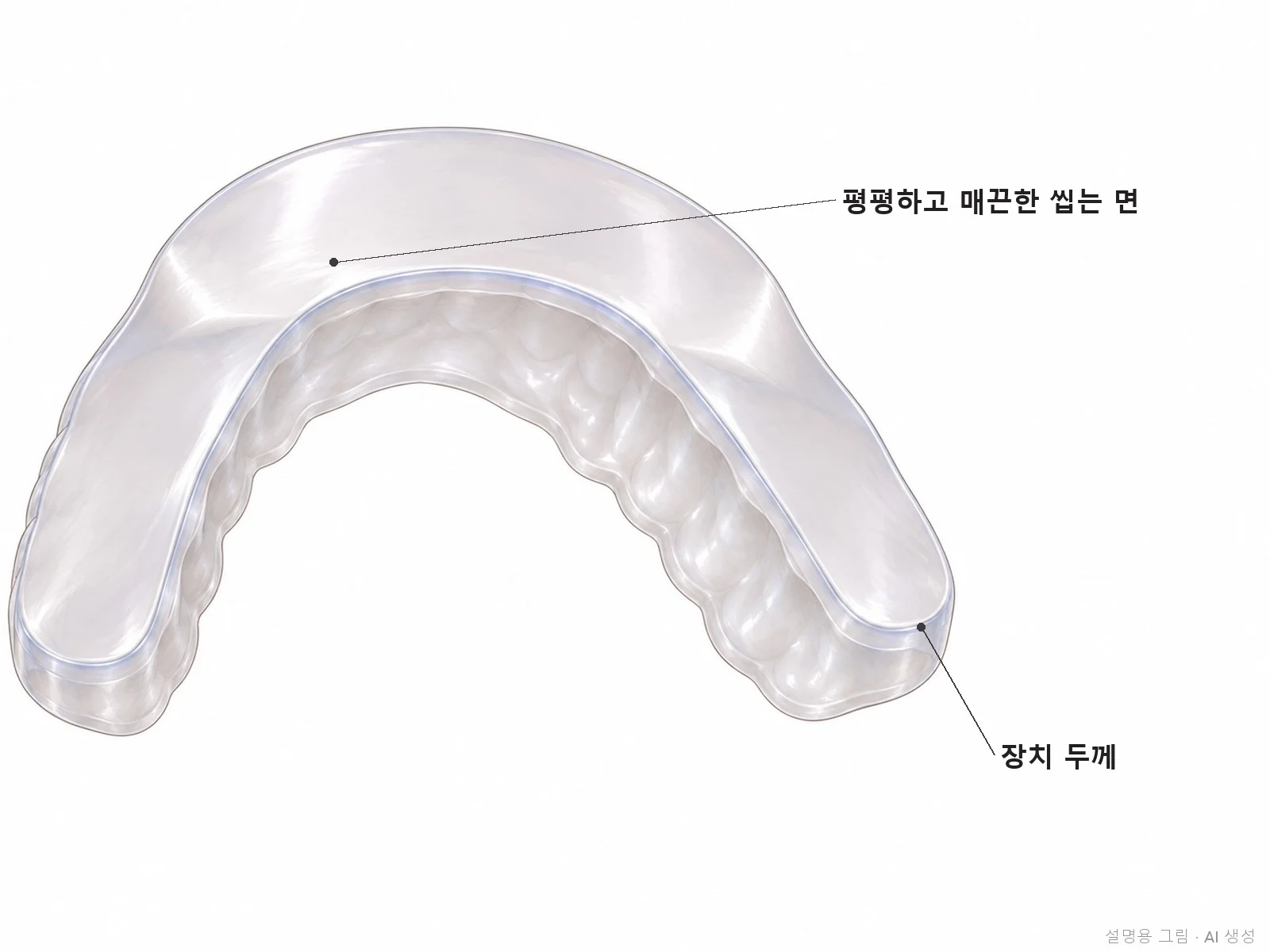
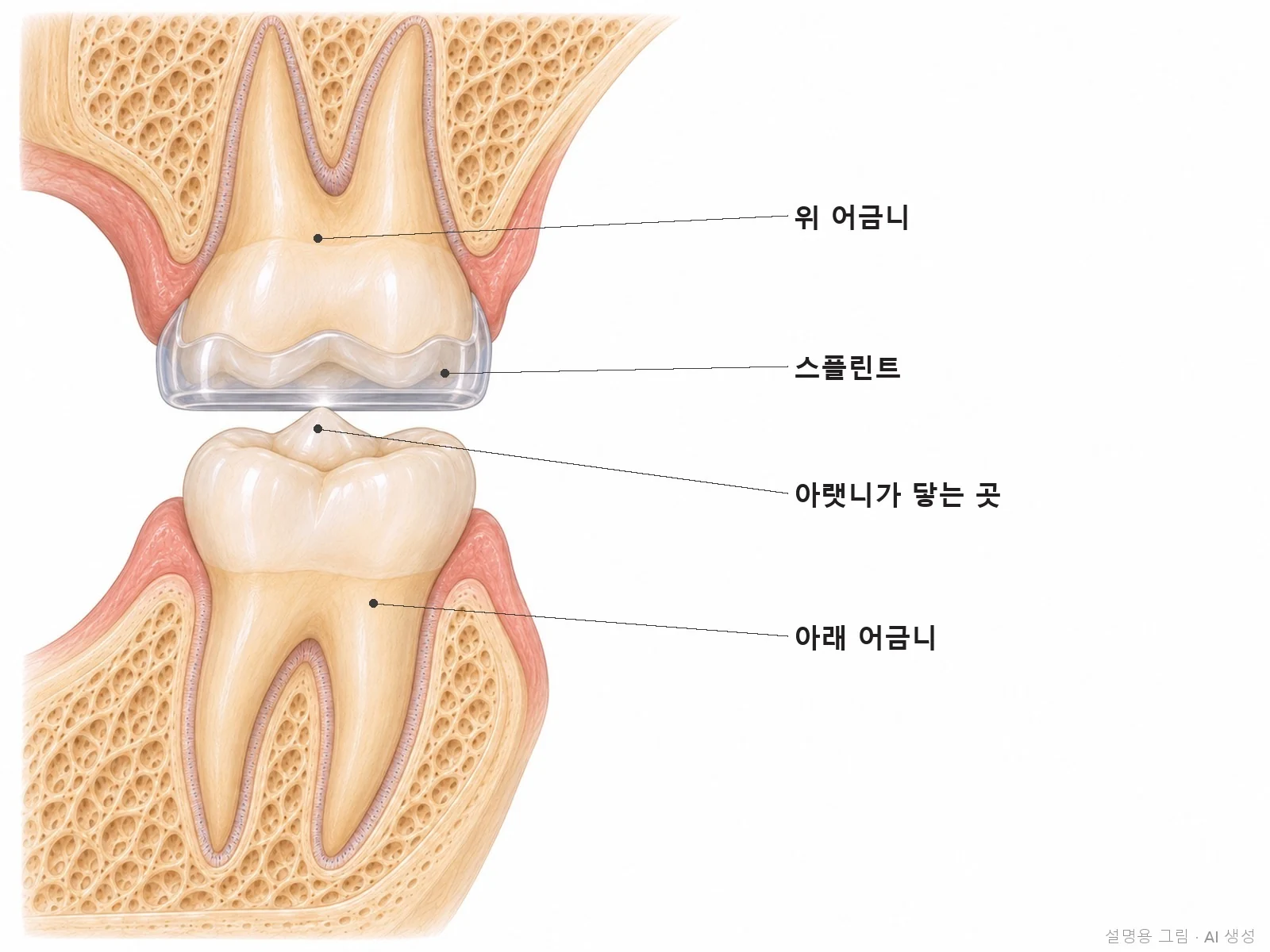
Finished custom splint. It is made from a hard material, and the biting surface is smoothed flat so the lower teeth touch it evenly.
STEP 03
We design the bite height and splint thickness
Based on a model of your teeth, we set the splint thickness and bite height. We make a hard splint worn over the upper teeth and design it so the lower teeth touch its flat surface evenly.
Why we do thisSome experts say a soft ready-made mouthguard cannot be fitted to your bite, so force goes to only some teeth and it may even increase chewing habits. A custom splint is adjusted for height and contact to spread the force evenly.
Fitting and adjustment
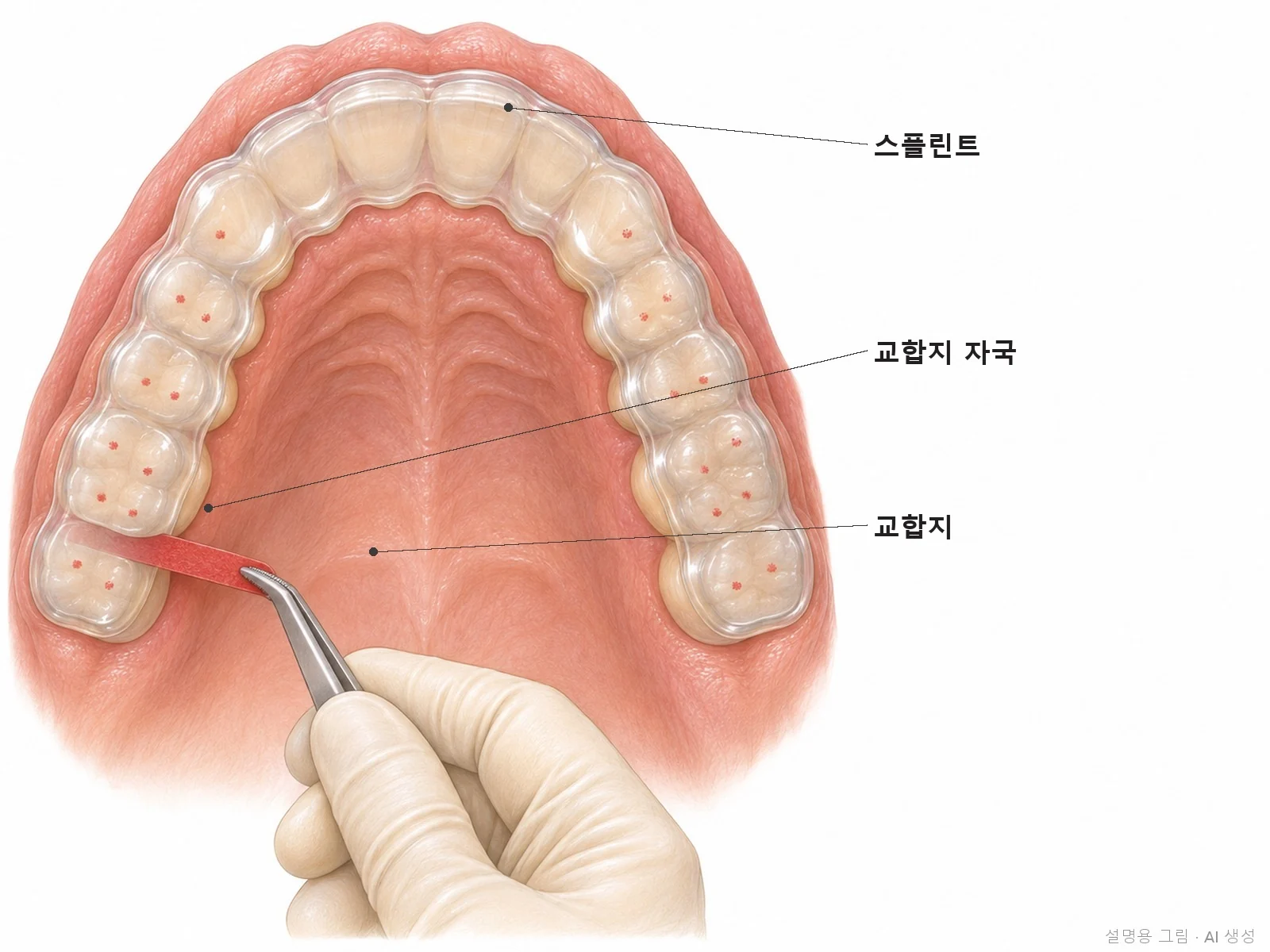
Fitting and bite adjustment. You bite on thin paper (articulating paper), and we smooth high spots so your lower teeth touch the splint evenly.
STEP 04
We adjust the bite on the fitting day and 2 weeks later
On the fitting day, we adjust the bite and show you how to put the splint in, take it out, and clean it. After about 2 weeks of use, you come back, tell us what felt uncomfortable in the morning, and we adjust it once more. Adjustments are usually 1–2 visits.
Why we do thisThe bite set in the clinic on the first day can differ slightly from how you actually bite while sleeping. Listening to discomfort after a few days and refining the splint helps you keep wearing it regularly.
Regular check-ups
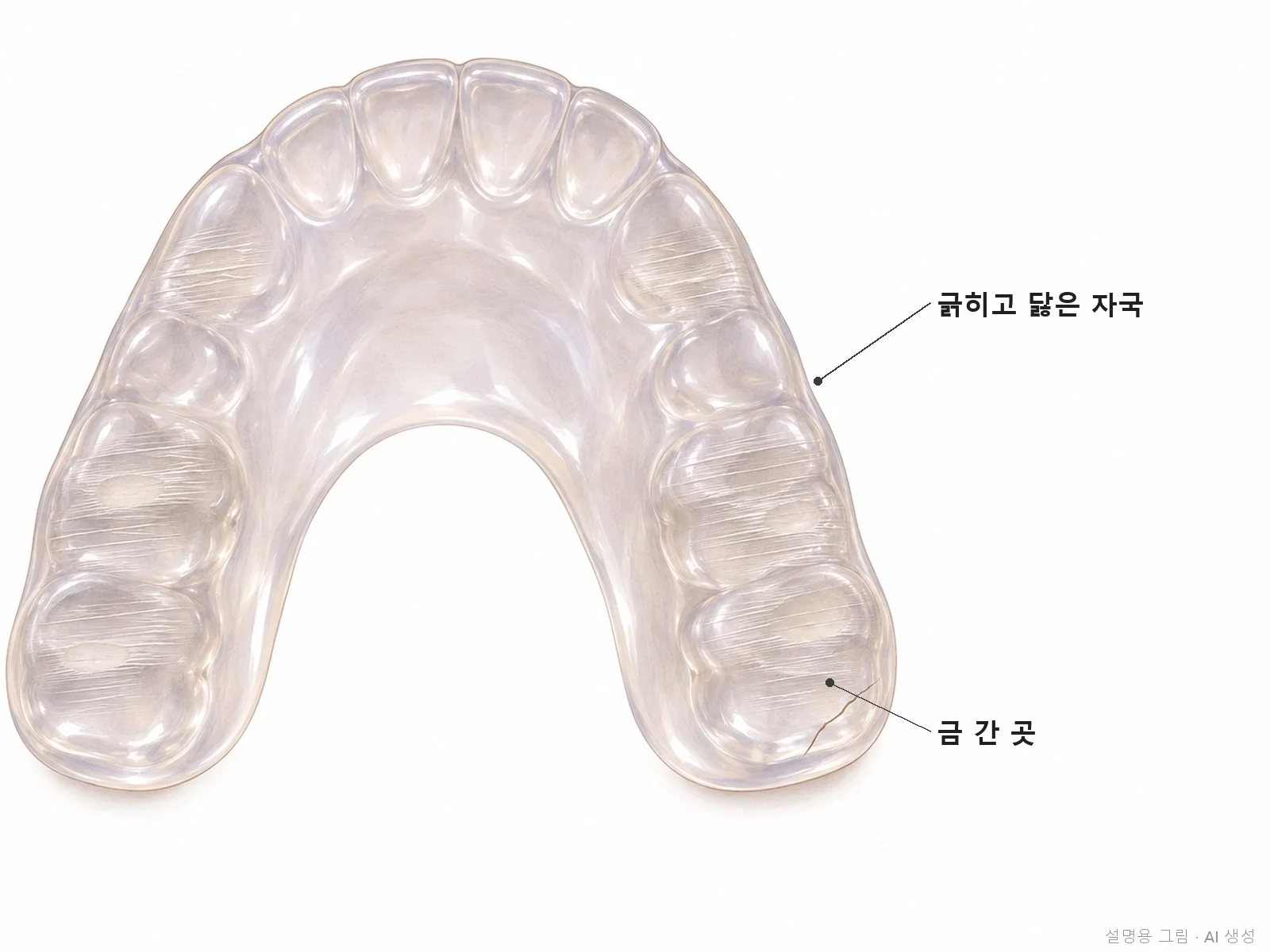
Regular check-ups. Marks left on the splint surface show how strong your grinding is and in which direction it goes.
STEP 05
At regular check-ups, we look at the splint and your teeth together
Bring your splint usually every 6 months. We check the marks on it, any cracks, and the fit, and compare with your first records to see whether tooth wear has progressed. If grinding has decreased, we also decide whether you still need it.
Why we do thisWhile the splint wears down in place of your teeth, your teeth are protected. But if the splint is badly worn or cracked, it protects less. Marks on the splint are also a record showing whether grinding continues.
* Clinical photos were published with the patients' consent. Side effects such as temporary pain or discomfort may occur depending on the person.
Clean the splint with a toothbrush in the morning and keep it in its case. Avoid hot water, which can warp it.
04°
Check yourself for signs of grinding
If 3 or more apply, we recommend an exam. You can send us photos of your worn teeth first.
05°
Comparing treatment options for grinding and clenching
If grinding continues, they can break again, so we consider them together with a splint
Varies by treatment
⑥ Referral to other specialties
Suspected breathing problems during sleep
Sleep study
Finding hidden causes
Care outside dentistry
Varies by provider
06°
Who needs a splint, what to treat first, and who can wait and watch
A splint helps
You have tooth wear, chipping, or broken restorations from grinding at night
Night grinding with a stiff jaw in the morning
You need to protect veneers, implants, or crowns
Other treatment comes first
Severe jaw pain: we start with step-by-step TMJ treatment first
Broken teeth or cavities: we restore them first
Heavy snoring, or you have been told you stop breathing in your sleep: we recommend a sleep study first
You can wait and watch for now
Mild grinding with almost no wear and no symptoms: we watch with habit advice and regular check-ups
Only daytime clenching with no signs of night grinding: teeth-apart practice comes first
07°
Side effects and limits
Please read
· A splint protects your teeth and jaw but does not stop grinding. Grinding can get worse again.
· For the first few days, you may have more saliva or the splint may feel strange.
· Right after taking the splint out in the morning, your bite may feel strange for a moment. It usually returns to normal quickly.
· A poorly fitting splint can be uncomfortable and tense the muscles, so adjustment is needed.
· With long use, the splint may wear or crack and need to be remade.
· If you have breathing problems during sleep, the type of device may need to be decided separately.
FAQ
FAQ
Will wearing a splint stop my teeth grinding?
A splint does not stop teeth grinding. It keeps your upper and lower teeth from grinding directly against each other while you sleep, protecting your teeth, dental restorations, and jaw muscles.
You wear it for protection while the grinding continues. At regular check-ups, we look at the marks left on the splint and your symptoms to decide whether you still need it. If stress eases and the grinding weakens, you may wear it less often.
How is a dental splint different from a mouthguard from a pharmacy or online store?
A custom dental splint is made from a hard material to fit a model of your teeth, and we adjust its height and contact so your lower teeth touch it evenly. A soft ready-made mouthguard cannot be adjusted to your bite, so force may be concentrated on some teeth.
Is clenching my teeth during the day a problem too?
Daytime clenching keeps your jaw muscles from resting and is a common cause of jaw pain. A splint cannot stop it, so practicing keeping your upper and lower teeth apart and learning a relaxed jaw position come first.
My child grinds their teeth in their sleep. Do they need treatment?
Teeth grinding is common in growing children and usually decreases as they grow, so if there is no pain or severe wear, we watch and wait. If there is jaw pain, severe wear, or snoring as well, an exam is a good idea.
I have porcelain veneers or implants, and I grind my teeth.
Grinding raises the risk that veneers, crowns, and implant restorations will break or come off. To protect them, we may recommend a custom splint worn at night.
Can I wear a grinding splint during orthodontic treatment?
The approach depends on the type of braces and how much you grind, so we decide together at your consultation. As your teeth move, the splint sometimes needs to be refitted.
How do I take care of my splint?
When you take it out in the morning, brush it gently with a toothbrush and keep it in its case. Avoid hot water, which can warp it. Bring it to your regular check-ups so we can check its fit and wear.
Evidence and references
UK NHS GIRFT and Royal College of Surgeons guidance on TMJ disorders (2025): a splint is an adjunct, not a stand-alone treatment. View the source
Questions from international patients who live in Korea.
Can I use Korean National Health Insurance?
If you are enrolled in Korea's National Health Insurance, insured treatments are billed under the same insurance rules as for other enrollees. Whether a treatment is covered depends on the treatment and the insurance rules, and we tell you before treatment starts. If you are not enrolled, you pay the full fee.
Can I be seen in English?
Yes. The doctor in charge of each field consults with you directly in English, so you do not need an interpreter.
I am in Korea only for a short trip. Can I have this treatment?
It depends on how many visits the treatment needs. Tell us your travel dates when you contact us, and we will tell you after the examination whether the schedule is realistic.
Results, the number of visits and schedules vary from person to person. More questions: Visiting from abroad.


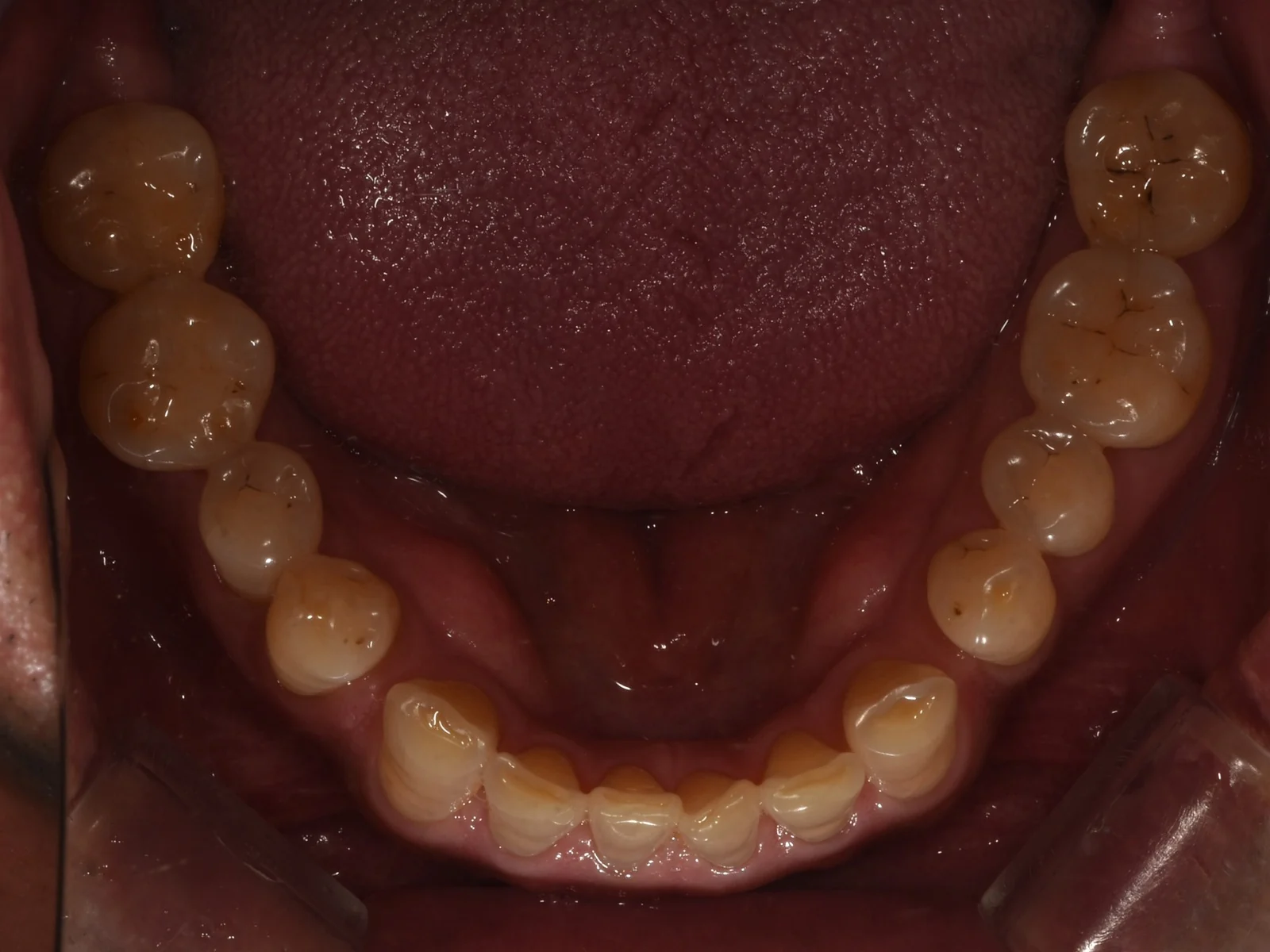 Tooth wear
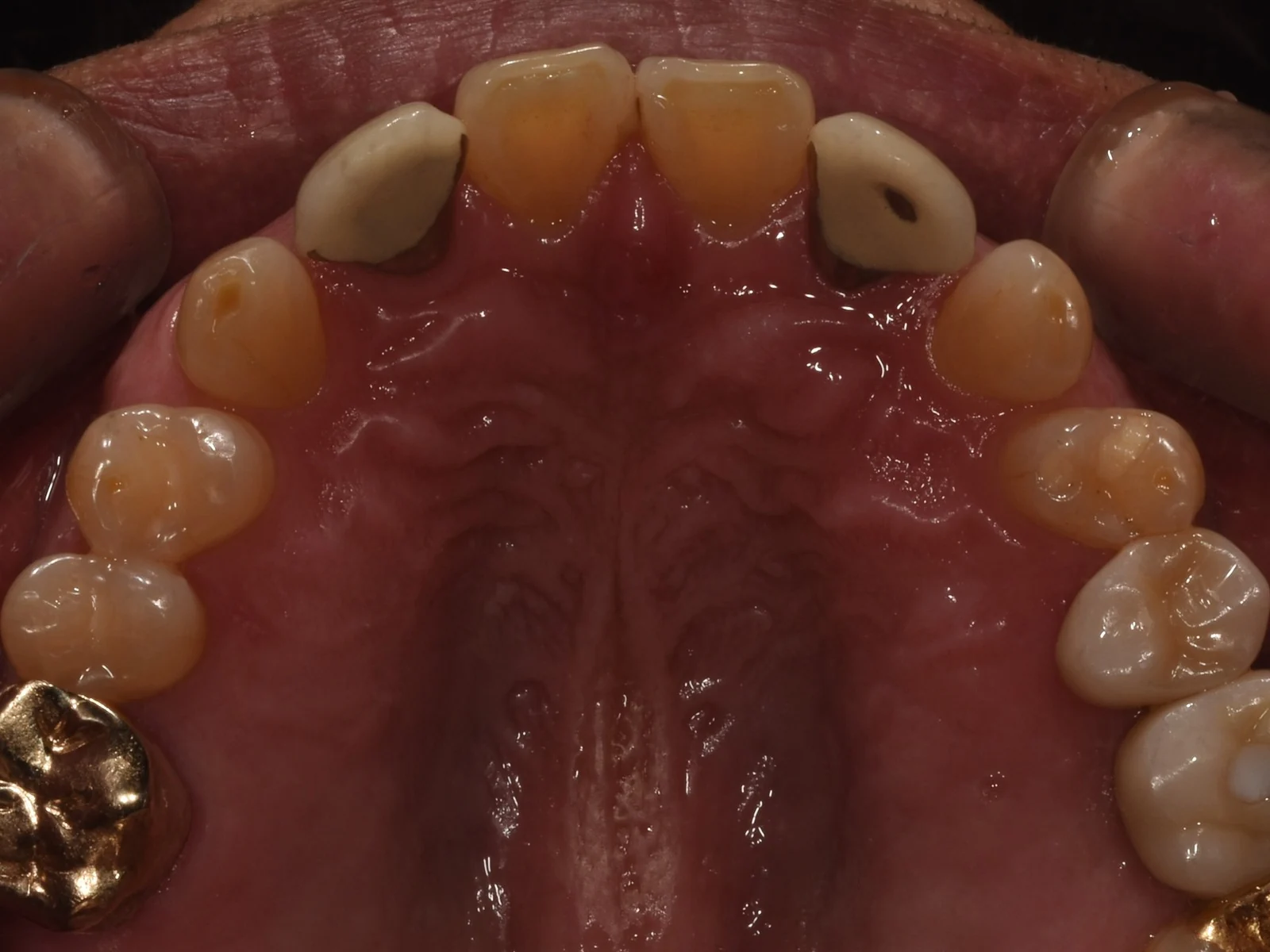 Broken restorations
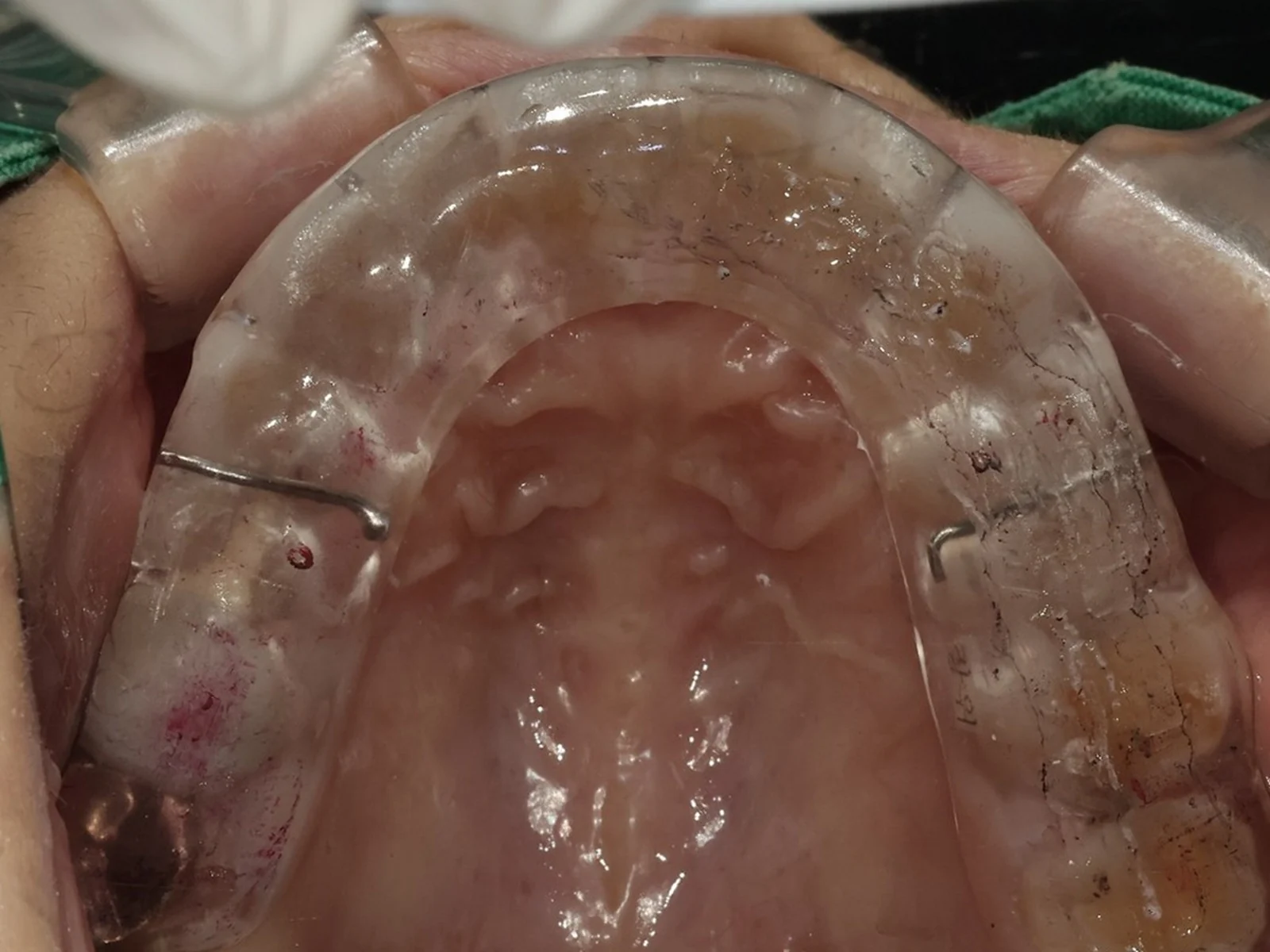 Splint
 Muscle record
 Habit correction
 Re-evaluation
 Before treatment
 After veneers
 Splint
 Signs of night grinding
 Signs of clenching
 Signs of clenching
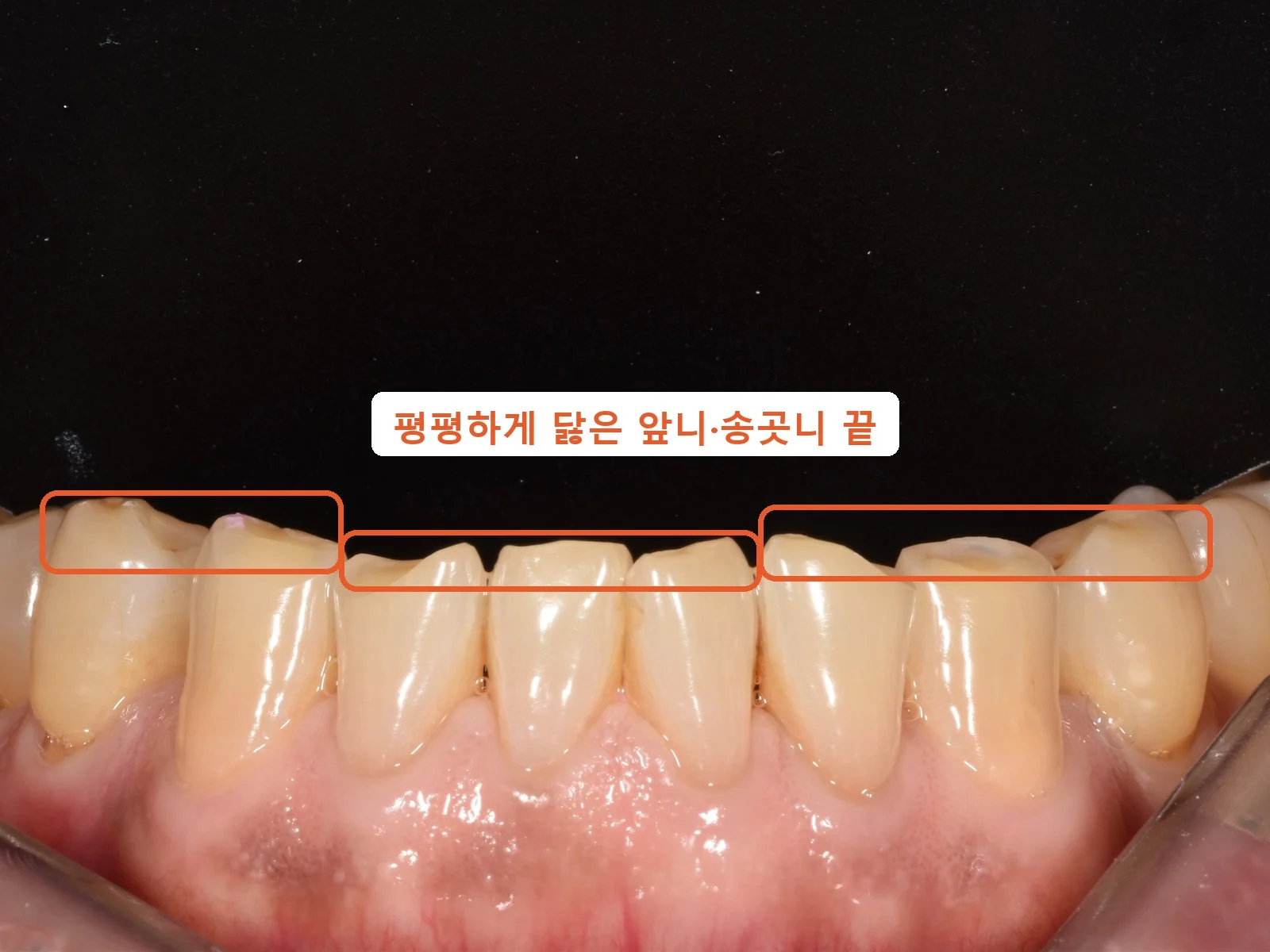 Photo records
 3D scan
 Self-questionnaire
 Design and fabrication
 Design and fabrication
 Fitting and adjustment
 Regular check-ups