CERAMIC BRACES

Ceramic Braces: What Makes Them Different?

Dr. Sunmin Kim, Head DentistTreated by Dr. Sunmin Kim (board-certified orthodontist) · Reviewed by Dr. Sunmin KimAbout the doctor →

Last reviewed October 29, 2026 · Dr. Sunmin Kim (board-certified orthodontist, Certified Orthodontist of the Korean Association of Orthodontists)

At a glance

Good for
People who want bracket braces with a less noticeable appliance
Treatment flow
Examination and diagnosis → bonding ceramic brackets → adjustment once a month → removal and retainers
Duration and limits
Ceramic is hard and can wear down the lower teeth that touch it, so we pay extra attention to bracket position and removal
Details

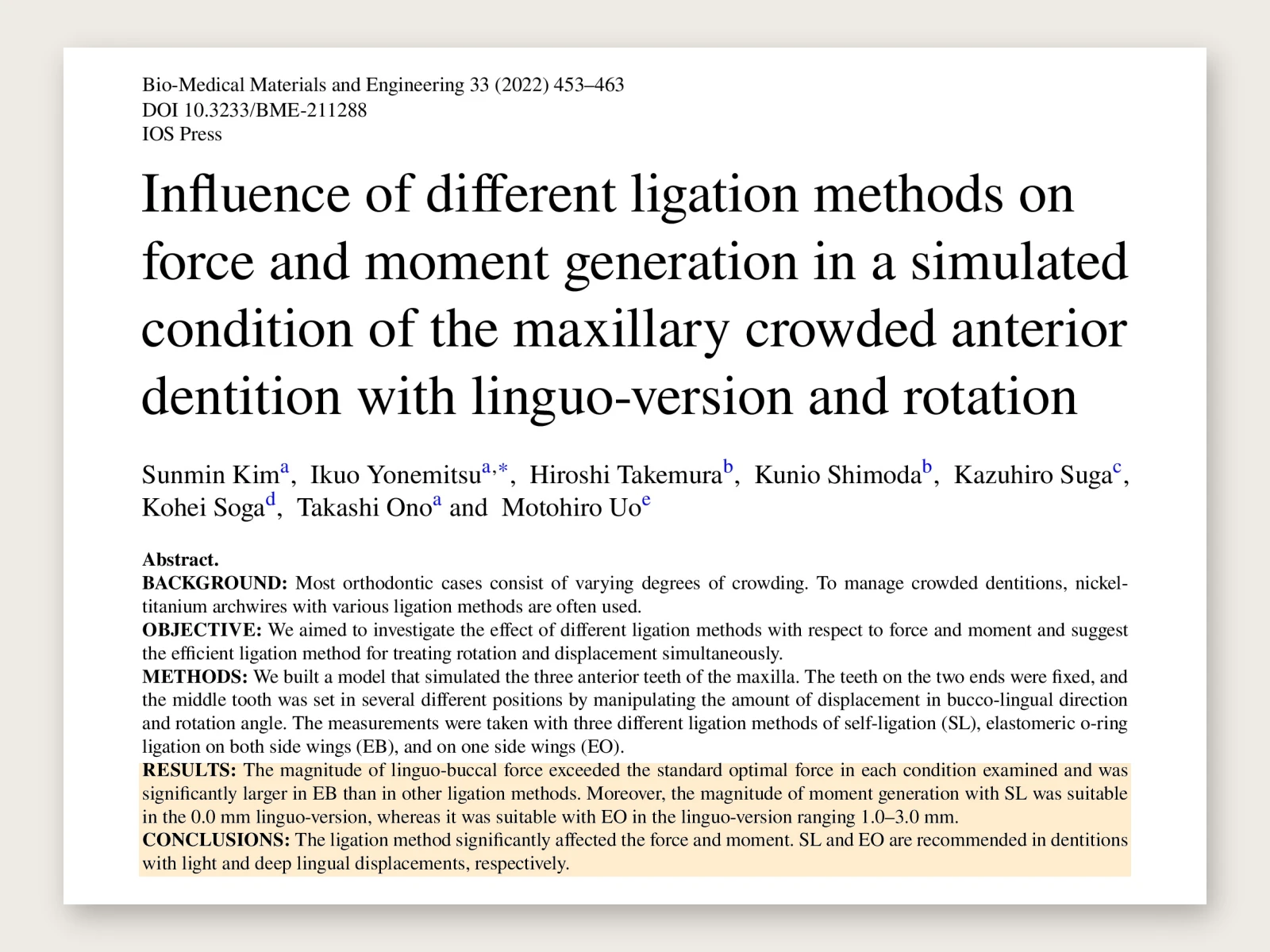
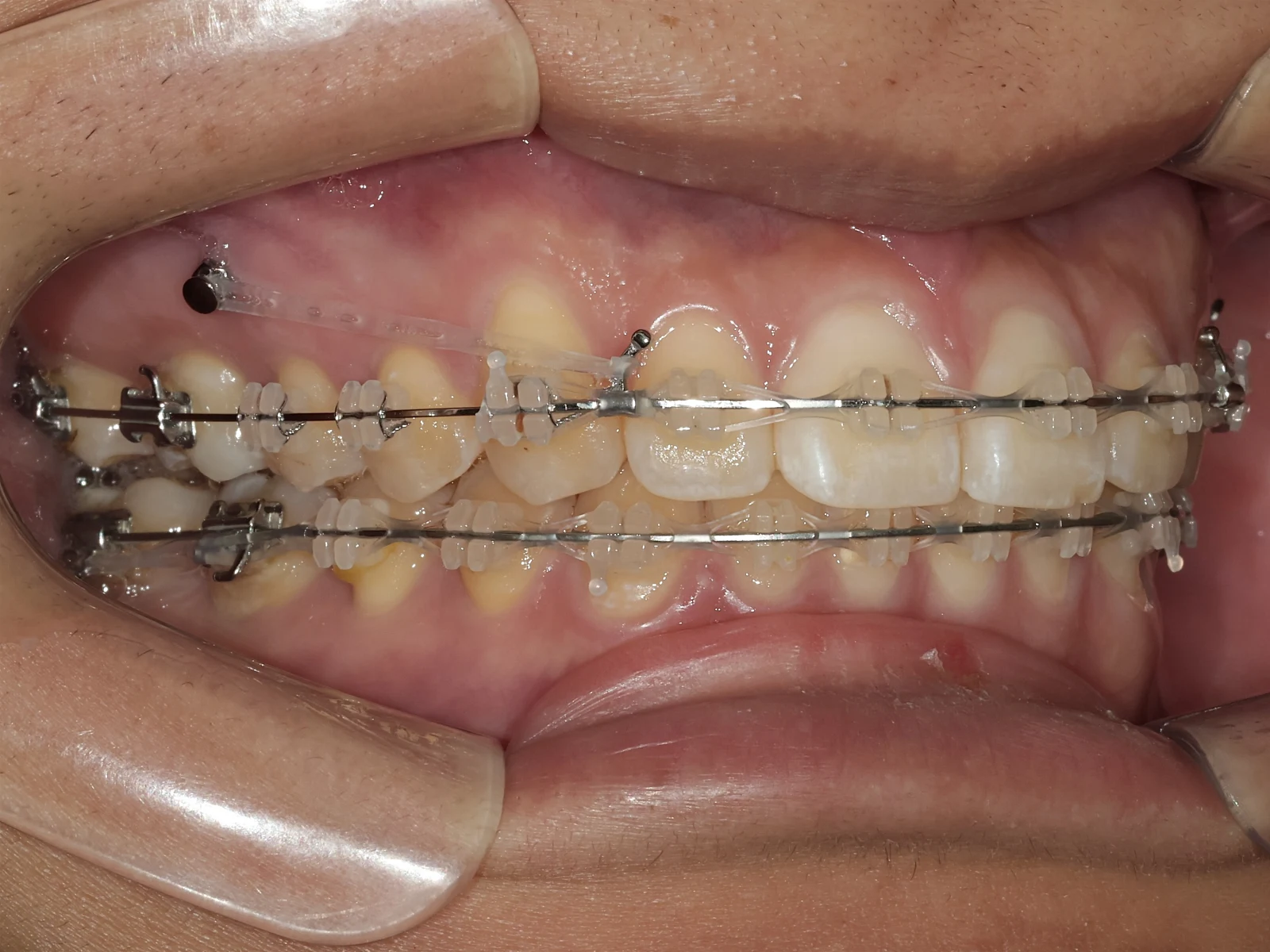
Ceramic braces use ceramic brackets close to tooth color, bonded to the outer surface of the teeth. They are less noticeable than metal braces, yet they can do most of the movements bracket braces can do, such as extraction cases, heavily rotated teeth and moving teeth bodily with the root. Visits are usually once a month. Ceramic is harder than metal, so it can wear down lower teeth that touch it, and it must be removed with care. That is why we pay extra attention to where the brackets are placed and how they are removed. At Ceramic Dental Clinic, we also choose how the wire is tied (conventional ligation or self-ligation) according to the condition of your teeth. Dr. Sunmin Kim's 2022 paper is a study that measured whether the force on teeth changes with the tying method.

01°

Even with ceramic braces, the tying method and sequence differed from person to person

We chose different tying methods and bracket positions depending on how rotated the teeth were, whether extraction was needed, and how deep the bite was. Here are three typical situations shown with real cases.

CASE01

Snaggletooth and heavily rotated front teeth

Ceramic braces · a low-friction tying method early on, and a tying method that controls rotation at the finish
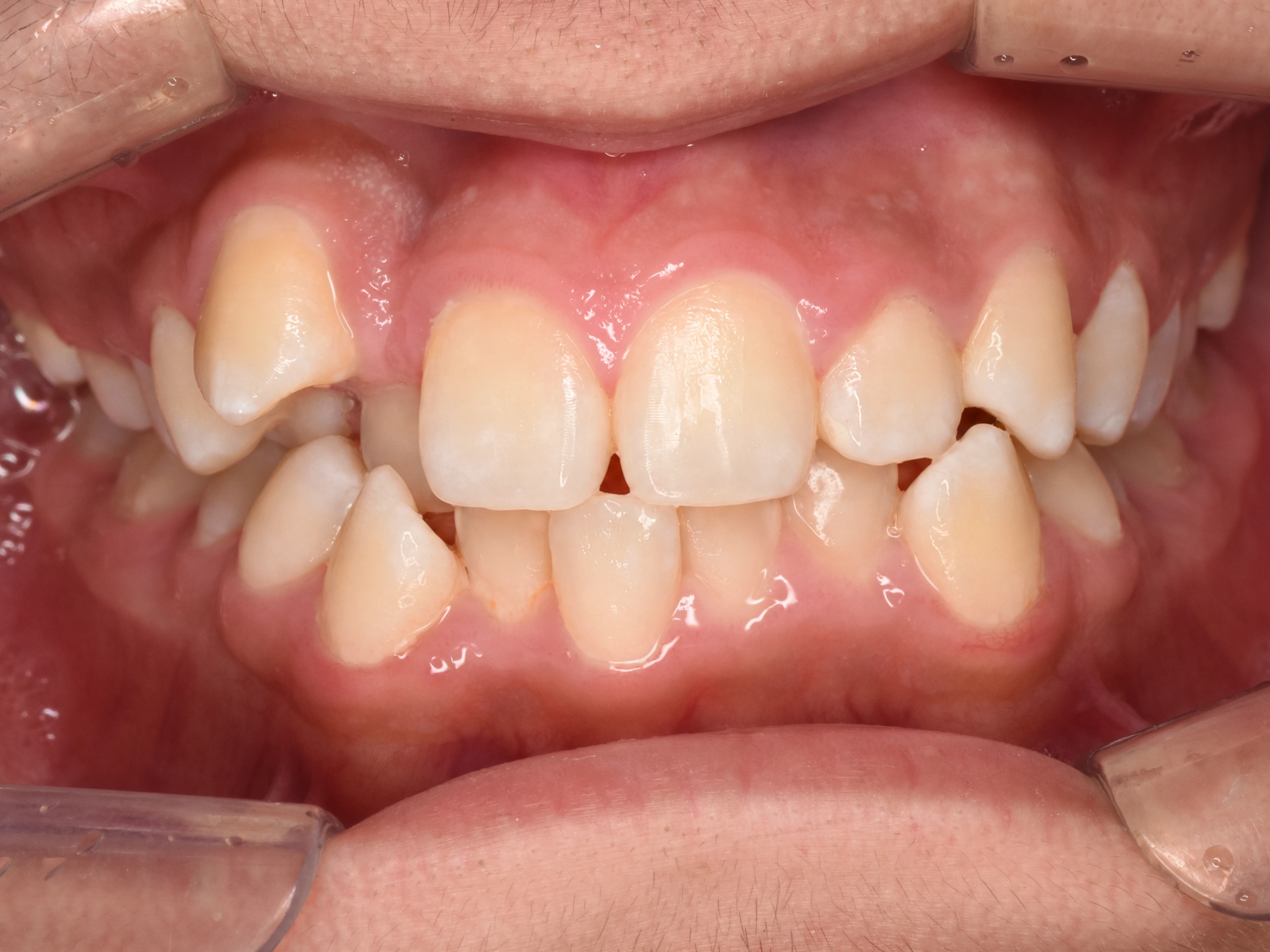
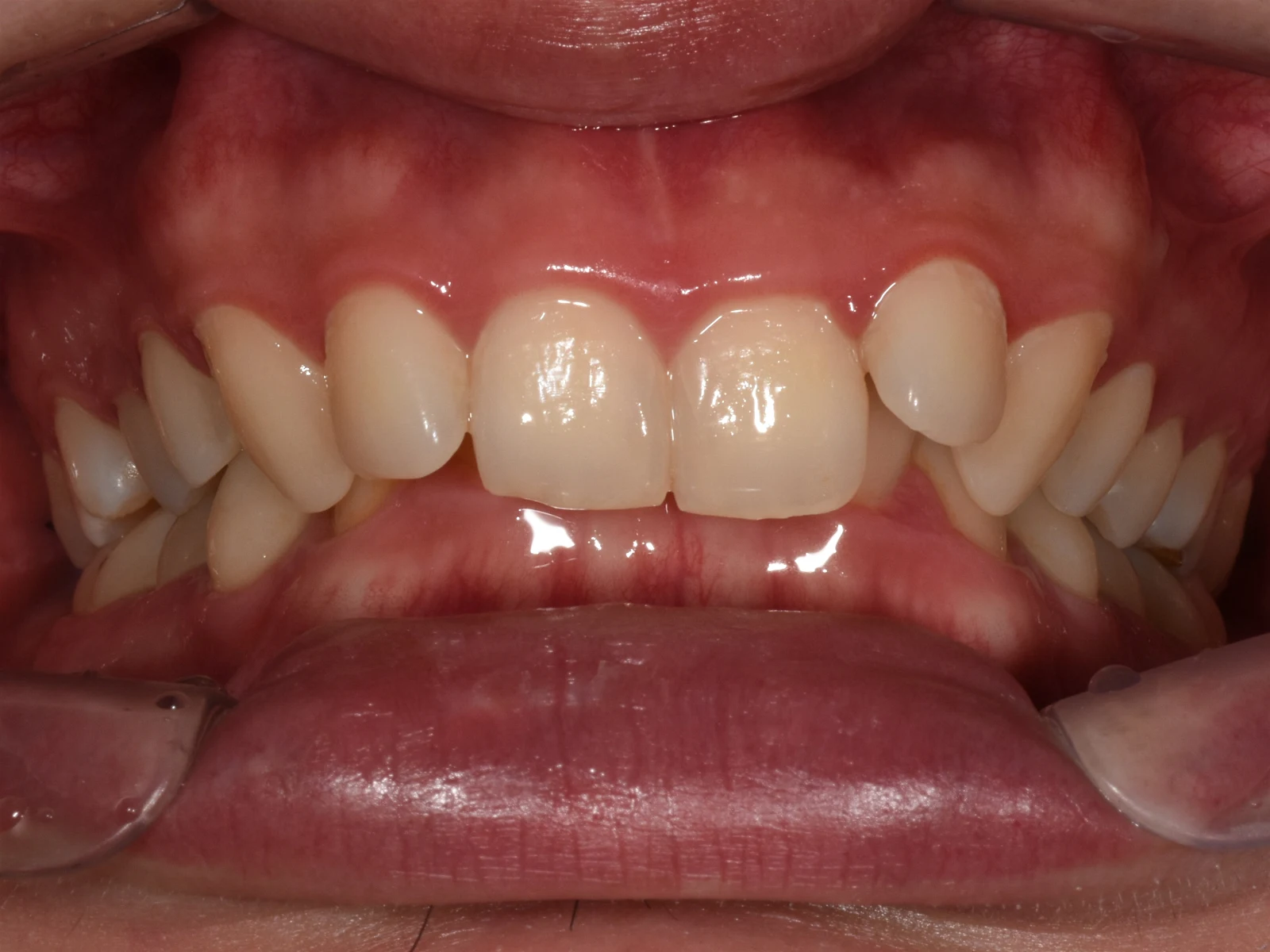
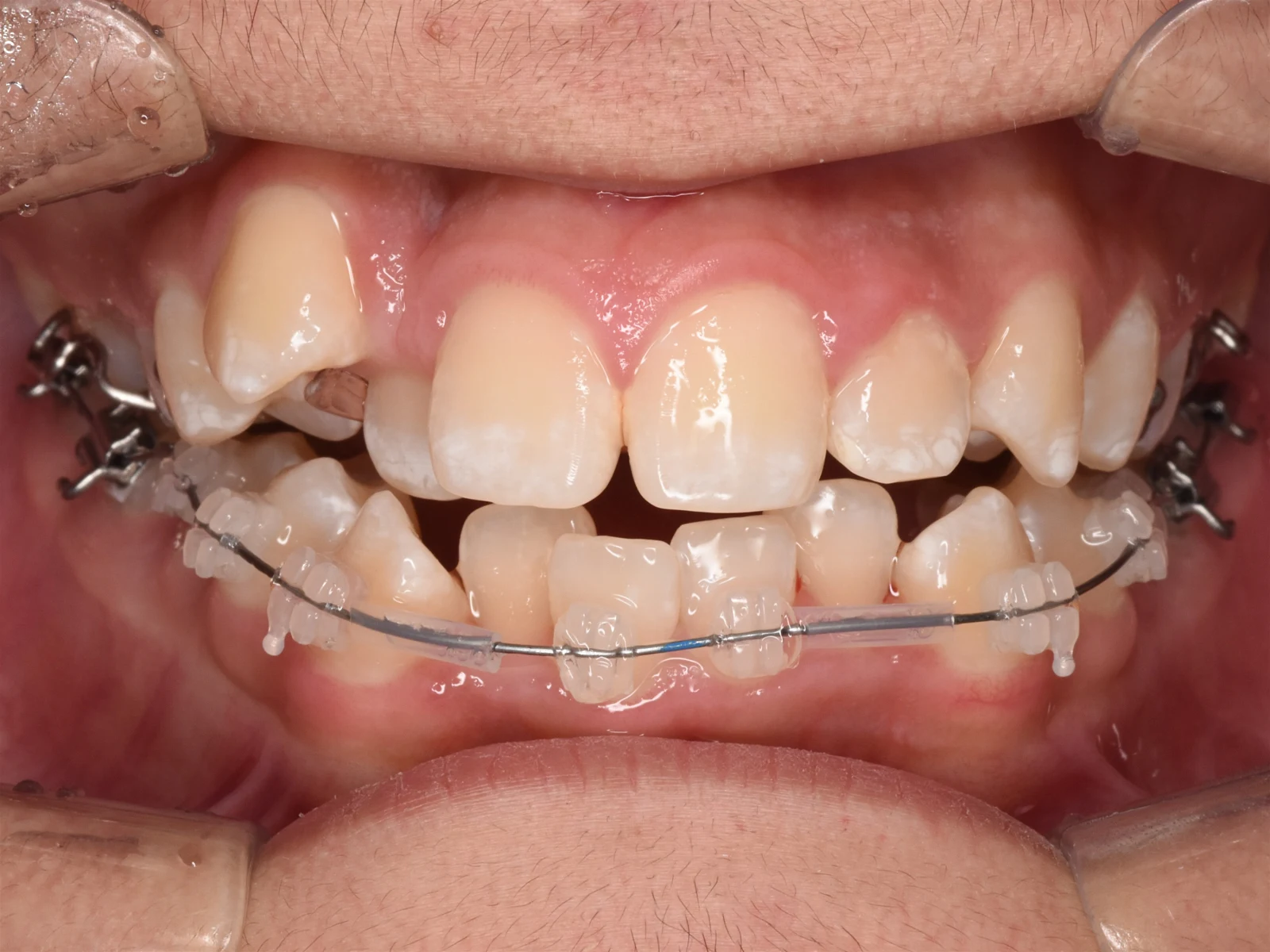
Front view of the mouth before treatment, showing a snaggletooth canine and rotated front teethBefore · Mar 2023
Front view before treatment. The canine stood out, and the lateral incisor was rotated at an angle.
Front view of the mouth after treatment, with the snaggletooth and rotated front teeth evenly alignedAfter · Aug 2026
Front view after treatment. In the finishing stage, we tied the wire more firmly to the brackets to fully control the rotated front teeth.
Condition
Snaggletooth with lack of space and rotated front teeth
Chosen
Ceramic brackets; low-friction tying at first, firm tying at the finish to control rotation
Not done
Extraction (the lips had little volume, so extraction would have worked against the mouth's appearance)
Duration
About 3 years
Note
Teeth that were rotated a lot keep a pull back toward their old positions for a long time after treatment, so retainers must be worn consistently.
CASE02

Protruding mouth needing extraction treatment

Ceramic braces · premolar extraction, closing spaces while controlling the root angle of the front teeth

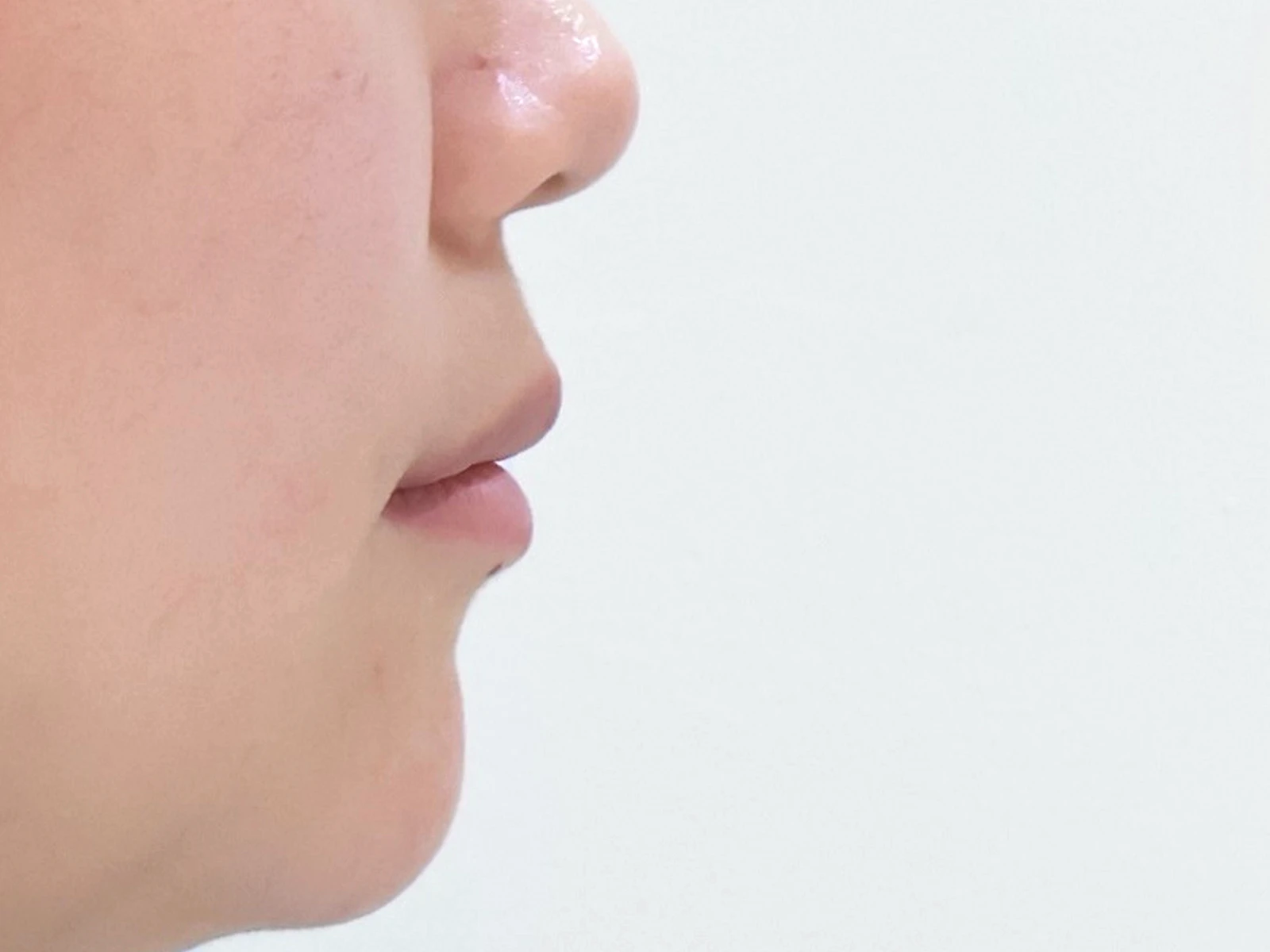
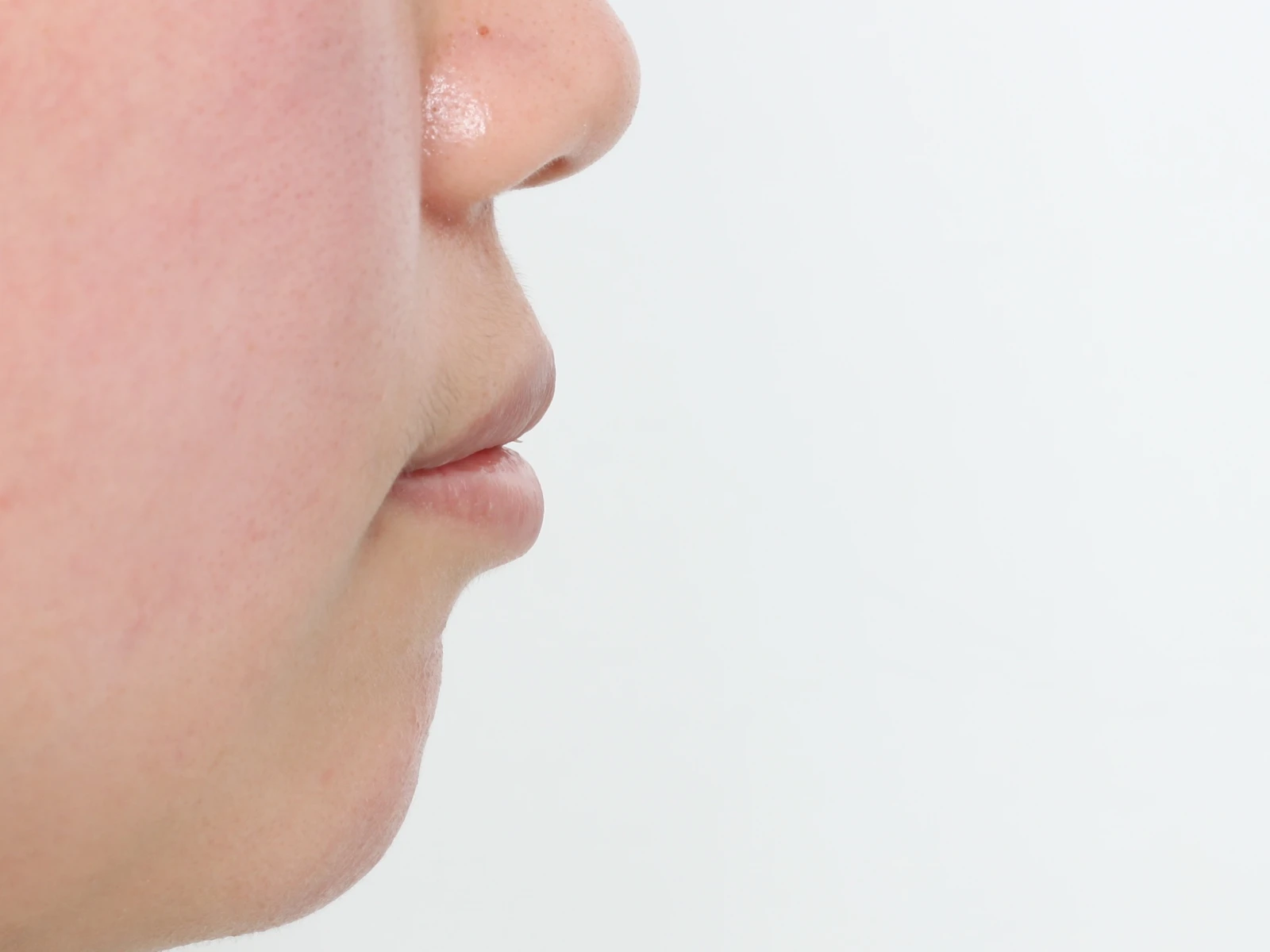
Side view of the mouth before treatment, with the lips pushed forwardBefore · Jan 2021
Side profile before treatment. The front teeth were tipped forward, so the lips looked pushed out.
Side view of the mouth after treatment, with the lips moved backAfter · Oct 2026
Side profile after treatment. We moved the front teeth back bodily, roots included, while closing the extraction spaces.
Condition
Dental protrusion; visible metal braces were a concern
Chosen
Ceramic brackets, premolar extraction
Not done
Clear aligners (the amount of root-angle control needed for the front teeth was large)
Duration
About 22 months
Note
Even after the extraction spaces are closed, retainers must be worn well early on so the spaces do not open again.

CASE03

Deep bite with the lower teeth touching the upper brackets

Ceramic braces · mini-screws to raise the upper teeth, an anterior bite plate (ABP) to lower the lower teeth, making the bite shallower

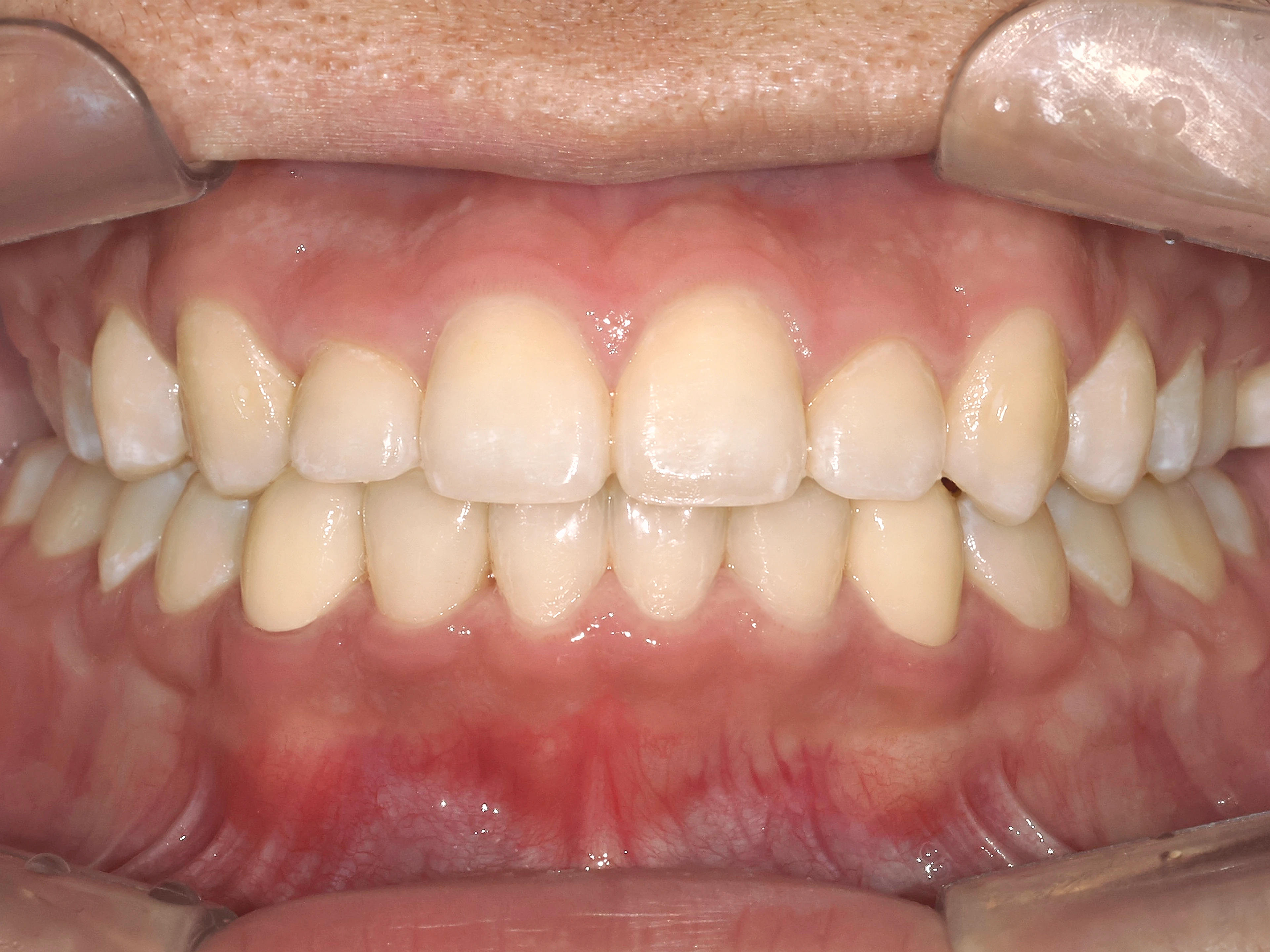
Front view of the mouth before treatment, with the upper front teeth deeply covering the lower front teethBefore · Mar 2024
Before treatment. The upper teeth deeply covered the lower teeth, so if the upper brackets were bonded as usual, the lower teeth could hit the ceramic.
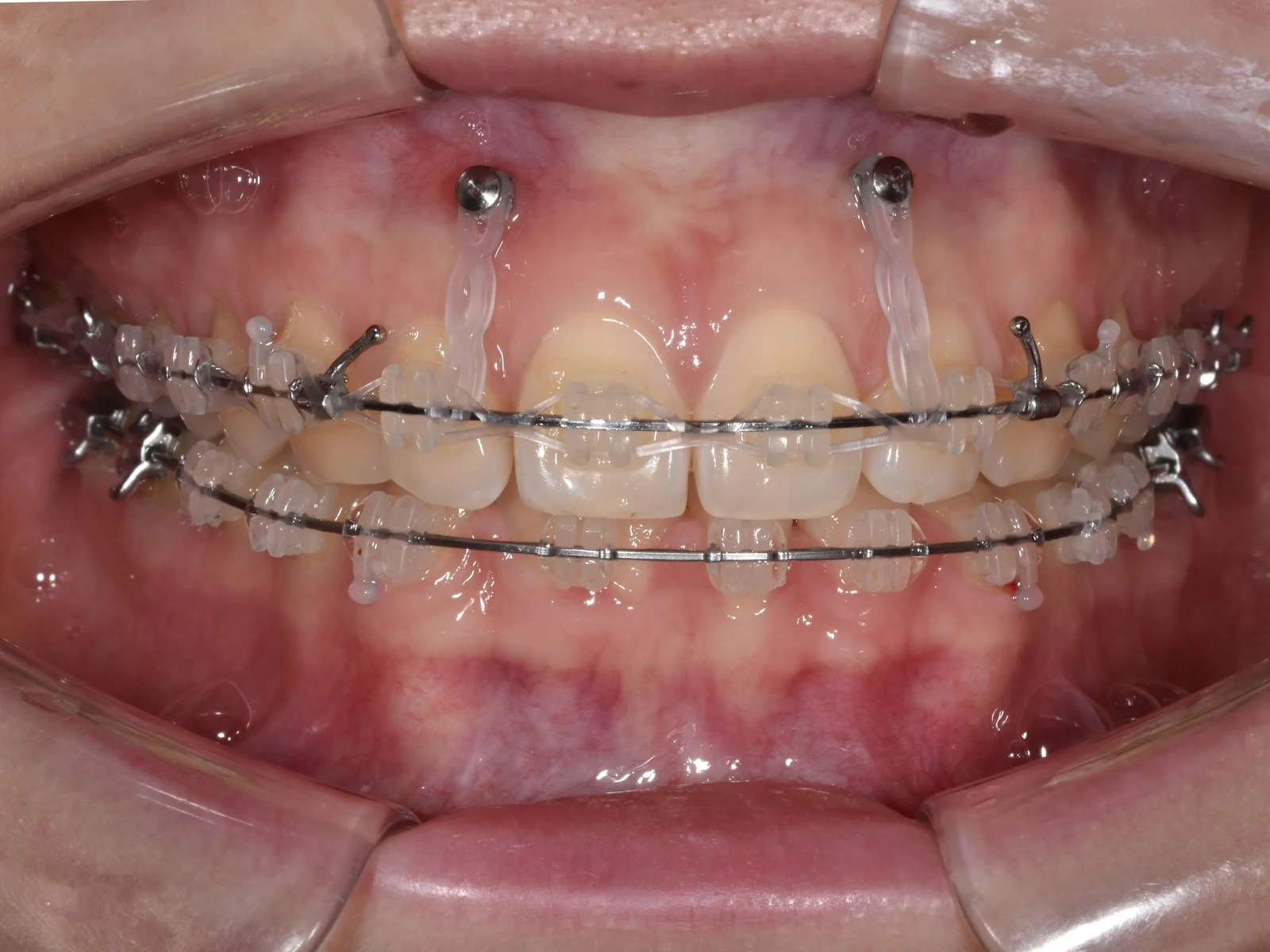
Front view during treatment, with a mini-screw above the upper front teeth and an elastic raising them toward the gumRaising the upper teeth · mini-screw
When the upper teeth need to move up. A mini-screw is placed in the gum bone above the upper front teeth, and an elastic pulls the front teeth up toward the gum. (Photo of another patient)
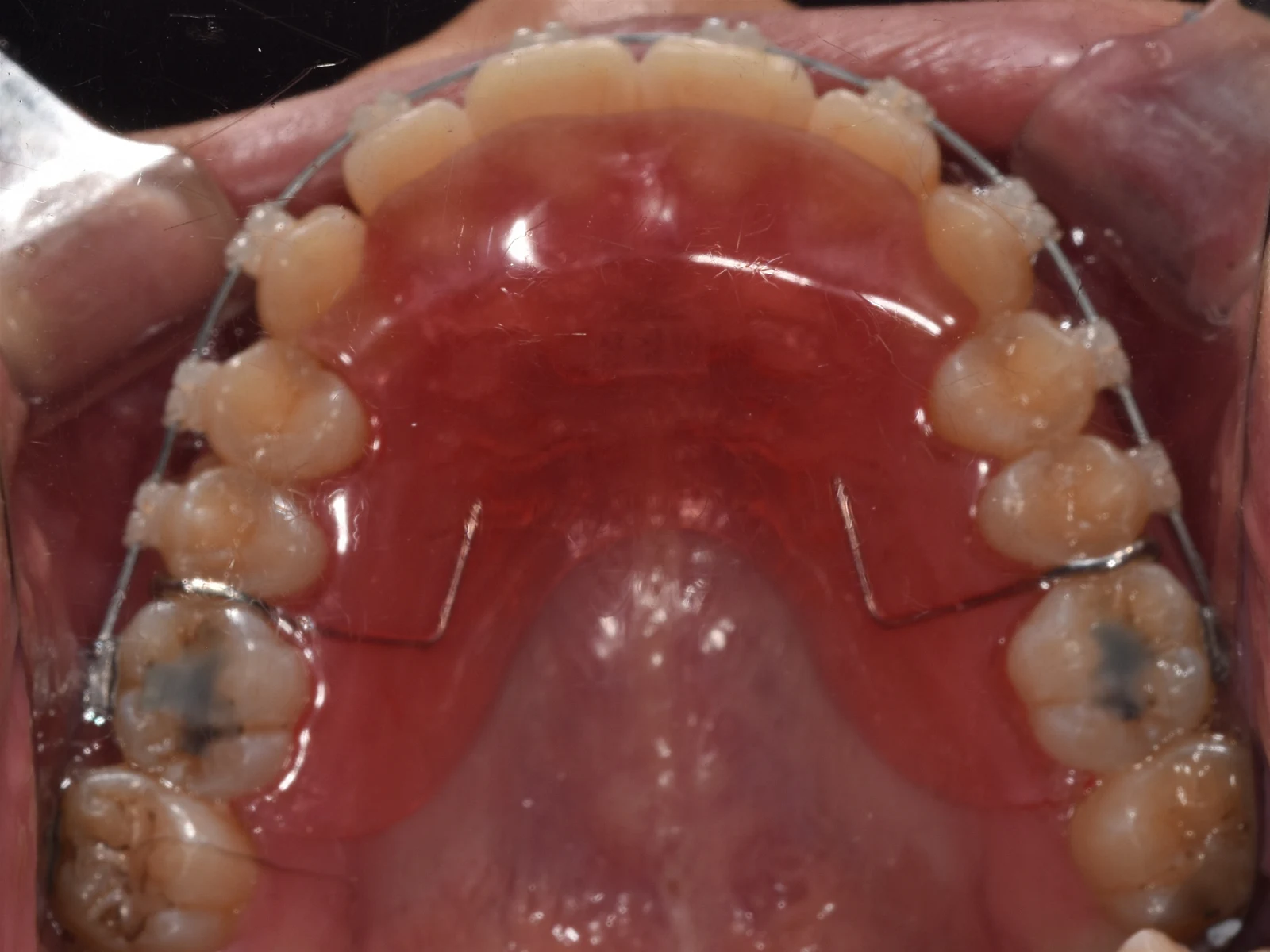
Upper occlusal view with a plastic anterior bite plate (ABP) bonded behind the upper front teethLowering the lower teeth · ABP
When the lower teeth need to move down. An anterior bite plate (ABP) is bonded behind the upper front teeth so the lower front teeth touch only this plate. The lower front teeth then move down, and meanwhile they do not touch the upper ceramic brackets. (Photo of another patient)
Condition
Deep bite (overbite); the lower teeth touched the back of the upper front teeth
Chosen
Ceramic brackets, mini-screws near the upper front teeth and an anterior bite plate (ABP)
Not done
Bonding brackets on the lower front teeth from the start (they would have hit the upper brackets, so we began bonding after the deep bite was corrected)
Duration
About 18–24 months
Note
A deep bite tends to deepen again after treatment, so retainers are worn for a long time.

* Photos were taken under the same conditions and published with the patients' consent. Treatment results and side effects may vary from person to person.

02°

Ceramic braces have three parts

The brackets, the wire, and the way the wire is tied to the brackets. How visible the braces are depends on the color of the brackets and wire, while the force on the teeth depends largely on the wire and the tying method.

01Ceramic brackets

Brackets made of ceramic close to tooth color. They are less noticeable than metal and hardly stain, but they are harder than metal and can break on impact. Ceramic Dental Clinic uses Bio-Cetec A-Line ceramic brackets.

02Wire

The wire produces the force that moves the teeth. At first, a thin, flexible wire is used to align the teeth, and at each stage it is replaced with a thicker, stiffer wire. A white-coated wire can be used to make it less noticeable, and the coating may wear off a little over time.

03Conventional ligation

The wire is tied to the brackets with small elastic rings or thin wire ties. It holds the wire firmly, which is good for finishing tooth rotation, and the elastic rings are replaced with new ones every time.

04Self-ligation

A small door built into the bracket holds the wire. With no elastic rings, staining is less of a worry and the wire slides easily, which can help with initial alignment and space closure.

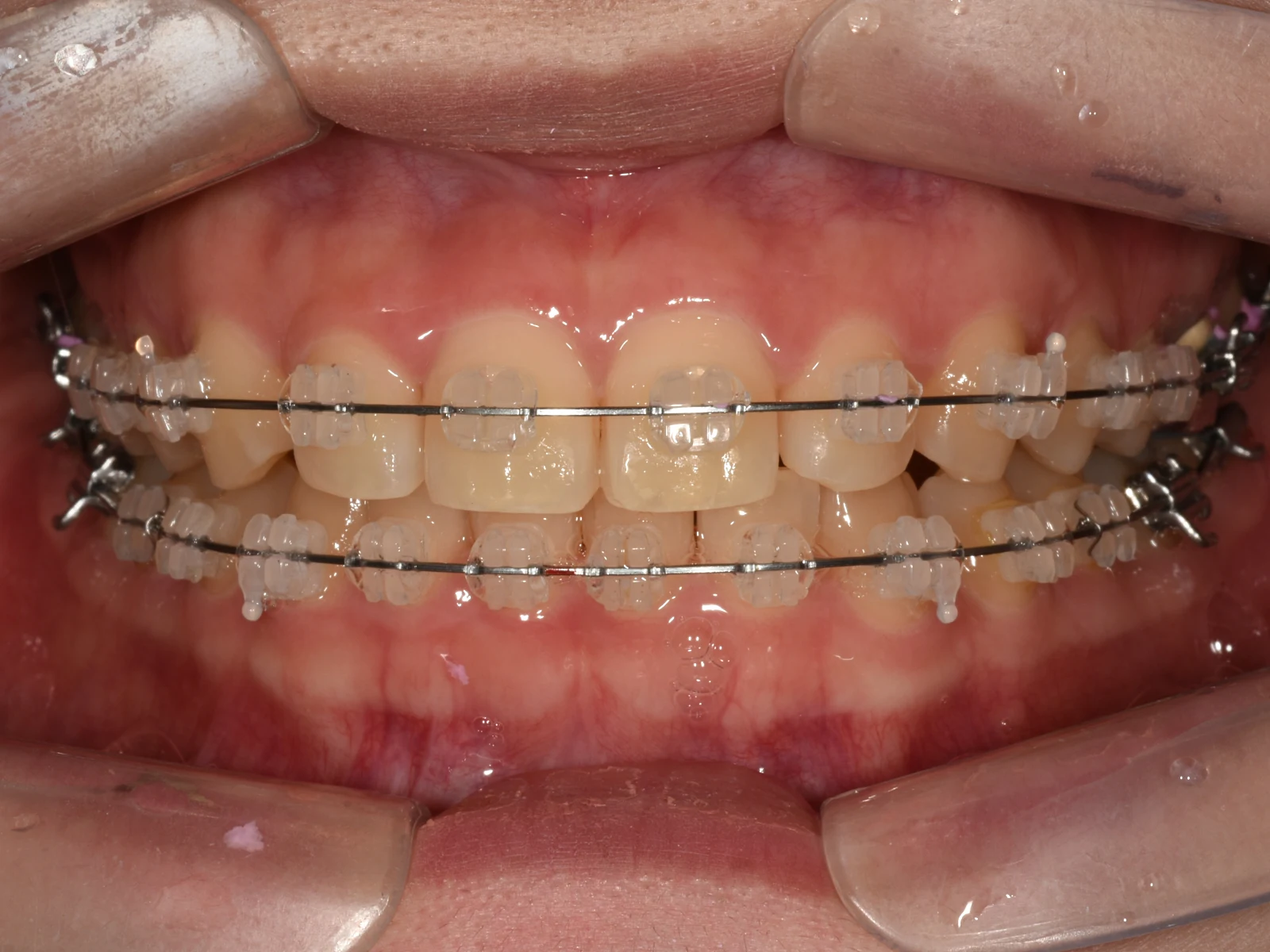
Front view of the mouth with ceramic brackets bonded to the upper and lower teethCeramic brackets · Aug 2024
Ceramic brackets in place. They are close to tooth color, so at a normal talking distance they are less noticeable than metal braces.
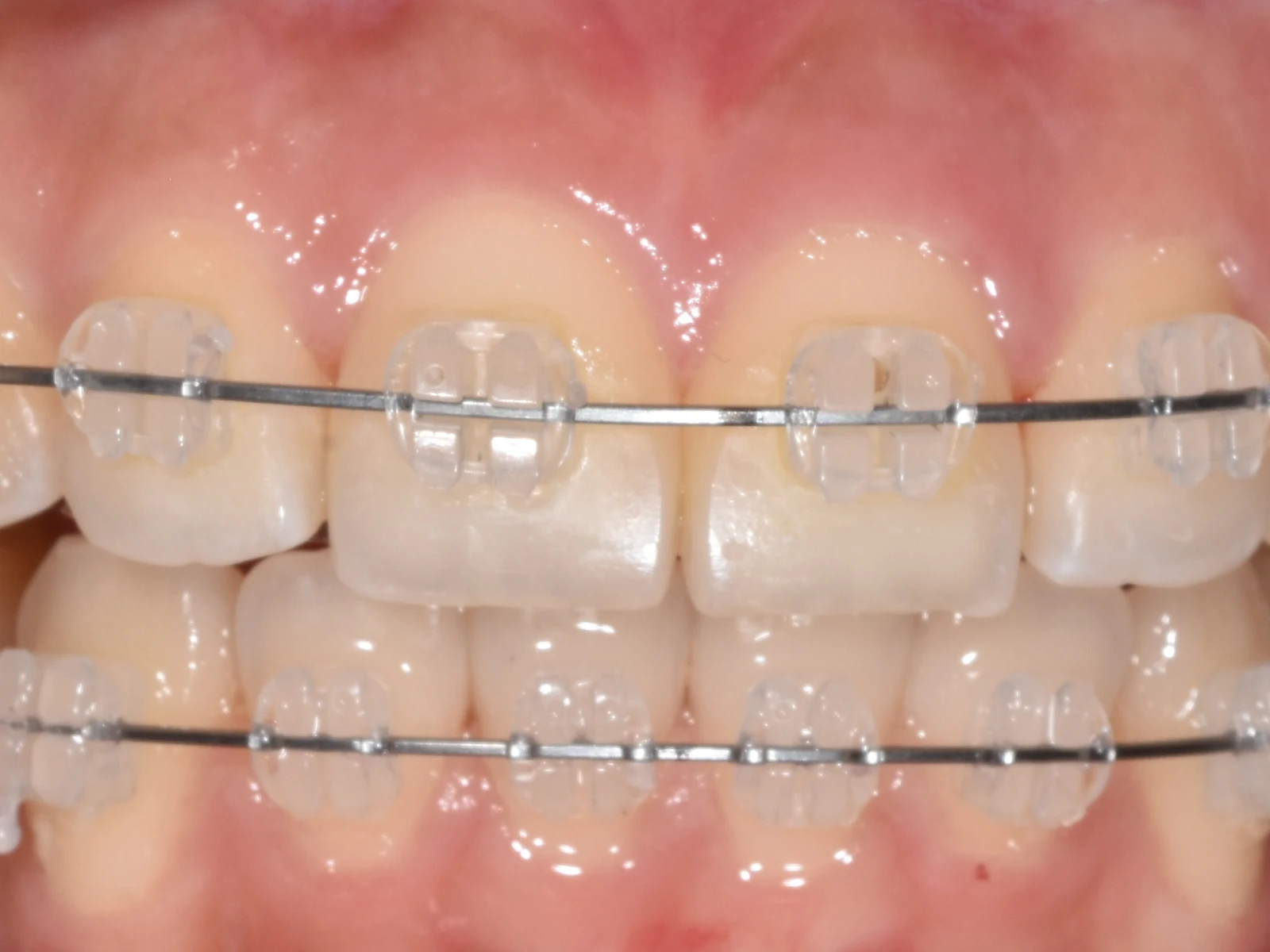
Close-up of a ceramic bracket with the wire tied by a clear elastic ringConventional ligation · elastic ring
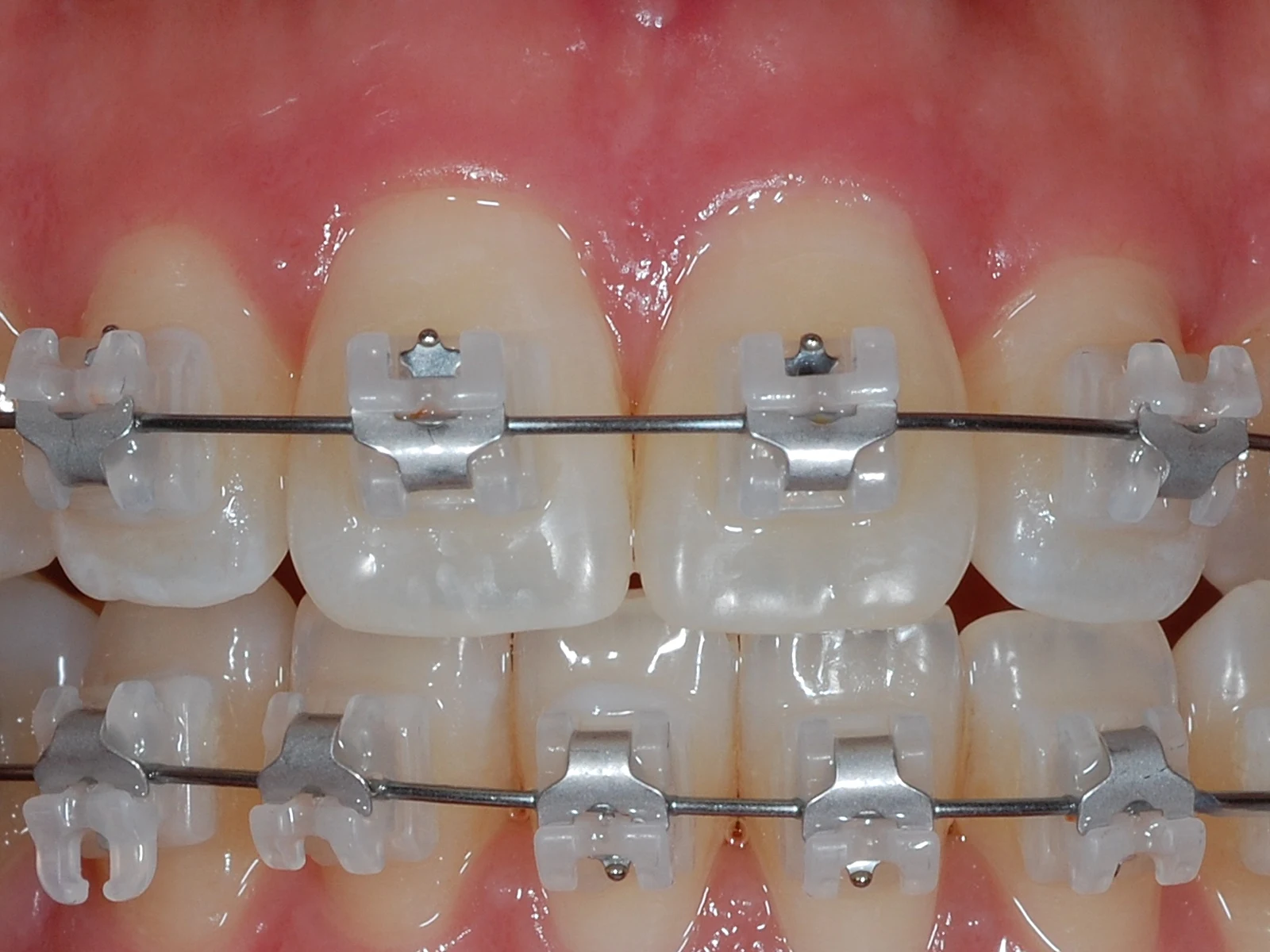
Close-up of a self-ligating ceramic bracket with the wire held by the bracket's metal coverSelf-ligation · Clippy-C
Left: conventional ligation with an elastic ring. Right: self-ligation, where a small door on the bracket holds the wire.

We do not say that self-ligation is always faster or better. We choose according to the condition of your teeth and the stage of treatment.

03°

The force on the teeth changes with the tying method

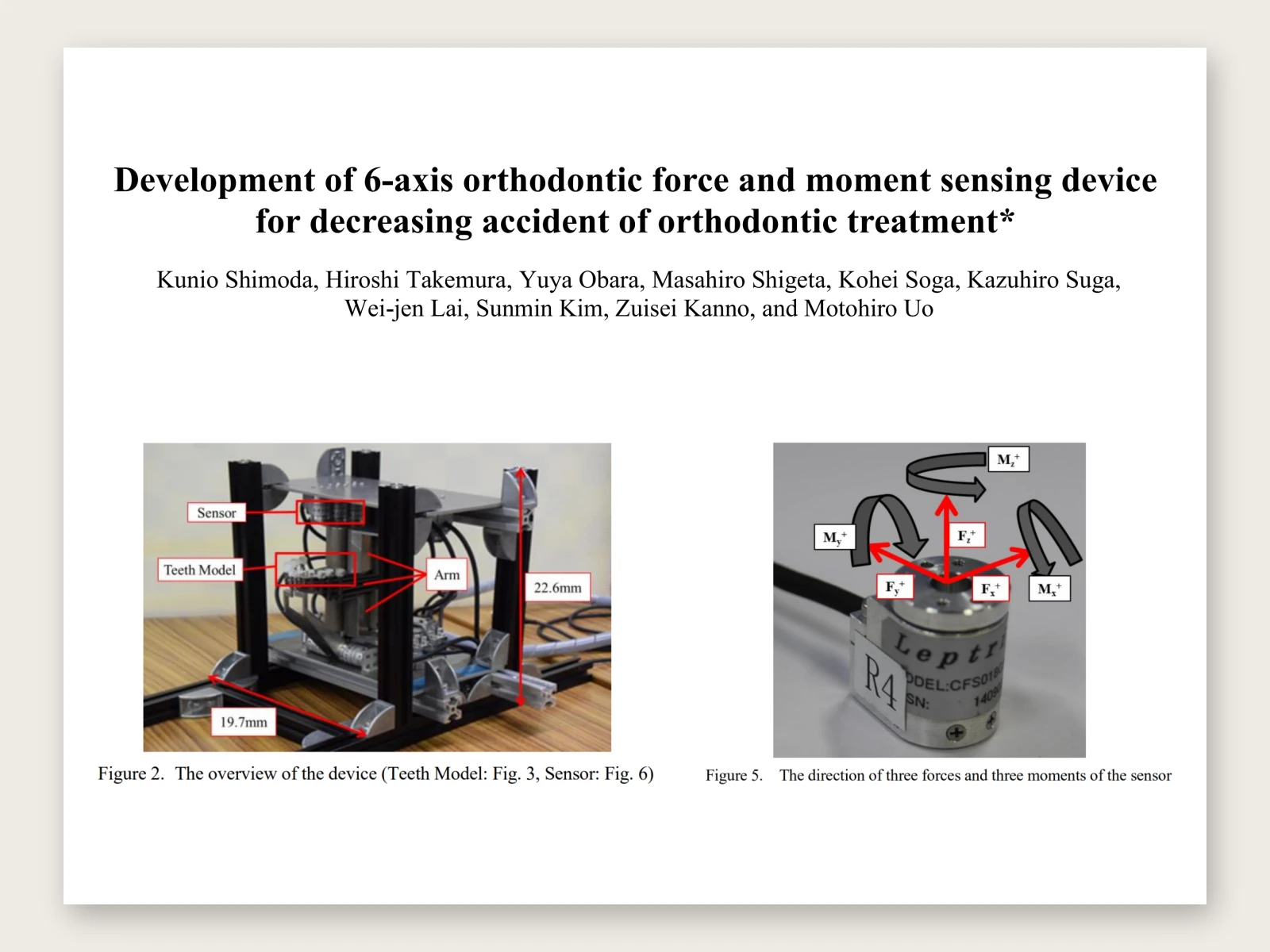
At Tokyo Medical and Dental University, I co-developed a device that measures the force and rotational moment on each tooth in six directions, and I used it to measure how much the force changes with the way the wire is tied. My 2022 paper compared the force and moment for each tying method under conditions reproducing upper front teeth that were tipped inward and rotated.

Even with the same wire, the force actually delivered to the teeth differs depending on whether the wire is tied with an elastic ring, tied with a wire tie, or held by the bracket's door. That is why we sometimes change the tying method between the first alignment and the final control of rotation and angle.

This research is a basis for choosing appliances and tying methods. It does not mean the results are guaranteed.

First page of an English paper introducing a six-axis orthodontic force and moment measuring device, with figures of the device and sensorsMeasuring device · 2018 IEEE EMBC
A measuring device with a six-axis sensor on each tooth model that measures force in 3 directions and moment in 3 directions together. This paper introduced the device developed with an engineering team at Tokyo University of Science (Dr. Sunmin Kim is a co-author).
First page of Dr. Sunmin Kim's 2022 paper in Bio-Medical Materials and Engineering, with the results and conclusion highlightedResults · 2022 paper
Dr. Sunmin Kim's 2022 paper. The force and moment on the teeth differed greatly by tying method (self-ligation, elastic ring on both wings, elastic ring on one wing). Self-ligation suited teeth set slightly inward, and the one-wing elastic ring method suited teeth set far inward (shaded parts).

04°

How ceramic braces treatment works

There are six steps, from the examination to retainers. For each step, we note what needs extra attention because the brackets are ceramic.

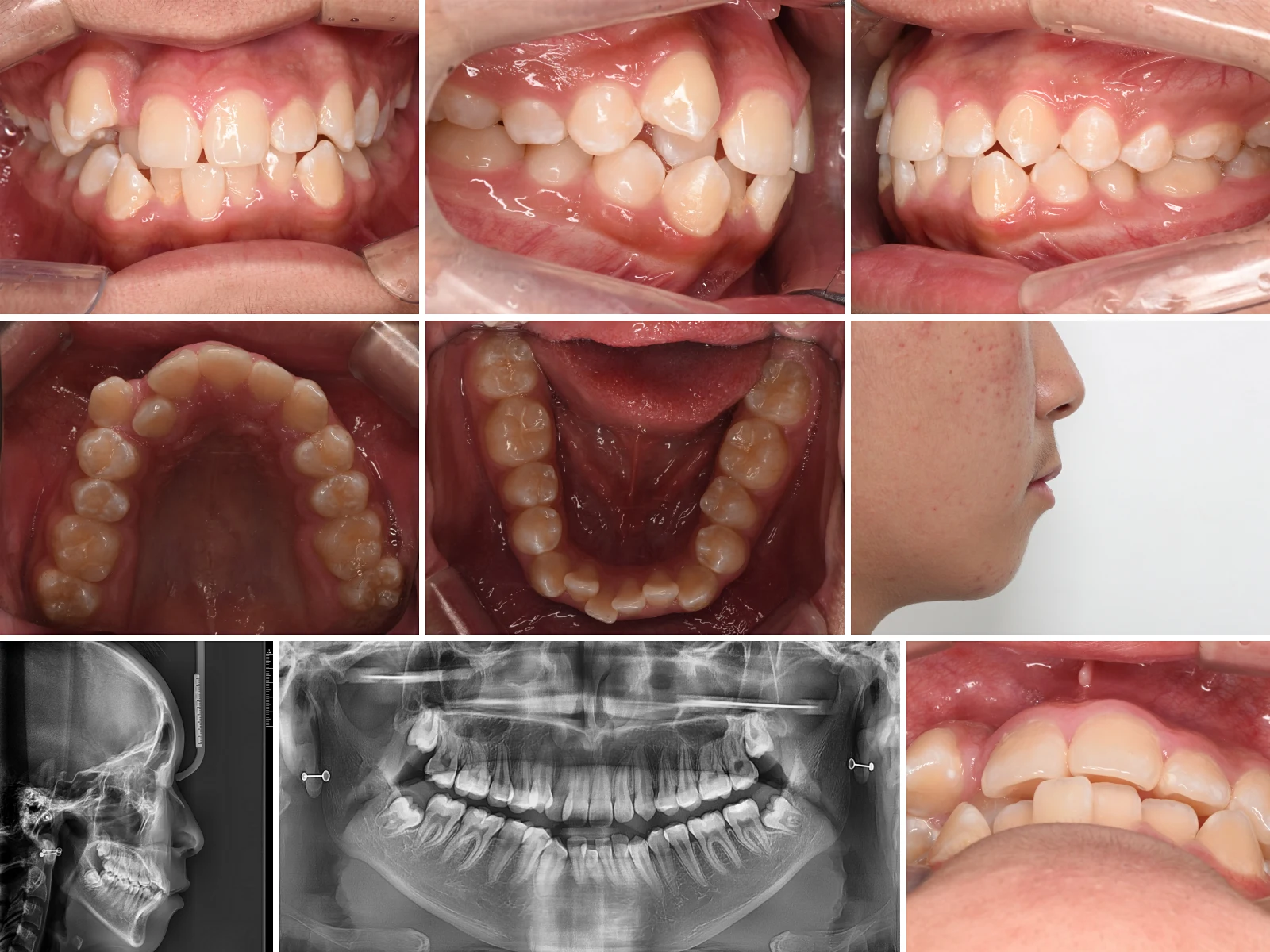
A full set of orthodontic records: eight intraoral photos, a side profile, a side-view X-ray and a panoramic X-rayExamination · Mar 2023
A full set of examination records. With intraoral photos, a side profile, a side-view X-ray and a panoramic X-ray, we look at the front-tooth angles, bite depth and tooth roots together.

STEP 01

In the full examination, we check bite depth and the movements needed

We take facial and intraoral photos, a side-view X-ray of the face and a panoramic X-ray, and make a tooth model with the iTero intraoral scanner. For ceramic braces, we especially check how deeply the upper and lower front teeth overlap and whether you grind your teeth hard.

Why we do thisCeramic is harder than tooth enamel, so if the lower teeth keep touching the upper brackets, the lower teeth can wear down. If the bite is deep or grinding is severe, we change the bracket positions or plan an appliance that props the bite open.
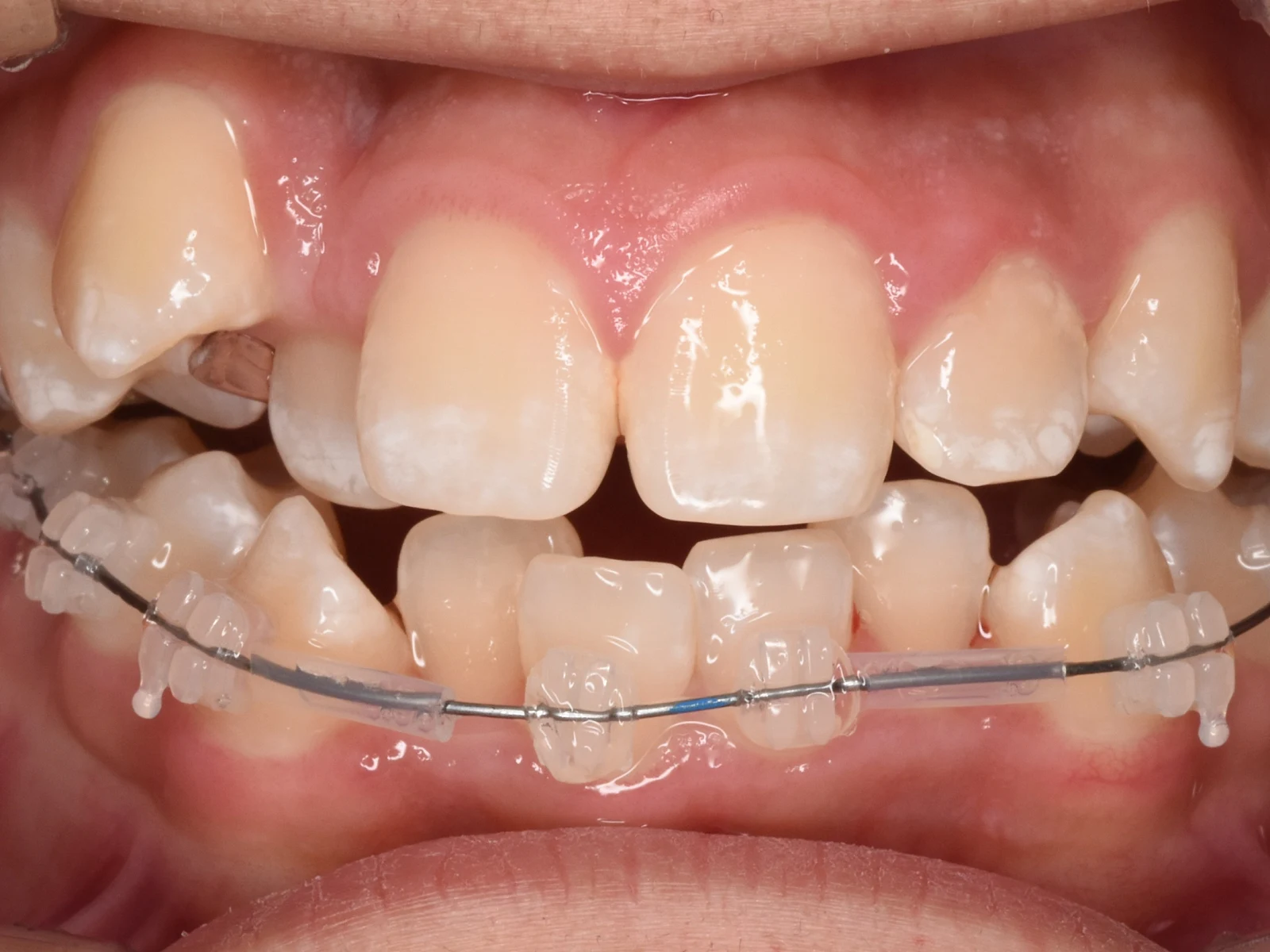
Front view early in treatment, with ceramic brackets and the first wire bonded while the snaggletooth was still presentBonding · Apr 2023
The day the braces are bonded. After cleaning the tooth surfaces, we bond the brackets at the planned height and insert the wire.

STEP 02

We decide where each bracket goes, bond them and insert the first wire

For each tooth, we decide the height and angle of the bracket and bond it. The first wire is thin and flexible, and it starts lining the teeth up evenly. For the first few days, your teeth may feel sore and the inside of your cheeks may get rubbed, so we give you protective wax.

Why we do thisEven a small error in bracket position leads to errors in tooth height or angle at the end. Bonding accurately at the start reduces the need to bend the wire many times in the finishing stage.
Front view of the mouth around the start of treatmentStart · Apr 2023
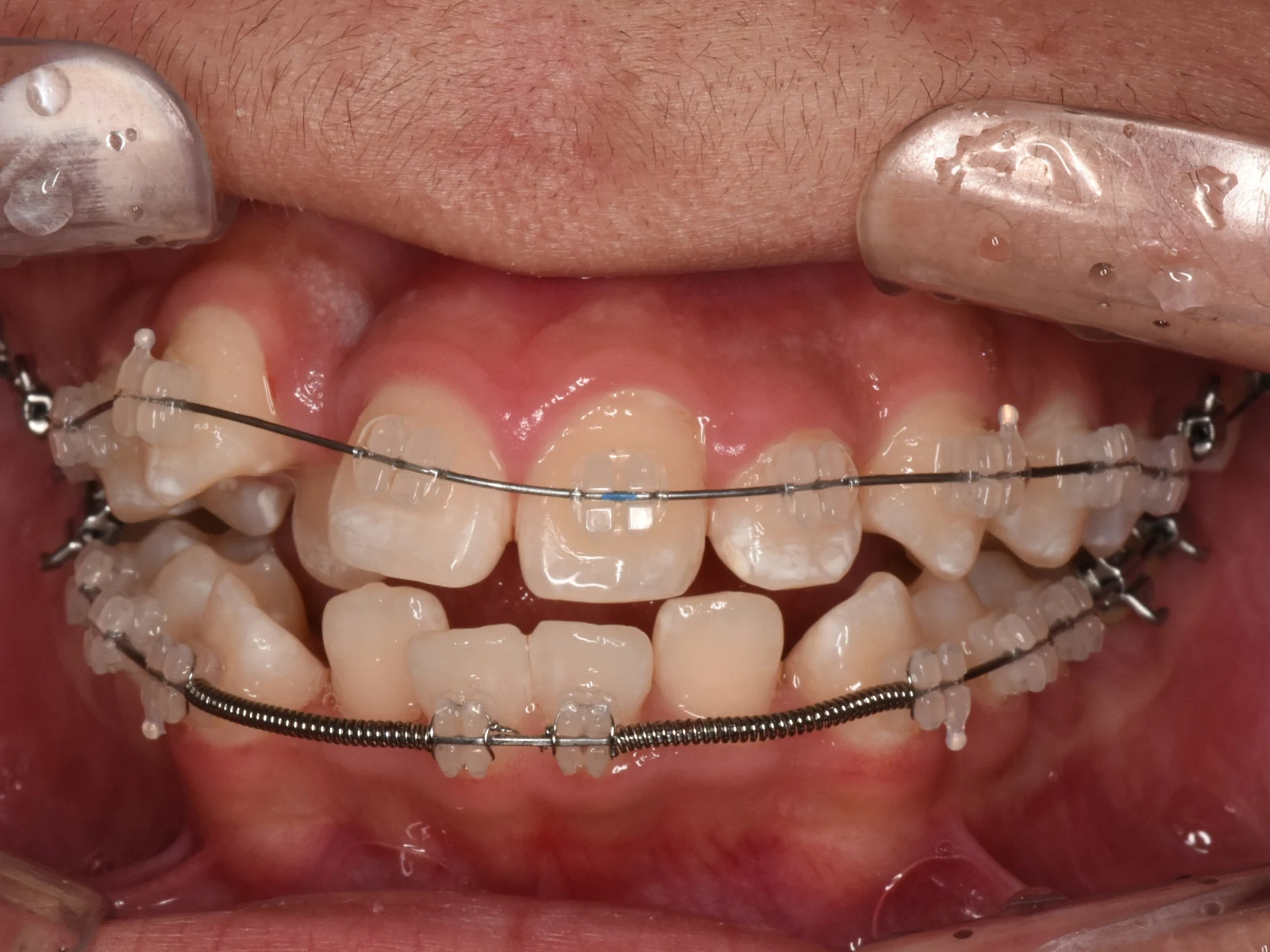
Front view of the same patient as alignment progressedAlignment · Aug 2023
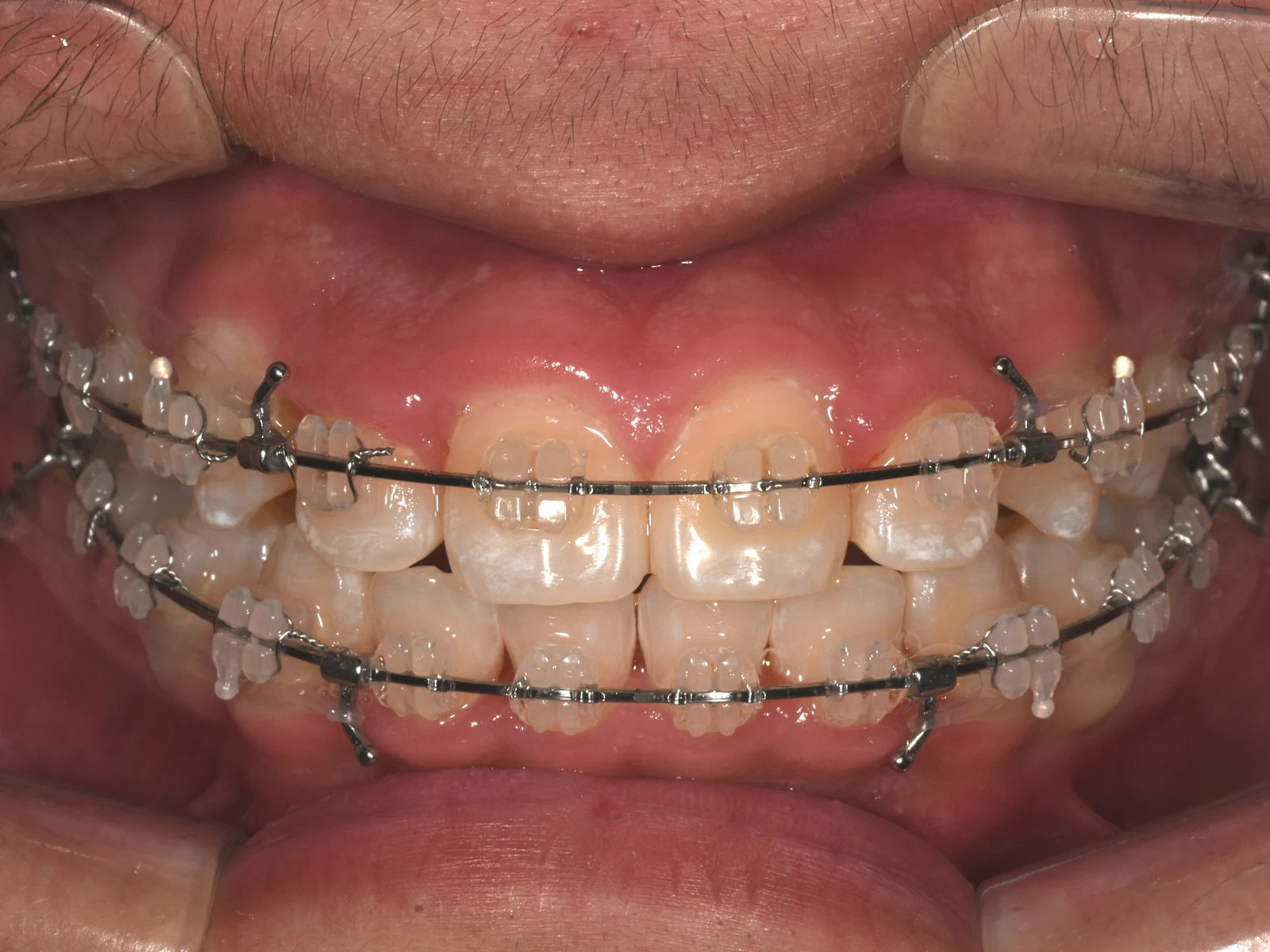
Front view of the same patient after switching to a thicker wireBefore finishing · Sep 2024
Progress of the same patient. After lining the teeth up with thin wires, we switch to thicker wires to close spaces and control angles.

STEP 03

Once a month we change the wire to move the teeth

You usually come once a month for a wire change or adjustment. When alignment is done, we switch to a thicker wire to close extraction spaces or control the angle of the front teeth. The tying method can also be changed at this point to suit the stage.

Why we do thisUsing a thick wire from the start increases pain and can tip teeth in unwanted directions. Moving step by step from thin to thick wires lets us start with light force and hold firmly only when needed.
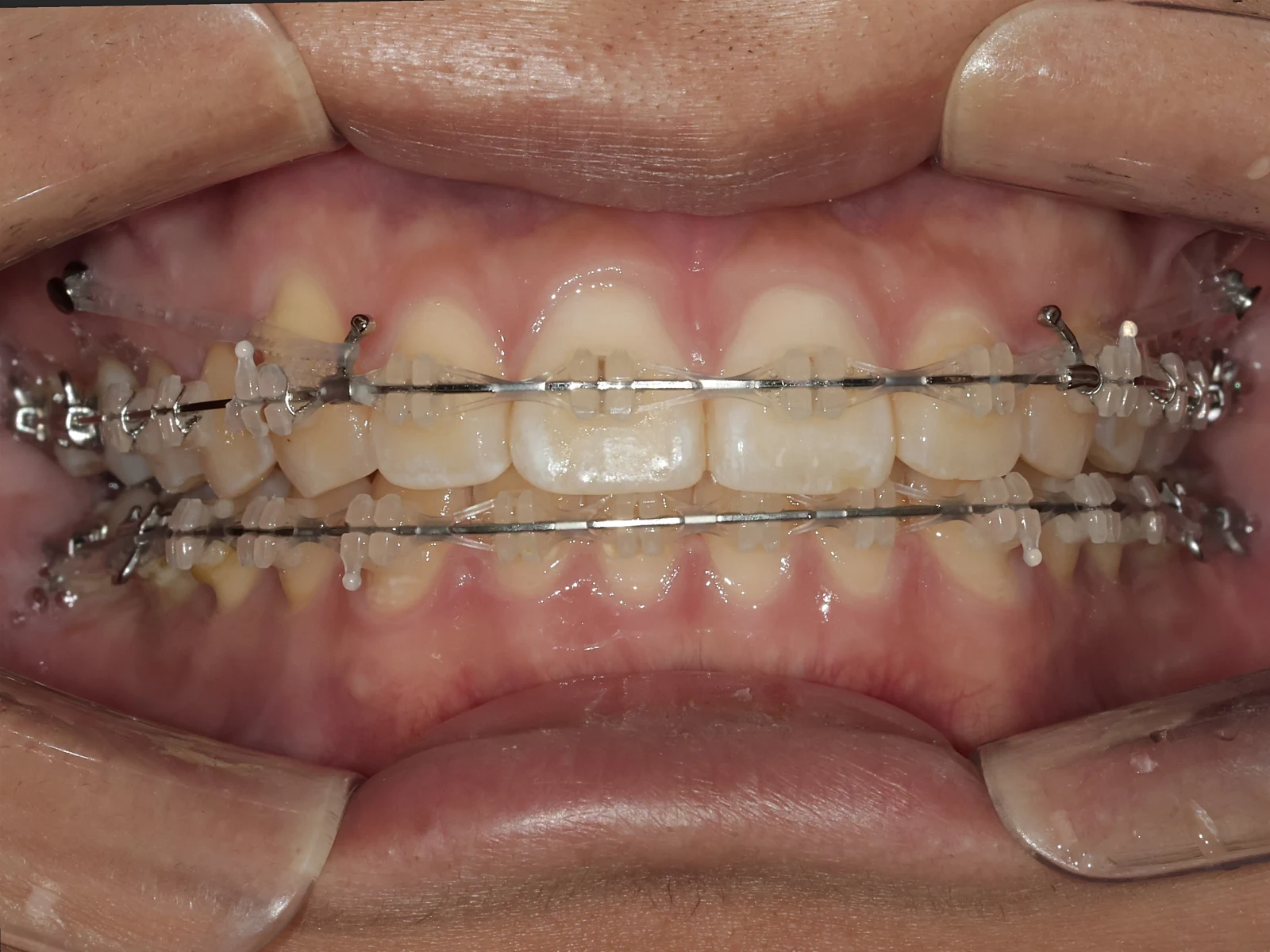
Front view of ceramic brackets in the finishing stageFinishing · front · Mar 2026
Side view of the mouth in the finishing stageFinishing · side
Finishing stage. We fine-tune while checking the bite of the upper and lower back teeth, the edge line of the front teeth and the midline.

STEP 04

We finish the bite while fully controlling rotation and angle

In the finishing stage, we check whether rotated teeth have come fully upright and whether the upper and lower bite and the front-tooth edge line match. If needed, we bend the wire slightly to adjust each tooth.

Why we do thisThe last few degrees of tooth rotation are the hardest to control, and rotation that is not fully corrected tends to come back after treatment. This is why we switch to a firmer tying method at this stage.
Front view of the mouth on the day the ceramic brackets were removed and the surfaces polishedRemoval · Sep 2026
The day the braces were removed, after the remaining adhesive was smoothed off and the tooth surfaces polished.

STEP 05

We remove the braces with instruments made for ceramic and polish the surfaces

Ceramic brackets bend less than metal, so we remove them with instruments designed for ceramic, applying force in the right direction. The remaining adhesive is smoothed off little by little and polished without damaging the tooth surface.

Why we do thisIf ceramic brackets are twisted off with force, in rare cases the tooth surface (enamel) can crack or chip. Keeping to the right direction and instruments reduces this risk.
Fixed retainer bonded behind the lower front teethFixed retainer
Clear retainerClear retainer
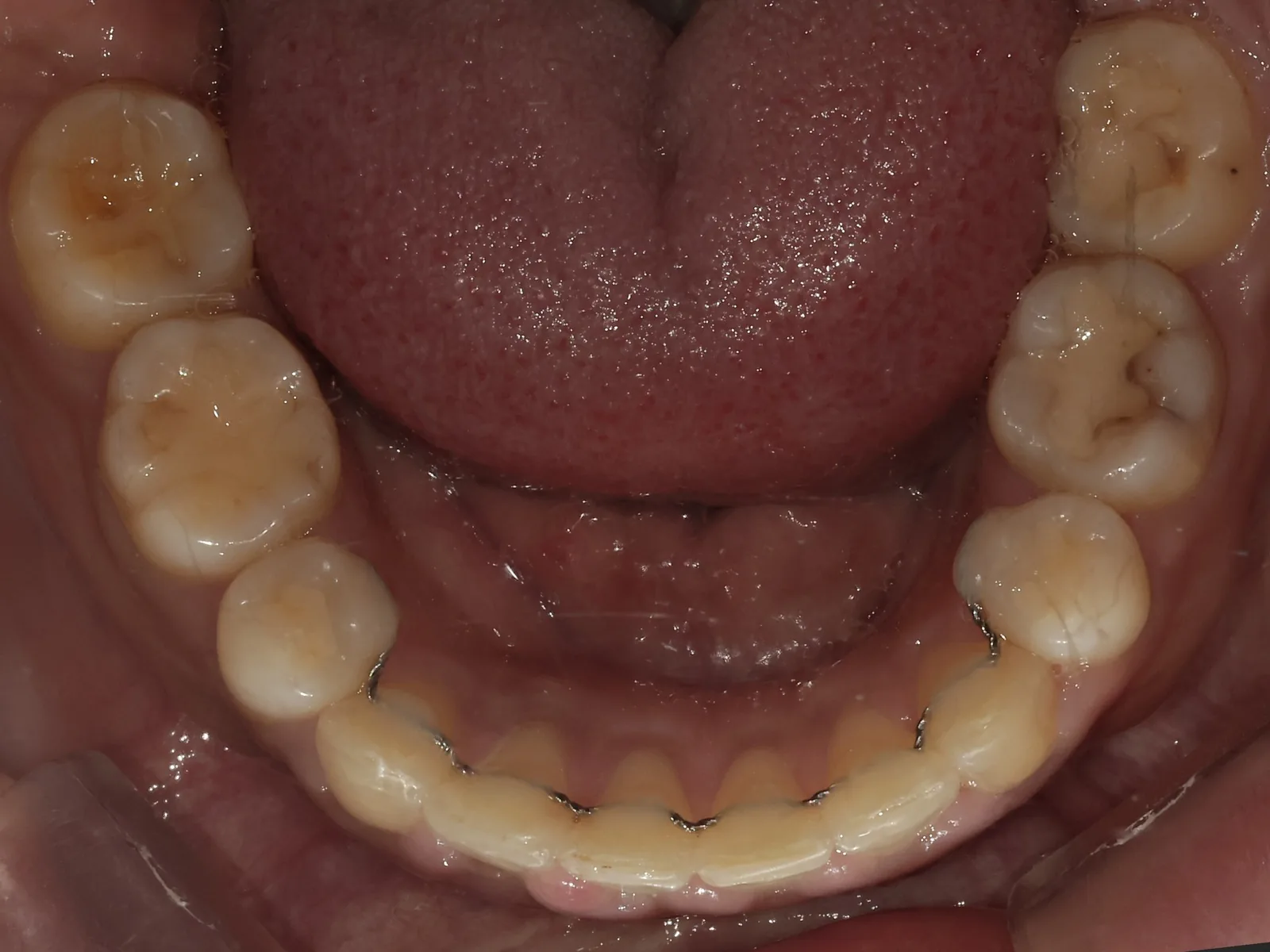
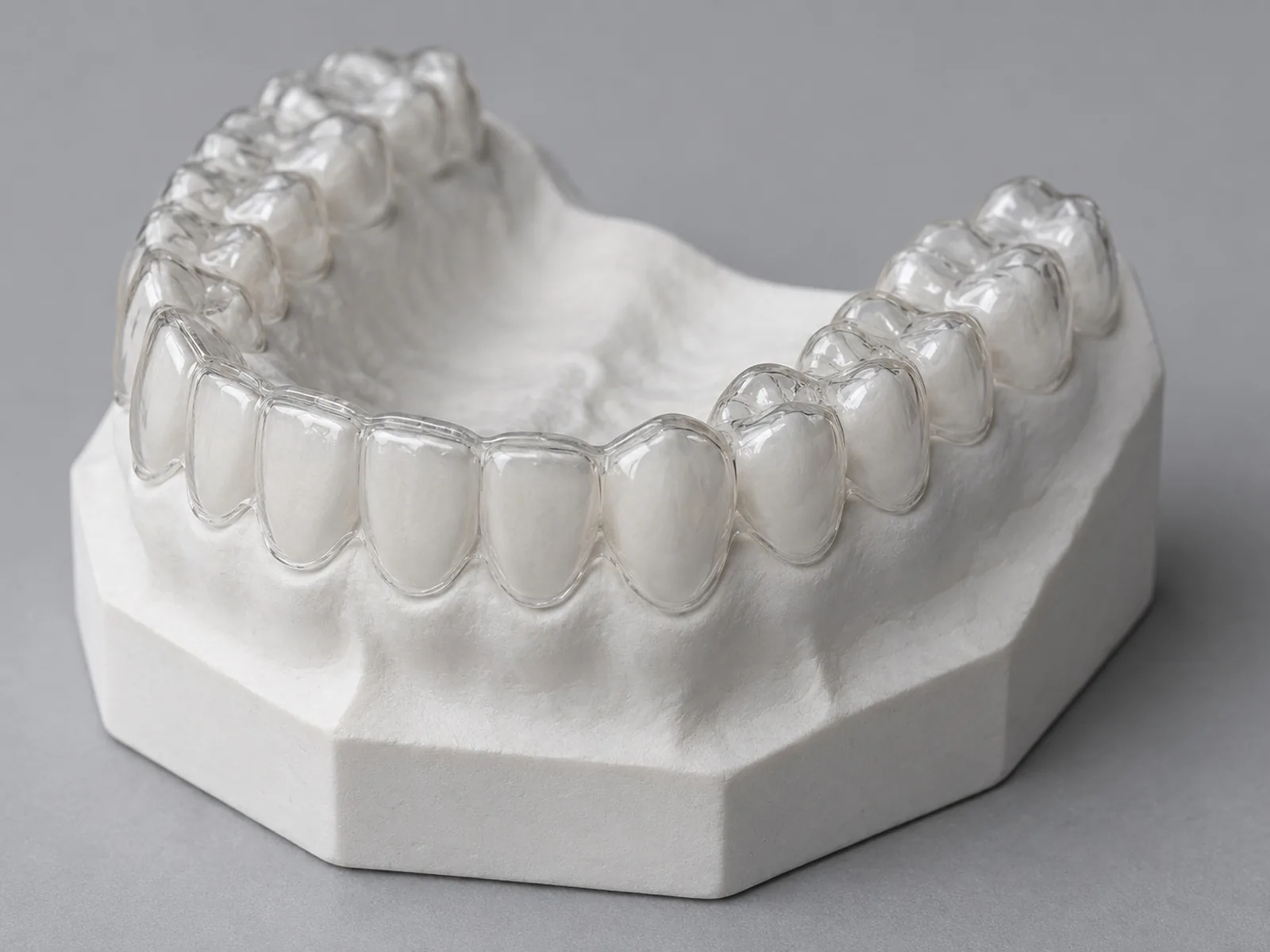
Two kinds of retainers used after treatment. A thin wire bonded behind the front teeth (fixed) is used together with a clear retainer worn at night.

STEP 06

Two kinds of retainers keep your new tooth alignment

We bond a thin wire retainer behind the front teeth and give you a clear retainer. For 2 years after treatment, retainer check-ups and adjustments are included in the orthodontic fee.

Why we do thisThe gum fibers supporting the teeth keep pulling them back toward their old positions for a while after they move. Teeth shift most easily in the first year, so we keep check-up intervals short during this period.

* Clinical photos were published with the patients' consent. Side effects such as temporary pain or discomfort may occur depending on the person.

For 2–3 days after the braces are bonded or the wire is changed, your teeth may feel sore. Starting with soft foods makes it easier.

05°

Comparing orthodontic appliances

Ceramic bracesLingual and combination bracesInvisalign
VisibilityTooth-colored brackets, less noticeable than metalUpper braces are on the inside, so they are almost invisibleClear aligners; only the edges show up close
Movements possibleMost, including extraction cases, heavy rotation and bodily movementMost, including extraction casesMost; extruding and heavy rotation need auxiliaries
Your partAvoid hard foods; brush carefullyAvoid hard foods; brush the inner surfaces tooWear 20–22 hours a day
Points to watchCan wear down lower teeth that touch them; care needed at removalTongue discomfort and speech changes for the first 2–4 weeksTeeth do not move as planned if wearing time is short
Visit intervalUsually once a monthUsually once a monthUsually 2–3 months
CostSee the fee schedule →See the fee schedule →See the fee schedule →

Ceramic Dental Clinic does not offer metal bracket braces.

06°

Who ceramic braces suit, and when another appliance is better

Good for you if

  • You want less visible braces but find it hard to manage clear aligner wear
  • You need movements where brackets have the advantage, such as extraction cases or heavily rotated teeth
  • You want orthodontic treatment without the hassle of taking appliances out and putting them back in

Other treatment comes first

  • Gum inflammation: we treat the gums first
  • Cavities: we bond the braces after treating them
  • Jaw joint pain: we manage the pain first

Another appliance may be better

  • If the braces must not show at all: lingual or combination braces
  • If the bite is deep and the lower teeth keep touching the upper brackets: adjusting bracket positions or considering another appliance
  • If grinding is severe and the risk of the ceramic breaking is high

07°

Daily life and care

The ceramic brackets themselves hardly discolor, but the elastic rings used for conventional ligation can be stained by strongly colored foods such as coffee, curry and kimchi broth. The elastic rings are replaced with new ones every time the wire is adjusted.

Hard nuts, ice and chewy foods can knock off or break brackets, so please avoid them. If a bracket comes off or the wire pokes your cheek, contact us, and in the meantime cover it with protective wax. When brushing, clean above and below the brackets separately and use an interdental brush as well.

08°

Side effects and limits

Please read

· Ceramic is harder than metal, so if the lower teeth touch the upper brackets, the lower teeth can wear down.

· Brackets can break on impact.

· Elastic rings can be stained by strongly colored foods.

· When the braces are removed, in rare cases the tooth surface (enamel) can crack or chip, so we remove them with instruments made for ceramic, in the right direction.

· Food easily gets caught around the braces, which can lead to cavities and gum inflammation.

· Shortening of tooth roots or gum recession can occur with orthodontic treatment regardless of the appliance type.

FAQ

FAQ

Do ceramic braces take longer than metal braces?
Ceramic braces move teeth on the same principle as metal brackets, so treatment time depends on how much the teeth need to move, not on the bracket material. Ceramic brackets can have slightly more friction with the wire, so we choose the tying method and the wire to suit each stage.
Is self-ligation faster with ceramic braces?
We do not say that self-ligation is always faster or better. Dr. Sunmin Kim's 2022 paper also measured whether the force on teeth changes with the tying method, and we choose the tying method to suit the condition of your teeth and the stage of treatment.
Do ceramic braces change color?
The ceramic brackets themselves hardly discolor. The elastic rings used for conventional ligation can be stained by strongly colored foods such as coffee or curry, but we replace them with new ones every time we adjust the wire.
Can ceramic brackets break?
They can break if you bite something hard or take a knock. If you grind or clench your teeth hard, please tell us at the consultation, and we will decide the bracket position and how to protect them together.
Can removing ceramic braces damage my teeth?
Ceramic brackets do not bend easily, so if they are removed with force, in rare cases the tooth surface can crack. We remove them with instruments made for ceramic, applying force in the right direction, and then smooth and polish away the remaining adhesive without damaging the tooth.
Does Ceramic Dental Clinic only do ceramic braces?
No, we do not do only ceramic braces. After the diagnosis, we choose the appliance that suits your teeth and explain how it compares with clear aligners and lingual or combination braces.
Can ceramic braces be used for extraction cases?
Yes. Like metal brackets, ceramic brackets can close extraction spaces and move the front teeth bodily with their roots.
How much do ceramic braces cost?
The cost of ceramic braces is listed in the orthodontic fee table on our treatment cost guide page. Parts that change depending on extraction or auxiliary appliances are explained after the examination.

Evidence and references

  • Kim S, et al. Influence of different ligation methods on force and moment generation in a simulated condition of the maxillary crowded anterior dentition with linguo-version and rotation. Bio-Medical Materials and Engineering, 2022. doi:10.3233/BME-211288 (Measurement of orthodontic force and moment by tying method)
  • Dr. Sunmin Kim's training: McLaughlin Orthodontic Course (Courses 1 and 7). About the doctor
COSTAll costs are gathered on one page, the treatment cost guideSee orthodontic costs →

ABROAD

Visiting from abroad

Questions from patients who travel to Seoul for treatment.

How much does ceramic braces cost?
Ceramic braces are KRW 6,000,000. The orthodontic fee includes the orthodontic diagnosis, extraction (except wisdom teeth), mini-screws, basic retainers and retention care for 2 years. If you have only the diagnosis and do not start treatment, it is KRW 50,000 (KRW 100,000 if a CT scan is needed). If a retainer breaks or is lost later, remaking it costs extra. International and Korean patients pay the same fees. We explain the total before treatment starts. See our fee schedule.
Can I continue treatment after I go home?
Yes, but it needs a plan. Fixed braces need regular adjustment visits: the first two visits are 2 weeks apart, then usually once a month. Clear aligners are easier from abroad: after you receive your aligners, you visit once every 2–3 months, and between visits we check by photo only if something comes up. Your doctor tells you at diagnosis which method fits your case.
Can I have my consultation in English?
Yes. The doctor in charge of each field consults with you directly in English. For orthodontics, this is Dr. Sunmin Kim, a board-certified orthodontist. Before you travel, you can send photos of your teeth on WhatsApp or by email. An accurate diagnosis is made after we examine you in person.
What happens after treatment, and what if something comes off?
You need retainers after treatment, because teeth tend to move back. Retention care for 2 years is included in the orthodontic fee. If a bracket comes off or a wire hurts after you go home, send us a photo on WhatsApp. We check it and tell you what to do. Some repairs need a visit.

Results, the number of visits and schedules vary from person to person. More questions: Visiting from abroad.

MORE

Related pages

Treatment results and side effects may vary from person to person.

You can ask first by sending photos of your teeth

TOP
Request a ConsultationView