Last reviewed October 29, 2026 · Dr. Sunmin Kim (board-certified orthodontist, Certified Orthodontist of the Korean Association of Orthodontists)
At a glance
Good for
People who want braces that are almost invisible from outside
Treatment flow
Examination and diagnosis → bonding inner braces (or combination braces) → adjustments with the direction of force calculated
Duration and limits
For the first 2–4 weeks, your tongue may feel uncomfortable and your speech slightly lisped
Details
Lingual braces are bonded to the inner (tongue) side of the teeth, so they are almost invisible from outside, and they can handle movements that are difficult for clear aligners, such as extraction cases. For the first 2–4 weeks, your tongue touches the braces, which is uncomfortable, your "s" sounds may feel slightly lisped, and cleaning is harder than with braces on the outside. Combination braces, which place braces on the inner surfaces of the upper teeth (the ones that show when you smile or talk) and the outer surfaces of the lower teeth, are an option that reduces tongue discomfort and cost. When we move the front teeth back with inner braces, Ceramic Dental Clinic separately calculates the direction of force so the front teeth do not tip back.
01°
Even for hidden braces, we chose differently for each person
Depending on the person's job, how deep the bite was and whether extraction was needed, we decided whether to bond both upper and lower braces on the inside or only the upper ones. Here are three typical situations shown with real cases.
CASE01
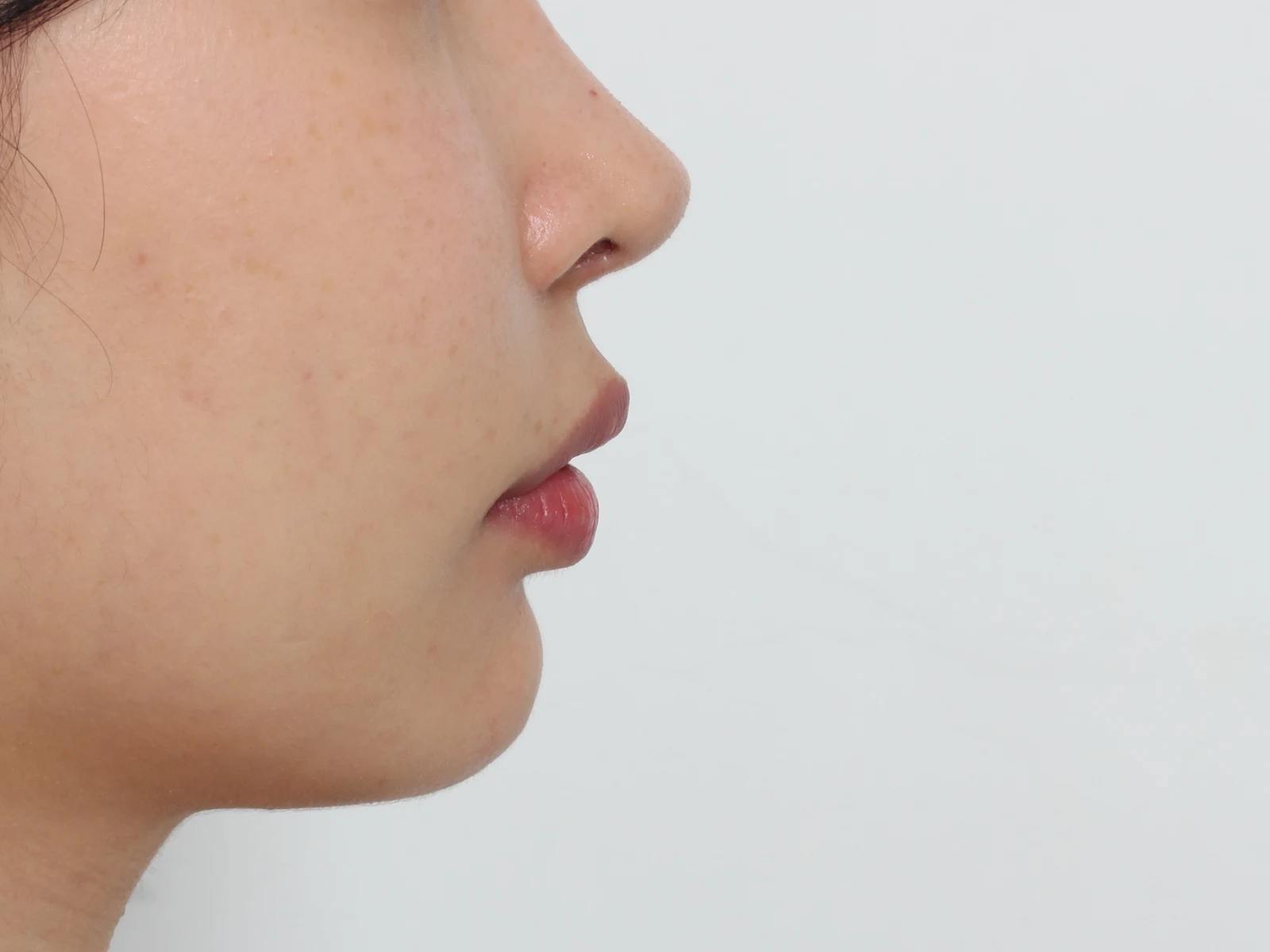
Protruding mouth needing extraction, and braces must not show because of work
Side profile before treatment. The front teeth were tipped forward and the mouth looked protruding. This patient met many people at work and wanted to avoid visible braces.
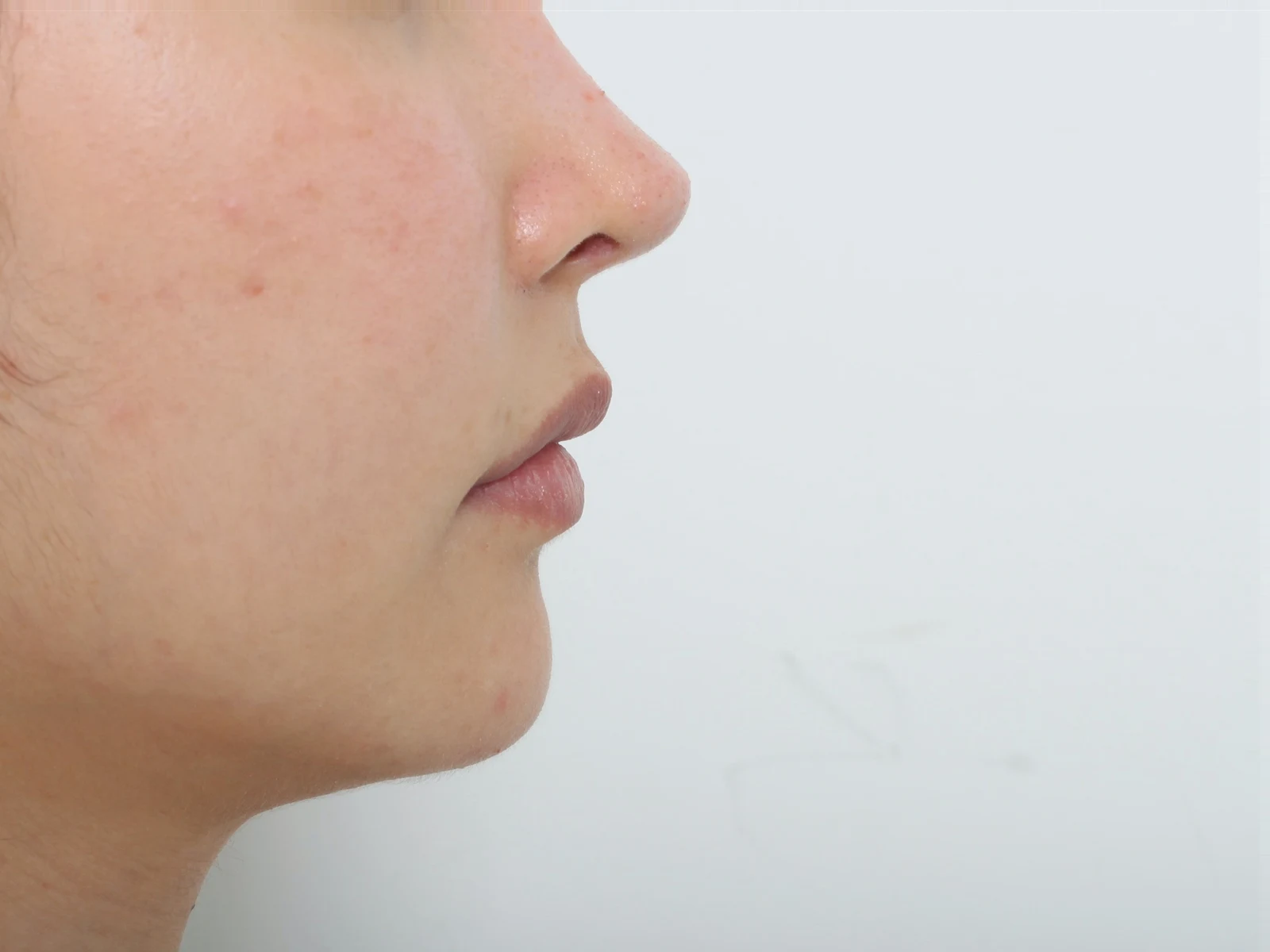
After · May 2025
Side profile after treatment. The mouth moved back as the inner braces on the upper teeth moved the front teeth back.
Condition
Dental protrusion; upper braces must not show when smiling
Inner braces on the lower teeth (the lower teeth do not show much when smiling)
Duration
About 2 years and 10 months
CASE02
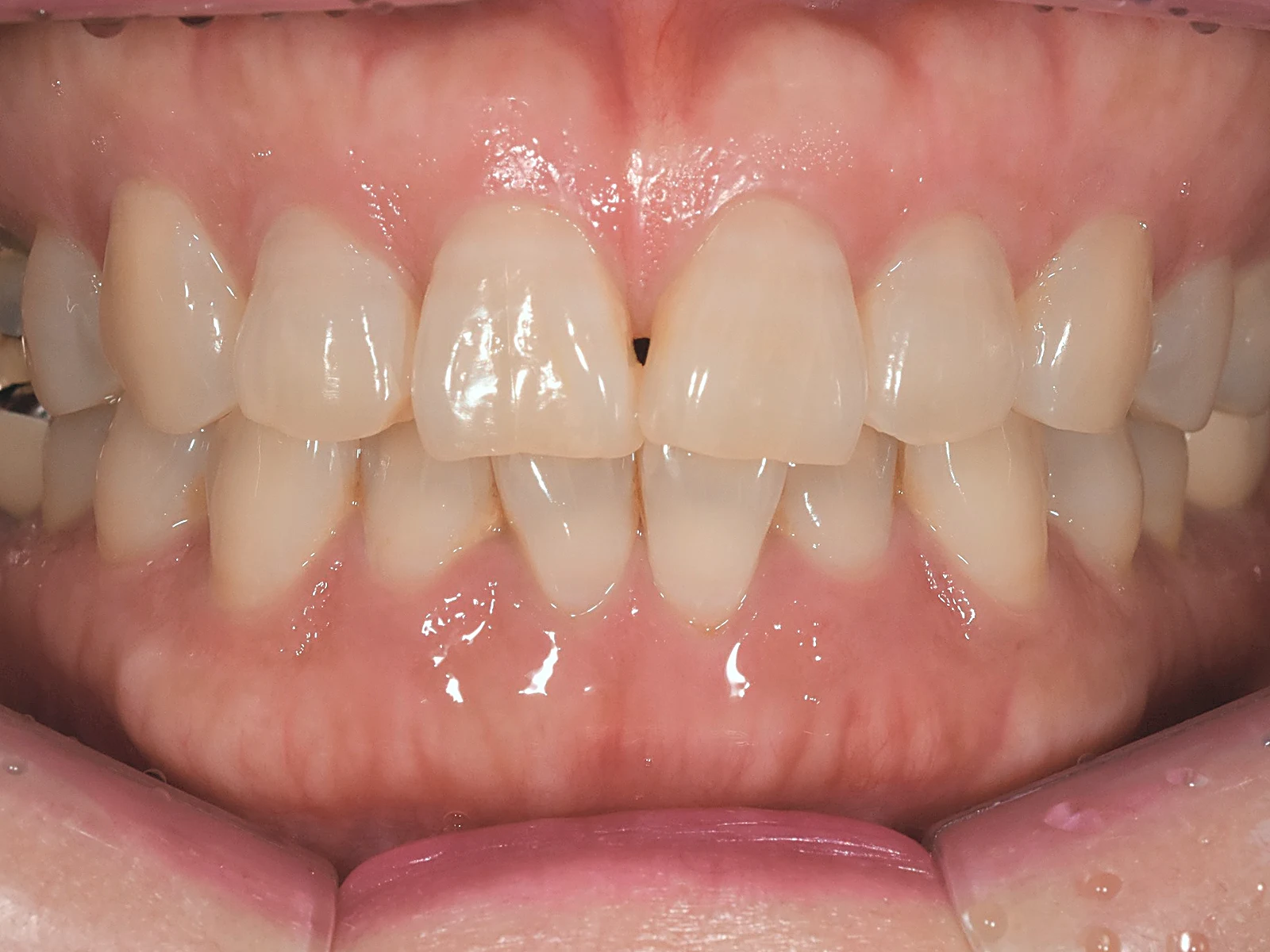
Snaggletooth and overlapping front teeth straightened without visible braces
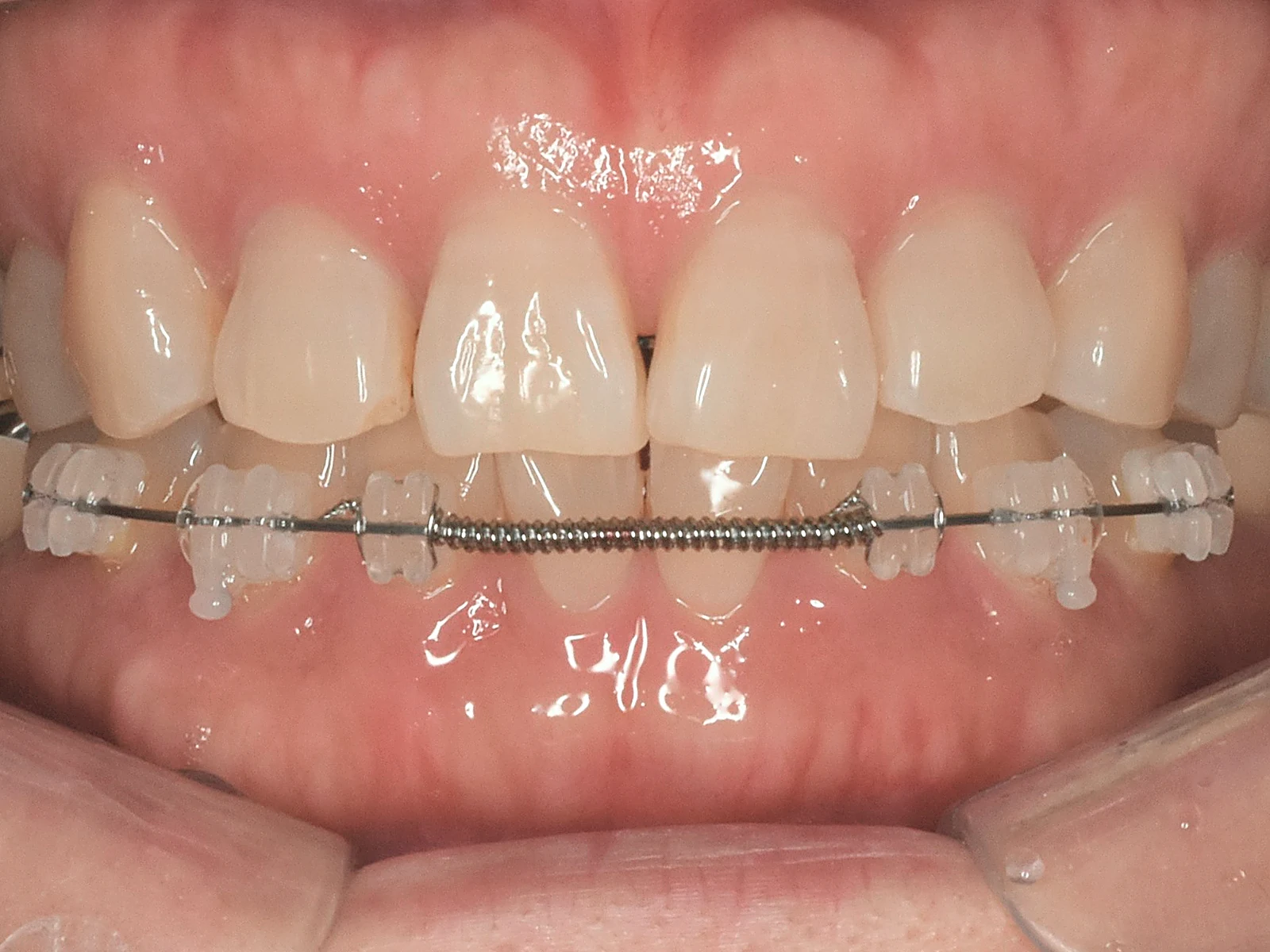
Upper partial lingual + lower partial ceramic · no extraction, space made by reshaping between teeth
Before · Aug 2022
Front view before treatment. The upper central incisors overlapped each other.
During treatment · Oct 2022
Front view during treatment. The upper braces are on the inside and cannot be seen from the front, and tooth-colored ceramic braces were bonded to the lower teeth.
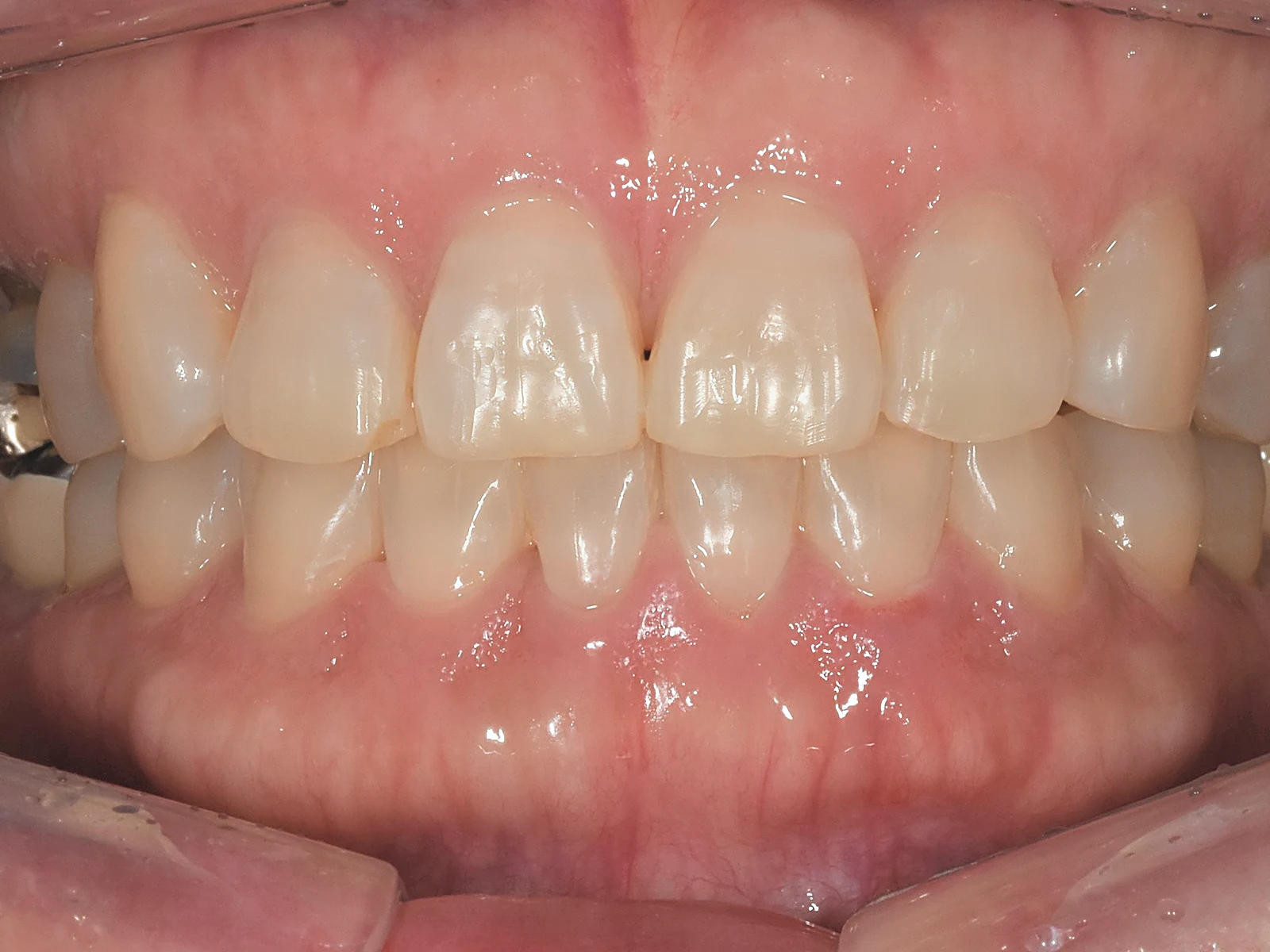
After · Oct 2023
Front view after treatment. The overlapping upper front teeth now stand in a neat line.
Condition
Snaggletooth and overlapping front teeth without a large lack of space
Usually 2–4 weeks until speaking feels comfortable
CASE03
Deep bite with the lower teeth touching the inner upper braces
Combination braces · making the bite shallower first, then aligning the front teeth
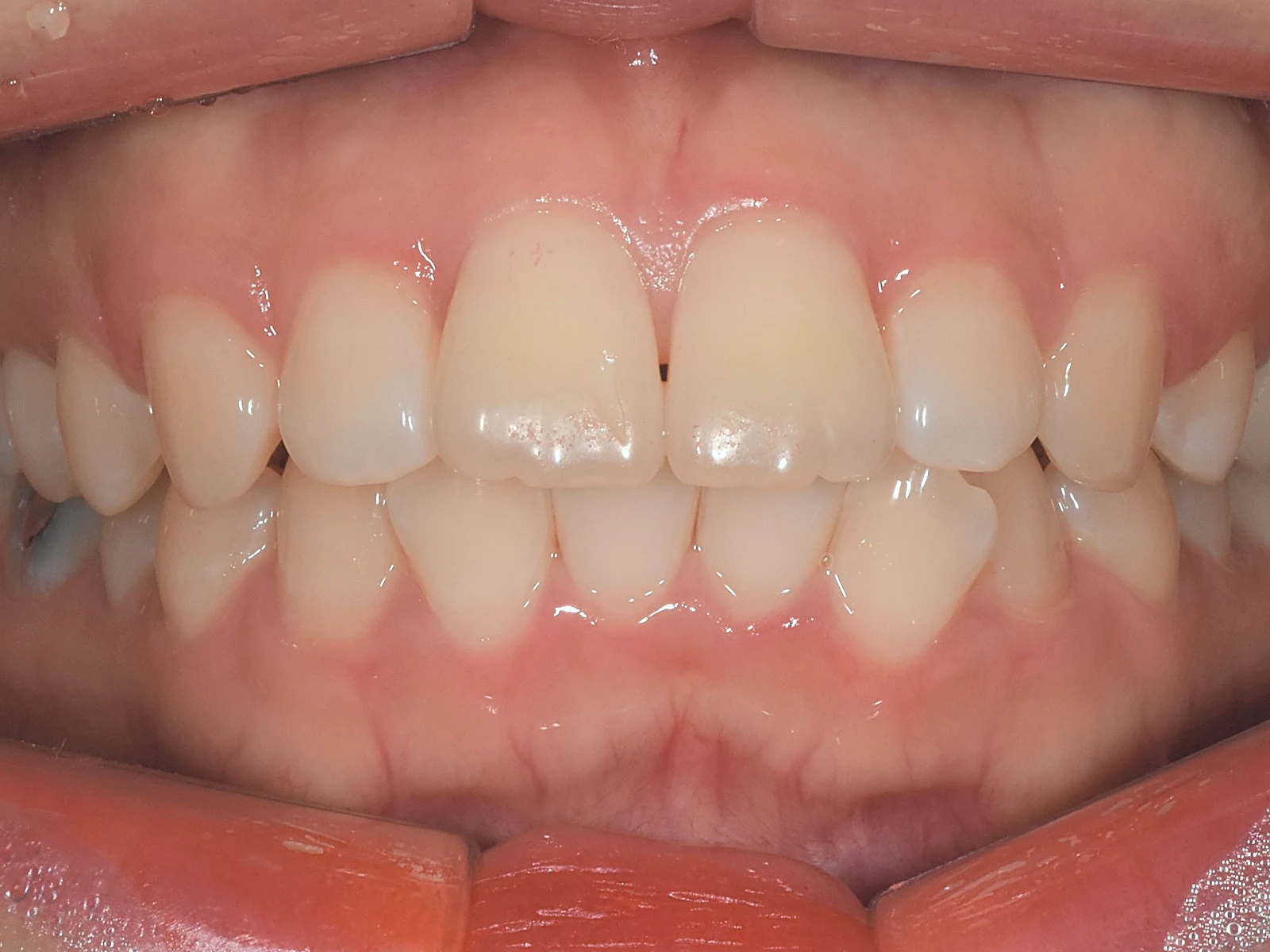
Before · Jun 2021
Before treatment. The upper teeth deeply covered the lower teeth, so braces bonded inside the upper teeth would have been hit directly by the lower teeth.
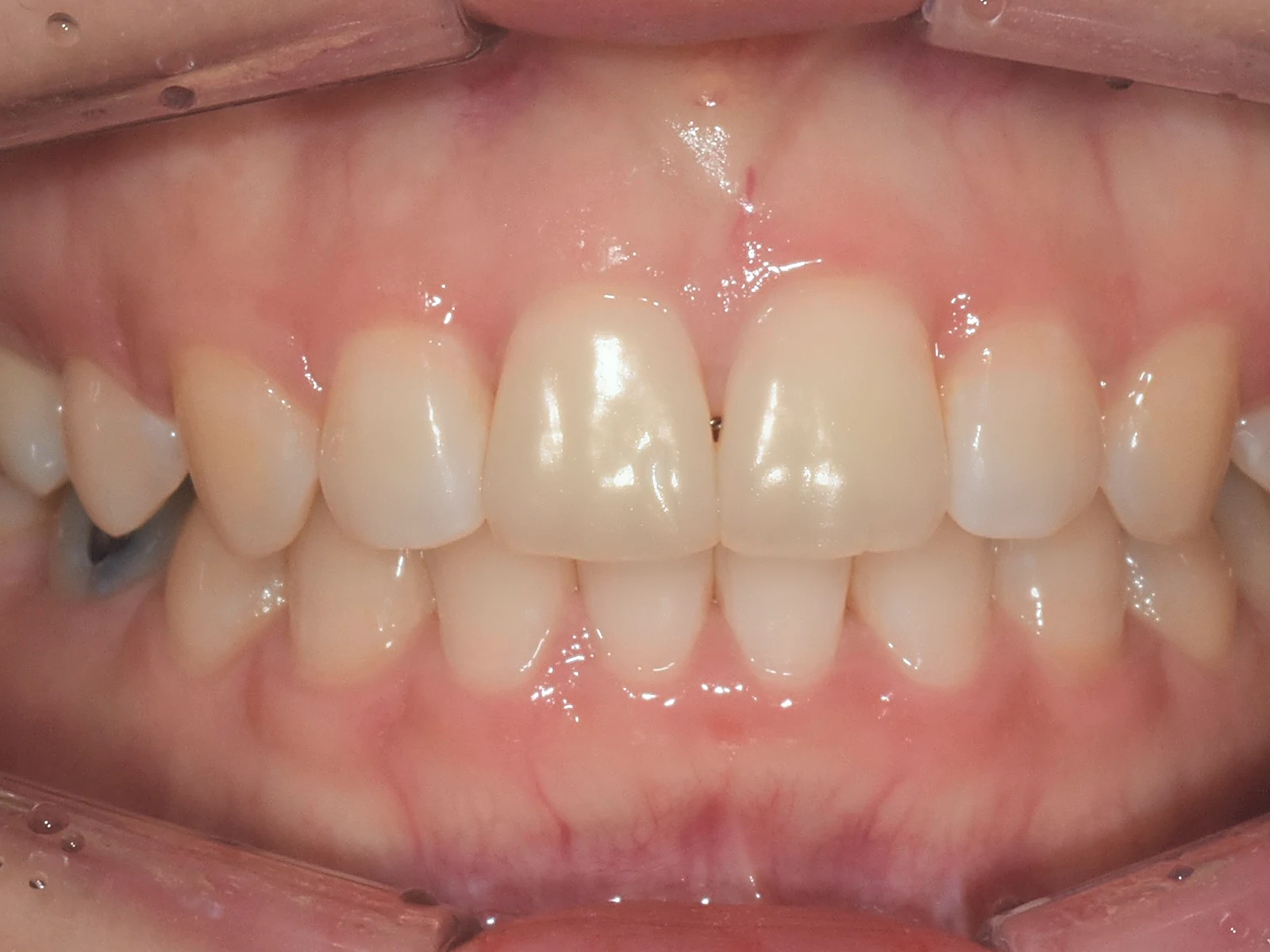
After · Mar 2024
After treatment. We reduced the bite depth and aligned the front teeth.
Condition
Deep bite (overbite) and front-tooth alignment problems
Chosen
Upper lingual + lower outer braces, adjusting the bite height first
Not done
Inner braces on both upper and lower teeth (there was not enough room on the lower teeth for brackets or for the bite)
Duration
About 2.5 years
Note
A deep bite tends to deepen again after treatment, so retainers are worn for a long time. The retainers are also shaped to keep the bite from deepening again.
* Photos were taken under the same conditions and published with the patients' consent. Treatment results and side effects may vary from person to person.
02°
How are lingual braces and combination braces different?
Both aim to keep the braces out of sight. The difference is where the lower braces go, and this changes tongue discomfort, speech and cost.
01Upper and lower lingual braces
Braces are bonded to the inside of both upper and lower teeth. They are almost invisible from outside, but the tongue touches both sets, so the first adjustment is the hardest and the cost is the highest.
02Combination braces
Only the upper teeth, which show easily when you smile or talk, have braces on the inside; the lower teeth have braces on the outside. The lower braces are often hidden by the lip, and tongue discomfort and cost are lower. Tooth-colored ceramic brackets are used on the outside of the lower teeth.
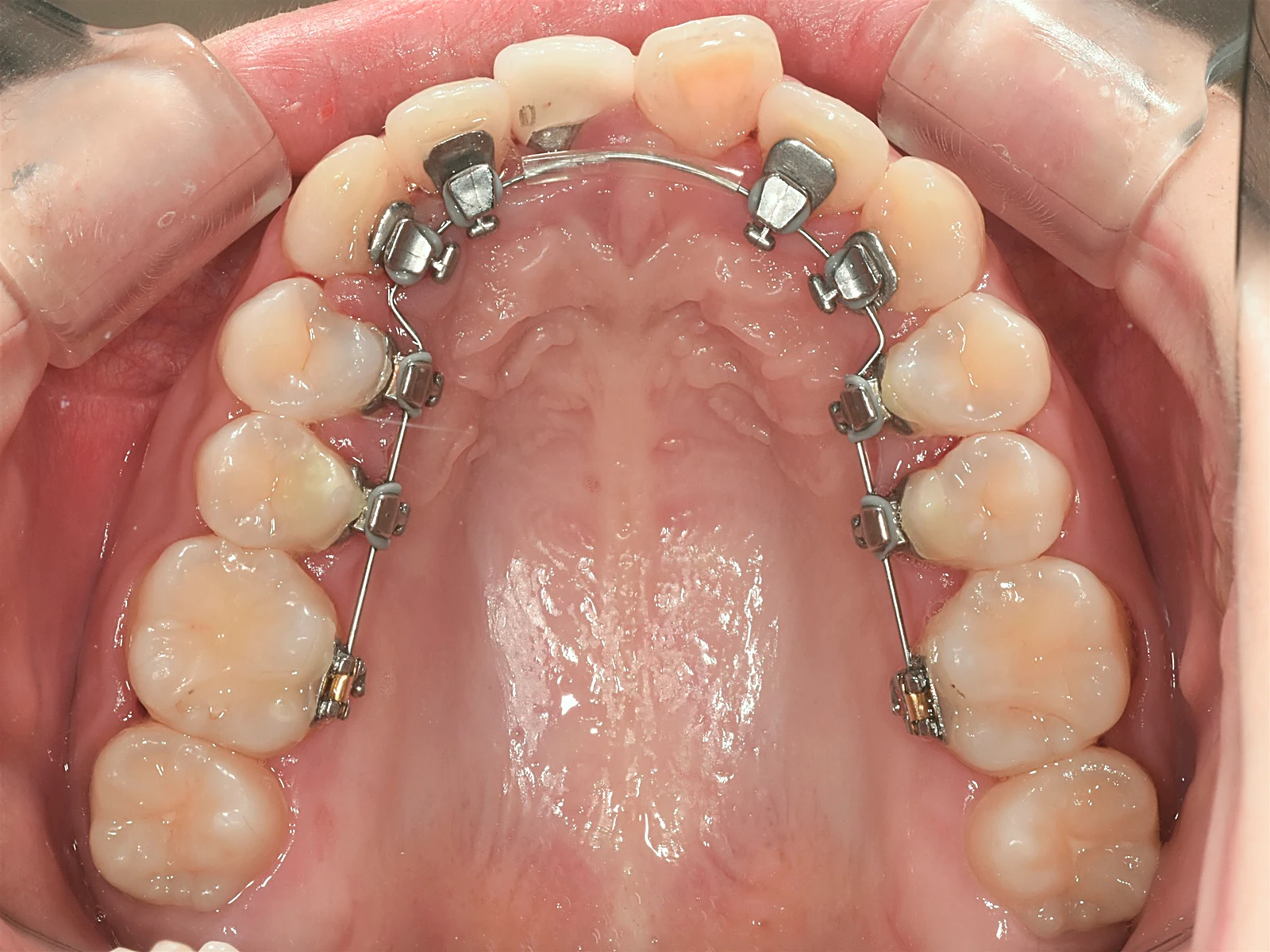
Inner braces on the upper teeth
Lingual braces bonded inside the upper teeth. This is the side the tongue touches, so they feel very foreign for the first few weeks.
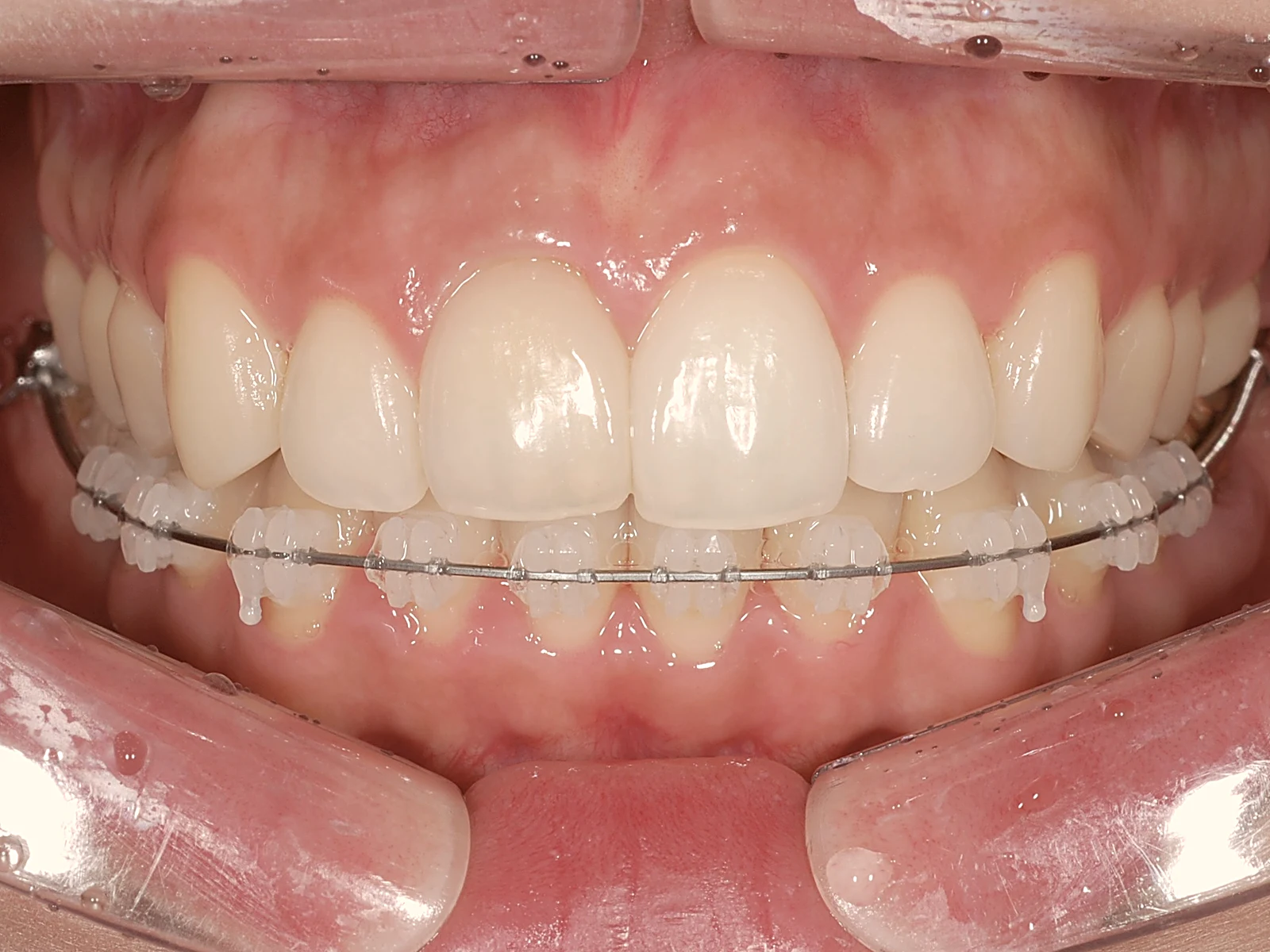
During combination braces · Feb 2016
Front view during combination braces. The upper braces are on the inside and cannot be seen; only the lower teeth have outer braces. When smiling or talking, the lower braces are mostly hidden by the lower lip.
Which suits you is decided by how much your lower teeth show when you smile and how deep your bite is. Lingual braces are custom-made for each patient by a dental laboratory.
03°
How lingual braces treatment works
There are six steps, from the examination to retainers. For each step, we note what we handle differently from outer braces because the braces are on the inside.
Examination
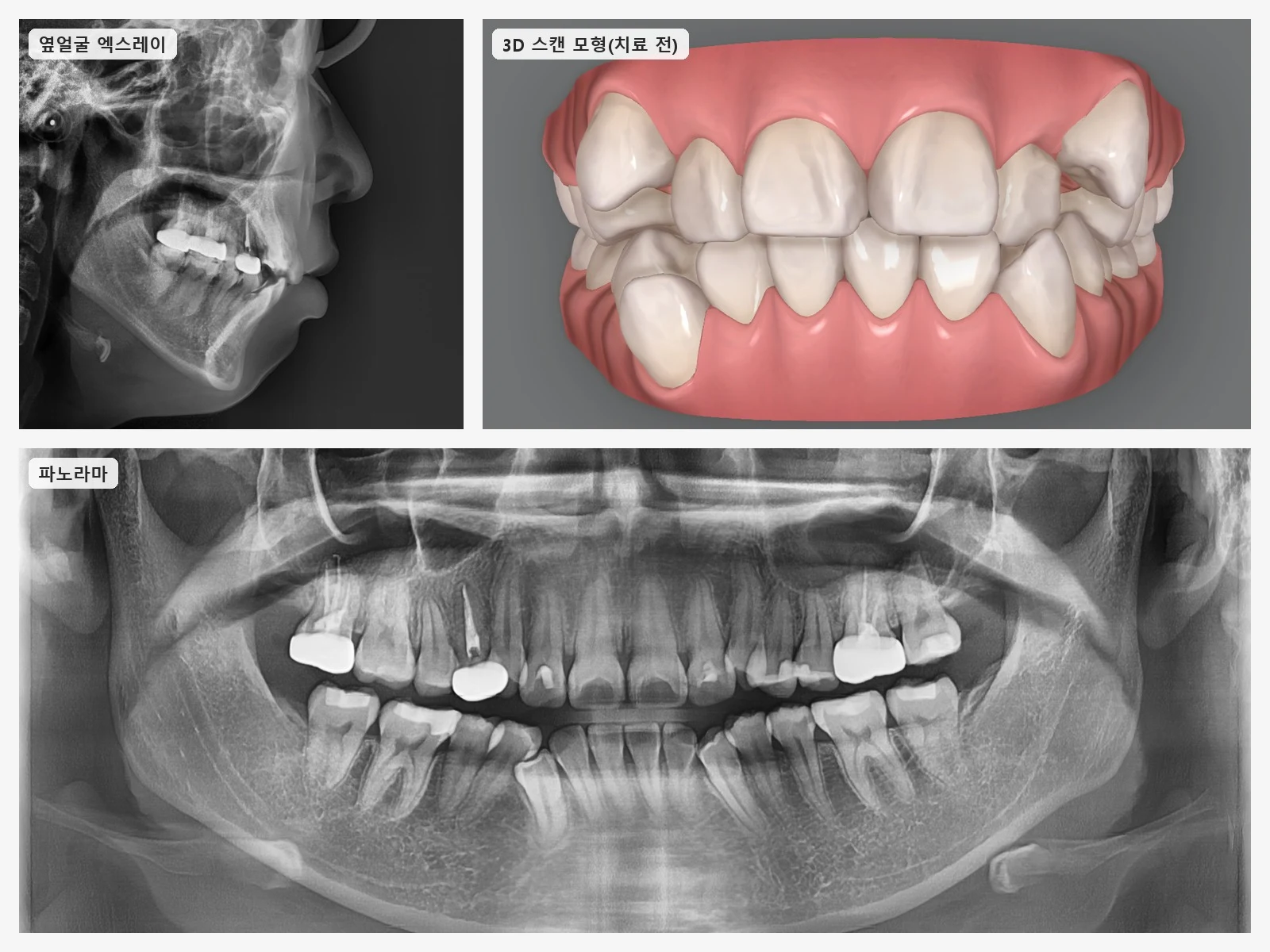
Full examination. We measure the front-tooth angle and lip position with a side-view X-ray, check the roots and jawbone with a panoramic X-ray, and record the teeth in 3D, inner surfaces included, with the iTero intraoral scanner.
STEP 01
In the full examination, we check bite depth and the inner surfaces of the teeth
We take facial and intraoral photos, a side-view X-ray of the face and a panoramic X-ray, and make a tooth model with the iTero intraoral scanner. For lingual braces, we especially check how deeply the upper and lower front teeth overlap and whether the inner surfaces of the teeth are tall enough to bond the braces.
Why we do thisIf the bite is deep, the lower teeth hit the inner upper braces, so the braces may come off or the back teeth may not meet well for the first few weeks. If the lower teeth are short, there is not enough room to bond braces inside them. These two points decide whether we choose upper and lower lingual braces or combination braces.
Design and fabrication
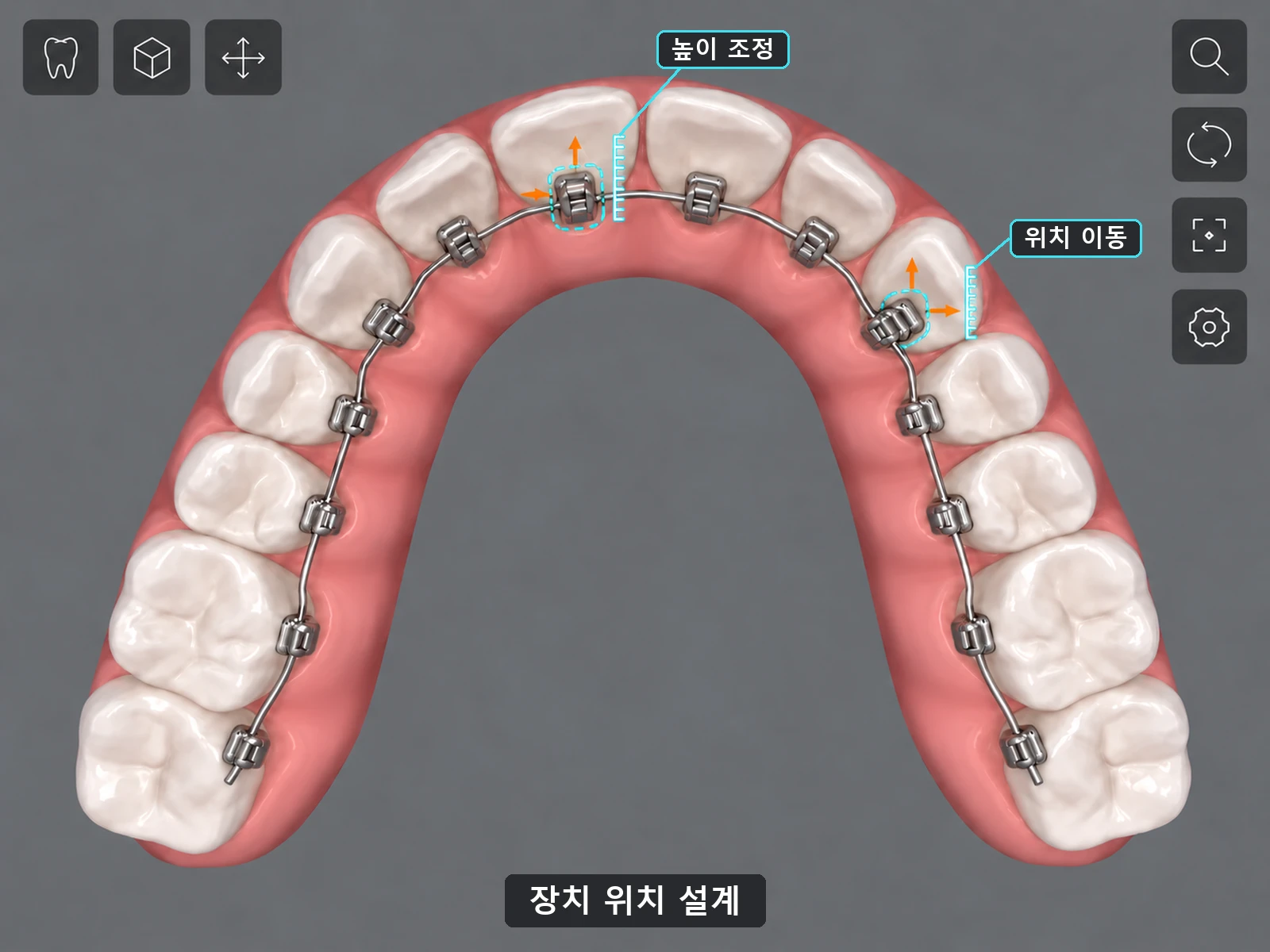
Bracket position design. The inner surfaces of teeth vary in shape, so the position and height of each bracket are set on a model in advance.
STEP 02
We set the bracket positions on a model in advance and design the forces so the front teeth do not tip back
The inner surfaces of teeth are very curved and differ from person to person, so it is hard to place the braces by eye in the dental chair. We first design the bracket positions on a 3D model on the computer, then use a tray to transfer them to those exact spots.
Why we do thisInner braces sit on the tongue side of the tooth's center of force, so even when pulled in the same direction, the tooth tips differently than with outer braces. If the front teeth are simply pulled back, they tend to tip inward, so we separately calculate the wire angle and pulling point. My research measuring the force and moment on teeth is the basis for these calculations.
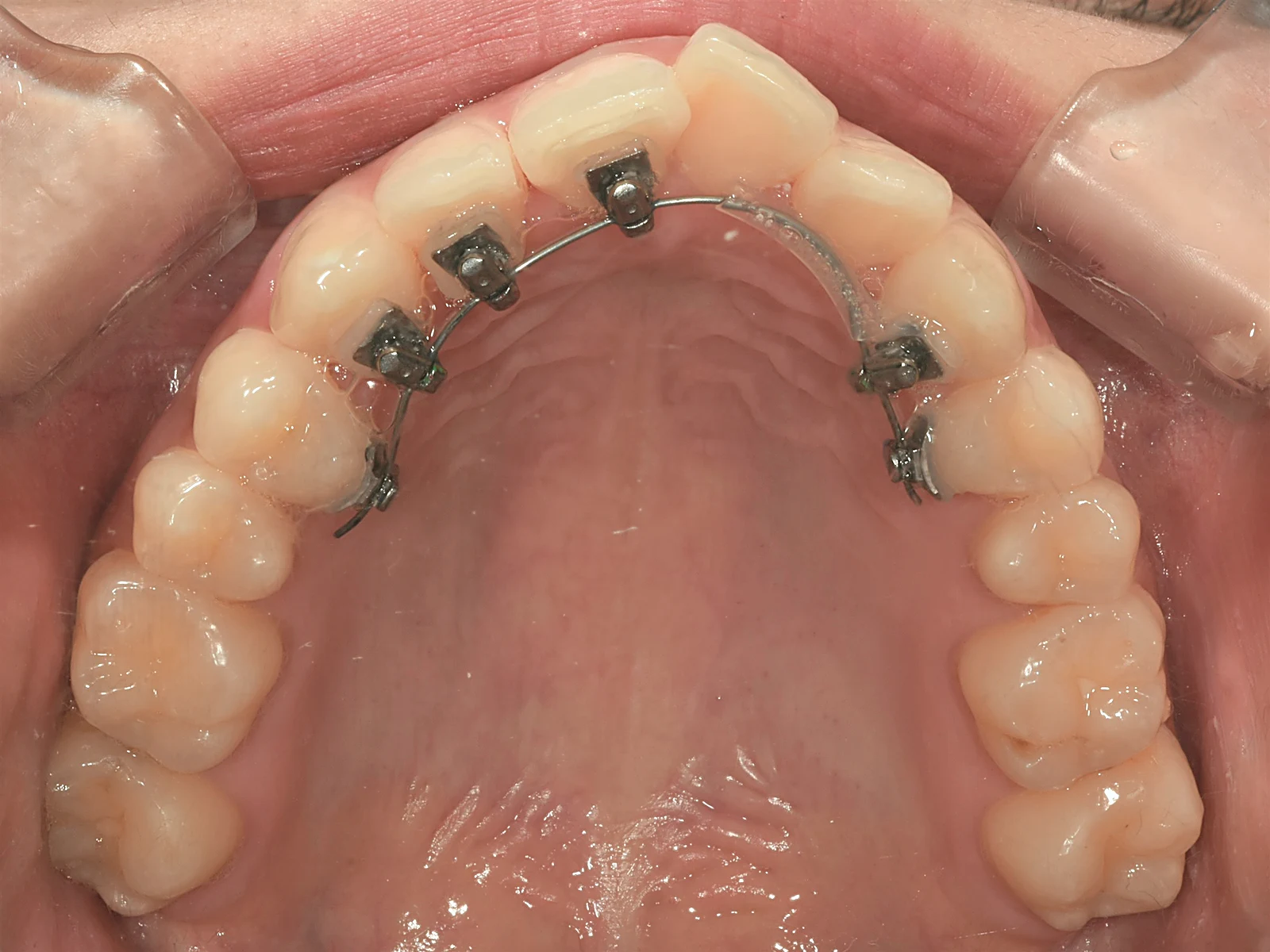
Early after bonding · Oct 2024
Shortly after the braces were bonded. We check where the tongue touches and give you protective wax for spots that bother you.
STEP 03
We bond the braces and help you adjust over the first few weeks
On the day the braces are bonded, we check where your tongue touches and show you how to brush, how to use an interdental brush and which foods to avoid. For the first 2–4 weeks, your tongue feels a strong foreign sensation and your "s" sounds may feel lisped, but most people gradually get used to it.
Why we do thisBecause the tongue keeps touching the braces, it may get rubbed or sore at first. Wax and oral ointment help you through this period, and if the same spot keeps hurting, we smooth the edge of the bracket.
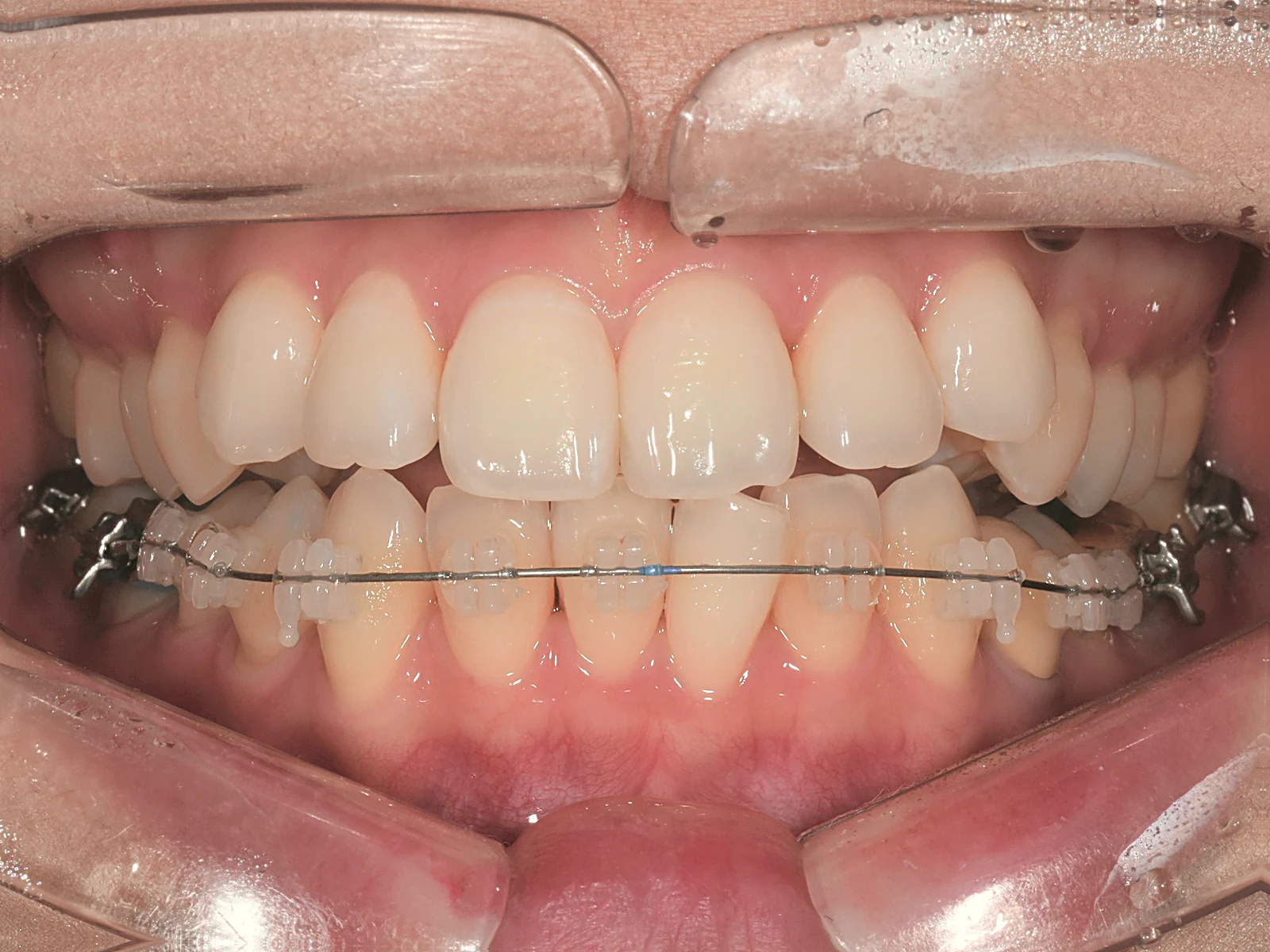
Start · Feb 2021
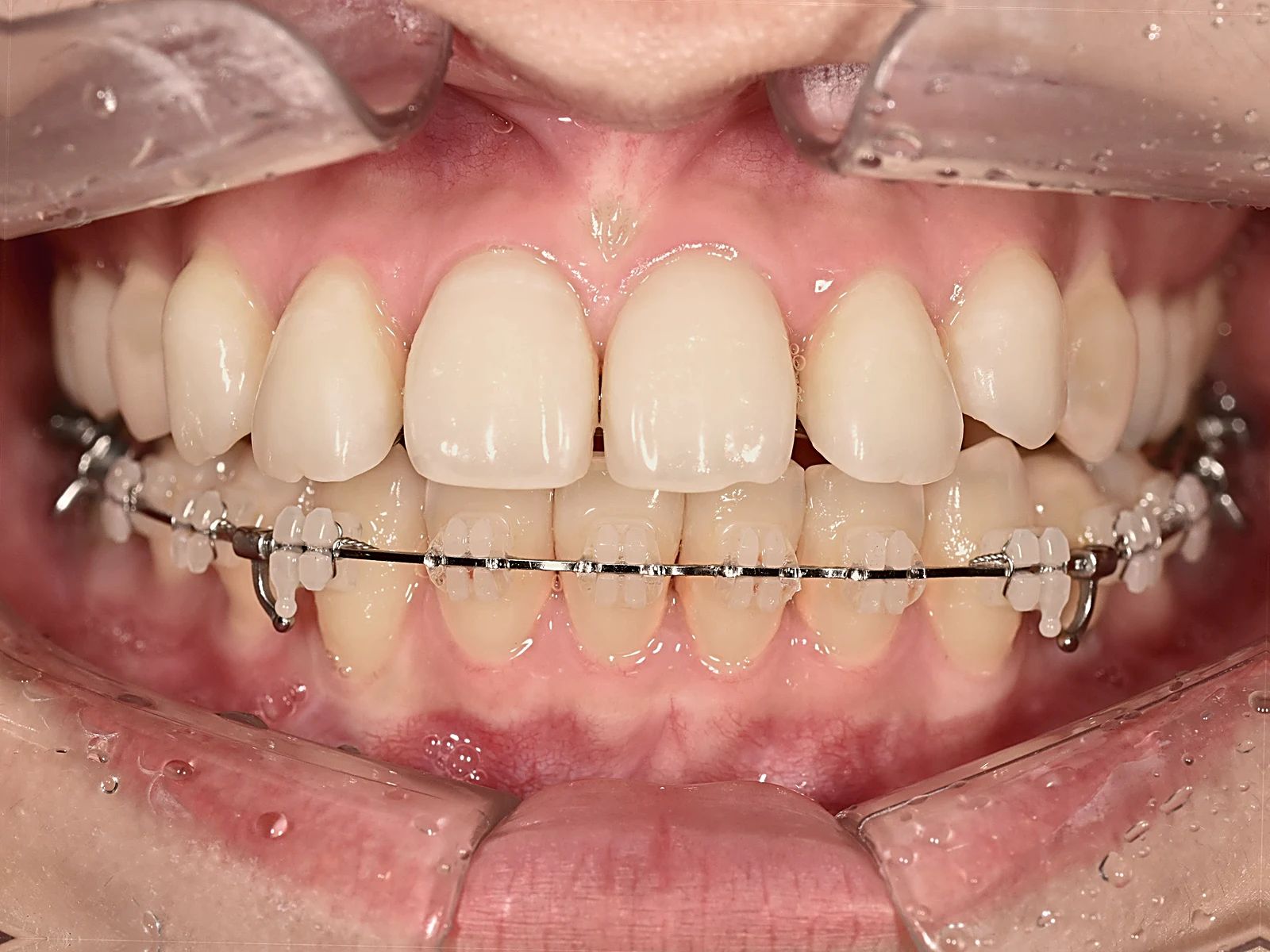
Midway · May 2022
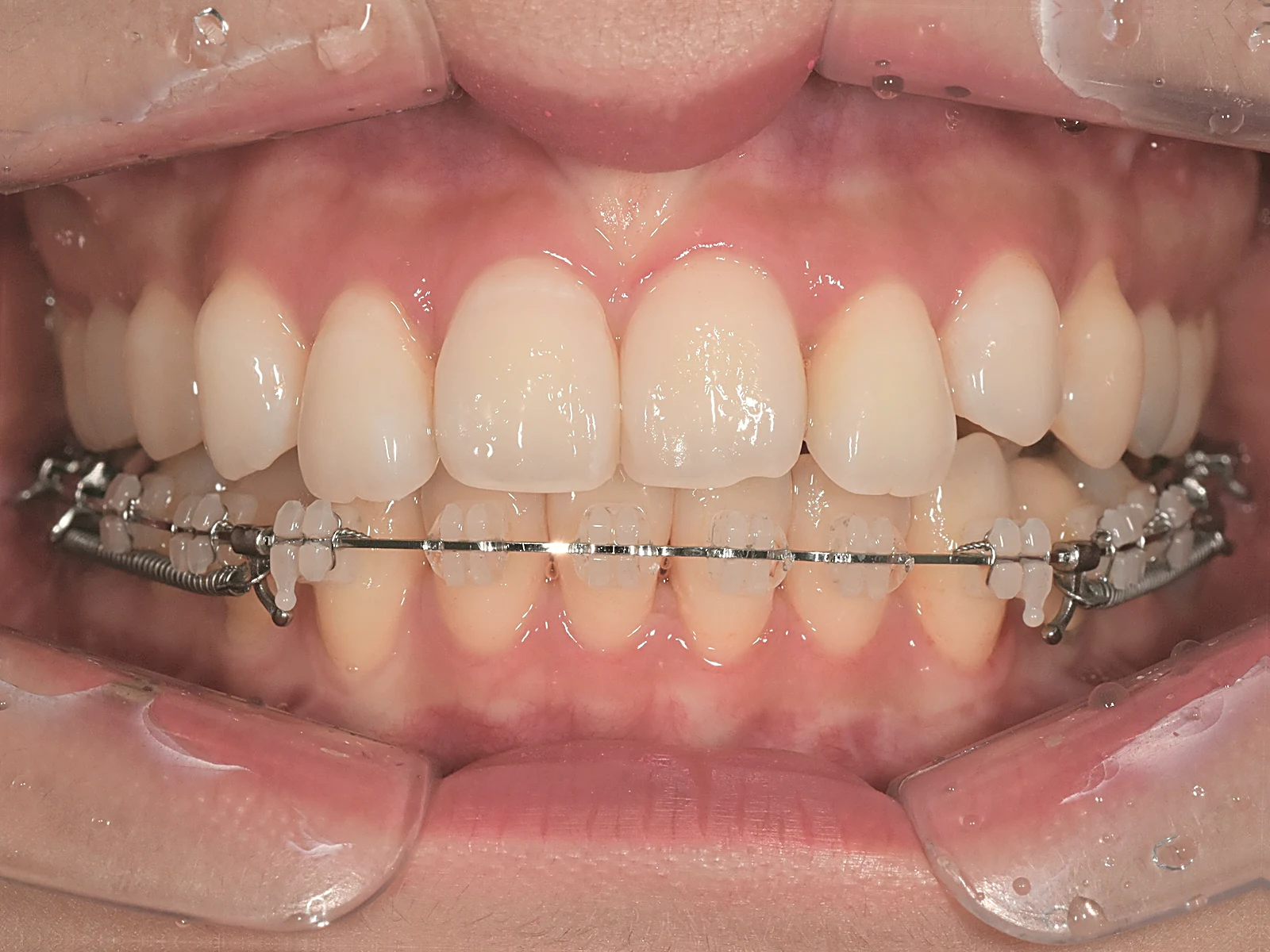
Late stage · Jul 2022
Progress of the same patient (combination braces). The upper braces are on the inside and cannot be seen from the front; only the outer braces on the lower teeth are visible.
STEP 04
Once a month we change the wire to move the teeth
You usually come once a month for a wire change or adjustment. With lingual braces, the brackets are closer together, so the wire feels stiffer than with outer braces, and we raise the force a little at each stage.
Why we do thisOn the inside, the distance between teeth is shorter than on the outside, so the same wire delivers more force to the teeth. A strong wire from the start increases pain and makes brackets come off more easily, so we move from thin wires up step by step.
STEP 05
We finish the bite while checking the front-tooth angle
In the finishing stage, we check the front-tooth angle again with a side-view X-ray and fine-tune the upper and lower bite and the front-tooth edge line.
Why we do thisWhen the front teeth are moved back with inner braces, they easily end up tipped back more than planned. Even if they look neat from outside, tipped-back front teeth look shorter and deepen the bite, so we always check the angle at the end.
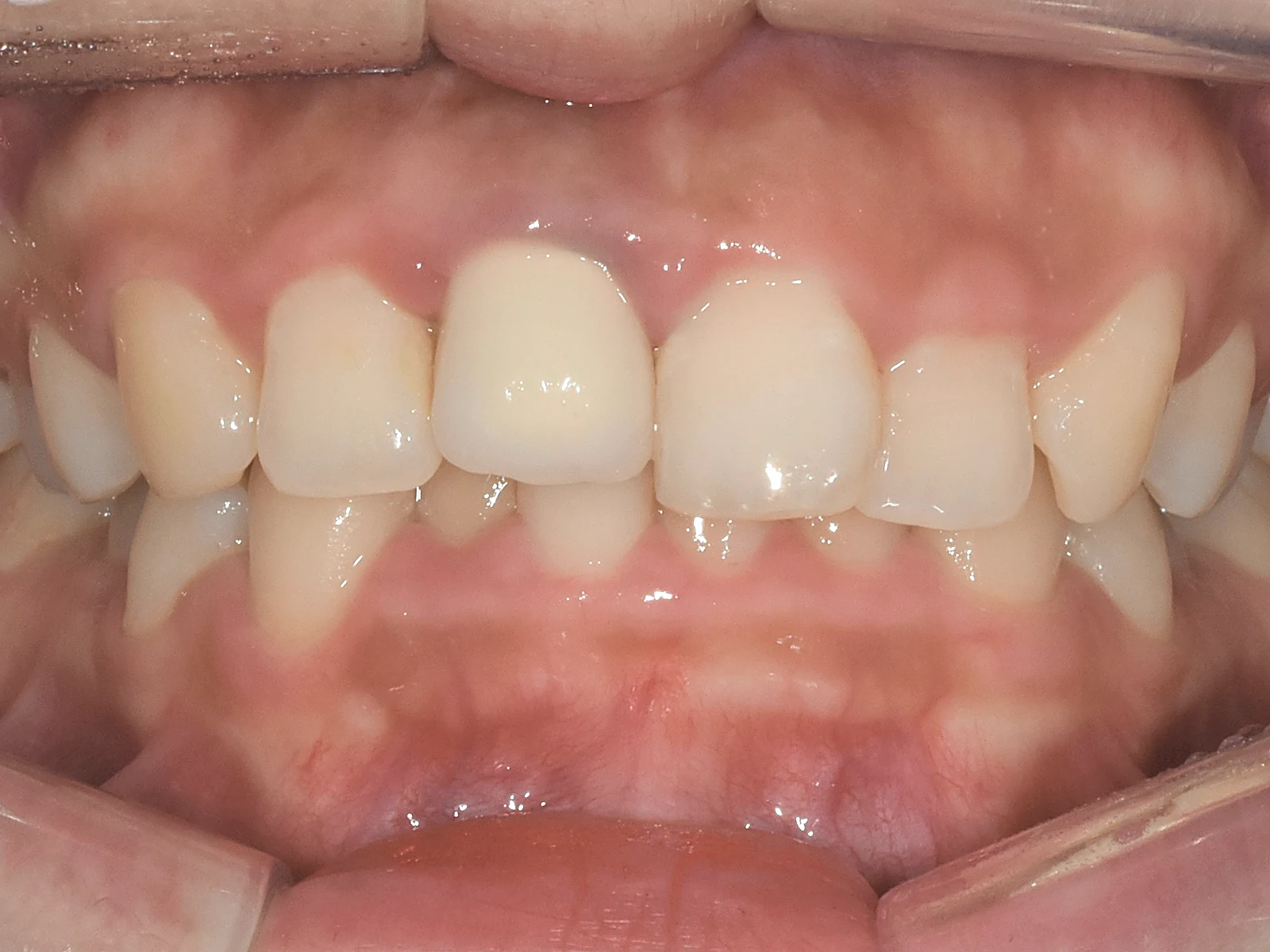
Before · Oct 2019
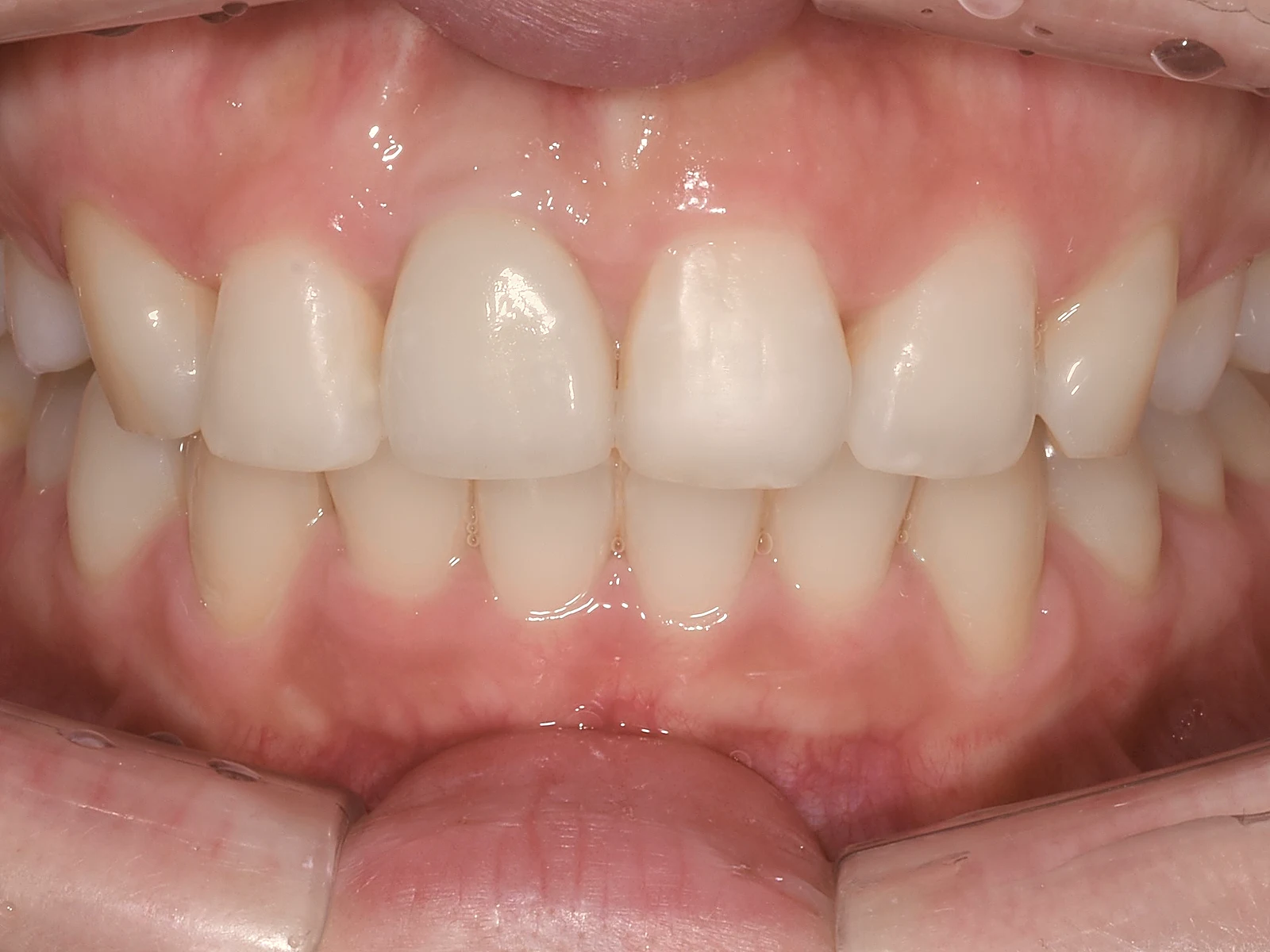
Removal day · Jul 2025
Final check. The upper teeth that covered the lower teeth deeply before treatment (left) cover them by the right amount on removal day (right), and the front-tooth edge line is even.
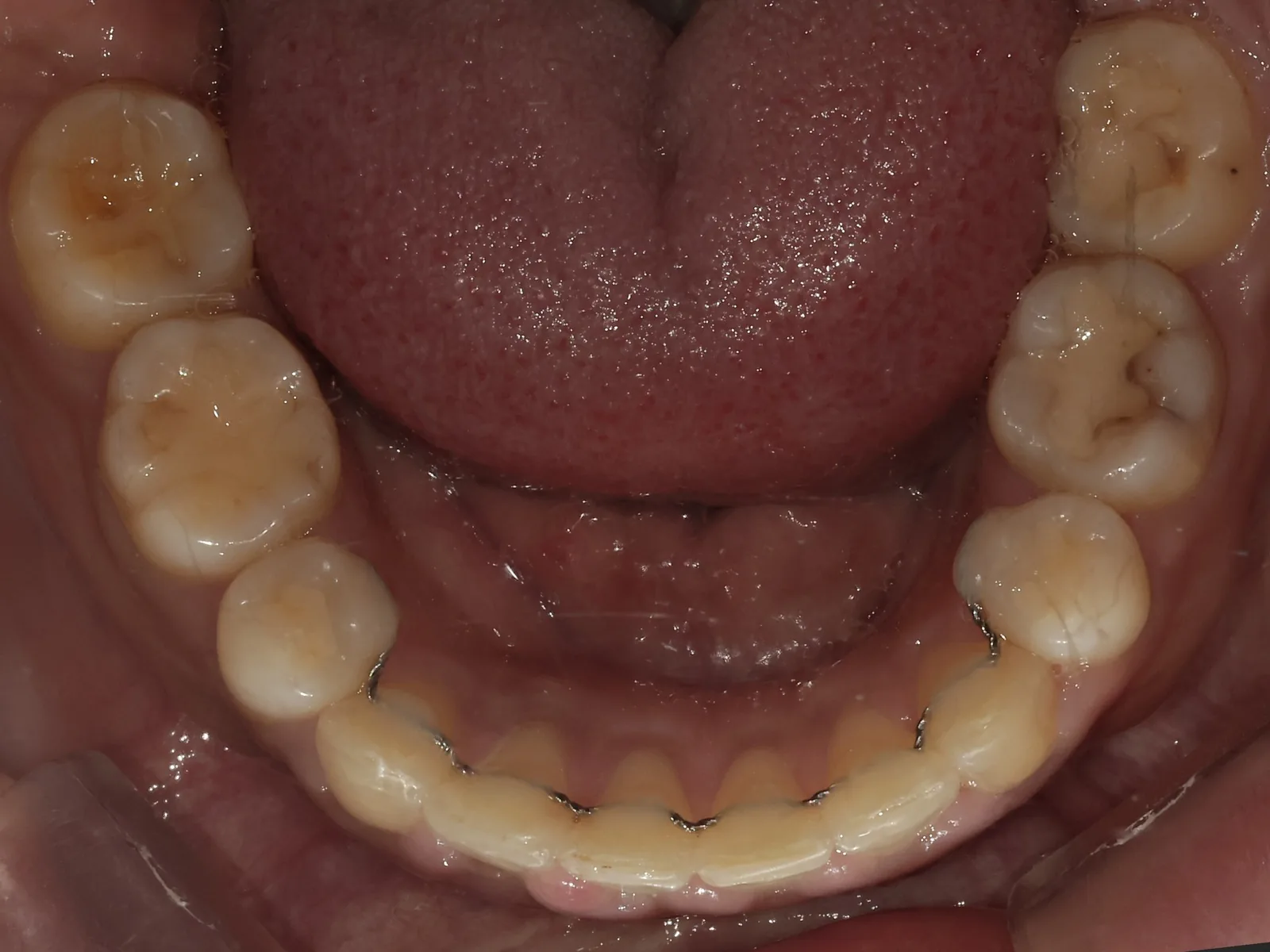
Fixed
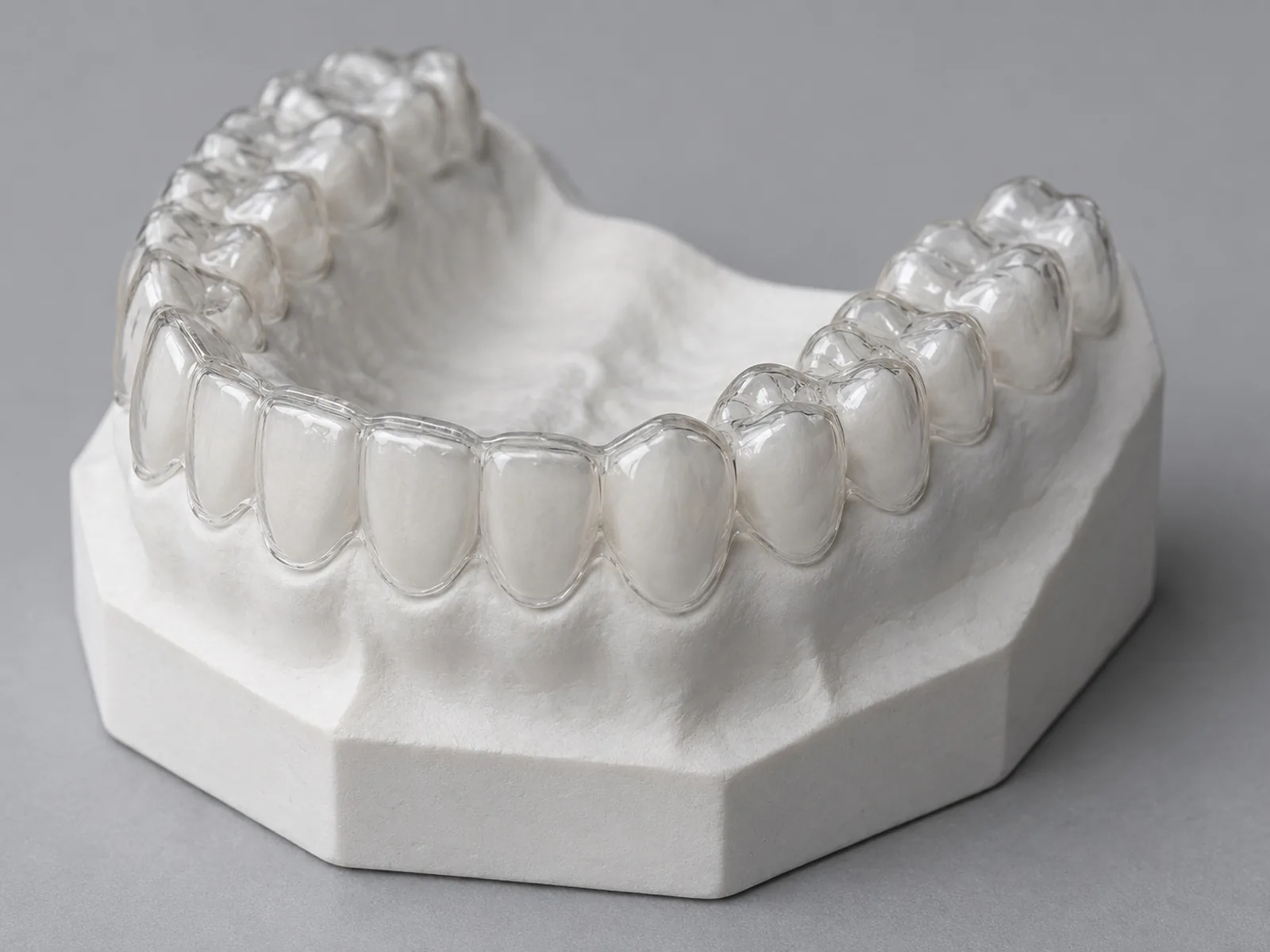
Clear retainer
Retainers used after the braces come off. The thin wire bonded behind the front teeth (left) cannot be seen from outside, and a clear retainer (right) is used with it.
STEP 06
We remove the braces and hold the result with retainers
After removing the braces and smoothing the inner surfaces of the teeth, we bond a thin wire retainer behind the front teeth and also give you a clear retainer. For 2 years after treatment, retainer check-ups and adjustments are included in the orthodontic fee.
Why we do thisTeeth moved with lingual braces also tend to move back, as with any orthodontic treatment. Especially when a deep bite has been reduced, it tends to deepen again, so we advise wearing retainers for a long time.
* Clinical photos were published with the patients' consent. Side effects such as temporary pain or discomfort may occur depending on the person.
The first 2–4 weeks after bonding are the most uncomfortable; after that, most people have no trouble with everyday conversation.
04°
Upper and lower lingual or combination: how do we decide?
We consider both how important it is that the braces do not show and the conditions in your mouth.
How much your lower teeth show when you smile · If your lower teeth show a lot when you smile or talk, we recommend upper and lower lingual braces; if they hardly show, combination braces.
Bite depth · If the bite is deep, the lower teeth hit the inner upper braces, so a plan that makes the bite shallower first is needed.
Length of the lower teeth · If the lower teeth are short, there may not be enough room to bond braces inside them.
Jobs where speech matters · If your work involves a lot of speaking, such as lecturing, broadcasting or interpreting, we plan the adjustment period around your schedule.
Gums and brushing habits · The toothbrush does not reach the inside well, so gum inflammation is treated first.
05°
Comparing orthodontic appliances
Lingual braces (upper and lower)
Combination braces
Ceramic braces
Invisalign
Visibility
Almost invisible from outside
Upper braces cannot be seen; lower braces are mostly hidden by the lip
Tooth-colored brackets, less noticeable than metal
Clear aligners; only the edges show up close
Tongue and speech discomfort
Greatest in the first 2–4 weeks
Less than lingual
Rubbing on the inside of the lips and cheeks
Speech changes for 1–2 days after each aligner change
Who lingual braces suit, and when another appliance is better
Good for you if
Braces must not show because of your job or situation
You need extraction treatment but want the braces out of sight
You find it hard to keep to clear aligner wearing time, but visible braces are also a concern
Other treatment comes first
Gum inflammation: we treat the gums first
Cavities: we bond the braces after treating them
Jaw joint pain: we manage the pain first
Another appliance may be better
When the lower teeth are short and there is not enough room to bond braces inside
When even a few weeks of speech changes would be hard to manage with your schedule
When it is hard to brush carefully all the way to the inner surfaces
07°
Side effects and limits
Please read
· Your tongue may get rubbed, sore or ulcerated by the braces. It is usually worst in the first few weeks.
· For the first 2–4 weeks, sounds such as "s" may feel lisped, and how quickly you adjust differs from person to person.
· The toothbrush does not reach the inner surfaces well, which raises the risk of cavities and gum inflammation.
· If the bite is deep, the braces may come off, or the back teeth may not meet well for the first few weeks.
· When the front teeth are moved back a lot, they tend to tip back, so the angle must be checked continuously.
· Shortening of tooth roots or gum recession can occur with orthodontic treatment regardless of the appliance type.
· Fabrication of the braces and treatment time are longer, so the cost is higher than braces on the outside.
FAQ
FAQ
Are lingual braces really invisible from outside?
The braces are bonded to the inner (tongue) side of the teeth, so they are almost invisible when you talk face to face or from the side. When you open your mouth wide or smile with your head tilted up, the inner braces may show slightly.
How much do lingual braces affect speech?
For the first 2–4 weeks, your tongue touches the braces and your "s" sounds may feel slightly lisped, but most people gradually get used to it. With combination braces, only the upper teeth have braces the tongue touches, so adapting is a little easier.
How are combination braces different from lingual braces?
With combination braces, only the upper teeth, which show easily when you smile or talk, have braces on the inside, and the lower teeth, which show less, have braces on the outside. Tongue discomfort and cost are lower than with upper and lower lingual braces.
Can lingual braces be used for extraction cases?
Yes. Treatment that moves the front teeth back while closing extraction spaces can also be done with inner braces, and we separately calculate the wire angle and pulling point so the front teeth do not tip back.
Do lingual braces take longer?
Teeth move at about the same speed as with outer braces, but fine adjustment in the finishing stage sometimes takes a little longer. We tell you the expected duration after the examination, based on how much movement is needed.
What if my tongue hurts during lingual braces?
At first, putting protective wax on the braces and applying oral ointment to sore spots usually helps within 1–2 weeks. If the same spot keeps hurting, come in and we will smooth the edge of the bracket.
Why do lingual braces cost more?
The inner surfaces of teeth vary in shape, so the bracket positions must be designed on a model in advance and then transferred to the teeth, and each adjustment visit takes longer. Detailed costs are listed on the fee table in our treatment cost guide.
Are there foods I should not eat with lingual braces?
Hard nuts, ice, chewy rice cakes and caramel easily knock off brackets, so it is best to avoid them. Instead of biting directly with your front teeth, cut food into small pieces and chew with your back teeth.
Evidence and references
Kim S, et al. Influence of different ligation methods on force and moment generation in a simulated condition of the maxillary crowded anterior dentition with linguo-version and rotation. Bio-Medical Materials and Engineering, 2022. doi:10.3233/BME-211288 (Measurement of orthodontic force and moment on teeth)
Dr. Sunmin Kim's training: completed two training courses of the Korean Society of Lingual Orthodontics (these are training courses, not a society certification). About the doctor
Questions from patients who travel to Seoul for treatment.
How much does lingual braces cost?
Lingual braces (upper and lower) are KRW 8,600,000, and combination braces (upper lingual, lower ceramic) are KRW 7,600,000. The orthodontic fee includes the orthodontic diagnosis, extraction (except wisdom teeth), mini-screws, basic retainers and retention care for 2 years. If you have only the diagnosis and do not start treatment, it is KRW 50,000 (KRW 100,000 if a CT scan is needed). If a retainer breaks or is lost later, remaking it costs extra. International and Korean patients pay the same fees. We explain the total before treatment starts. See our fee schedule.
Can I continue treatment after I go home?
Yes, but it needs a plan. Fixed braces need regular adjustment visits: the first two visits are 2 weeks apart, then usually once a month. Clear aligners are easier from abroad: after you receive your aligners, you visit once every 2–3 months, and between visits we check by photo only if something comes up. Your doctor tells you at diagnosis which method fits your case.
Can I have my consultation in English?
Yes. The doctor in charge of each field consults with you directly in English. For orthodontics, this is Dr. Sunmin Kim, a board-certified orthodontist. Before you travel, you can send photos of your teeth on WhatsApp or by email. An accurate diagnosis is made after we examine you in person.
What happens after treatment, and what if something comes off?
You need retainers after treatment, because teeth tend to move back. Retention care for 2 years is included in the orthodontic fee. If a bracket comes off or a wire hurts after you go home, send us a photo on WhatsApp. We check it and tell you what to do. Some repairs need a visit.
Results, the number of visits and schedules vary from person to person. More questions: Visiting from abroad.


 Before · Sep 2022
 After · May 2025
 Before · Aug 2022
 During treatment · Oct 2022
 After · Oct 2023
 Before · Jun 2021
 After · Mar 2024
 Inner braces on the upper teeth
 During combination braces · Feb 2016
 Examination
 Design and fabrication
 Early after bonding · Oct 2024
 Start · Feb 2021
 Midway · May 2022
 Late stage · Jul 2022
 Before · Oct 2019
 Removal day · Jul 2025
 Fixed
 Clear retainer