Last reviewed Oct 29, 2026 · Dr. Sunmin Kim (board-certified orthodontist, certified by the Korean Association of Orthodontists)
At a glance
Who it suits
A gap between the front teeth
Treatment flow
Check the cause (position, habit, tooth size, gums) → choose braces, resin bonding or porcelain veneers, or gum treatment
Duration and limits
Partial orthodontics usually takes 4–6 months. A gap that appeared suddenly after middle age needs gum treatment first
Details
The right treatment for a gap between the front teeth depends on why the gap formed. If it formed because of tooth position or a tongue habit, braces can close it, and partial orthodontics that moves only the front teeth usually takes 4–6 months. If the gap formed because the teeth are small, gaps remain elsewhere even after braces bring the teeth together, so resin bonding or porcelain veneers are the better fit. A gap that appears suddenly or grows after middle age may mean weakened gum bone has pushed the teeth out, so gum treatment comes first. At Ceramic Dental Clinic, a board-certified orthodontist looks at the cause first. Even when veneers are needed, we also assess whether braces can divide the gaps properly so that less tooth has to be reshaped.
01°
The same front-teeth gap, but a different cause meant a different treatment
Depending on whether tooth position, tooth size or gum bone made the gap, we used braces only, veneers after braces, or gum treatment first. Here are three typical real cases.
CASE01
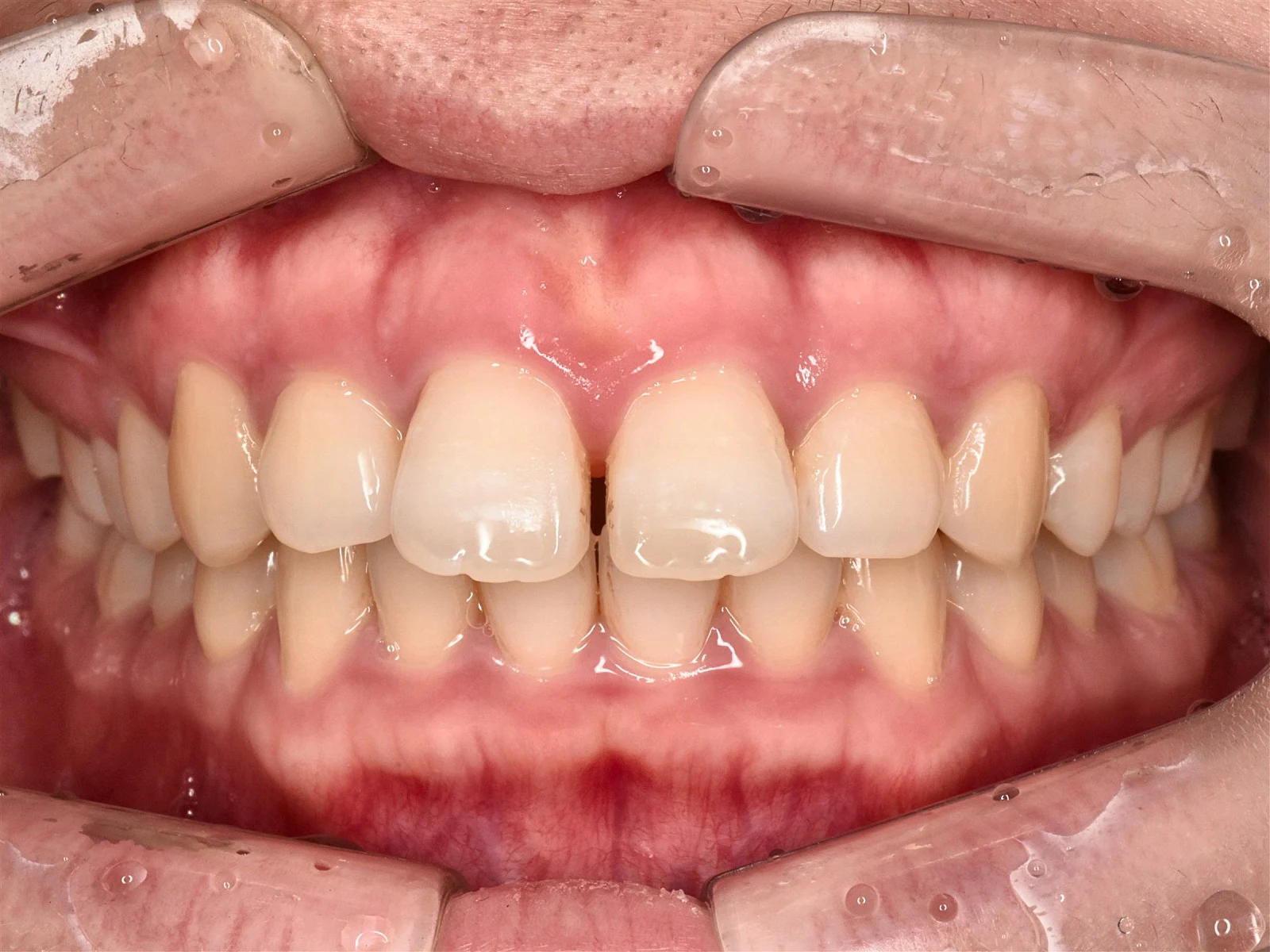
A gap only between the two upper center front teeth
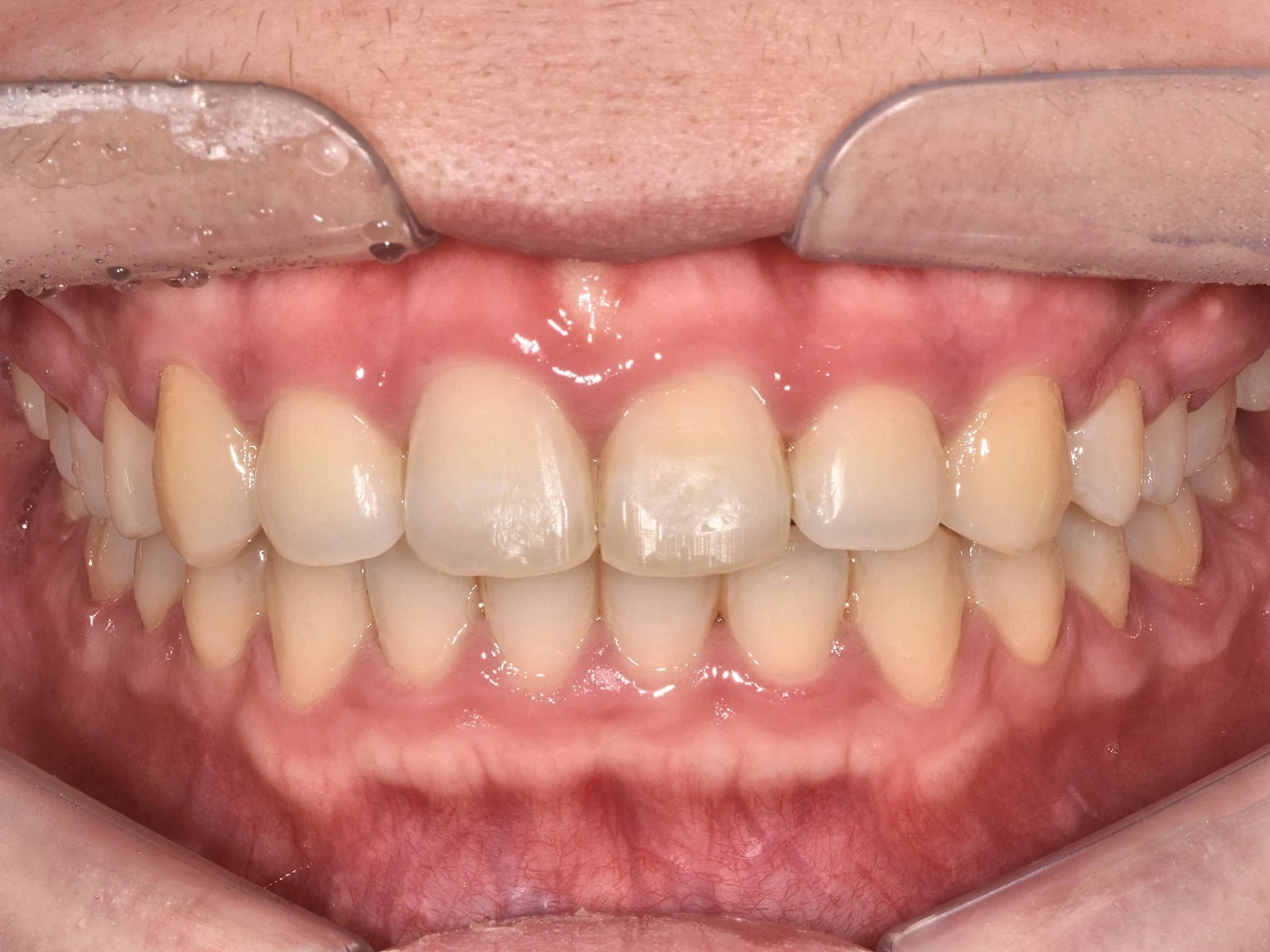
Partial orthodontics for the front teeth · closed the gap without reshaping the teeth, then bonded a fixed retainer to the inside of the front teeth
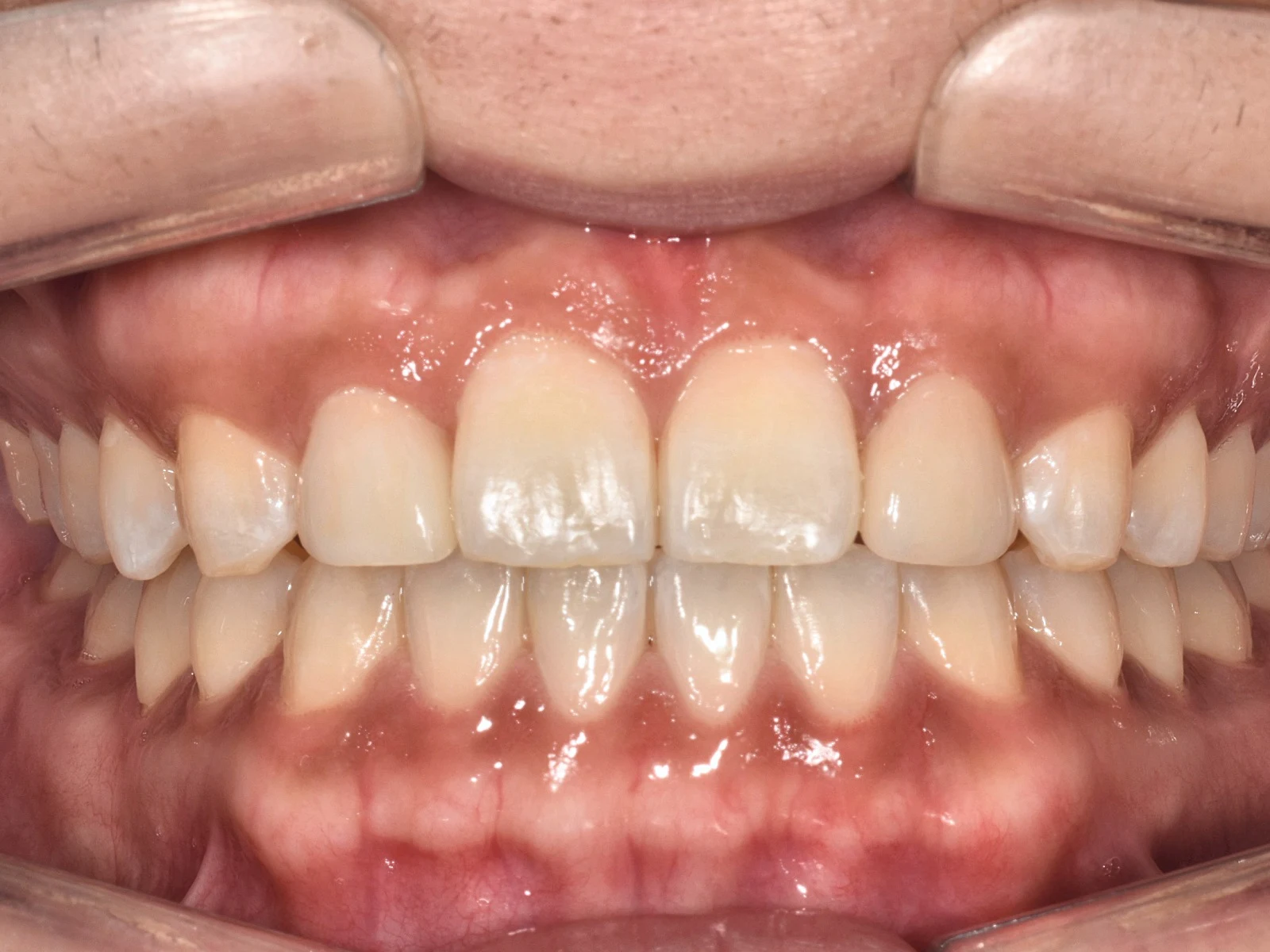
Before treatment · July 2023
Front teeth before treatment, front view. There is a gap only between the two upper center front teeth, and the size and shape of the front teeth are within the normal range.
After treatment · April 2025
Front teeth after treatment, front view. We closed the gap by bringing the front teeth to the center, roots and all, without reshaping the teeth.
Condition
A center gap formed as the front teeth tipped slightly forward; normal tooth size
Choice
Partial orthodontics for the upper front teeth, then a fixed retainer on the inside of the front teeth
What we did not do
Porcelain veneers (the teeth were normal in size, so there was no reason to reshape and cover them)
Duration
About 21 months
Note
A center gap reopens easily, so we decided to keep the fixed retainer in place for a long time. We regularly check the fixed retainer to make sure the gap is not reopening.
CASE02
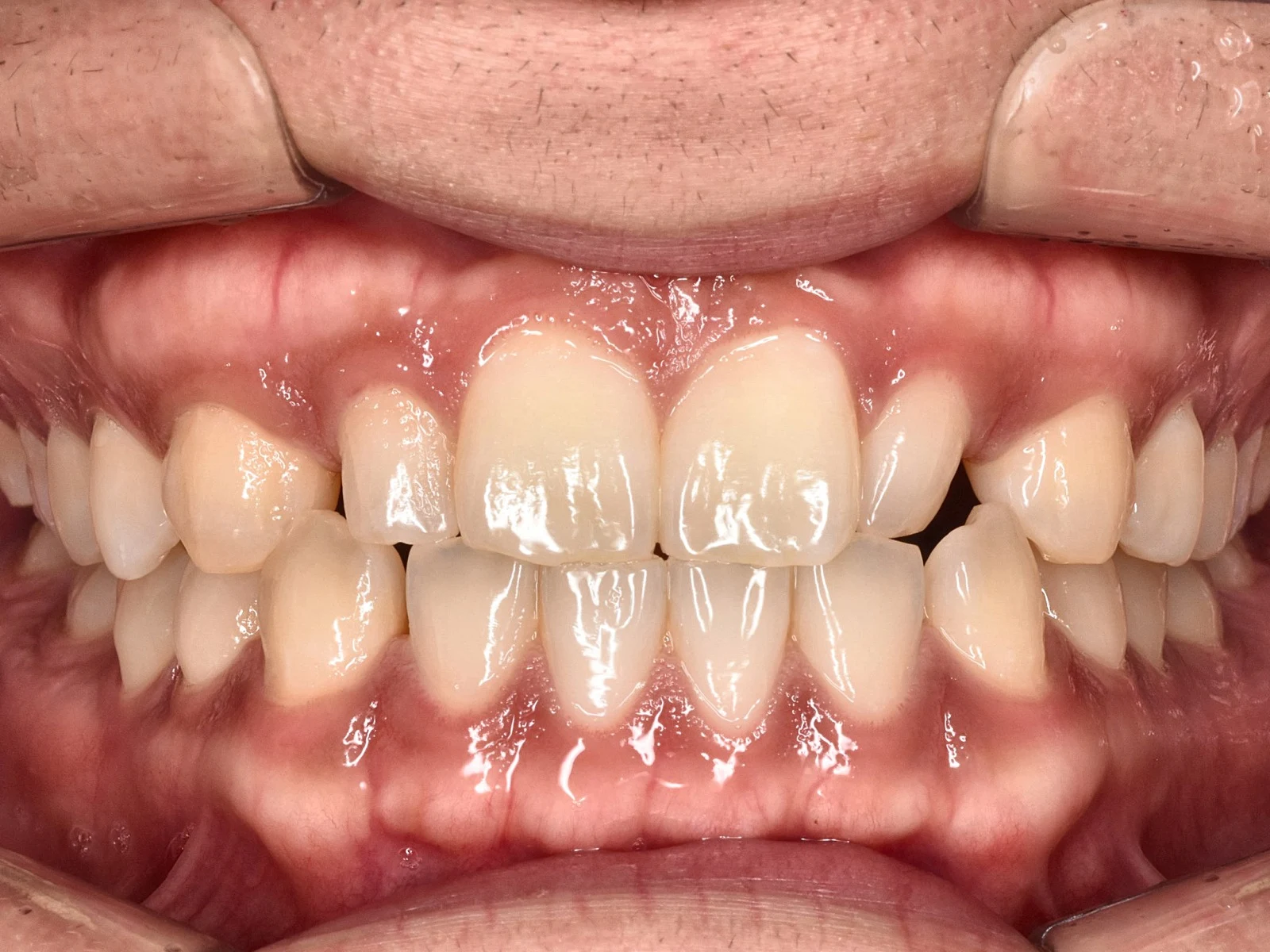
Small side front teeth leaving gaps in several places
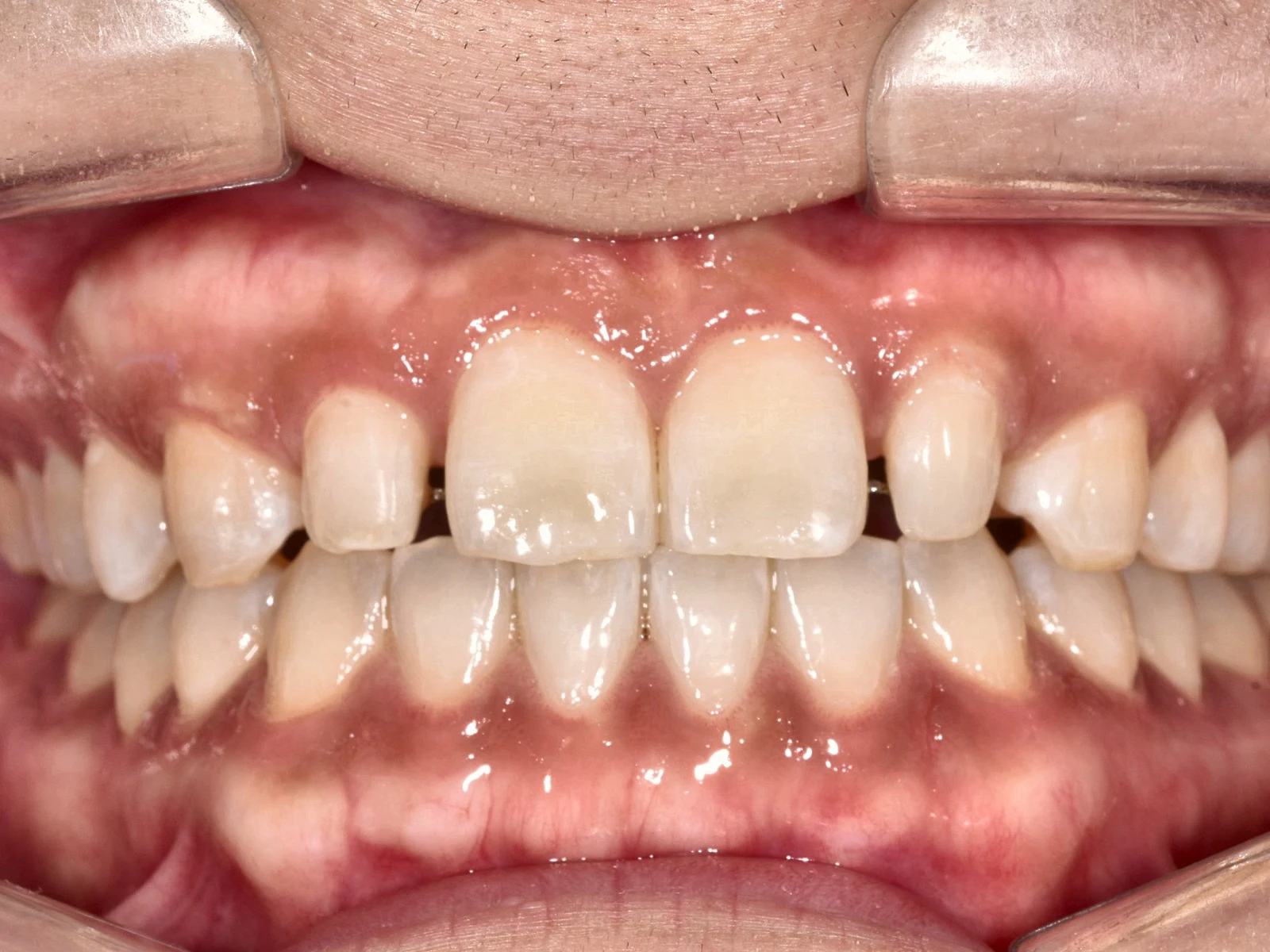
Divided the gaps evenly on both sides with partial orthodontics · then 2 porcelain veneers with no tooth reduction
Before treatment · June 2023
Before treatment. The side front teeth are small, leaving gaps in several places between the front teeth.
After braces · January 2025
Right after partial orthodontics. The scattered gaps were gathered on both sides of the small side front teeth, making room for veneers.
After veneers · February 2025
After the veneers were bonded. We filled the gaps by adding only the missing width, without reshaping the side front teeth.
Condition
Small lateral incisors (microdontia) with gaps in several places between the front teeth
Choice
Divided the gaps on both sides of the side front teeth with partial orthodontics, then 2 porcelain veneers with no tooth reduction
What we did not do
Closing all the gaps with braces alone (the teeth were too small, so gaps would remain elsewhere); reshaping the large front teeth
Duration
About 1.5 years
CASE03
A front-teeth gap that newly appeared over a few years after age 40
A board-certified periodontist treated the gums first · once the gums were stable, braces with light force closed the gap
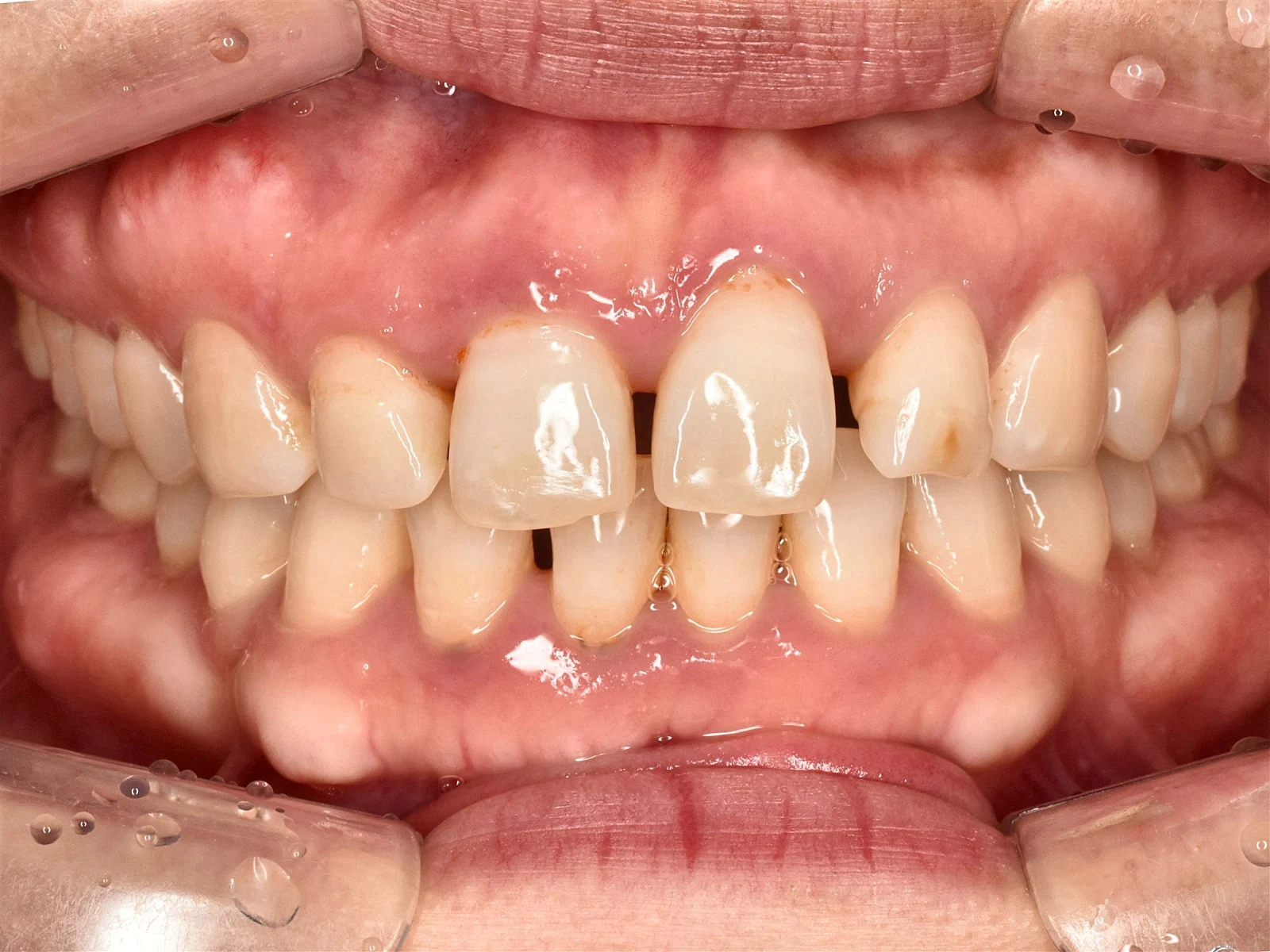
Before treatment · June 2023
Before treatment. As the gum bone decreased, the front teeth fanned out and were pushed forward.
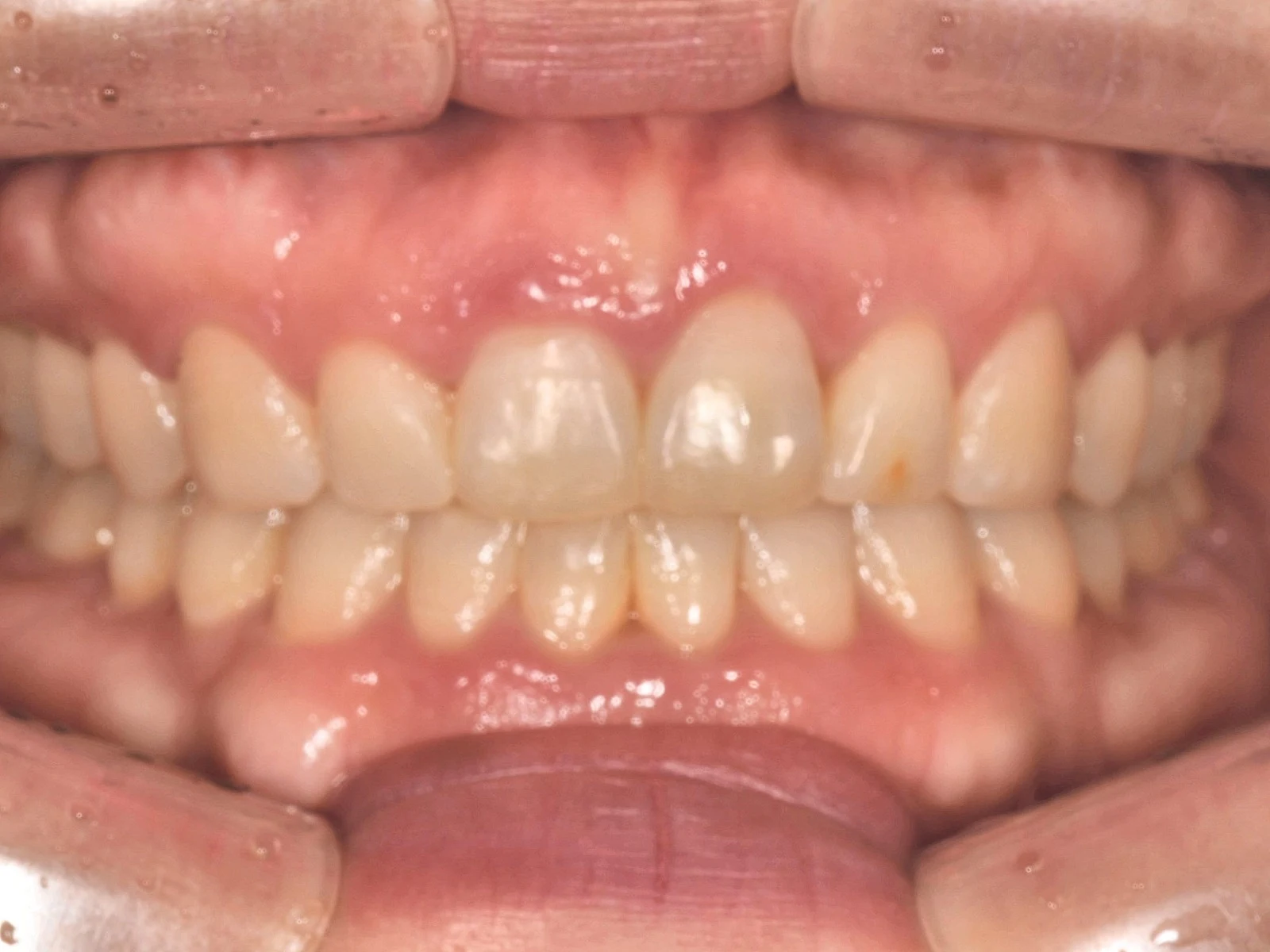
After treatment · August 2024
The gaps closed with braces after gum treatment. The lost gum bone does not grow back, so gum care continues.
Condition
Front teeth pushed apart because the gum bone had decreased (pathologic migration)
Choice
Gum treatment by Dr. Ilseop Ahn (board-certified periodontist and board-certified specialist in advanced general dentistry), then braces with light force and a fixed retainer
What we did not do
Starting braces right away before gum treatment, or covering the gaps with veneers
Duration
About 14 months
Note
Because the gums between the teeth are low, small dark triangles may show. The lost gum bone does not come back with braces, so gum care must continue.
* Photos were taken under the same conditions and published with the patients' consent. Treatment results and side effects can vary from person to person.
02°
Why do front-teeth gaps form? We start by sorting the cause
There are four main causes of a gap, and two often overlap. If only the gap is filled while the cause remains, it can reopen, or teeth that did not need reshaping end up being reshaped.
01Tooth position
The front teeth have tipped forward and spread apart. The teeth are normal in size, so bringing them together with braces closes the gap.
02Tooth size
The side front teeth are small (microdontia), or the jaw is wide compared with the size of the teeth. Even if braces bring the teeth together, the teeth are not wide enough, so width must be added with resin bonding or porcelain veneers.
03Weakened gum bone
Gum disease has reduced the bone and the front teeth have been pushed apart. If a gap has newly appeared over a few years after middle age, we suspect this first, and gum treatment comes first.
04Habits and the lip band
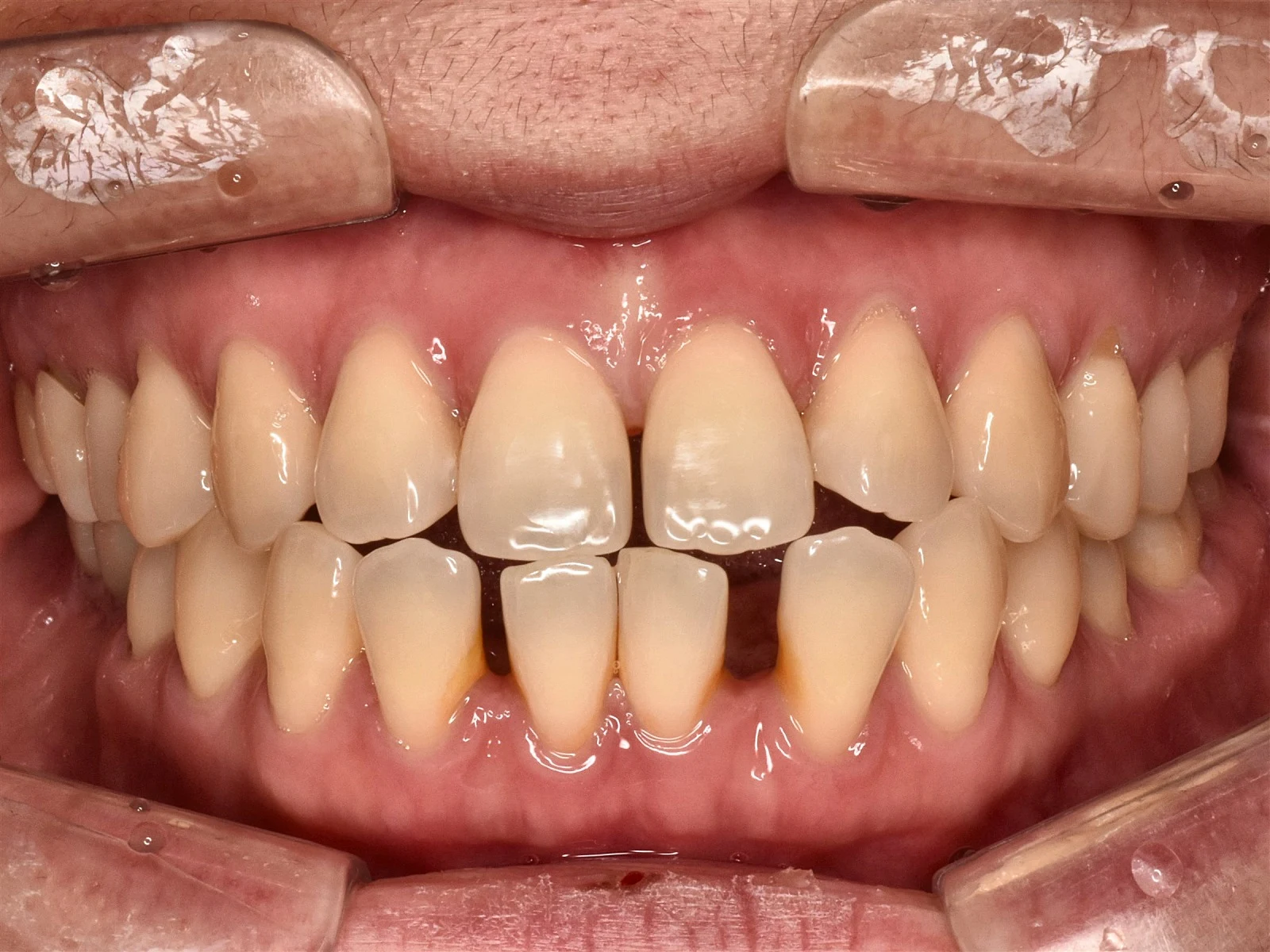
A habit of pushing the front teeth with the tongue when swallowing, or a band inside the upper lip (labial frenum) that comes down thick to the gum between the front teeth. We also put teeth that have tipped toward a missing tooth's space in this group.
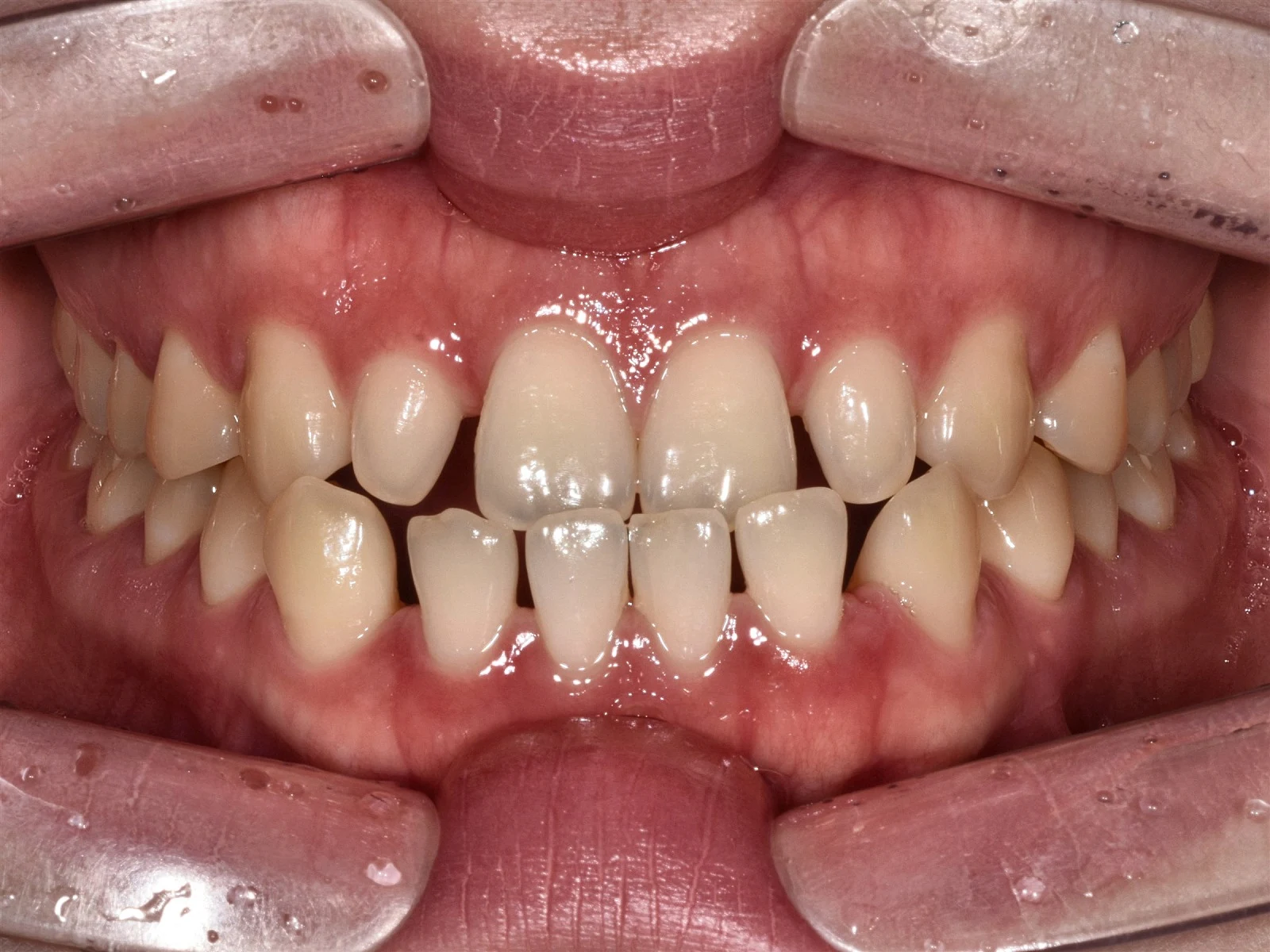
Tooth size cause
A gap caused by tooth size. The side front teeth are much smaller than the center front teeth, leaving gaps on both sides.
Gum bone cause · inside the mouth, front view
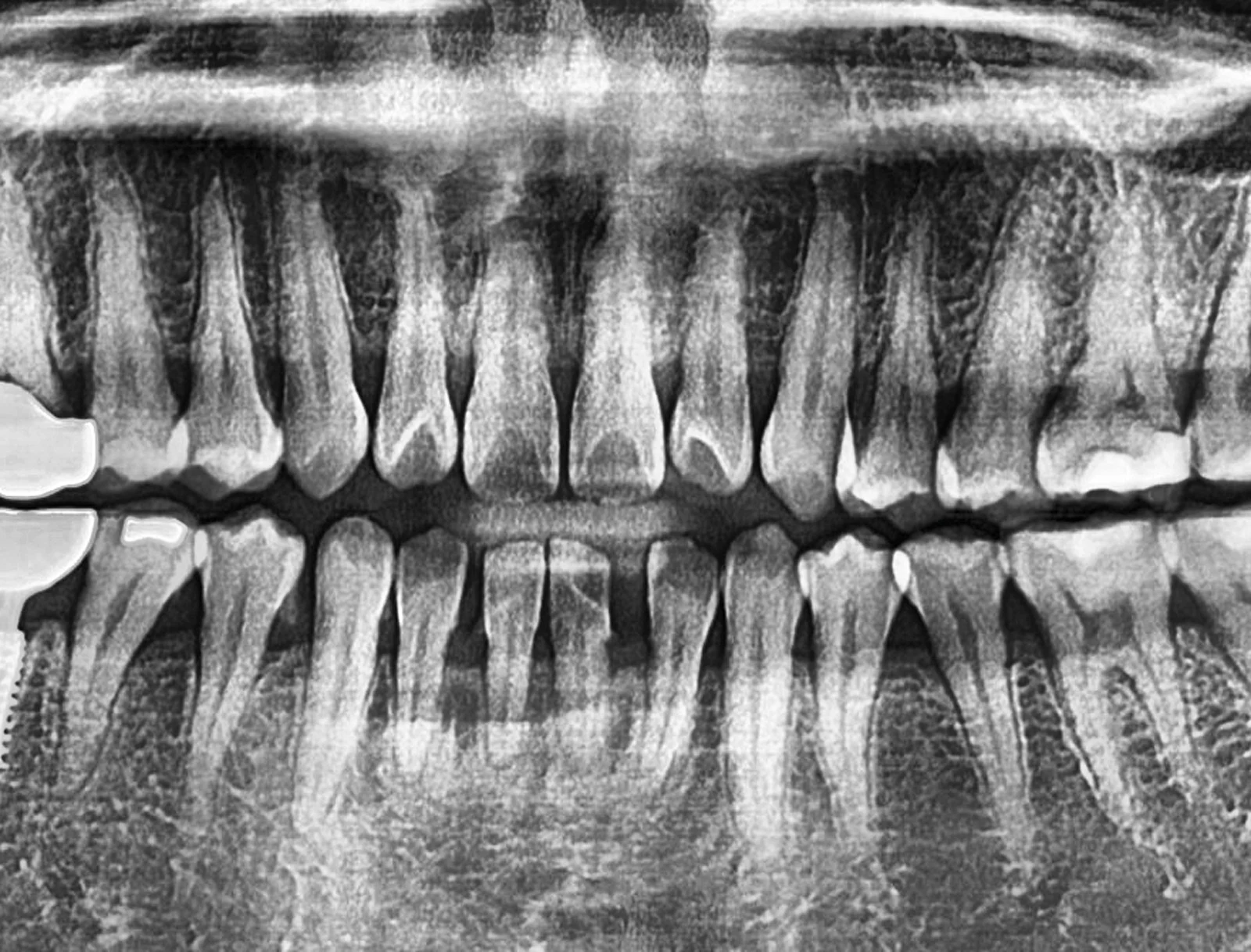
Same patient, panoramic, front-teeth area
A gap caused by the gum bone. Left: inside the mouth, front view. Right: the front-teeth area on a panoramic X-ray of the same patient. When the height of the bone around the front-teeth roots drops, the teeth are pushed forward.
If tooth size is the cause, braces alone are not enough. If the gum bone is the cause, gum treatment comes before braces or veneers.
03°
How we close a front-teeth gap
There are six steps, from the exam to the retainers. Some steps are skipped depending on the cause, and for each step we explain what we look at and why, with real clinical photos.
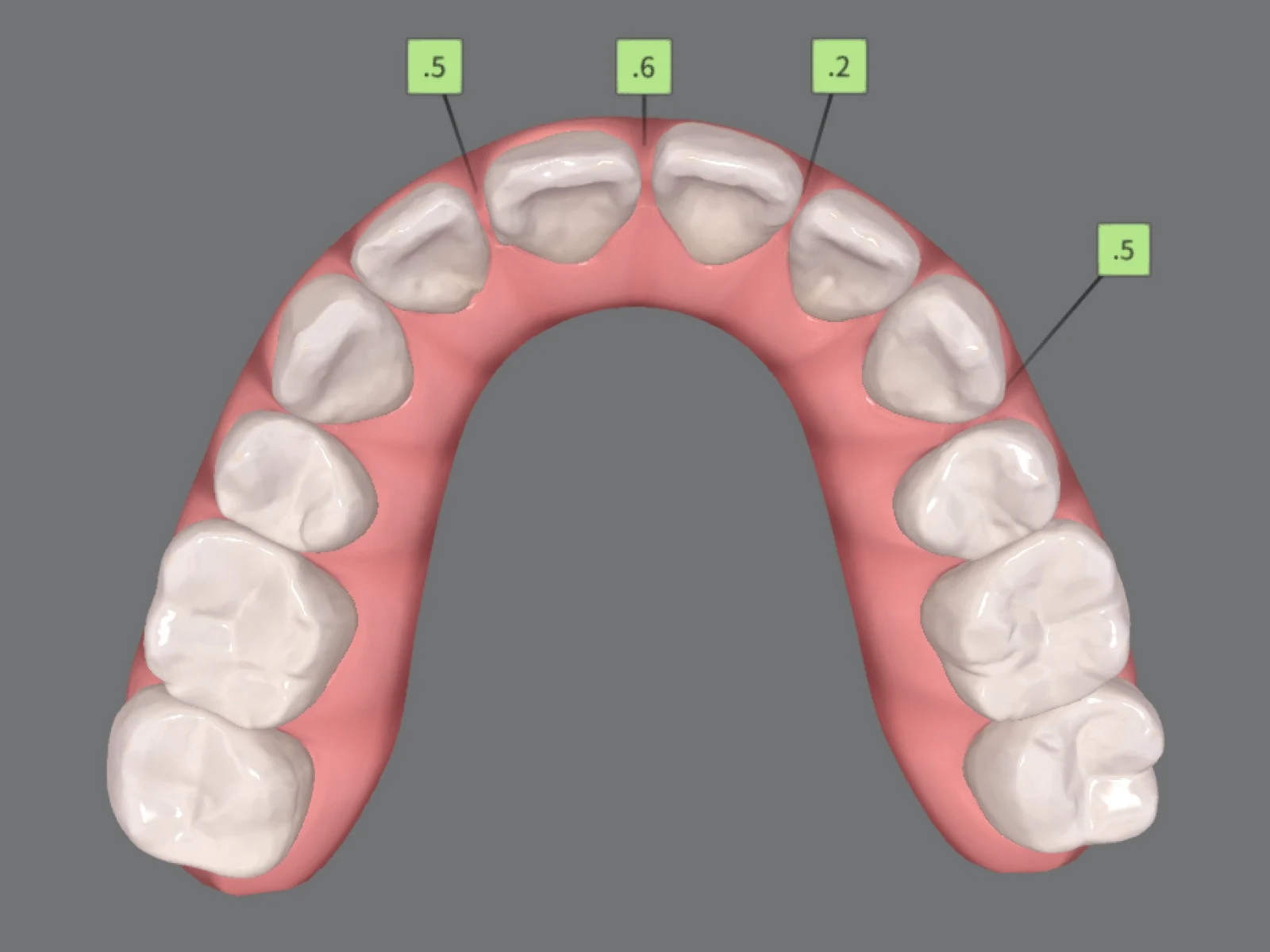
Exam · ClinCheck
A digital model made from an intraoral scan. We show in numbers how many gaps there are and how many millimeters each one is.
STEP 01
We measure the size of the gaps and the width of the teeth in millimeters
With an iTero intraoral scan, we make a digital model without traditional impressions and measure how many gaps there are and how many millimeters each one is. We also measure the width and length of the center and side front teeth to see whether the teeth are normal in size or small.
We also check on a side-view X-ray (cephalogram) how far the front teeth are tipped forward.
Why we do thisIf the teeth are much narrower than the total of the gaps, closing everything with braces leaves a bite that does not fit or creates gaps elsewhere. We measure at the start so that the choice between braces and veneers is made with numbers, not by eye.
Gum exam
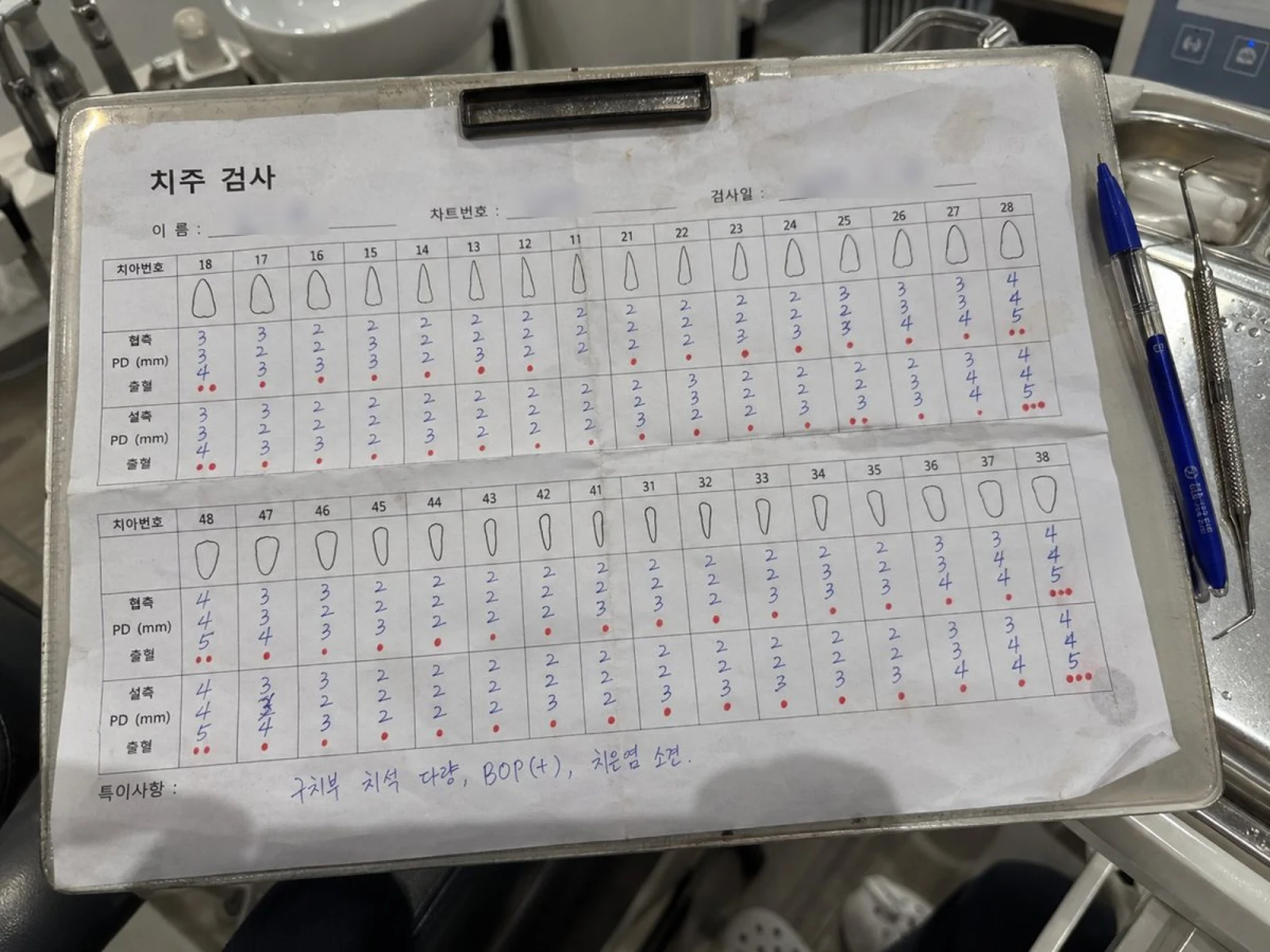
Gum exam. We check the depth of the pockets between the teeth and gums, whether there is bleeding and whether the teeth are loose.
STEP 02
If the gap is new, we check the gums first
If a gap has appeared or grown in the last few years, Dr. Ilseop Ahn, a board-certified periodontist and board-certified specialist in advanced general dentistry, checks the gum depth, looseness and bone height on X-rays. If there is inflammation, we treat the gums first and start braces after confirming that the gums are stable.
Why we do thisMoving teeth in inflamed gums can reduce the remaining bone further. If a gap caused by the gums is covered with veneers, the gap is hidden but the teeth can keep being pushed out.
Planning · ClinCheck
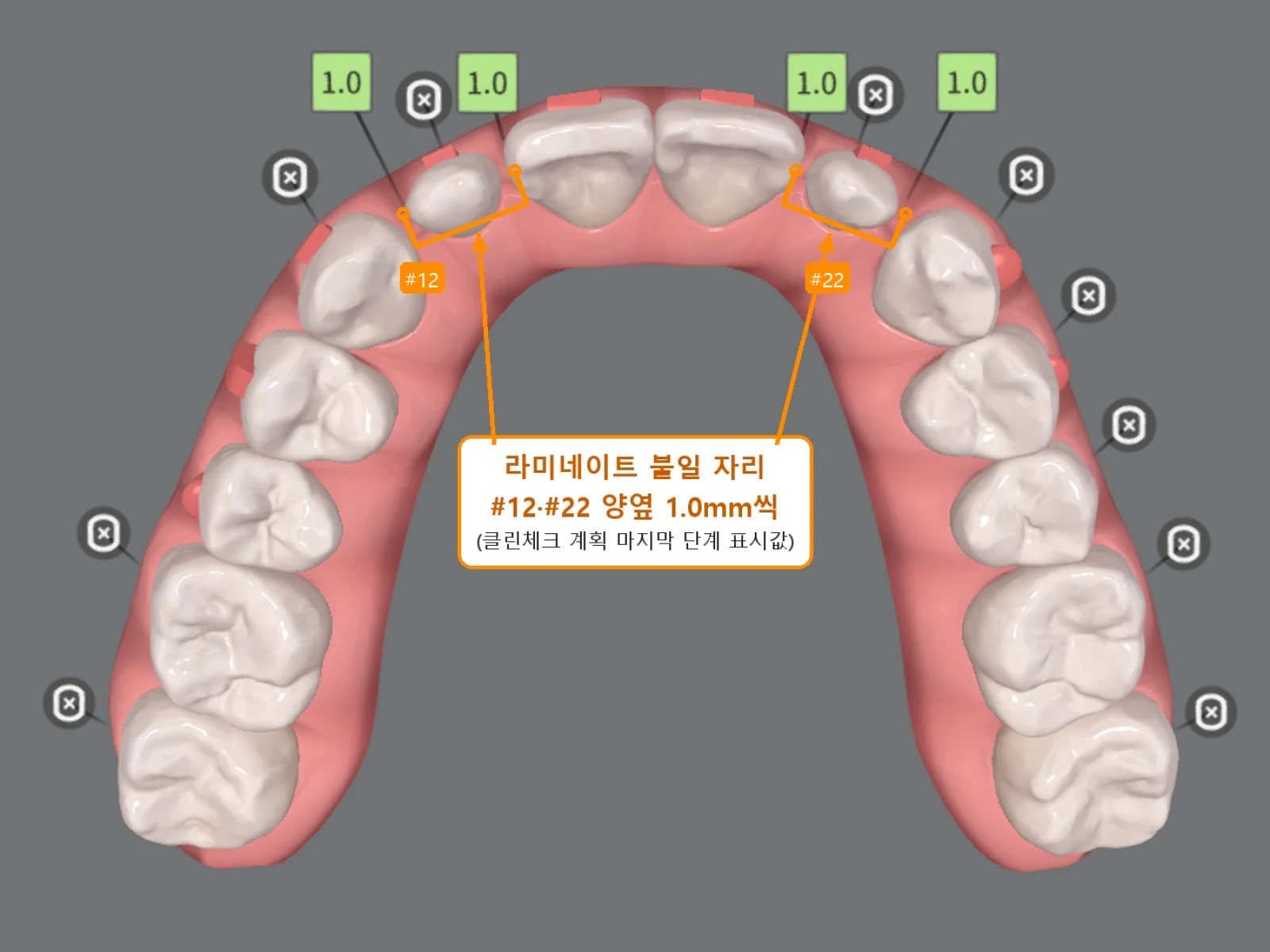
Treatment planning screen. We decide in advance whether to close all the gaps or leave a few millimeters as room for veneers.
STEP 03
We decide whether to close all the gaps or divide them evenly
If the teeth are normal in size, we close all the gaps with braces. If the side front teeth are small, we gather the scattered gaps on both sides of the small teeth to make room for adding width with veneers or resin bonding. We explain this plan with drawings while looking at your exam images.
If the band inside the upper lip (labial frenum) comes down thick to the gum between the front teeth, the gap tends to reopen after braces, so we also consider a minor procedure to trim the band. This procedure is done at Ceramic Dental Clinic.
Why we do thisIf gaps are left anywhere and filled with veneers, each tooth ends up with a different thickness and width, which looks unnatural, and more tooth has to be reshaped to match. If braces divide the space first, in some cases the veneers can be bonded with no reshaping or less reshaping.
Braces attached
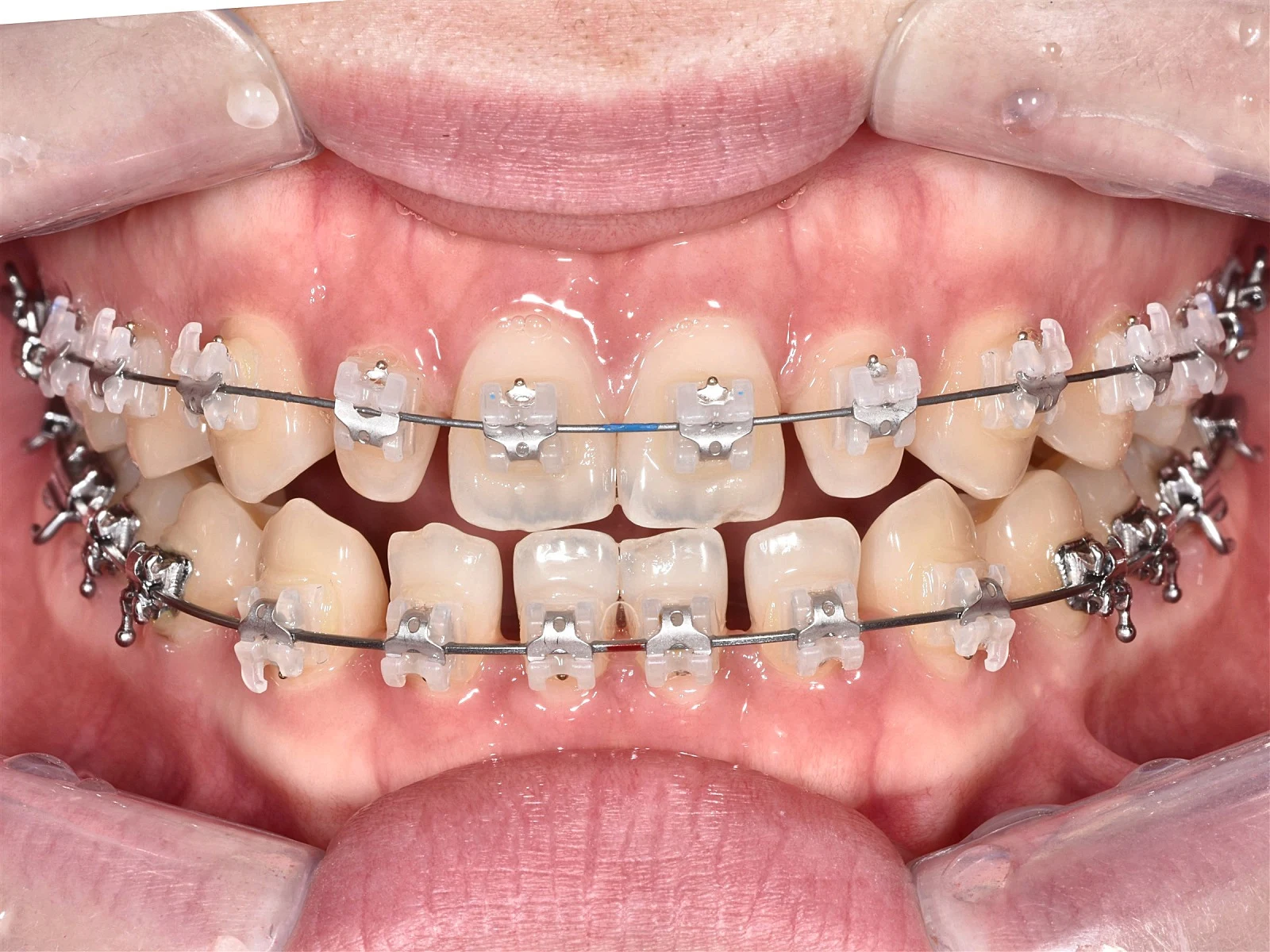
Braces attached while the gap between the front teeth is still open. We bring the teeth together parallel, roots included, instead of tipping only the crowns.
STEP 04
We close the gap by bringing the front teeth together parallel, roots and all
We close the gap by attaching braces to only a few front teeth or by wearing clear aligners. It depends on the size of the gap and the tilt of the front teeth, but partial orthodontics for the front teeth usually takes 4–6 months, and if gaps are spread out and the whole upper and lower teeth must move, it takes a year or more.
If the gap opened because the front teeth tipped forward, we stand the front teeth slightly back while bringing them together, tidying the look of the mouth as well.
Why we do thisIf only the crowns of the front teeth are pulled together with elastics, the roots stay apart and the teeth tilt, so the gap reopens easily. The gap stays closed longer when we control the angle with wires or appliances so that the roots also stand parallel.
Before bonding
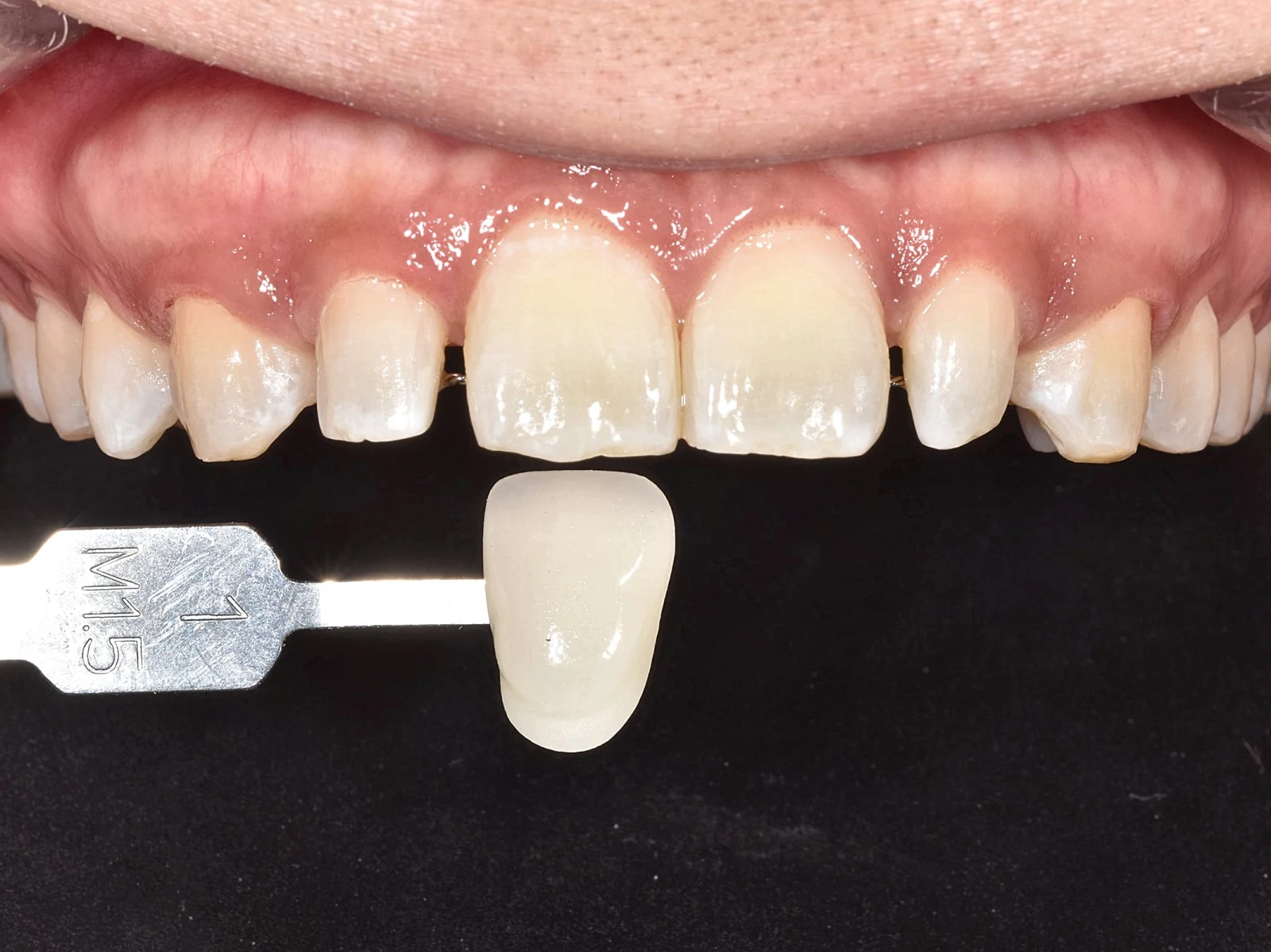
Braces divided the gaps on both sides of the small side front teeth. Veneers are bonded here to add the missing width.
STEP 05
If the teeth are small, we add width with resin bonding or porcelain veneers
After braces, we add resin or bond veneers in the spaces we left. For veneers, we assign a veneer doctor after the consultation, who matches the width and length of the teeth using the same exam records as the doctor who planned the braces.
Why we do thisBecause braces set up the spaces first, there are more cases in which veneers can be bonded with almost no reshaping of the outer surface of the teeth. When deciding the width of the front teeth, we also look at the proportions of the six front teeth that show when you smile.
Retainer
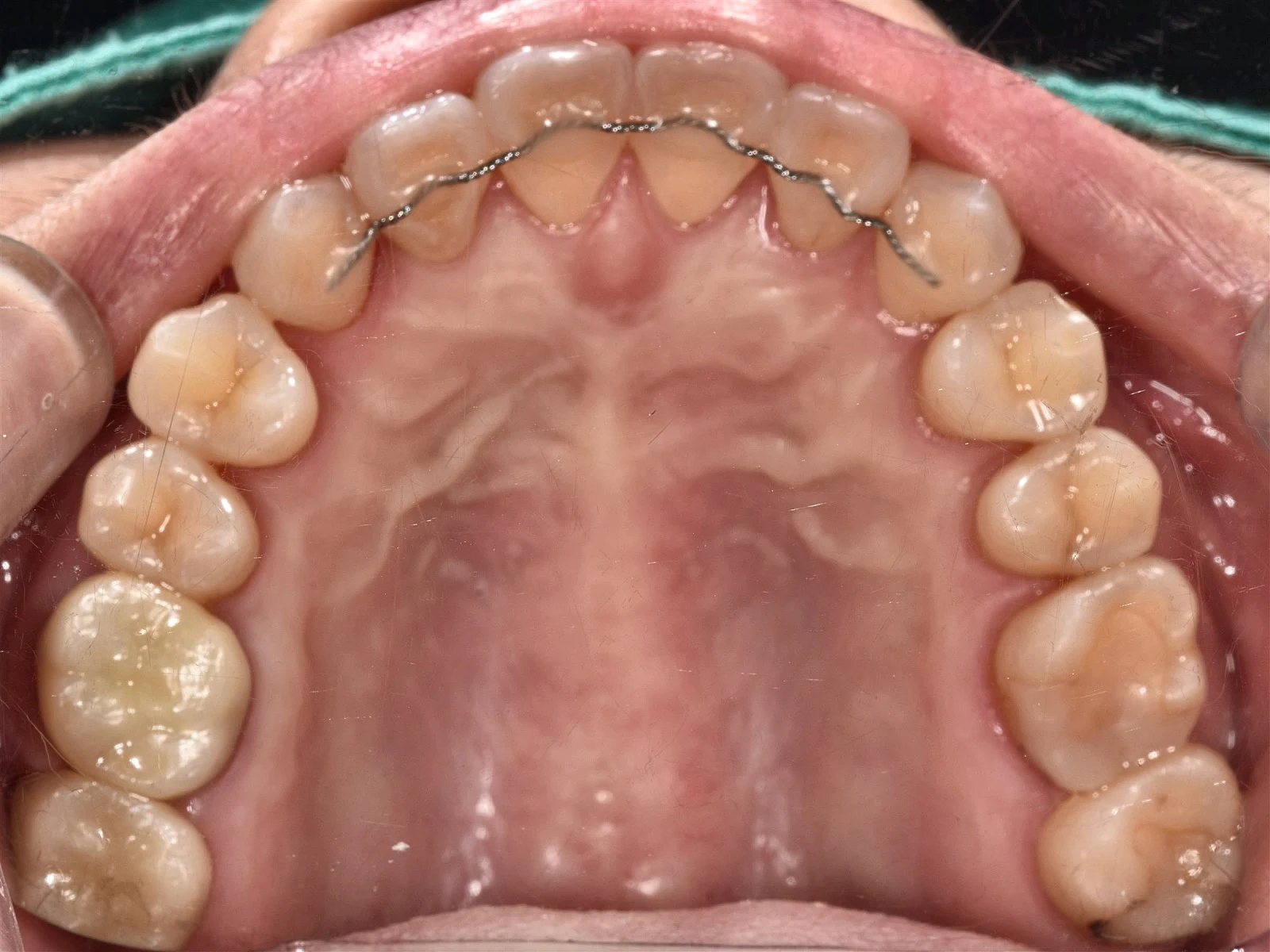
Fixed retainer bonded to the inside of the upper front teeth. It cannot be seen from the outside and holds the closed gap so it does not reopen.
STEP 06
We keep the closed gap with a retainer on the inside of the front teeth
Once the gap is closed, we bond a thin-wire retainer to the inside of the upper front teeth and also give you a clear retainer to wear at night. For 2 years after treatment, retainer check-ups and adjustments are covered by the orthodontic fee.
Why we do thisThe gap between the center front teeth is one of the places most likely to reopen after braces. So, provided you wear the night-time clear retainer well, we usually recommend keeping the fixed retainer for about 4 years.
* Clinical photos are published with the patients' consent. Side effects such as temporary pain or discomfort may occur, depending on the person.
During treatment, you usually visit once a month; with clear aligners, usually once every 2–3 months.
04°
How do we decide between braces and porcelain veneers?
We decide based on what caused the gap. Looking at the five points below, we explain which suits you: braces only, veneers after braces, veneers or resin bonding only, gum treatment first, or watching for now.
Size and number of gaps · Whether there is one gap or several changes how many teeth need to move.
Width-to-length ratio of the teeth · If the side front teeth are small, gaps remain after braces alone, so width needs to be added.
Front-teeth tilt · If the gap opened because the front teeth tipped forward, closing it while uprighting them with braces is also better for the look of the mouth.
Gum depth and looseness · If the gum bone is the cause, gum treatment comes before any other treatment.
Tongue habits and the lip band · If the cause remains, the gap can reopen easily after closing, so we manage it as well.
If the teeth are normal in size and the gap is filled with veneers alone, the teeth have to be made wider, so the front teeth can look large.
05°
Comparison of treatment options
Partial orthodontics for the front teeth
Comprehensive orthodontics
Resin bonding
Porcelain veneers (CERANATE)
Porcelain veneers after partial orthodontics
Suitable causes
Tooth position or habit as the cause, gaps in a few places between the front teeth
Gaps in several places, when the bite or the look of the mouth also needs to change
Small teeth and small gaps
Small teeth, or when you also want to change the shape and color
Small teeth with scattered gaps
Tooth reshaping
None
Usually none (the sides of the teeth may be slimmed slightly if space is needed)
Almost none
No reshaping, or slight reshaping of the outer surface (depending on the tooth)
Often less reshaping or none needed
Duration
Usually 4–6 months
Usually 1–2 years
Usually one visit
Usually 2–3 visits
A few months of partial orthodontics + veneers
Advantages
Closes the gap with your own teeth as they are
Also tidies the bite and the look of the mouth
Quick and simple
Changes width, shape and color at once
Can divide the gaps into the right positions for veneers
Limits
A closed gap reopens easily
Takes longer, and a closed gap reopens easily
Discolors and wears at the edges, so it needs touch-ups
Has a limited lifespan and may need replacement later
Goes through two processes: braces and veneers
To make it last
Fixed retainer
Fixed and clear retainers
Regular check-ups and touch-ups
Regular check-ups, and a night guard if you grind your teeth
For some people, another treatment comes first, or no treatment is needed
Braces suit you if
Your teeth are normal in size, but the front teeth have tipped and spread apart
A tongue habit has spread your front teeth apart (together with habit management)
You want the gaps divided properly before veneers
Another treatment comes first
A gap that newly appeared or grew after middle age: a gum exam and treatment come first
Bleeding gums or loose front teeth
Decay in the front teeth
No treatment needed for now
A very small gap that does not bother you
A front-teeth gap in a child whose permanent teeth are not all in yet: it often closes on its own as the canines come in, so we watch it
07°
Self-check
If the first or second item applies to you, have your gums checked before considering braces or veneers.
08°
Side effects and limits
Please read
· A gap closed with braces reopens easily. You need to wear your retainers consistently, and if the fixed retainer comes off, contact us right away.
· Dark triangles (black triangles) may show in the gum above where the gap was closed. This is more common in people with low gums or front teeth that narrow toward the gumline.
· If the gums were the cause, gum care must continue even after the gap is closed. The lost gum bone does not grow back.
· Resin bonding discolors and wears at the edges and may need touch-ups every few years, and porcelain veneers also have a limited lifespan and may need replacement.
· For the first few days after braces are attached, the front teeth may feel sore and chewing may be uncomfortable.
FAQ
FAQ
Can I just get porcelain veneers for a front-teeth gap?
If the gap is caused by tooth size, veneers alone can fill it. If the cause is tooth position and the gap is filled only with veneers, the teeth have to be made wider, so the front teeth can look large or more tooth may need to be reshaped. In that case, we recommend braces first.
The gap between the two center front teeth is one of the places most likely to reopen after braces close it. So we bond a fixed retainer to the inside of the front teeth and recommend wearing a clear retainer at night. Retainer check-ups and adjustments for 2 years after treatment are included in the orthodontic fee.
How long does orthodontic treatment for a front-teeth gap take?
Partial orthodontics that moves only a few front teeth usually takes 4–6 months. If there are gaps in several places or the bite also needs to change, comprehensive orthodontic treatment can take a year or more.
I am middle-aged, and a gap suddenly opened between my front teeth.
A front-teeth gap that has appeared over a few years after middle age may mean the gum bone has weakened and the teeth have been pushed out. A board-certified periodontist first checks the gum depth and X-rays, and once the gums are stable, we decide on braces or other treatment.
Which is better for a front-teeth gap: resin bonding or porcelain veneers?
Resin bonding removes almost no tooth and is done in one visit, but it discolors and wears down, so it needs touch-ups every few years. Porcelain veneers keep their color and shape for a long time, but they cost more, and depending on the tooth, the outer surface may be reshaped slightly. We choose together based on the size of the gap and how long you want the result to last.
My child has a gap between the front teeth. Does it need treatment?
A gap that appears when the permanent front teeth have just come in often closes on its own as the canines come in, so we usually watch it. If the gap is still large after the canines are fully in, if the band inside the upper lip is thick, or if there is an extra tooth between the front teeth, we check it separately.
Can a front-teeth gap be closed with clear aligners?
Front-teeth gaps are often closed with clear aligners. However, aligners must be worn 20 hours or more a day for the teeth to move as planned, and if the front-teeth roots need to be uprighted a lot, fixed braces may be better. We decide together after the exam.
If braces close the gap, will my front teeth look pushed in?
If the gap opened because the front teeth tipped forward, closing it tends to stand the front teeth slightly back and tidy up the look of the mouth. If the front teeth are already upright, moving them back a lot can make the mouth look sunken, so in that case we also compare other options.
Gaps caused by the gums: Gum treatment page (Dr. Ilseop Ahn, board-certified periodontist and board-certified specialist in advanced general dentistry)
Questions from patients who travel to Seoul for treatment.
How much does orthodontic treatment cost?
The fee depends on the appliance. For example, metal braces are KRW 4,800,000, ceramic braces KRW 6,000,000, Invisalign KRW 8,500,000 and lingual braces KRW 8,600,000. The orthodontic fee includes the orthodontic diagnosis, extraction (except wisdom teeth), mini-screws, basic retainers and retention care for 2 years. If you have only the diagnosis and do not start treatment, it is KRW 50,000 (KRW 100,000 if a CT scan is needed). If a retainer breaks or is lost later, remaking it costs extra. International and Korean patients pay the same fees. We explain the total before treatment starts. See our fee schedule.
Can I continue treatment after I go home?
Yes, but it needs a plan. Fixed braces need regular adjustment visits: the first two visits are 2 weeks apart, then usually once a month. Clear aligners are easier from abroad: after you receive your aligners, you visit once every 2–3 months, and between visits we check by photo only if something comes up. Your doctor tells you at diagnosis which method fits your case.
Can I have my consultation in English?
Yes. The doctor in charge of each field consults with you directly in English. For orthodontics, this is Dr. Sunmin Kim, a board-certified orthodontist. Before you travel, you can send photos of your teeth on WhatsApp or by email. An accurate diagnosis is made after we examine you in person.
What happens after treatment, and what if something comes off?
You need retainers after treatment, because teeth tend to move back. Retention care for 2 years is included in the orthodontic fee. If a bracket comes off or a wire hurts after you go home, send us a photo on WhatsApp. We check it and tell you what to do. Some repairs need a visit.
Results, the number of visits and schedules vary from person to person. More questions: Visiting from abroad.


 Before treatment · July 2023
 After treatment · April 2025
 Before treatment · June 2023
 After braces · January 2025
 After veneers · February 2025
 Before treatment · June 2023
 After treatment · August 2024
 Tooth size cause
 Gum bone cause · inside the mouth, front view
 Same patient, panoramic, front-teeth area
 Exam · ClinCheck
 Gum exam
 Planning · ClinCheck
 Braces attached
 Before bonding
 Retainer