Last reviewed October 29, 2026 · Dr. Ilseop Ahn (board-certified periodontist, specialist in integrated dentistry)
At a glance
Good for
Bleeding or swollen gums, or loose teeth
Treatment flow
Gum depth measurement → removal of tartar below the gumline (in several sessions) → re-measurement 4–8 weeks later → regular maintenance
Duration and limits
If deep spots remain, we consider gum surgery, and after that we usually provide maintenance care every 3–6 months
Details
Gum treatment can often save teeth even when your gums bleed and teeth feel loose. If the gums only bleed and swell, it is gingivitis; if the inflammation has started to destroy the jawbone, it is periodontitis. For periodontitis, we numb the area and remove tartar and bacterial film from below the gumline, spread over several visits, and then measure again, usually 4–8 weeks later, to check that things have improved. If deep spots remain, we consider gum surgery, and after that we usually provide maintenance care every 3–6 months. At Ceramic Dental Clinic, a board-certified periodontist who specializes in gum disease measures the gum depth around each tooth in mm and shows you the before and after using the same measurements.
01°
We compared before and after using the same measurements
Whether gum treatment worked is checked with gum depth and bleeding, not with how it feels. We show three cases with periodontal charts and X-rays.
CASE01
Moderate periodontitis with bleeding at every brushing and strong bad breath
Re-evaluation after treatment below the gumline · regular maintenance without surgery
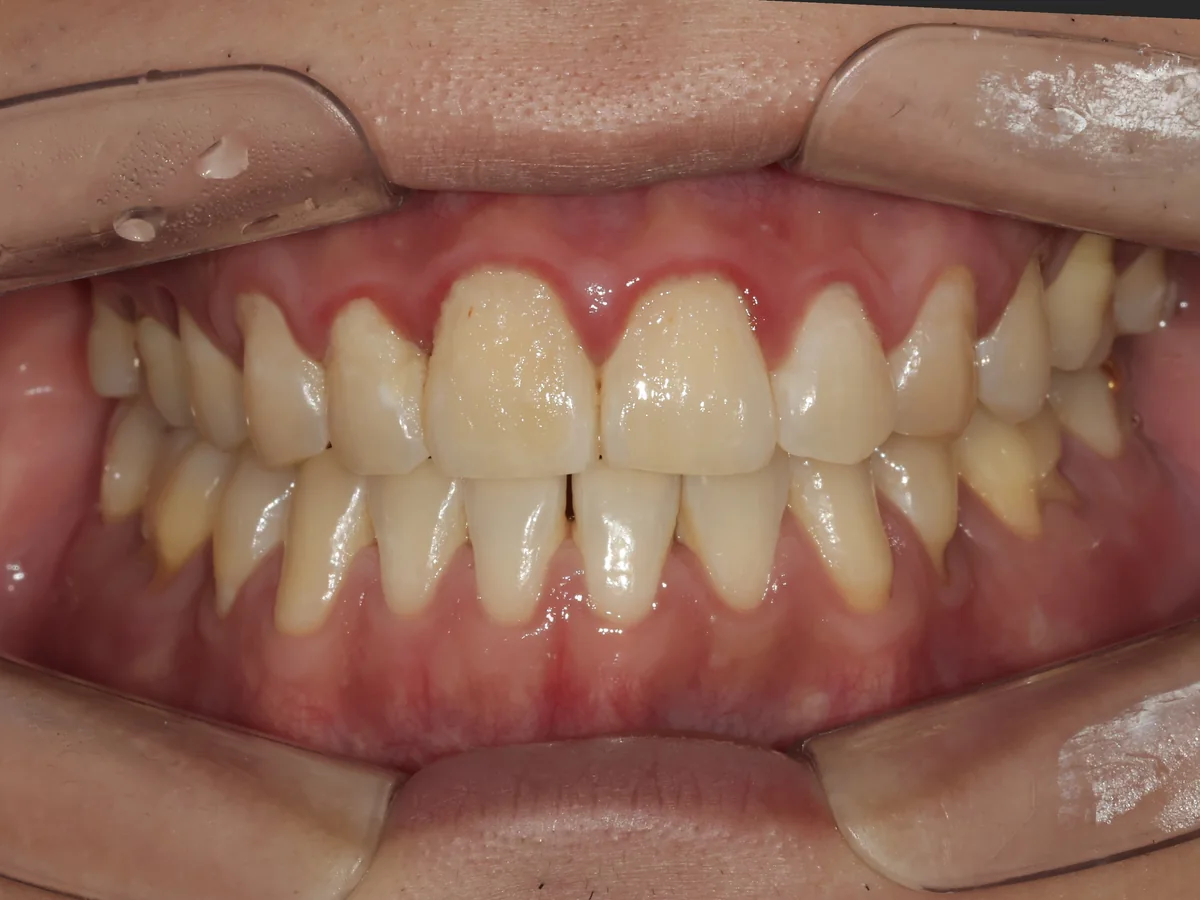
Before treatment · August 2026
Front intraoral view before treatment. The gums were red and swollen throughout, the gums between the teeth were puffy, and they bled at every brushing.
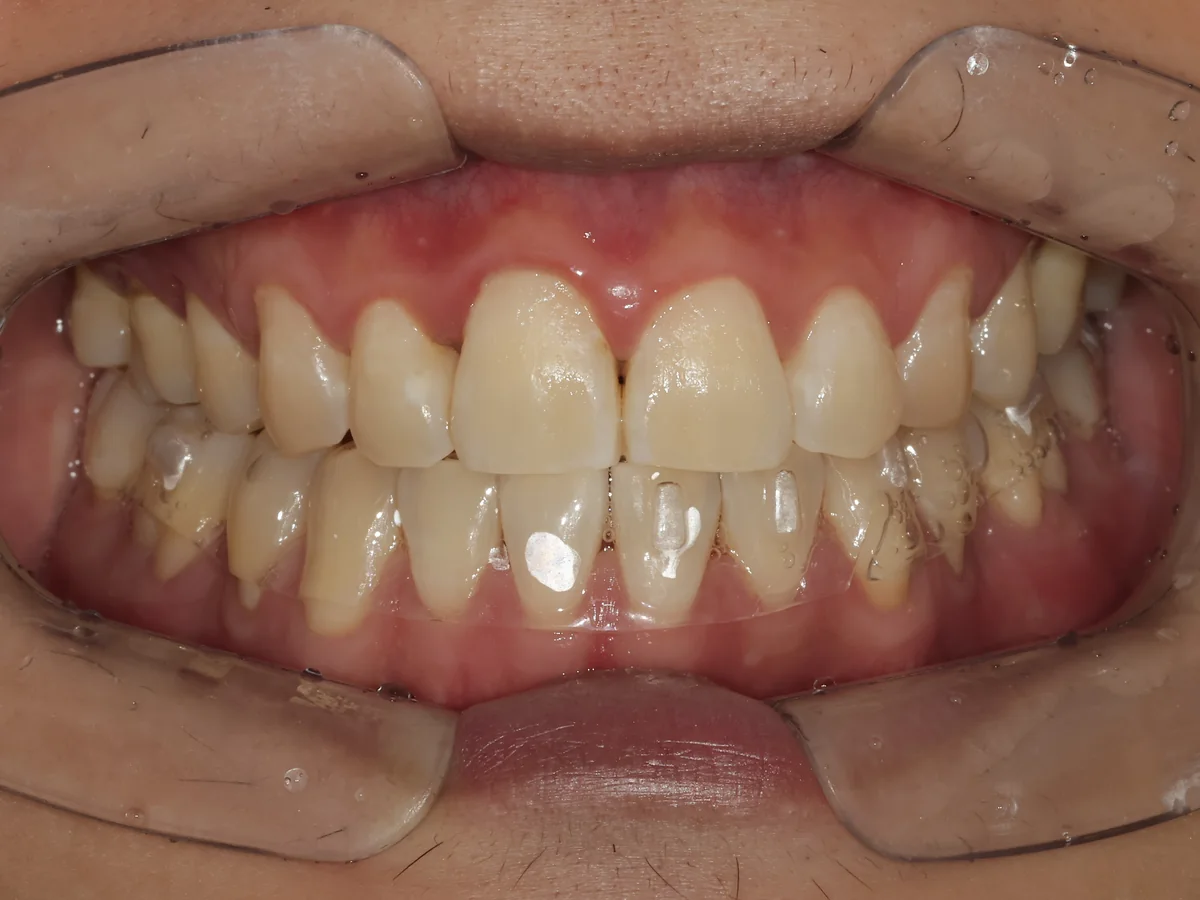
1 month after treatment · September 2026
Front intraoral view from the same angle one month after treatment below the gumline. The red, swollen gums have settled, and the gumline at the necks of the teeth is clearly defined again.
Chart before treatment
Periodontal chart before treatment. There were several spots with gum depth of 5mm or more (red) and many spots that bled when measured (red dots).
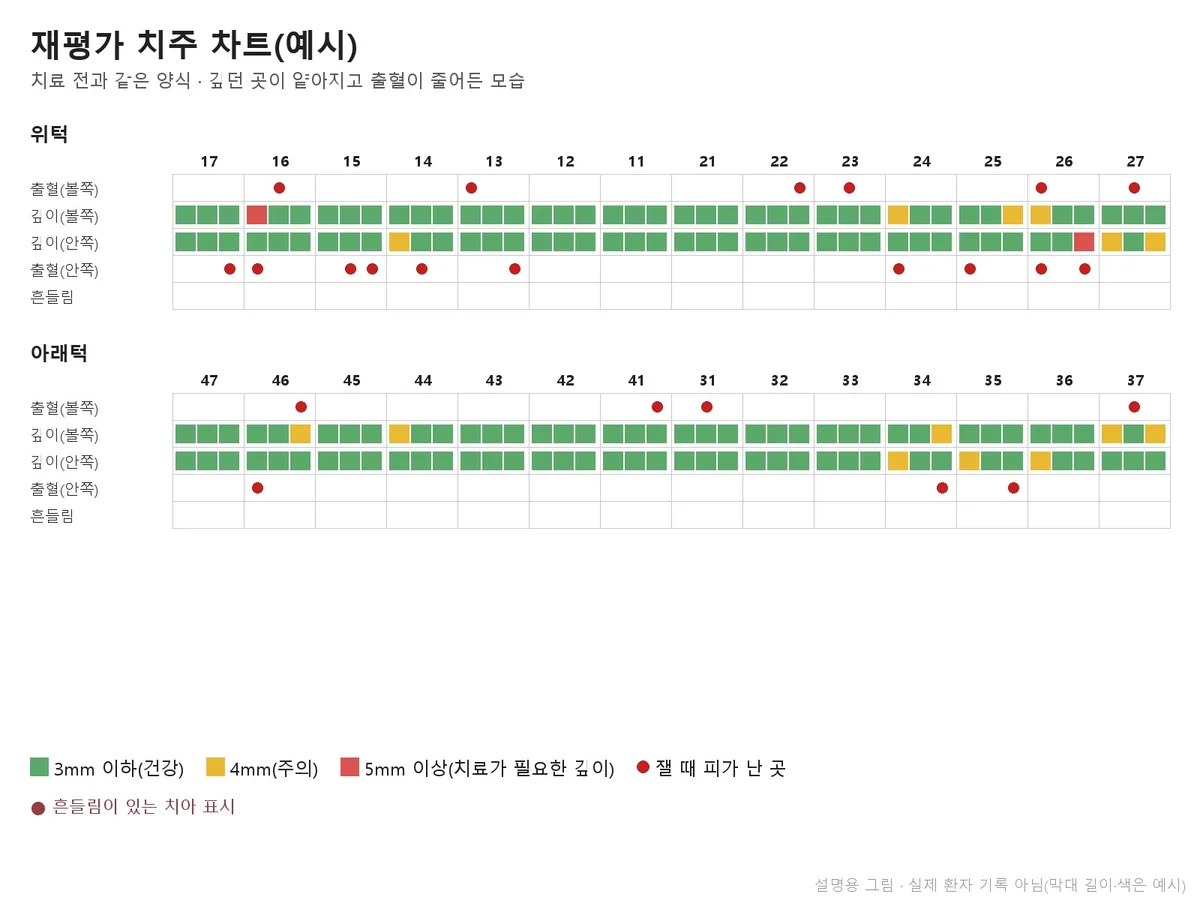
Re-evaluation chart
Re-evaluation chart. Most of the deep spots became shallower and bleeding decreased, so the patient moved to regular maintenance without surgery.
Condition
Moderate periodontitis
Chosen
2–4 sessions of treatment below the gumline under local anesthesia, re-evaluation 4–8 weeks later
Number of deep spots
5 spots of 5mm or more → 1 spot
Not done
Gum surgery (almost no deep spots remained at re-evaluation)
CASE02
When deep spots remained near a molar even after re-evaluation
Gum surgery that opens the gum only at the remaining spots to see and clean the roots directly
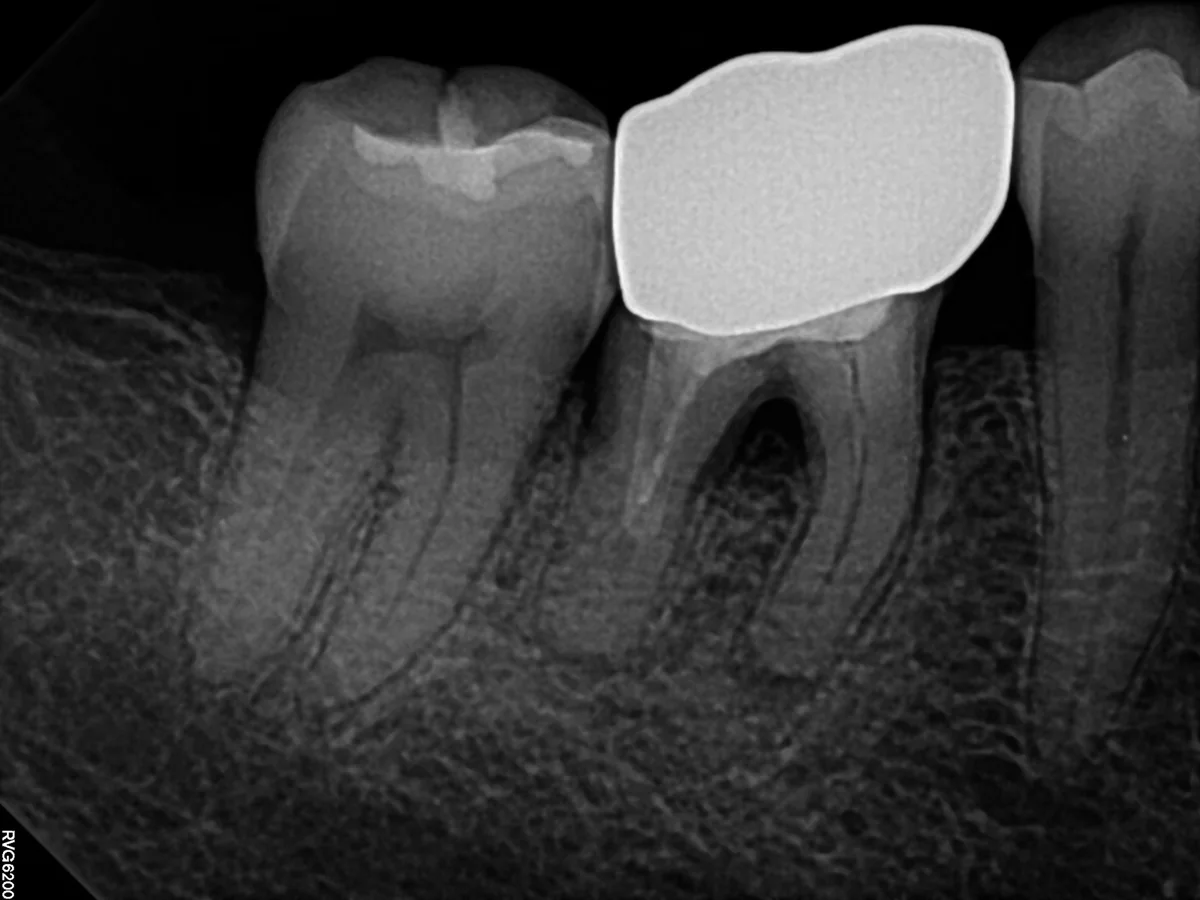
Periapical X-ray · July 2026
Periapical X-ray before treatment. Bone between the two roots of the lower right first molar (tooth 46) was lost and looks dark, and this spot measured 8mm deep.
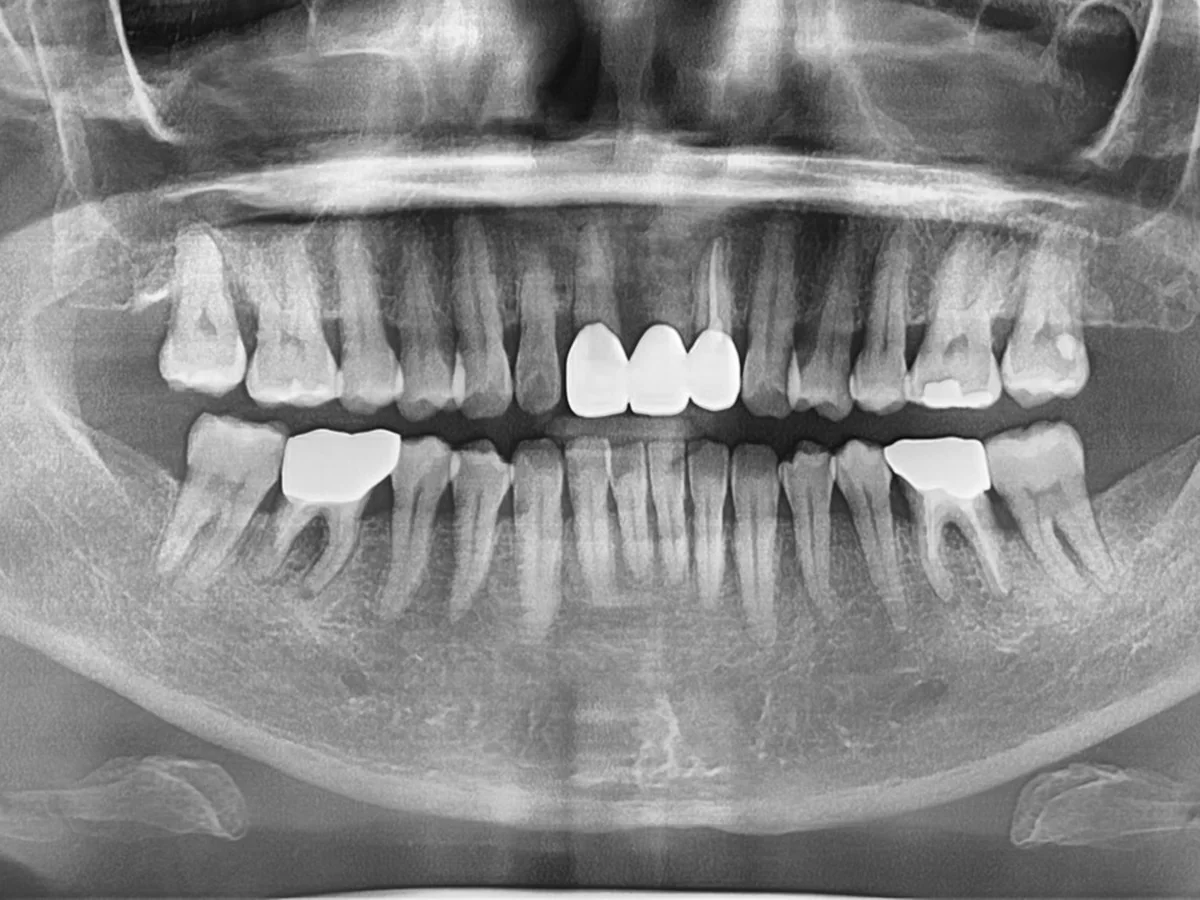
Panoramic X-ray · July 2026
Panoramic X-ray from the same day. Compared with the other teeth, we confirmed that heavy bone loss was limited to the area between the molar roots.
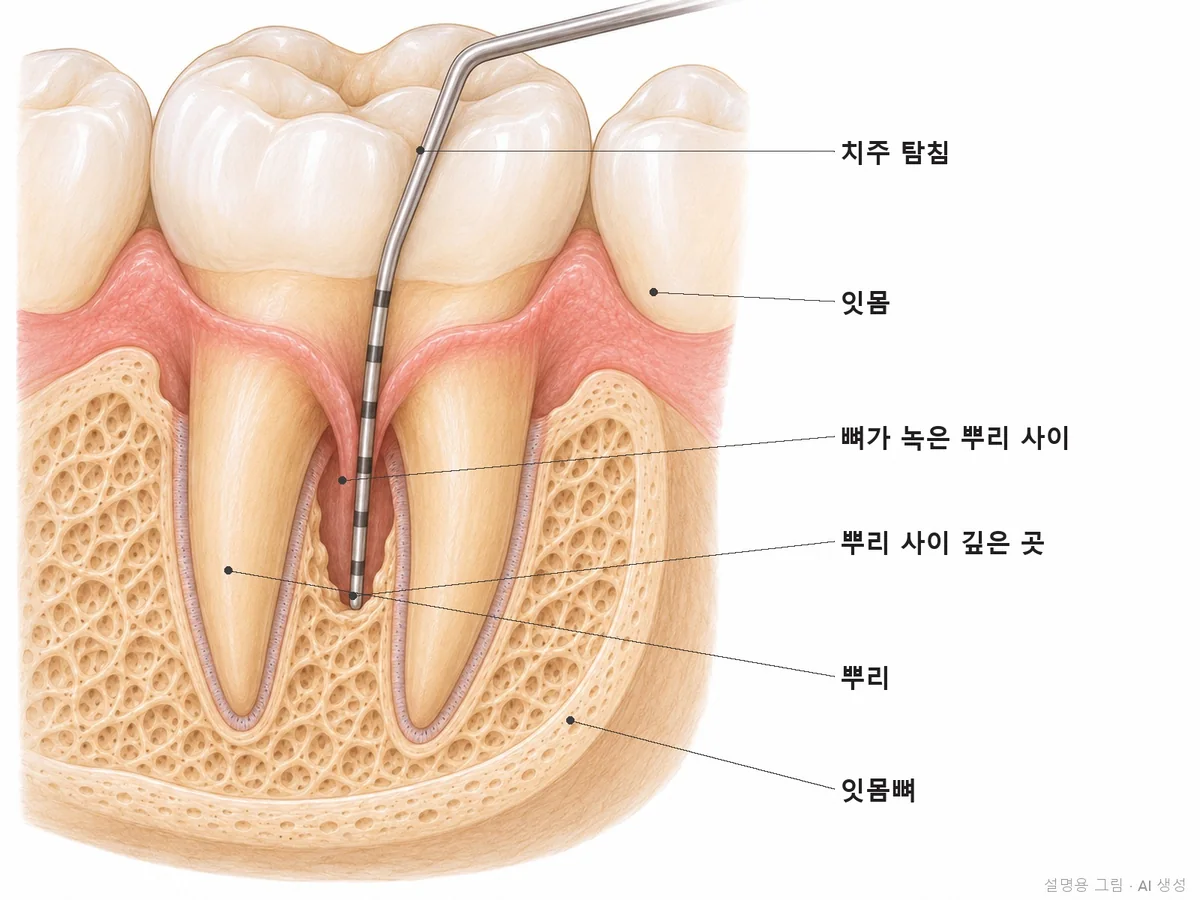
Re-evaluation
Re-evaluation. Other areas improved, but a deep spot remained between the molar roots.
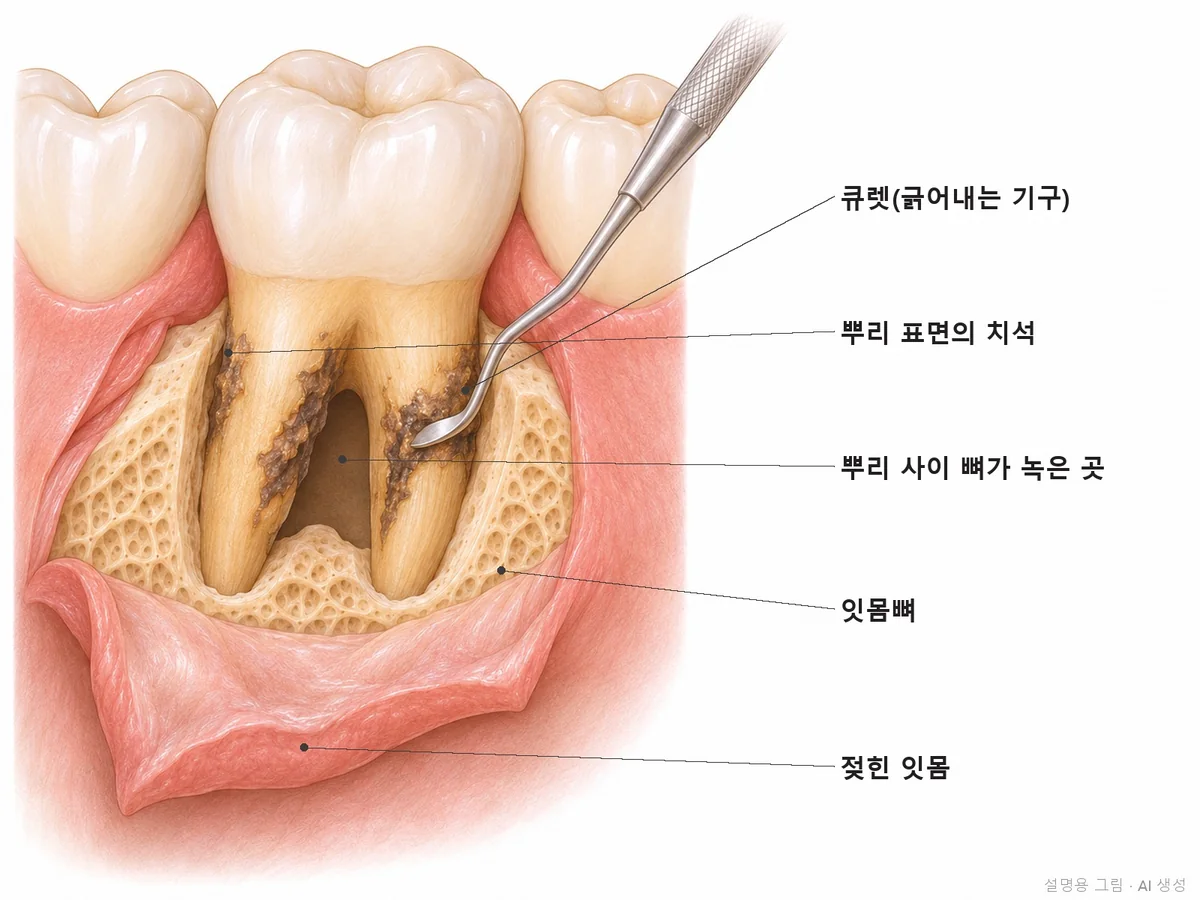
During surgery
During surgery. We open the gum and remove tartar from root surfaces that could not be seen, while looking directly at them.
After surgery
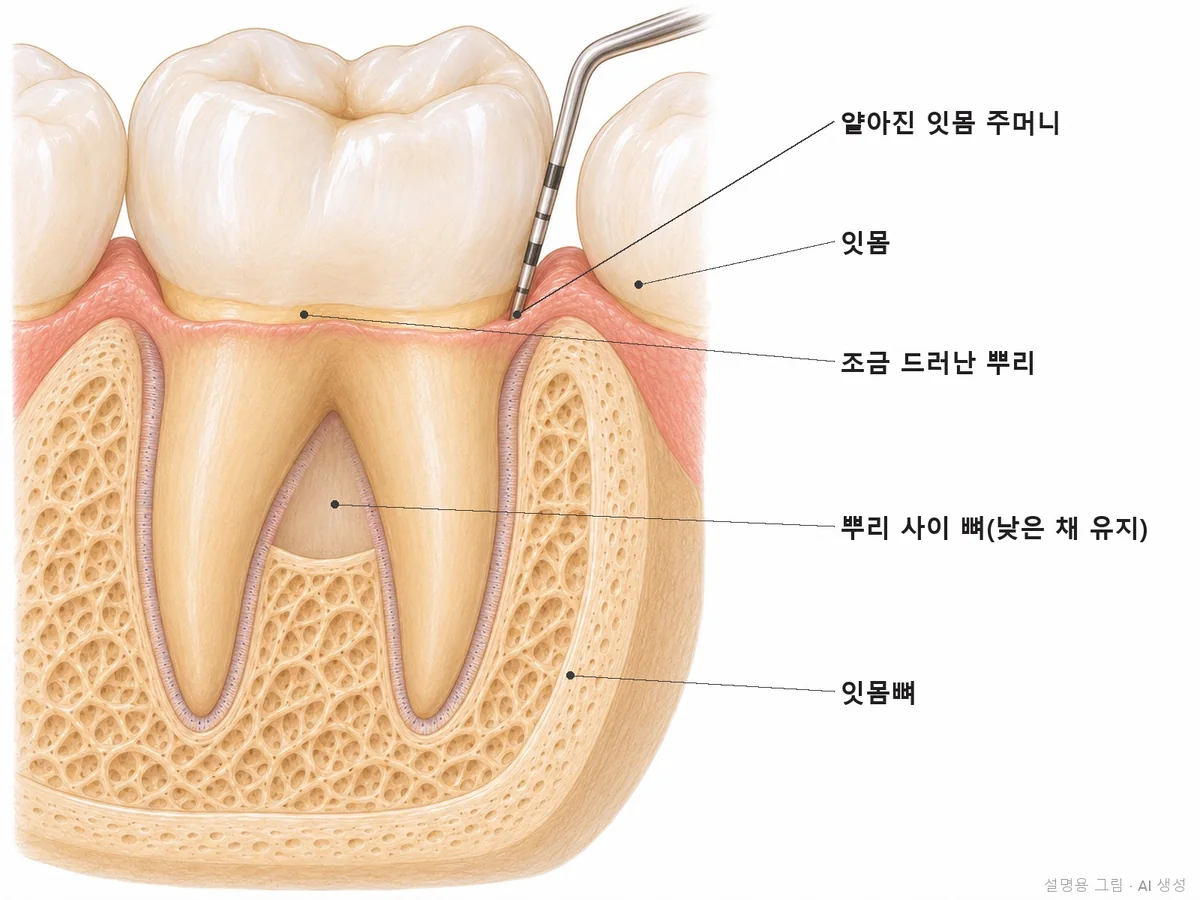
After surgery. Lost bone does not all grow back, but the deep spot becomes shallower so it can be cleaned at home.
Condition
A molar where tartar tends to build up again between the two roots (furcation area) even after re-evaluation
Chosen
Gum surgery that opens the gum in that area and scrapes between the roots while looking directly
Goal
Rather than greatly reducing the depth, keep the current state and manage it so it does not get deeper again
Note
The gums may recede slightly and cause sensitivity, and gaps between teeth may become visible
CASE03
A case with several loose teeth, divided into teeth to keep and teeth to extract
Decided at re-evaluation after gum treatment · kept teeth maintained every 3 months
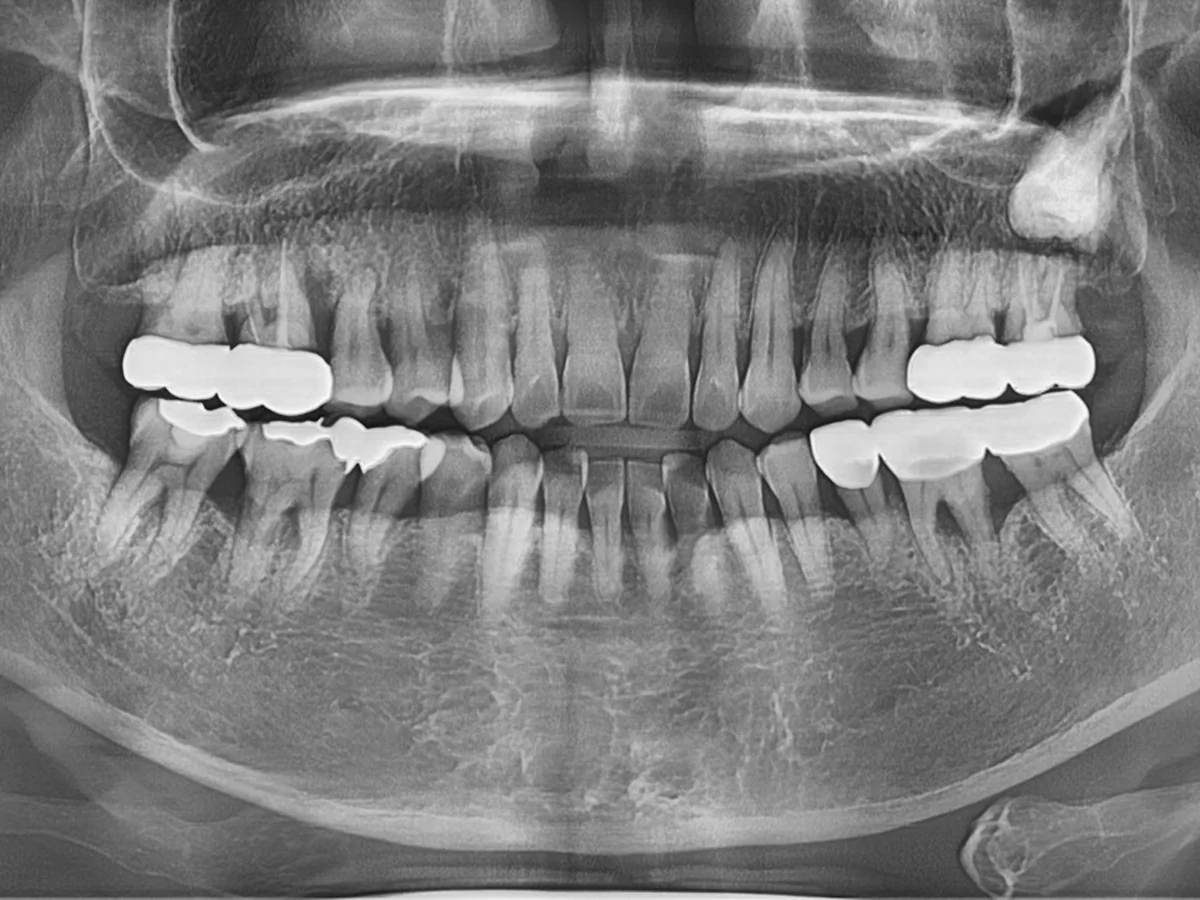
Before treatment · September 2022
Panoramic X-ray before treatment. Even on the same side, the amount of bone loss differed from tooth to tooth. We decided to try to keep the loose upper front teeth and to extract the upper right premolar and molar (teeth 15 and 16), which had lost a lot of bone.
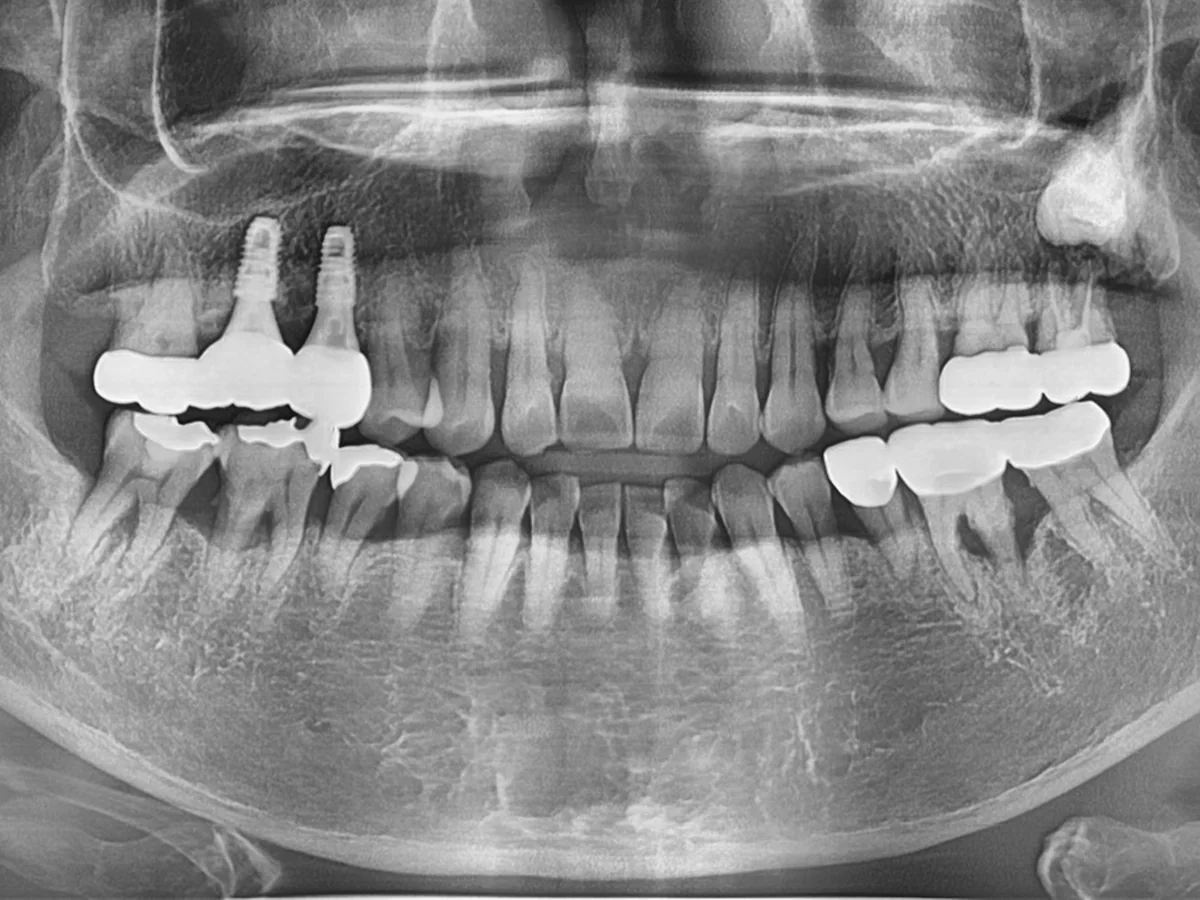
2 years later · October 2024
About 2 years later. The bone level around the front teeth we kept is holding, so regular maintenance continues. Implants were placed where teeth were extracted.
Condition
9 loose teeth, with a different degree of bone loss at each tooth
Chosen
7 teeth kept · 2 teeth extracted
Maintenance
Every 3 months
Note
Lost bone does not all grow back, so the disease can progress again if maintenance stops
* Photos were taken under the same conditions and published with the patients' consent. Treatment results and side effects may vary from person to person.
02°
What is the difference between gingivitis and periodontitis?
01Gingivitis
The gums bleed and swell, but bone has not yet been lost. It can be reversed with scaling and better brushing.
02Periodontitis
Inflammation has moved below the gumline and the bone supporting the teeth has started to break down. Most lost bone stays lost, so the goal of treatment is to stop it from progressing further.
What we look at
How it is classified
Stage (1–4)
How far it has progressed so far (gum depth, bone loss, number of teeth lost)
Stage 1 early → Stage 4 advanced, affecting chewing and tooth alignment
Grade (A–C)
How fast it is progressing (bone loss relative to age, smoking, diabetes)
A slow · B moderate · C rapid
Stage and grade follow the 2017 World Workshop classification of periodontal diseases. They are set using gum depth and X-rays and used to plan treatment and maintenance intervals.
03°
How periodontitis treatment proceeds
The order is measure, treat, and measure again. For each step, we explain what we look at and why, with real clinical photos.
Measurement
Periodontal chart
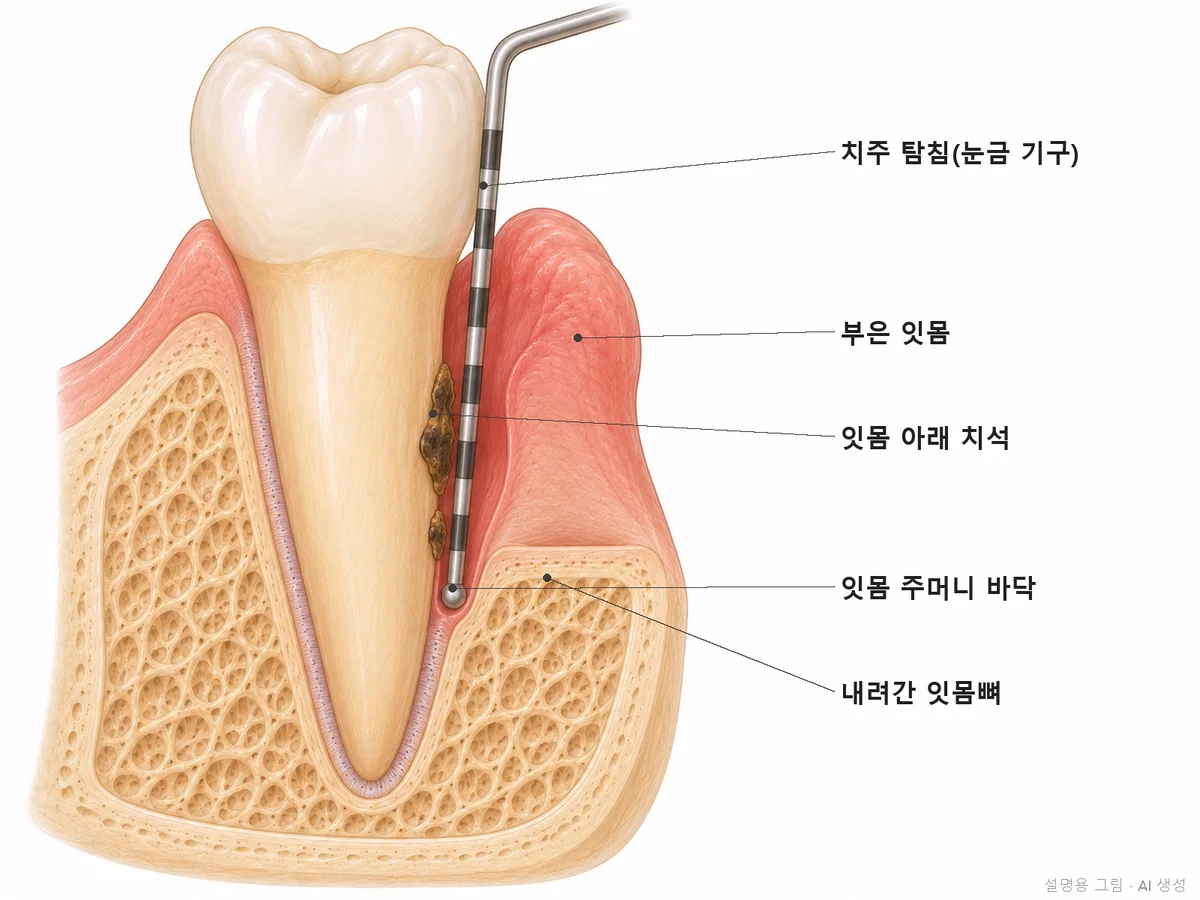
Gum depth measurement. With a thin graduated instrument, we measure the gum pocket depth in mm at several points per tooth (left) and record bleeding and looseness on a periodontal chart (right, same format as CASE 01).
STEP 01
We measure gum depth around each tooth
We measure gum depth at several points per tooth (usually 6) and record whether it bleeds when measured, whether the tooth is loose, and whether the area between the roots is exposed. A healthy gum pocket is usually 3mm or less; from 4mm it needs attention, and 5–6mm or more is considered a depth that needs treatment.
Why we do thisGum disease progresses below the gumline even when things look fine on the outside. Only by recording numbers can we compare, by the same standard, whether things really improved after treatment.
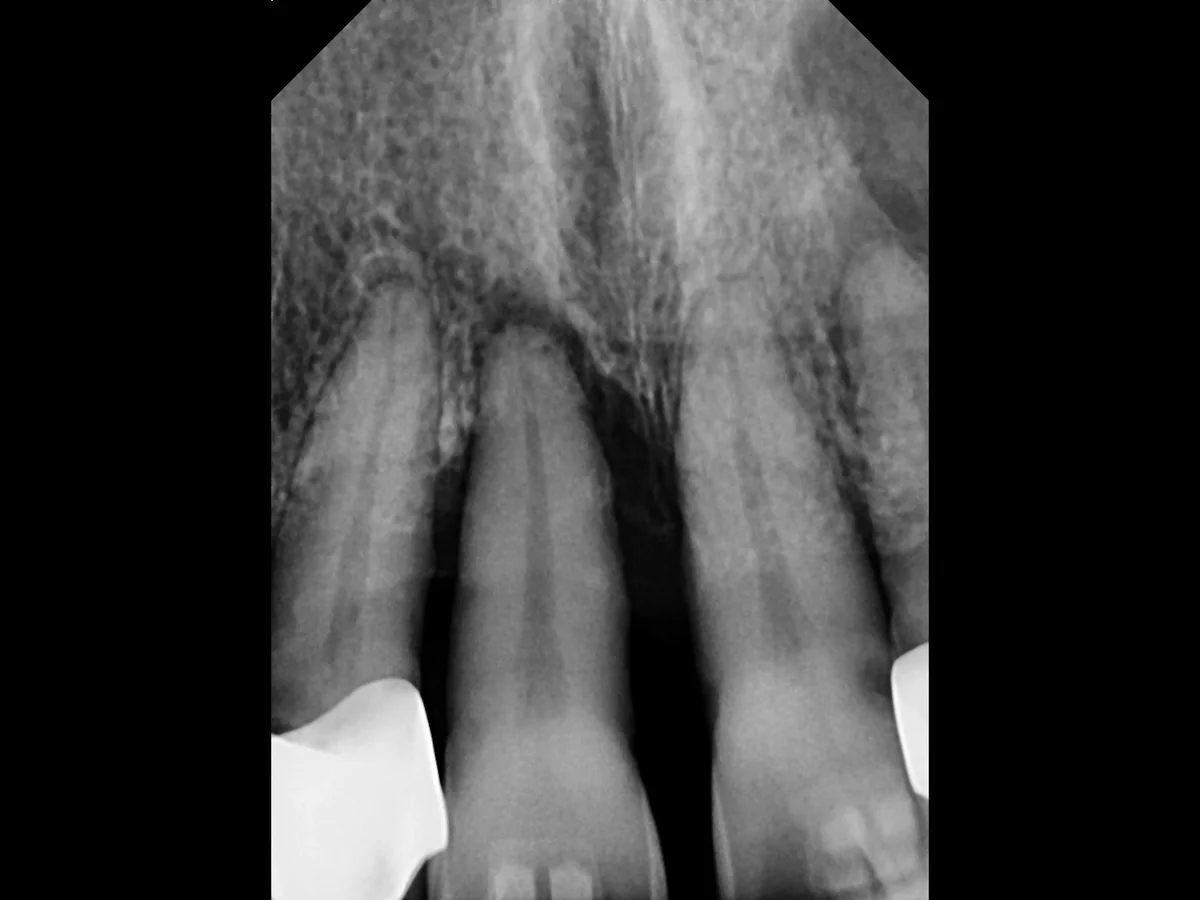
Periapical X-ray · February 2026
X-ray. A line shows the bone around the roots of the upper front teeth lowered evenly. We look at how much of the root length is still surrounded by bone to set the stage and grade.
STEP 02
We check on X-rays how much bone remains
With a digital panoramic X-ray and X-rays of the areas needed, we see how far down the bone around the roots has gone. We combine gum depth, bone condition, and smoking or diabetes status to set the stage and grade, and explain the treatment plan.
Why we do thisEven with the same gum depth, which teeth can be kept and how often maintenance is needed depend on how much bone remains and how fast the disease is progressing.
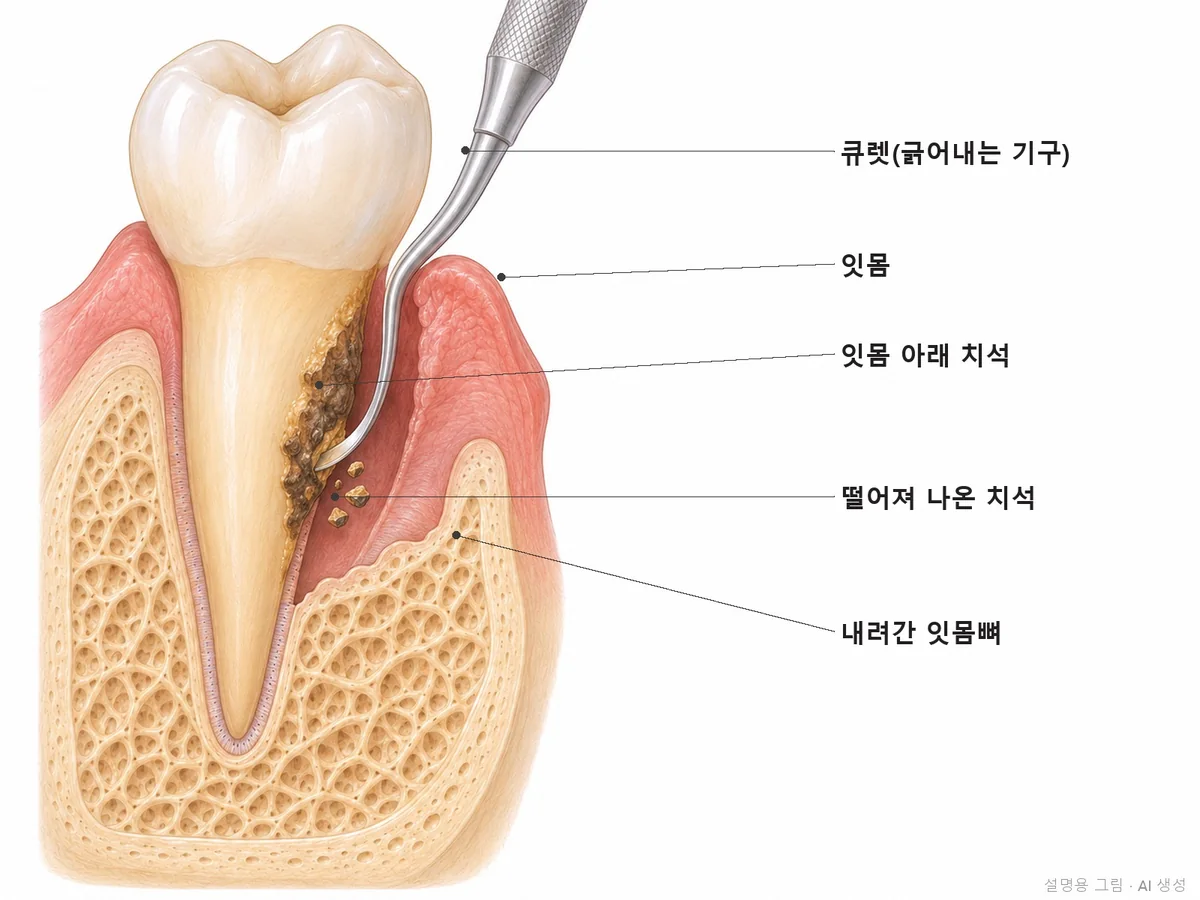
Treatment below the gumline
Treatment below the gumline. Under local anesthesia, we use instruments to remove tartar and bacterial film stuck to the root surfaces below the gumline.
STEP 03
We numb the area and clean below the gumline
Tartar and bacterial film stuck to the root surfaces below the gumline are removed under local anesthesia. This is usually done over several visits, dividing the mouth into 2–4 sections, and we also adjust how you clean at home at this time.
Why we do thisTartar below the gumline sits deeper than scaling can reach and is firmly attached, so anesthesia is needed to clean it thoroughly. Splitting the treatment means you do not have to keep your mouth open for a long time at once.
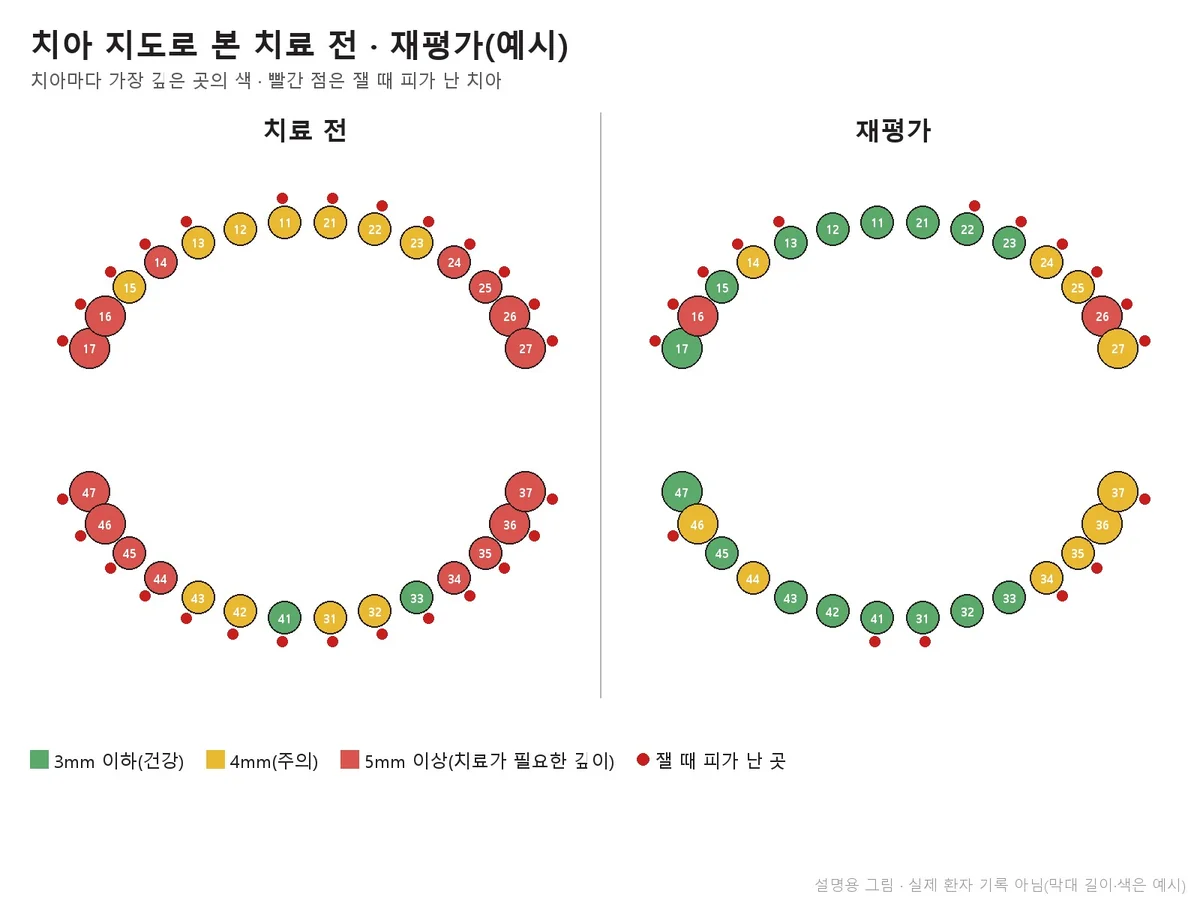
Re-evaluation comparison
Re-evaluation. We measure again in the same way as before treatment and show you in numbers how much the deep spots and bleeding have decreased.
STEP 04
We usually measure again 4–8 weeks later
After giving the gums time to heal, we measure gum depth and bleeding again in the same way as the first time. If almost no deep spots remain, you move to regular maintenance; if some remain, we decide the next step.
Why we do thisRight after treatment, the gums are still healing, so it is hard to know the exact depth. Only by measuring after healing can we judge whether the treatment worked and whether loose teeth can be kept.
Gum surgery
Gum surgery. Only at spots that are still deep after re-evaluation, we open the gum and tidy up the root surface and bone shape while looking directly.
STEP 05
We consider surgery only for spots that remain deep
If spots that are usually 5mm or deeper and still bleeding remain at re-evaluation, we consider surgery that opens the gum only at those spots to see and clean them directly. Depending on the bone shape, regenerative treatment to rebuild bone may also be possible. This is mainly attempted, to try to keep the tooth before extraction, at spots between the two roots of a molar (furcation area) that have become deep and may need extraction if left alone.
Why we do thisToothbrushes and instruments cannot reach deep spots, so inflammation easily comes back. The depth has to be reduced so the area can be cared for at home.
STEP 06
We set an interval for maintenance
After periodontitis treatment is finished, we usually re-measure gum depth and clean every 3–6 months. If the disease tends to progress quickly, or if you smoke or have diabetes, we set a shorter interval.
Why we do thisPeriodontitis can progress again even after treatment is finished. Years later, people who keep up regular maintenance and those who do not differ in how many teeth they have left.
* Clinical photos were published with the patients' consent. Side effects such as temporary pain or discomfort may occur depending on the person.
04°
Things that make gum disease progress faster
Smoking · It narrows the blood vessels in the gums so they bleed less, hiding symptoms, and it also weakens the response to treatment.
Diabetes · High blood sugar makes gum disease progress faster, and gum inflammation makes blood sugar harder to control.
Family history · If someone in your family lost teeth early to gum disease, it may progress faster.
Stress and clenching · When force concentrates on teeth that are already weakened, they can become looser.
Ill-fitting restorations and cavities · A ledge at the gum line lets tartar stick easily and makes cleaning hard.
05°
Comparing treatment options
Scaling
Treatment below the gumline
Gum surgery
Good for
Gingivitis, tartar above and just below the gumline
Periodontitis with tartar and bacterial film below the gumline
When deep spots remain after re-evaluation
Anesthesia
Usually possible without it
Usually local anesthesia
Local anesthesia
Visits
Usually 1 visit
Usually split into 2–4 sessions
By area
Korean National Health Insurance (NHI)
Age 19 or older, once a year
Mostly covered by NHI
Covered by NHI; some materials used for bone regeneration are not covered
If a tooth is loose because of inflammation, it sometimes becomes less loose after gum treatment, so in many cases it is not too late to decide at the re-evaluation.
We show you the gum depth, looseness, and bone height, and explain both options: keeping the tooth or extracting it.
If bone has been lost close to the root tip, if the area between the roots is deeply open, or if the tooth moves even when pressed up and down, it is often hard to keep.
Looseness may decrease as inflammation goes down, but lost bone does not all come back.
Leaving a tooth that is hard to keep for a long time can cause bone loss around the neighboring teeth too, and we will tell you honestly when that is the case.
07°
For these people, another treatment comes first, or treatment is not needed
Gum treatment is right for
People whose gums bleed and swell
People confirmed to have periodontitis by gum depth measurement
People with gum inflammation who are about to have orthodontics, implants, or restorations
There are things to take care of together
People with poorly controlled diabetes: gum treatment works better when blood sugar is also managed with your physician.
People who smoke: we also recommend quitting smoking.
People taking blood-thinning medication: please tell us the name of the medication, and we will check it before proceeding.
You may not need gum treatment
Gingivitis stage: if gum depth is shallow and no bone has been lost, scaling and better brushing may be enough.
08°
Why we check the gums before orthodontics, implants, or restorations
For adult orthodontics, a board-certified orthodontist and a board-certified periodontist check the gums together. Moving teeth while the gums are inflamed can cause more bone loss.
Implants or restorations placed over inflamed gums are unlikely to last. The same kind of inflammation can easily develop around implants as well.
09°
Self-check
If any of these apply, we will measure your gum depth and check what stage you are at.
10°
Side effects and limits
Please read
· After treatment, as the swelling goes down, the gums may look slightly lower and the exposed roots may be sensitive. This usually eases over a few weeks.
· Gaps between teeth may look larger, or dark gaps (black triangles) may appear.
· After the anesthesia wears off, you may feel sore for a day or two.
· Lost bone does not all grow back.
· Even after treatment is finished, the disease can progress again if maintenance stops.
FAQ
FAQ
If my gums bleed, do I have periodontitis?
Bleeding gums can be gingivitis or periodontitis. We can only tell them apart by measuring gum depth and checking on X-rays whether bone has been lost.
Treatment below the gumline is usually done under local anesthesia, so pain during treatment tends to be mild. After the anesthesia wears off, your teeth may feel sore or sensitive for a day or two.
How many visits does gum treatment take?
Gum treatment for periodontitis is usually done over several visits, dividing the mouth into 2–4 sections, followed by one re-evaluation 4–8 weeks later. Based on the re-evaluation, we decide whether any spots need surgery or whether you can move straight to regular maintenance.
Will loose teeth become firm again after gum treatment?
Teeth that were loose because of inflammation sometimes become less loose after gum treatment. However, lost bone does not fully come back, so we judge again at the re-evaluation whether the tooth can be kept.
Why are my teeth sensitive after gum treatment?
When the swelling goes down after gum treatment, the gums recede slightly and expose the roots, which can cause sensitivity. It usually eases over a few weeks; if it lasts, we treat the sensitivity.
Is gum treatment covered by health insurance?
For people enrolled in Korea's National Health Insurance (NHI), treatment below the gumline and most gum surgery are covered. If an item is not covered, such as some regenerative materials, we will tell you before we start.
Once gum treatment is finished, do I still need to come back?
Periodontitis can progress again even after treatment, so we usually re-measure gum depth and provide maintenance care every 3–6 months. We set the interval based on how fast the disease progresses and whether you smoke or have diabetes.
Are diabetes and gum disease related?
Diabetes is a risk factor that makes gum disease progress faster, and gum inflammation in turn makes blood sugar harder to control, so the two affect each other. That is why we recommend that people with diabetes manage both their medical care and their gums together.
Evidence and references
Papapanou PN, et al. Periodontitis: Consensus report of workgroup 2 of the 2017 World Workshop on the Classification of Periodontal and Peri-Implant Diseases and Conditions. Journal of Periodontology, 2018 (staging and grading of periodontitis)
Sanz M, et al. Treatment of stage I–III periodontitis: The EFP S3 level clinical practice guideline. Journal of Clinical Periodontology, 2020 (treatment steps, re-evaluation, and maintenance for periodontitis)
Questions from international patients who live in Korea.
Can I use Korean National Health Insurance?
If you are enrolled in Korea's National Health Insurance, insured treatments are billed under the same insurance rules as for other enrollees. Whether a treatment is covered depends on the treatment and the insurance rules, and we tell you before treatment starts. If you are not enrolled, you pay the full fee.
Can I be seen in English?
Yes. The doctor in charge of each field consults with you directly in English, so you do not need an interpreter.
I am in Korea only for a short trip. Can I have this treatment?
It depends on how many visits the treatment needs. Tell us your travel dates when you contact us, and we will tell you after the examination whether the schedule is realistic.
Results, the number of visits and schedules vary from person to person. More questions: Visiting from abroad.


 Before treatment · August 2026
 1 month after treatment · September 2026
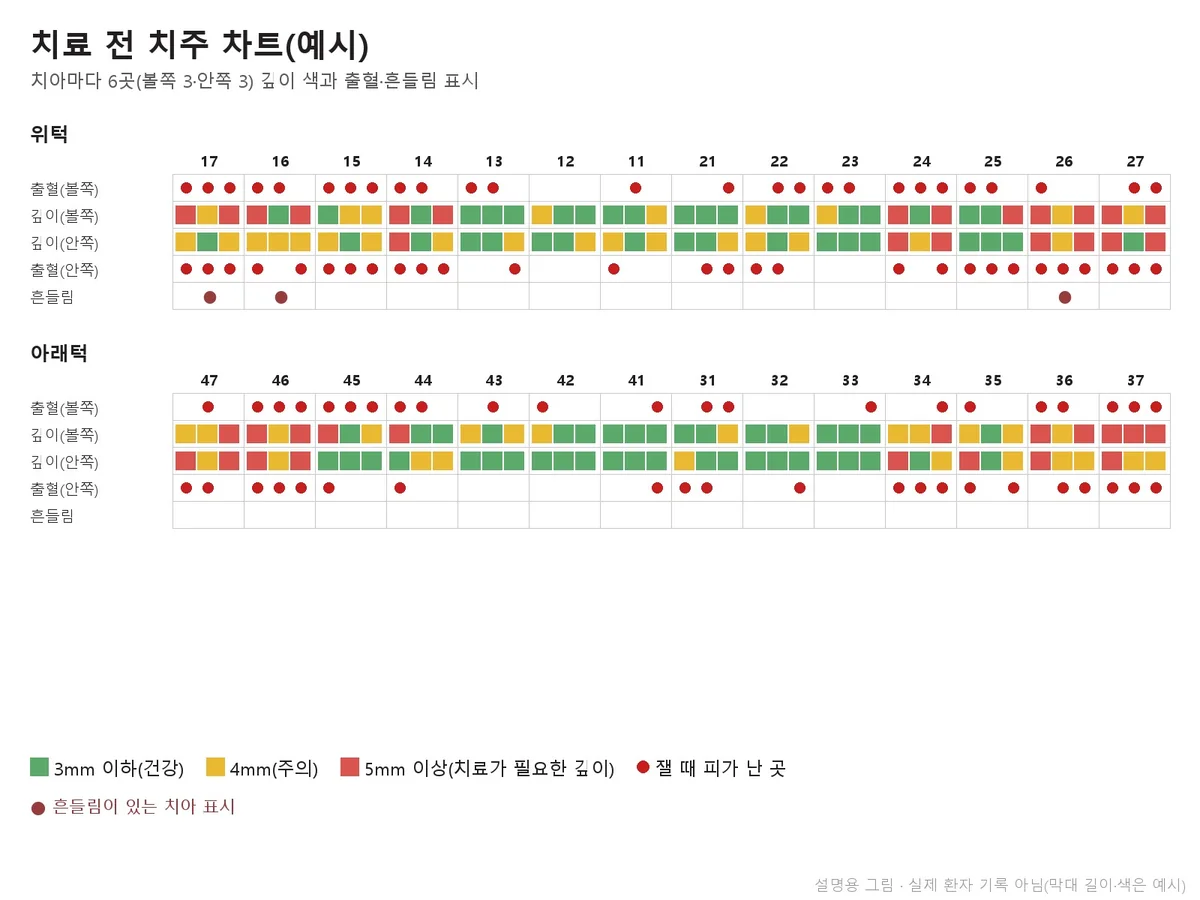 Chart before treatment
 Re-evaluation chart
 Periapical X-ray · July 2026
 Panoramic X-ray · July 2026
 Re-evaluation
 During surgery
 After surgery
 Before treatment · September 2022
 2 years later · October 2024
 Measurement
 Periapical X-ray · February 2026
 Treatment below the gumline
 Re-evaluation comparison