Last reviewed Oct 29, 2026 · Dr. Sunmin Kim (board-certified orthodontist, certified by the Korean Association of Orthodontists)
At a glance
Who it suits
A canine that erupted out of alignment because there was not enough room
Treatment flow
Check the space shortage and lip position → decide on extractions → bring the crowded canine into line step by step
Duration and limits
Without extractions usually 1.5–2 years; with extractions 2–2.5 years
Read more
Whether treatment for crowded teeth needs extractions depends on how much space the canine is short of and how far the front teeth already stick out. If the shortage is a few millimeters and your mouth is on the flat side, we can fit the tooth in without extractions by slightly reshaping between teeth or widening the arch. If a lot of space is missing or your mouth also sticks out, removing premolars gives a more stable result, and because the canine is an important tooth you use for a long time, we usually remove a premolar instead of the canine. Treatment usually takes 1.5–2 years without extractions and 2–2.5 years with extractions. Dr. Sunmin Kim of Ceramic Dental Clinic carried out a study (2022) measuring the forces on crowded and rotated upper front teeth, and he plans the order and force used to bring a crowded canine into line.
01°
Even with the same crowded canine, whether to remove teeth and how to bring it in differed from person to person
Depending on the size of the space shortage, the lip position, and where the canine was, we treated without extractions, removed premolars, or pulled down a canine from the bone. Here are three typical cases.
CASE01
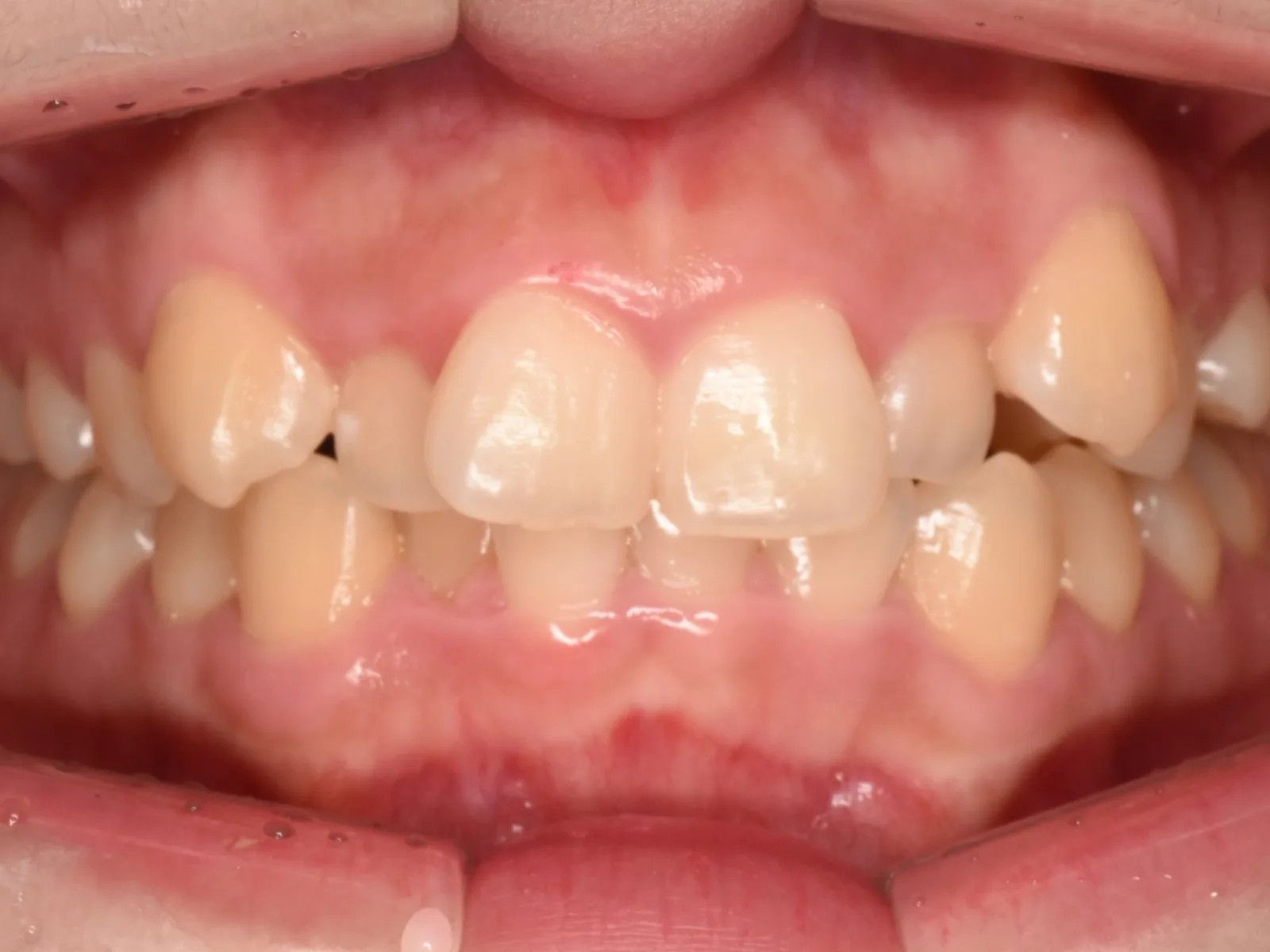
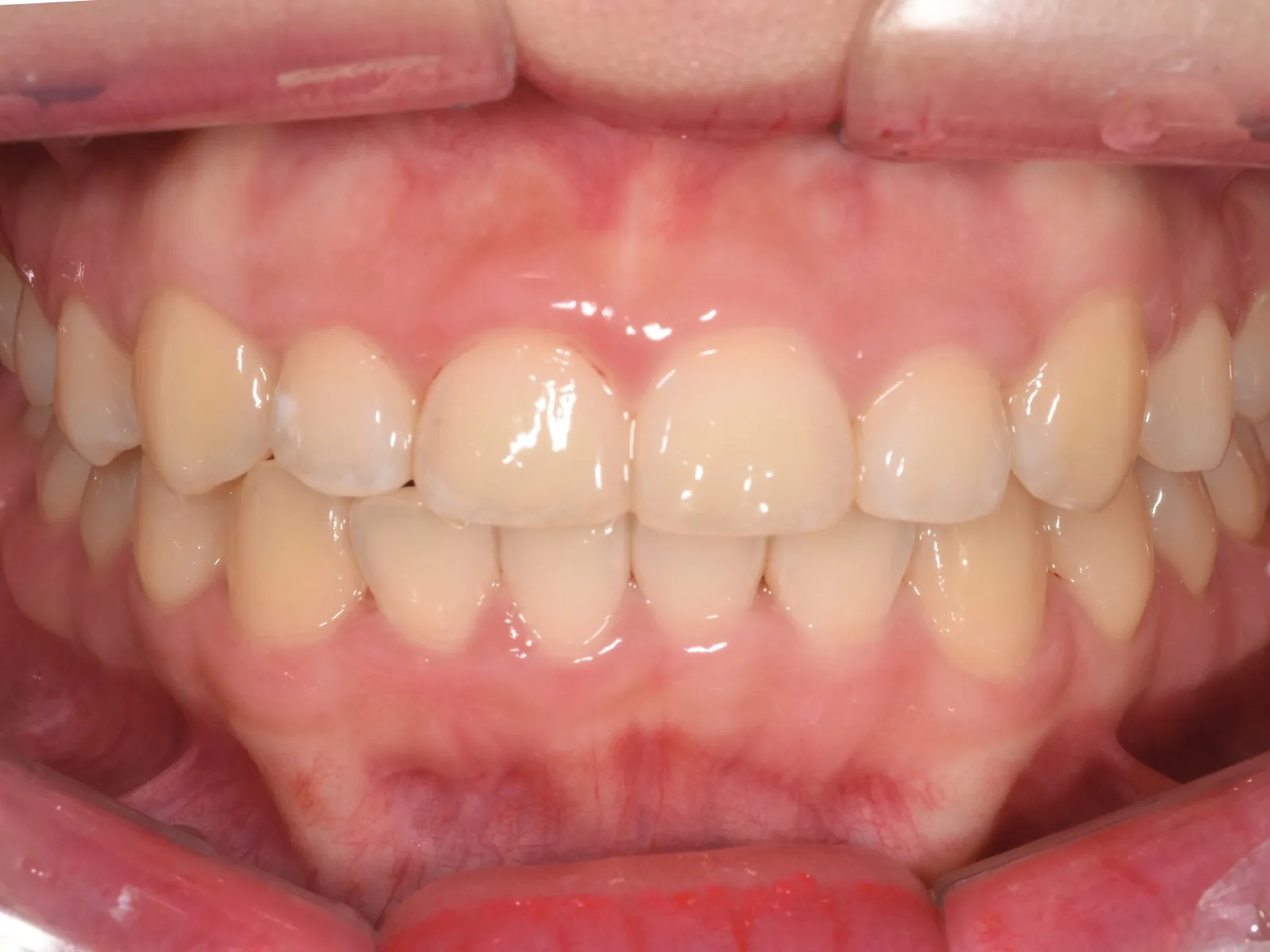
A crowded canine with a small space shortage and a mouth on the flat side
Non-extraction braces · Space was made by slightly reshaping between teeth, and the canine was brought down
Before · Mar 2023
Front view inside the mouth before treatment. The canine lacked room and was pushed up toward the gum.
After · Oct 2024
Front view inside the mouth after treatment. Using the space made by slightly reshaping between teeth, the canine was brought into place.
Condition
Space shortage of 9 mm; front teeth not very forward; mouth on the flat side
Choice
Non-extraction; space gained by reshaping between teeth
Not done
Extractions (the mouth was already flat, so moving the teeth back further could make it look sunken)
Duration
About 1 year 7 months (Mar 2023 → Oct 2024)
Note
Teeth that were rotated tend to rotate back, so the retainer is worn for a long time. We check the retainer to make sure the canine is not pushed out again.
CASE02
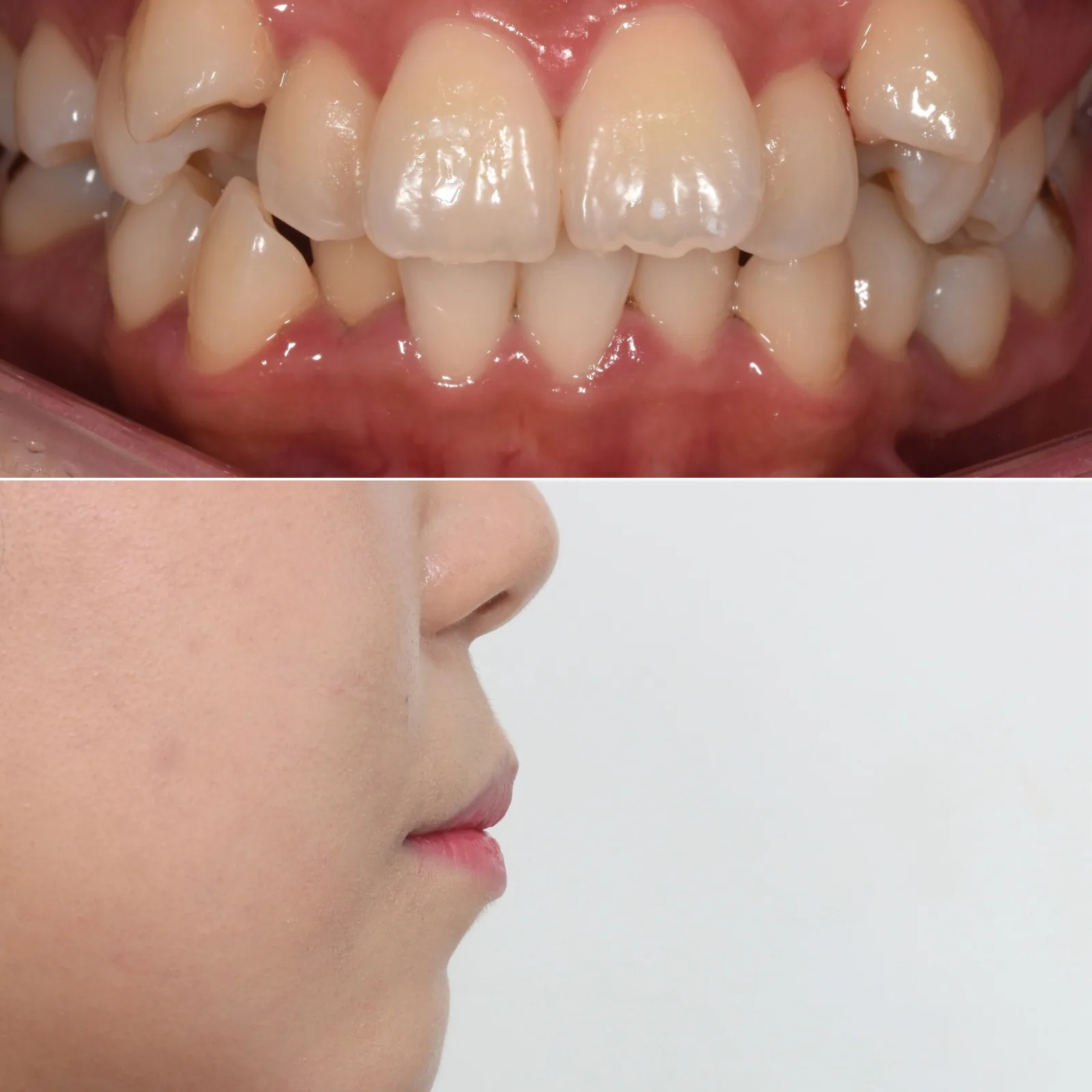
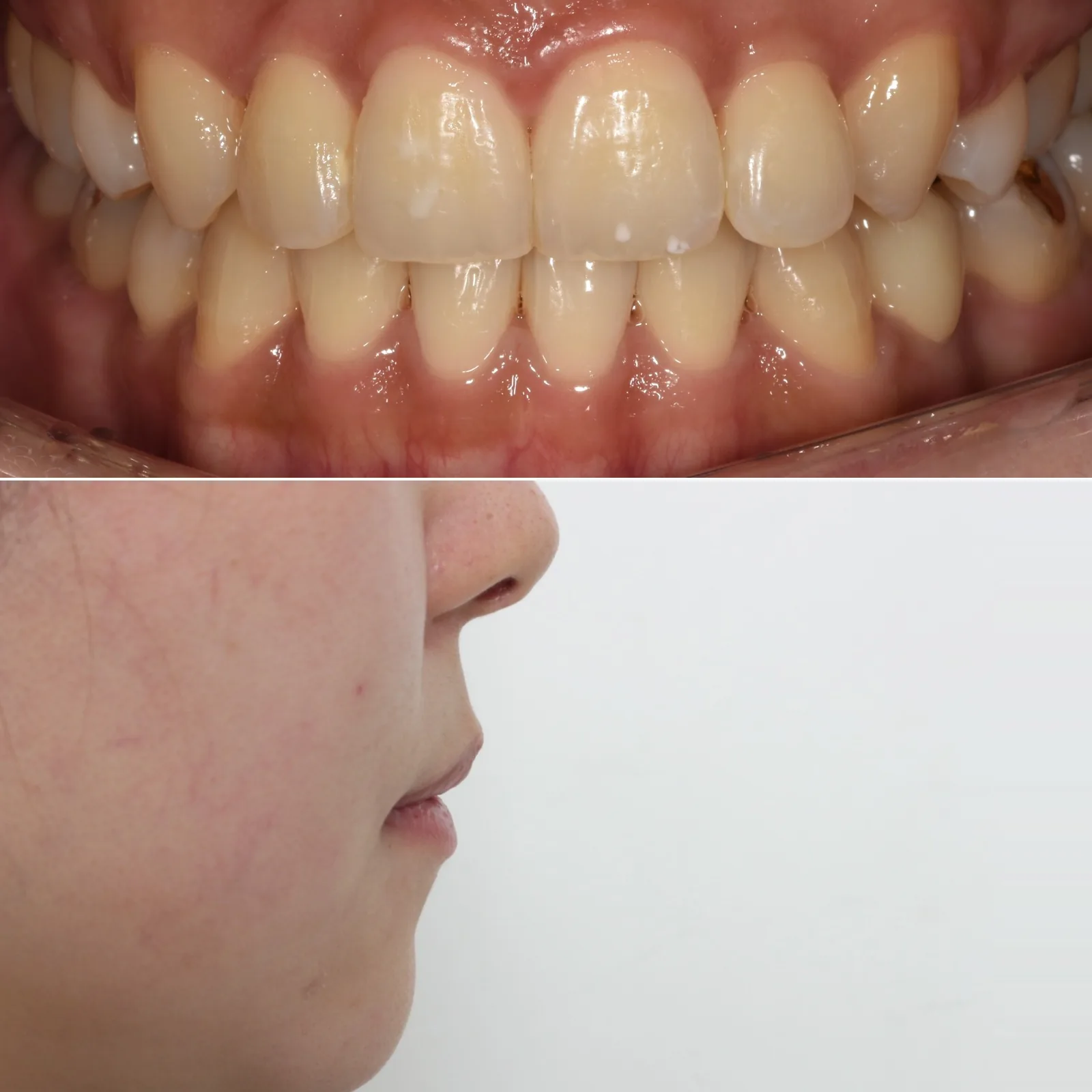
A crowded canine with a large space shortage and a mouth that also sticks out
Extraction braces · Four premolars removed; the crowded canine was brought in and the front teeth were also moved back
Before · Jul 2021
Front view inside the mouth (top) and side profile (bottom) before treatment. The canine is very short of space, and the front teeth are also forward, so the mouth looks like it sticks out.
After · Apr 2024
Front view inside the mouth (top) and side profile (bottom) after treatment. The crowded canine was brought down into the premolar extraction space, and the remaining space was used to move the front teeth back, also improving the lip position.
Condition
Space shortage of 13 mm; front teeth tilted forward; mouth looks like it sticks out
Choice
Four upper and lower premolars removed
Not done
Canine extraction (the canine is a tooth you need for a long time), forcing the arch wider without extractions
Duration
About 2 years 6 months
Note
The retainer is worn consistently so that the extraction spaces do not reopen.
CASE03
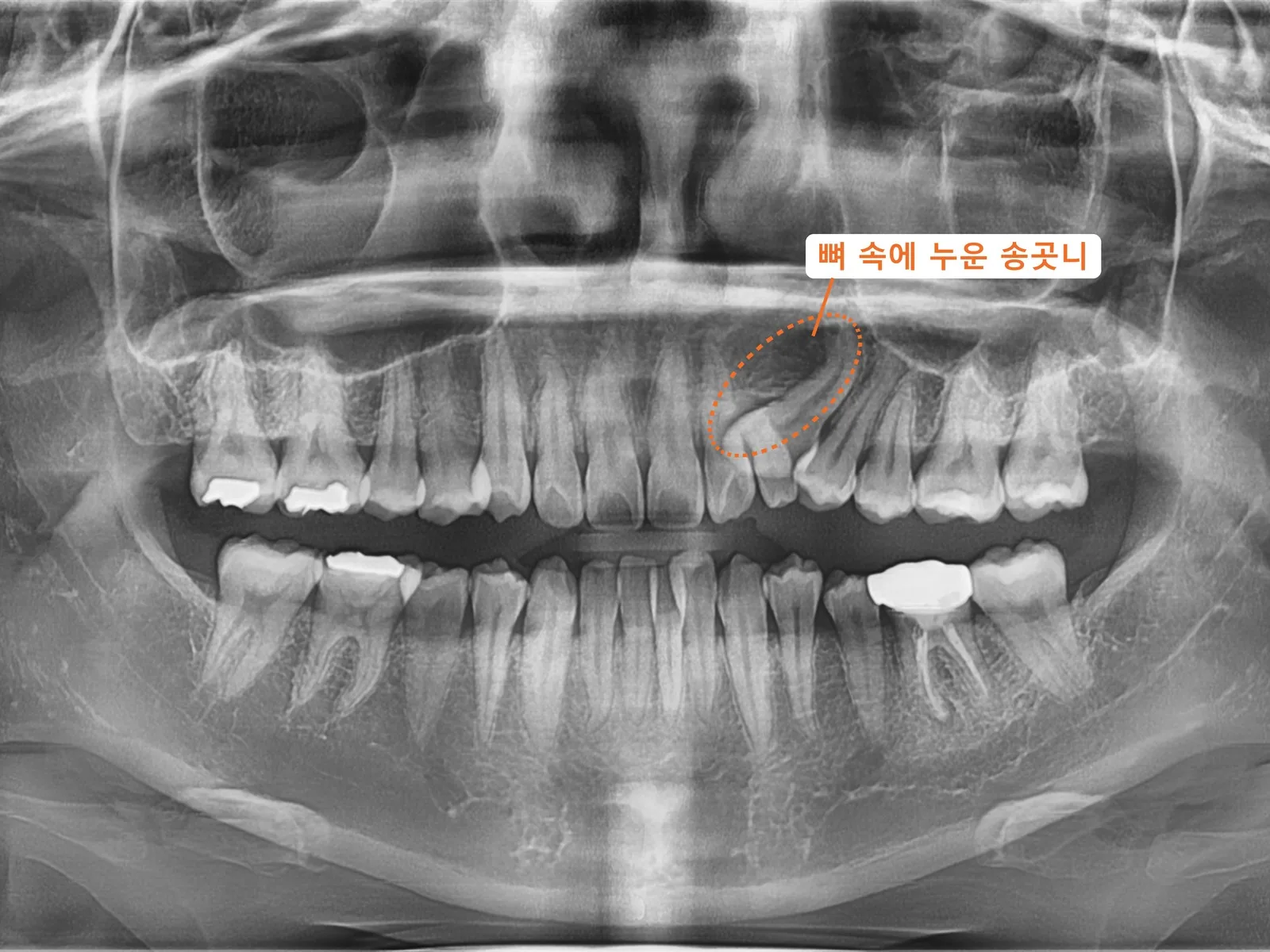
A canine stuck in the bone that could not come in (impacted)
After checking the position on 3D CT · The canine was exposed and slowly pulled down with braces
Before · Jun 2021
Panoramic X-ray before treatment. The canine lies at an angle in the bone and cannot come in on its own.
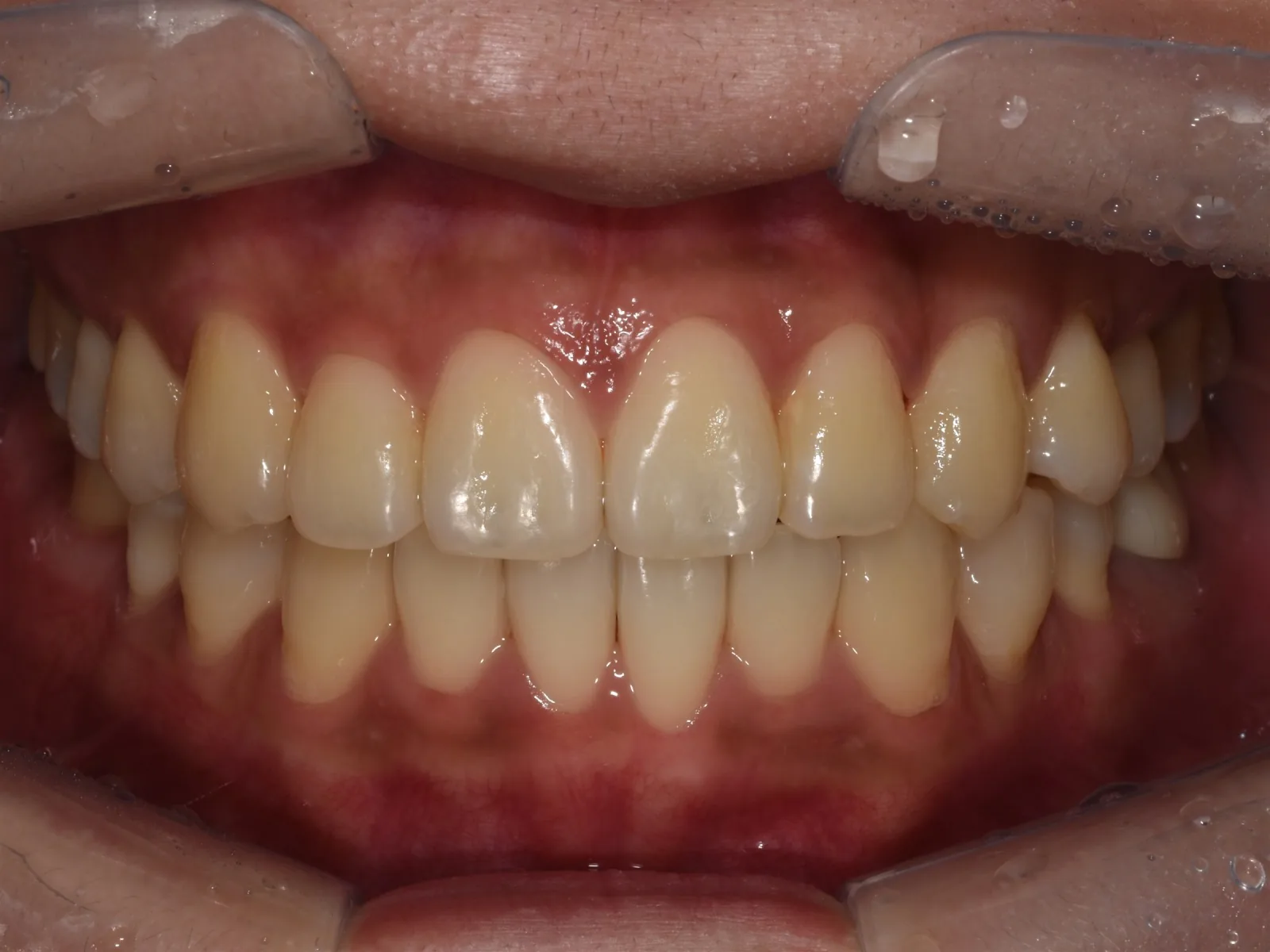
After · Oct 2024
After. A small hook was attached to the exposed canine, which was pulled into place over several months.
Condition
Upper canine stuck in the bone and unable to come in; baby canine still present
Choice
Position and neighboring roots checked on 3D CT; canine exposed (done at Ceramic Dental Clinic), then pulled down with braces
Not done
Removing the impacted canine (it was in a position that could be pulled down)
Duration
About 3 years 4 months (Jun 2021 → Oct 2024)
Note
The gum around the pulled-down canine may sit a little higher or lower than the neighboring teeth, so we check the surrounding gums regularly.
* Photos were taken under the same conditions and published with the patient's consent. Treatment results and side effects can vary from person to person.
02°
Why does a crowded canine form? We start by sorting out the cause
A crowded canine usually forms because the canine comes in last, finds too little room left, and gets pushed upward. How we gain space and when we start depend on the cause.
01Lack of space
The jaw is small for the size of the teeth, so there is not enough room for them. This is the most common cause, and we measure the shortage in millimeters to decide the method.
02Baby-tooth problems
A baby tooth was lost too early and the back teeth drifted forward, or a baby tooth stayed too long and blocked the permanent tooth's path.
03Canine position
The canine grew crooked from the start, or got stuck in the bone (impacted) and could not come into place. We check its position on 3D CT.
04Front teeth already forward
The front teeth tilted forward and took up the space first. This often comes with a protruding mouth, so we also plan the lip position.
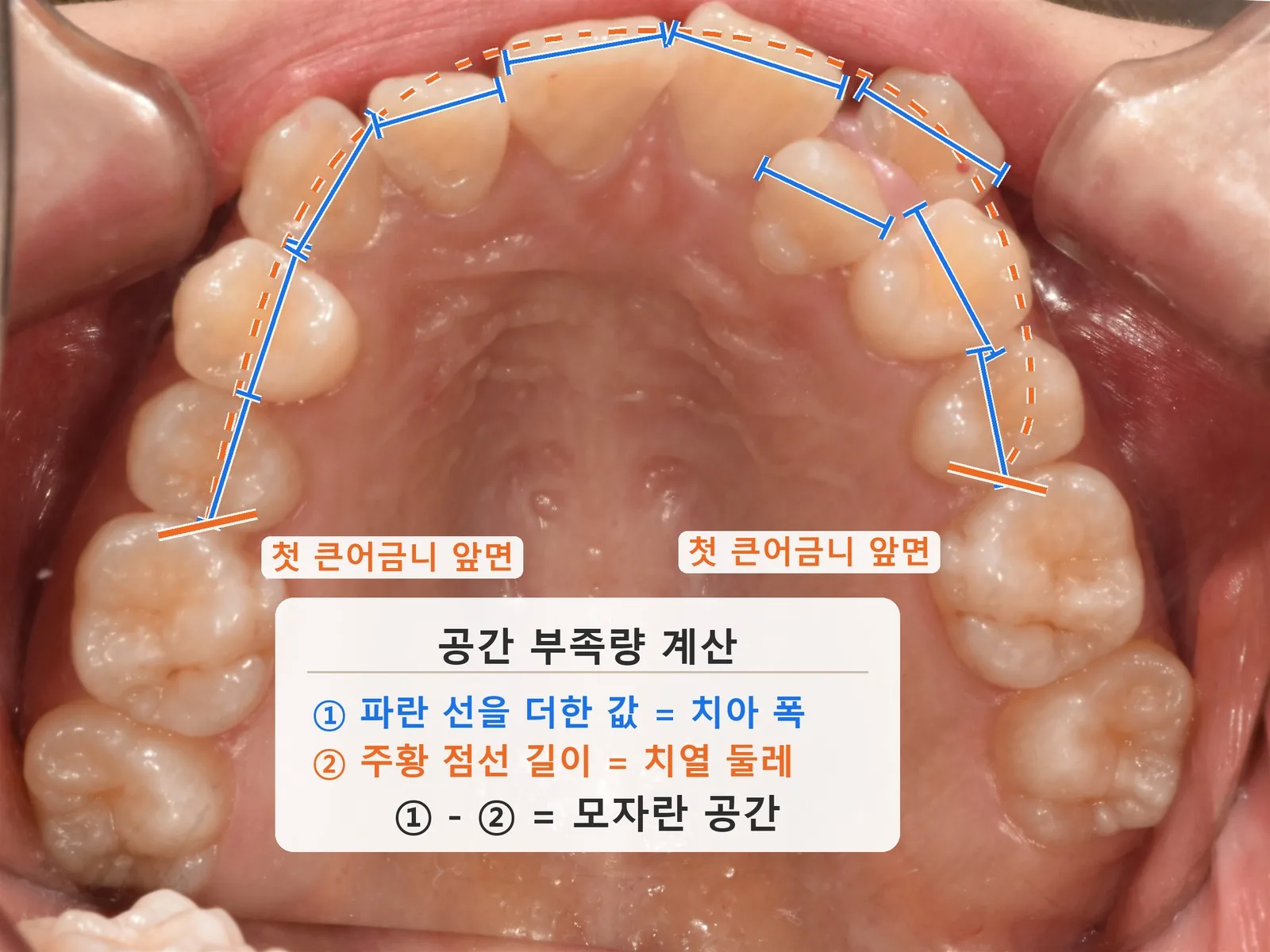
Space-shortage calculation
Calculating the space shortage. Between the front surfaces of the first molars on both sides, we compare the sum of the tooth widths with the arch perimeter available for the teeth to see how many millimeters are missing.
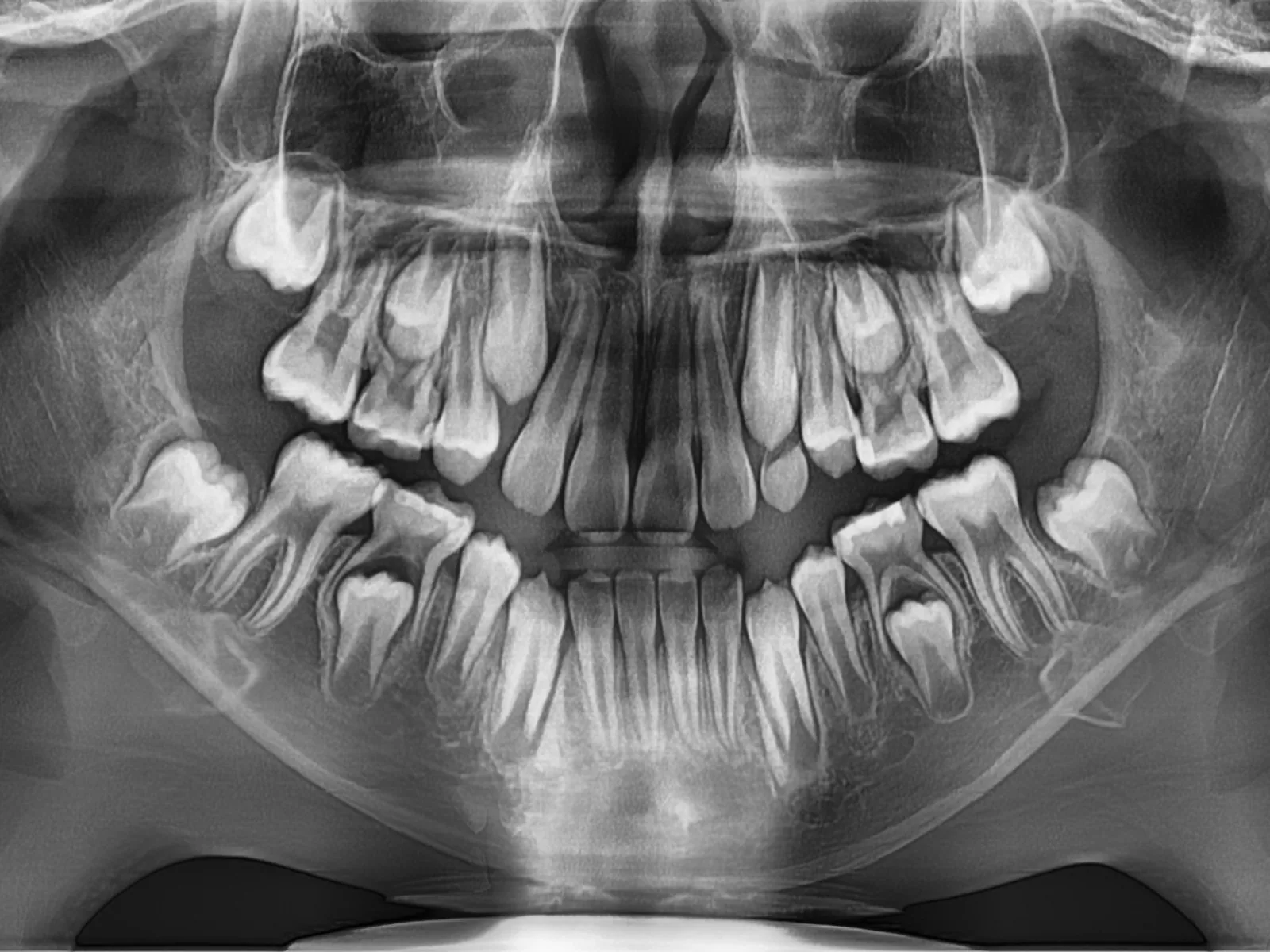
Baby teeth and canine position
Panoramic X-ray. We check the remaining baby teeth and the direction of canines that have not come in yet.
If the shortage is small, we treat without extractions; if it is large or the mouth sticks out, we also consider extractions. We show you these numbers at the examination.
03°
How treatment for crowded teeth works
There are five steps, from calculating the space to retainers. For each step, we explain what we look at and why, with real clinical photos.
Space calculation
Calculating the space shortage. We compare the sum of the tooth widths with the arch perimeter to measure how many millimeters are missing. We check the front-teeth tilt on a side-view X-ray and, if needed, the canine root position on 3D CT.
STEP 01
We measure the missing space in millimeters
We make a digital model with an iTero intraoral scan, compare the sum of the tooth widths with the arch perimeter, and calculate how many millimeters are missing for the canine to fit. A side-view X-ray (cephalogram) shows how much the front teeth are already tilted, and if the canine is stuck in the bone or close to the root of the neighboring front tooth, we check its position on 3D CT.
Why we do thisEven with the same crowded canine, a 3 mm shortage and an 8 mm shortage need completely different methods. The measured space, not how high the crowded canine looks, decides whether to remove teeth.
Planning
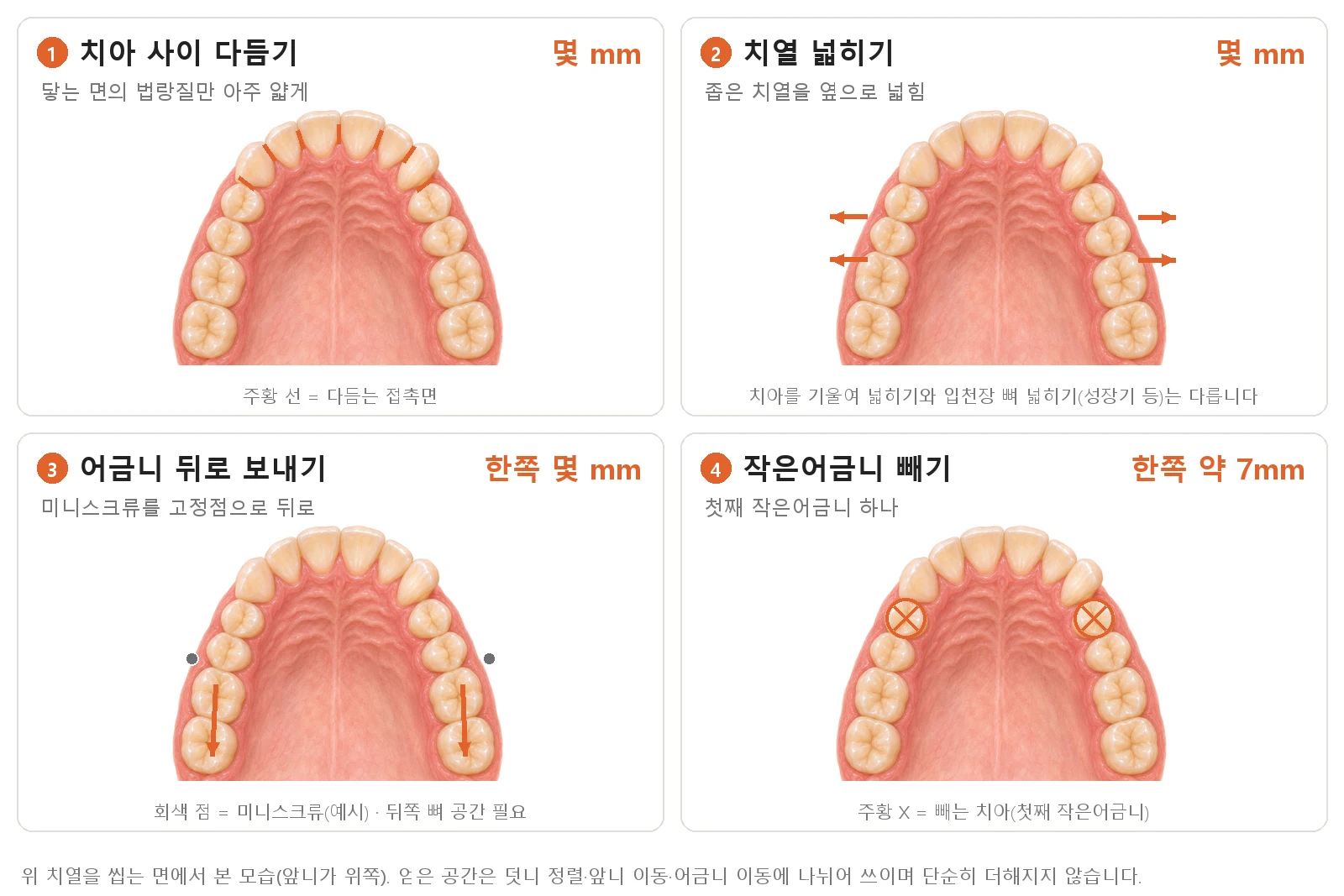
Comparing ways to gain space. Reshaping between teeth and widening the arch give a few millimeters, while removing one premolar creates about 7 mm of space on that side.
STEP 02
We decide where that space will come from
There are four ways to gain space: slightly reshaping between teeth (usually about 0.5 mm per contact), widening the arch a little to the sides, moving the molars back, and removing premolars. We look at both the shortage and the lip position, and use one method or combine several.
Why we do thisIf the arch is pushed forward to avoid extractions without enough space, the crowded canine may fit but the front teeth come forward and the mouth can look like it sticks out. On the other hand, if someone whose mouth is already flat has teeth removed, the area around the mouth can look sunken, so we look at space and lip position together.
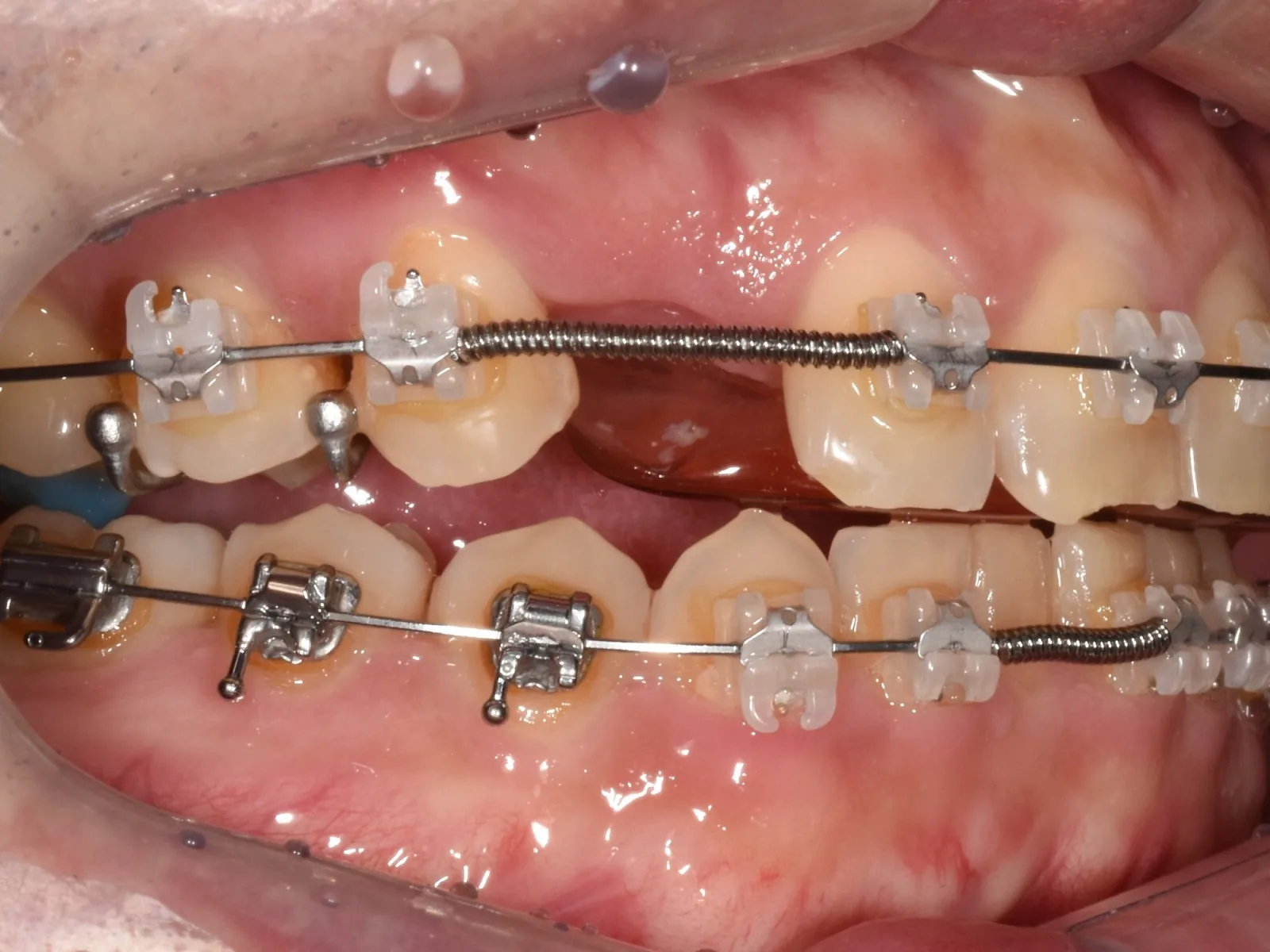
Making space · Nov 2021
The step that first opens room for the crowded canine. A coil spring between neighboring teeth widens the space, and we do not pull the crowded canine hard until there is enough room.
STEP 03
Before pulling the crowded canine, we first open the space it will go into
For the first few months after the braces go on, a thin wire evens out the overlapping front teeth and opens room for the crowded canine. When the space is almost ready, the wire is attached to the crowded canine to bring it down.
Why we do thisIf the crowded canine is pulled first without space, the neighboring teeth get pushed, and the front teeth come forward or tilt in unwanted directions. I measured how the force and turning force on the teeth change depending on how the wire is tied to rotated and tilted upper front teeth, so we do not apply strong force from the start and bring the teeth in step by step.
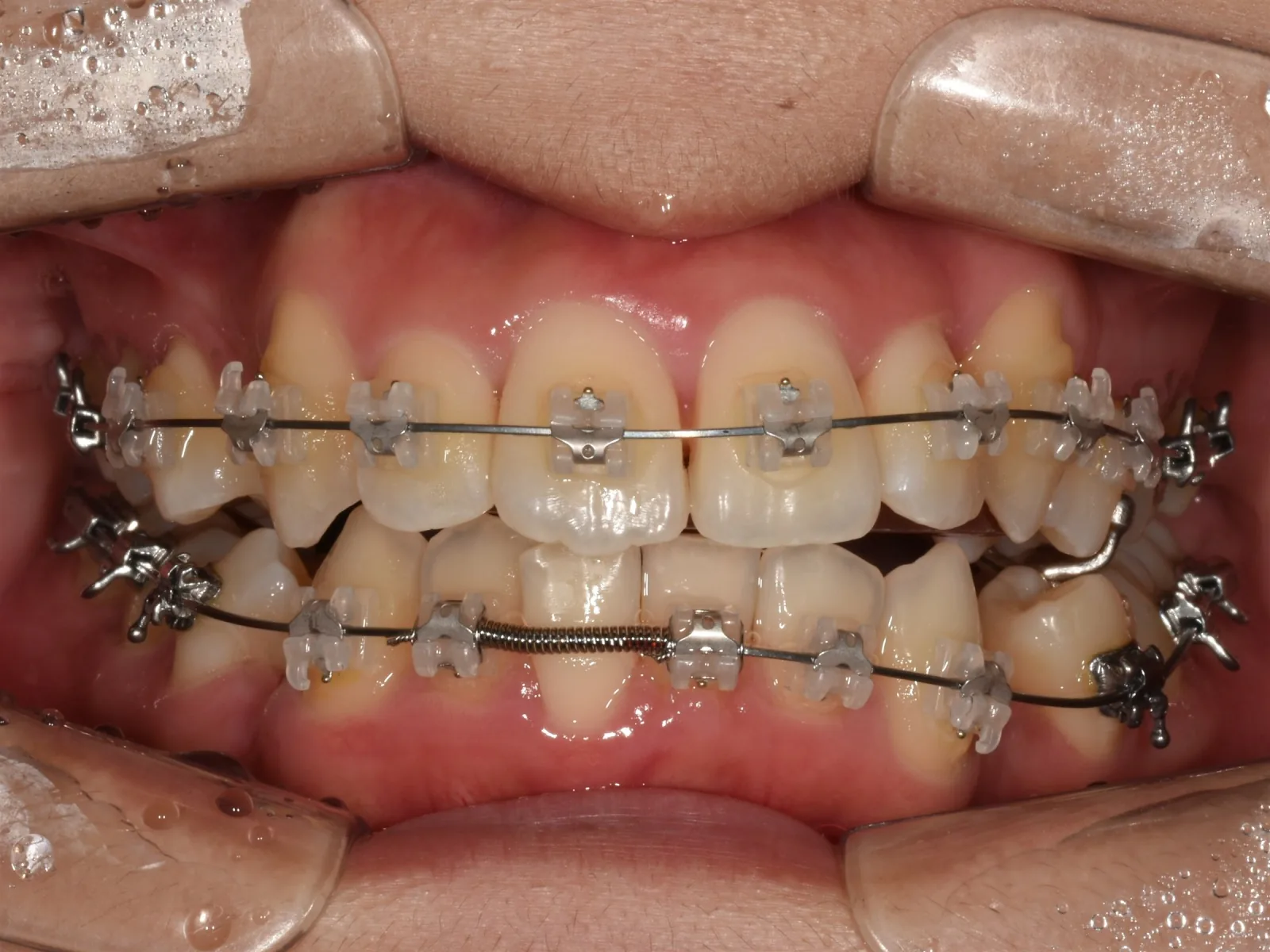
Start · Oct 2024
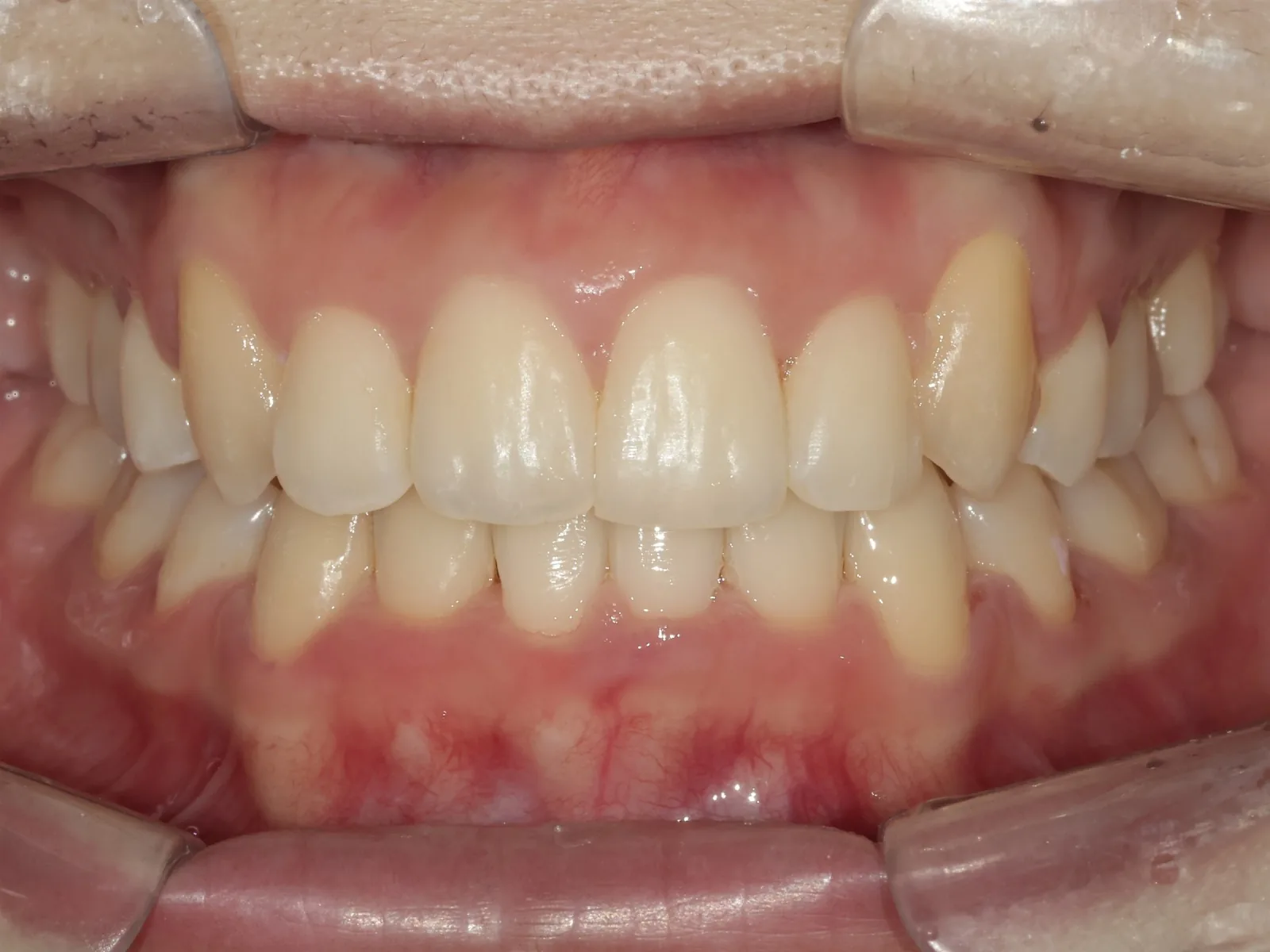
Done · Jun 2026
The same patient's crowded canine when the wire was first attached (left) and after it lined up (right). A crowded canine comes down little by little over several months to line up.
STEP 04
We bring the crowded canine into line and correct rotated teeth
Once the snaggletooth has come down, we correct its rotation and adjust the root angle. If teeth were removed, we close the remaining space while moving the front teeth back as planned. During treatment, you usually visit once a month.
Why we do thisRotated teeth have the strongest tendency to rotate back, because the gum fibers pull them toward their original direction. So even after they line up, we carefully adjust their angles, and we pay special attention to retainers after treatment.
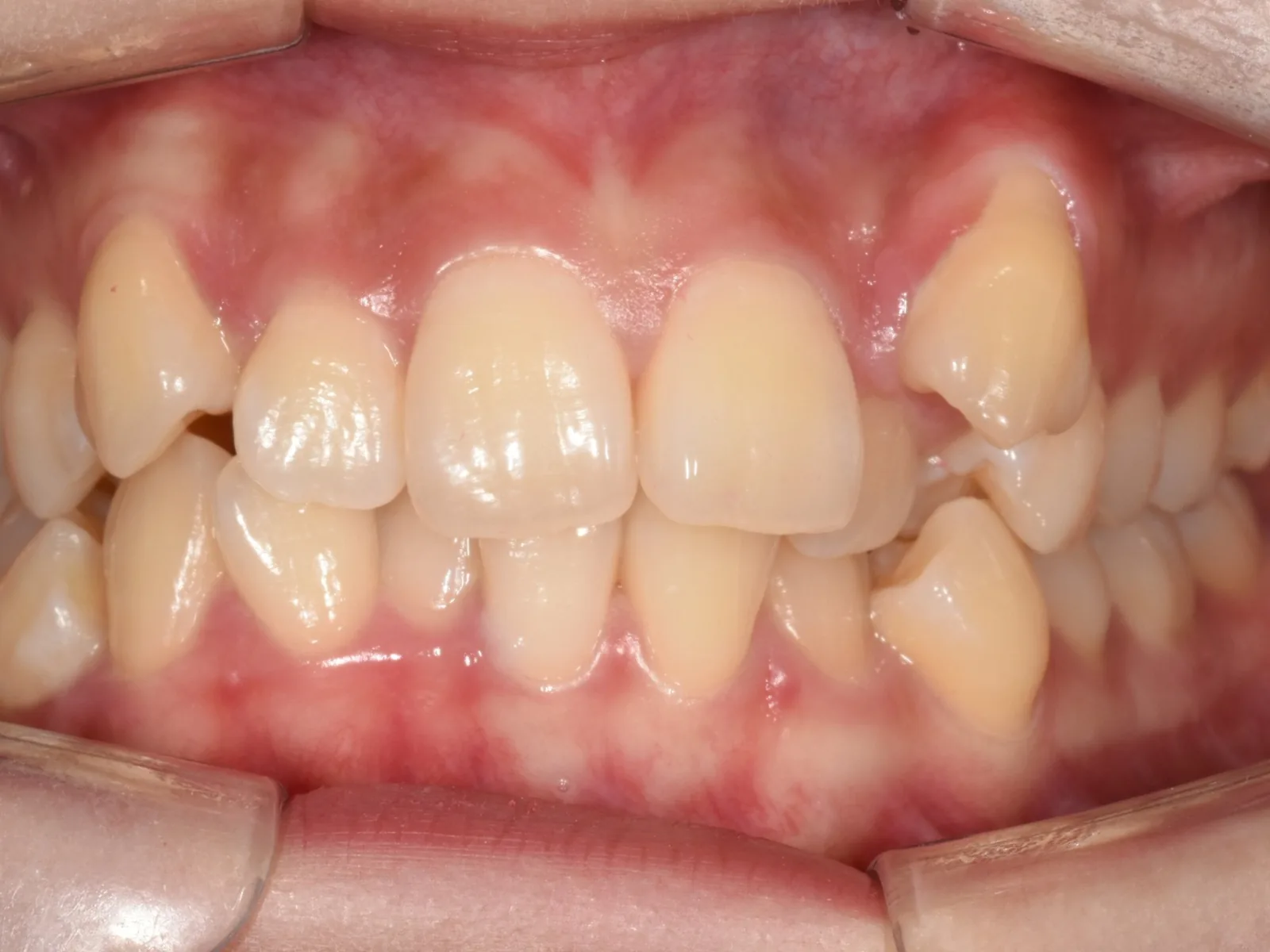
Before · Apr 2022
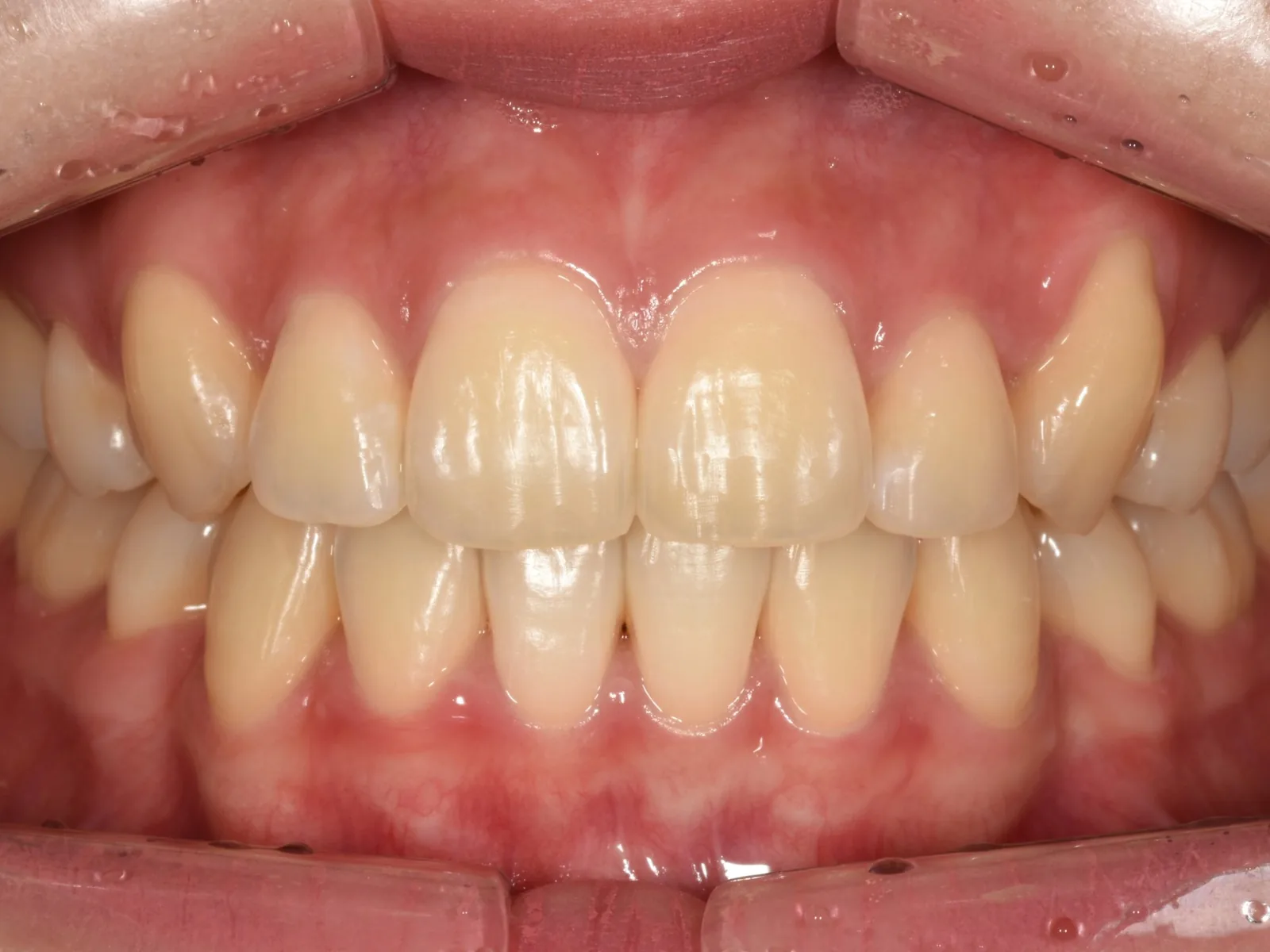
After · Sep 2024
Before and after finishing the bite (left: before, right: after). After finishing so the teeth meet evenly through the canines, a thin wire retainer is bonded behind the front teeth, and a clear retainer is also worn at night.
STEP 05
We finish the bite and protect it with retainers
After the upper and lower bite is set, the braces come off and a fixed retainer is bonded behind the front teeth. We also give you a clear retainer to wear at night. For 2 years after treatment, retainer check-ups and adjustments are covered by the orthodontic fee.
Why we do thisThe crowded canine area and the previously rotated front teeth try to move the most in the first year after treatment. During this period, we schedule check-ups closer together and check that the fixed retainer has not come loose anywhere.
* Clinical photos are published with the patient's consent. Some people may have side effects such as temporary pain or discomfort.
For a few days after the braces first go on or the wire is changed, your teeth may feel sore and chewing may be uncomfortable.
04°
How do we decide on extractions for a crowded canine?
Neither avoiding extractions nor removing teeth is the goal. We look at the five points below together and explain the expected lip position with and without extractions.
Size of the space shortage · If it is a few millimeters, we gain space by reshaping between teeth and widening; if a lot is missing, by extractions.
Front-teeth tilt and lip position · If the front teeth already stick out, the more the arch is widened without extractions, the more the mouth can stick out.
Canine position · If the canine sits high or is stuck in the bone, more space and time are needed to bring it down.
Age · Growing teenagers have a little more room for widening the arch.
Gum bone thickness · If the bone at the crowded canine and front teeth is thin, there is a limit to widening the arch outward.
Because the canine has a long root and is used for a long time, we usually remove a premolar instead of the canine. There are exceptions if the canine itself is badly damaged or impacted in a poor position.
05°
Comparing treatment options
Non-extraction (reshaping between teeth, widening)
Extraction treatment
Front-teeth partial braces
Clear aligners
Who it suits
The shortage is a few millimeters and the mouth is on the flat side
A lot of space is missing, or the front teeth stick out and the lip position also needs to change
The back teeth bite correctly and there is only mild overlap at the front
Mild to moderate crowding, when visible braces are a concern
How space is made
Reshaping between teeth, widening the arch, moving molars back
Premolar extraction (about 7 mm per side)
Reshaping between teeth
Reshaping between teeth and widening; extractions in some cases
Change in lip position
Little or none, or it may come forward a little
The lips may move back as the front teeth move back
None
Depends on the plan
Limits
Not suitable if a lot of space is missing; a little enamel is reshaped
Takes longer, and the extraction spaces must be closed
Cannot fix a high snaggletooth or bite problems
Must be worn 20 hours or more a day, and fixed braces may be better for a high canine
For these people, another treatment comes first, or treatment is not needed
This suits you if you have
A snaggletooth where the canine sits separately high on the gum
Overlapping or rotated front teeth that are hard to brush
A crowded canine with a mouth that also sticks out (we consider extraction braces)
Another treatment comes first
A canine stuck in the bone: we check its position on 3D CT and first plan the procedure to expose it
Gum inflammation: we treat the gums first
Cavities: we treat the cavities first
Not needed for now
Children whose permanent canines have not fully come in: we decide the timing while watching growth and the direction the teeth are coming in (see our children's orthodontics page)
07°
Self-check
If any of these apply, have the missing space checked first at an examination. You are welcome to send us photos of the inside of your mouth first.
08°
Side effects and limits
Please read
· If the gum over the crowded canine is thin, it can recede a little as the canine comes down. We check gum thickness beforehand at the examination.
· Teeth that were rotated tend to rotate back, so you need to wear a retainer for a long time.
· Reshaping between teeth removes a little of the outer enamel. It stays within the thickness of the enamel, but you may feel temporary sensitivity.
· When overlapping front teeth are straightened, dark triangles (black triangles) may appear in the gums between the teeth.
· Tooth roots can become shorter (root resorption). We check with X-rays during treatment.
· Rarely, an impacted canine is fused to the bone and does not move; in that case we change the plan.
FAQ
FAQ
Does treatment for crowded teeth always require extractions?
Not all treatment for crowded teeth involves extractions. If the shortage is a few millimeters and your mouth is on the flat side, we can fit the tooth in without extractions by slightly reshaping between teeth or widening the arch. If a lot of space is missing or your mouth also sticks out, we consider extractions.
The canine has the longest root and protects the other teeth when you chew sideways, so we usually keep it. That is why, when treatment for crowded teeth needs extractions, we usually remove the premolar behind the canine instead.
How long does treatment for crowded teeth take?
Without extractions it usually takes 1.5–2 years, and with extractions about 2–2.5 years. If the canine is stuck in the bone and needs to be pulled down, it can take longer.
Can a crowded canine be treated with partial braces?
If the back teeth bite correctly and the overlap at the front is mild, front-teeth partial braces can sometimes fix it. If the canine sits high or a lot of space is missing, the teeth behind the canine must also move, so full braces are needed.
Can a crowded canine be treated with clear aligners?
Mild to moderate crowding is often treated with clear aligners. If the canine sits high and must come down a lot, or extraction spaces must be closed, fixed braces may be more precise, so we compare the pros and cons after the examination.
I was told my canine is buried in the bone. Can it be treated with braces?
For an impacted canine, we first check its position and its distance from the neighboring roots on a 3D CT. If it is in a position that can be pulled down, the canine is exposed, a small hook is attached, and it is brought down with braces over several months. We can refer you to a partner hospital for the procedure to expose the canine, but you are free to choose another hospital.
Will my gums recede after treatment for crowded teeth?
If the gum over the crowded canine is thin, it can recede a little as the canine is brought into place. We check gum thickness at the examination and, if it is thin, we plan not to push the canine far outward.
When should treatment for crowded teeth begin?
Adults can start at any time. For children, we decide while watching the time the permanent canines come in (usually around ages 11–13). If a baby tooth stays too long and blocks the canine's path, removing that baby tooth earlier is sometimes enough to help.
Evidence and references
Kim S, et al. Influence of different ligation methods on force and moment generation in a simulated condition of the maxillary crowded anterior dentition with linguo-version and rotation. Bio-Medical Materials and Engineering, 2022. doi:10.3233/BME-211288 (Measured orthodontic force and turning force by ligation method on crowded and rotated upper front teeth)
Ceramic Dental Clinic's 12-step orthodontic examination and diagnosis: Orthodontics main page
Questions from patients who travel to Seoul for treatment.
How much does orthodontic treatment cost?
The fee depends on the appliance. For example, metal braces are KRW 4,800,000, ceramic braces KRW 6,000,000, Invisalign KRW 8,500,000 and lingual braces KRW 8,600,000. The orthodontic fee includes the orthodontic diagnosis, extraction (except wisdom teeth), mini-screws, basic retainers and retention care for 2 years. If you have only the diagnosis and do not start treatment, it is KRW 50,000 (KRW 100,000 if a CT scan is needed). If a retainer breaks or is lost later, remaking it costs extra. International and Korean patients pay the same fees. We explain the total before treatment starts. See our fee schedule.
Can I continue treatment after I go home?
Yes, but it needs a plan. Fixed braces need regular adjustment visits: the first two visits are 2 weeks apart, then usually once a month. Clear aligners are easier from abroad: after you receive your aligners, you visit once every 2–3 months, and between visits we check by photo only if something comes up. Your doctor tells you at diagnosis which method fits your case.
Can I have my consultation in English?
Yes. The doctor in charge of each field consults with you directly in English. For orthodontics, this is Dr. Sunmin Kim, a board-certified orthodontist. Before you travel, you can send photos of your teeth on WhatsApp or by email. An accurate diagnosis is made after we examine you in person.
What happens after treatment, and what if something comes off?
You need retainers after treatment, because teeth tend to move back. Retention care for 2 years is included in the orthodontic fee. If a bracket comes off or a wire hurts after you go home, send us a photo on WhatsApp. We check it and tell you what to do. Some repairs need a visit.
Results, the number of visits and schedules vary from person to person. More questions: Visiting from abroad.


 Before · Mar 2023
 After · Oct 2024
 Before · Jul 2021
 After · Apr 2024
 Before · Jun 2021
 After · Oct 2024
 Space-shortage calculation
 Baby teeth and canine position
 Planning
 Making space · Nov 2021
 Start · Oct 2024
 Done · Jun 2026
 Before · Apr 2022
 After · Sep 2024