Last reviewed Oct 29, 2026 · Dr. Ilseop Ahn (board-certified periodontist, specialist in integrated dentistry)
At a glance
Good for
NHI members or dependents aged 65 or older who still have some teeth (from January 2027, people with no teeth left are also included)
Treatment flow
Check eligibility → choose the spots → 3D CT diagnosis and placement → crown in the set materials
Duration and limits
2 in a lifetime, 30% out of pocket. Additional surgery such as bone grafting is not covered
Details
For people enrolled in Korea's National Health Insurance (NHI) as members or dependents who are 65 or older and still have at least some teeth (partially edentulous), up to 2 implants in a lifetime are covered, with a 30% out-of-pocket share (lower for the near-poverty group and Medical Aid recipients). From January 2027, people with no teeth left will also be eligible. Additional surgery such as bone grafting is not covered, and the crown materials are fixed. Because the limit is 2 in a lifetime, where you use them matters. At Ceramic Dental Clinic, we first save the teeth that can be saved and choose together the spots that matter most for chewing. Insured implants are done by the same board-certified periodontist, with the same 3D CT diagnosis and the same checkup schedule.
01°
How we decided where to use the 2 insured implants
Insured implants are limited to 2 in a lifetime. Depending on the remaining teeth and bone, where the 2 were used differed from person to person.
CASE01
Chewing with the front teeth because the lower back teeth on both sides hurt
2 insured implants, one in the lower back teeth on each side · so you can chew on both sides
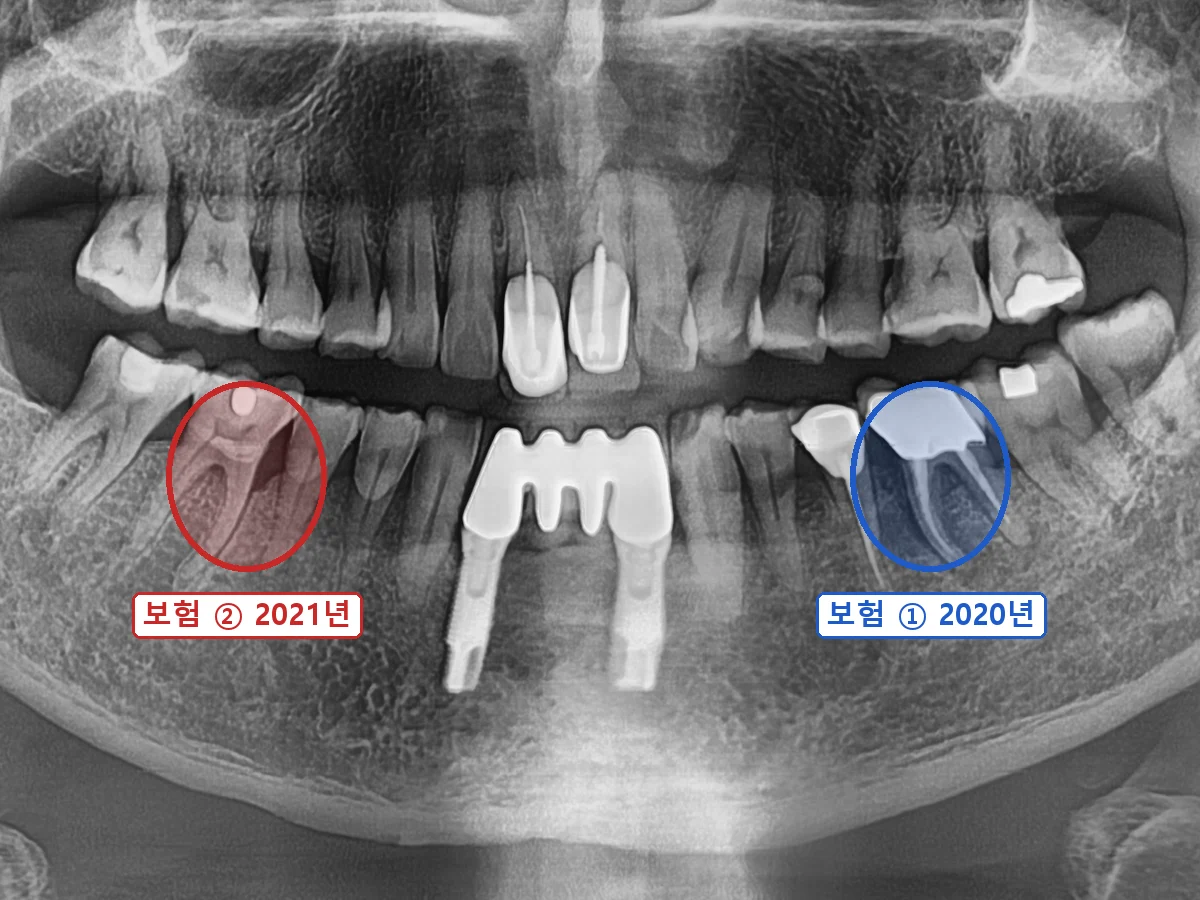
Before · January 2019
Panoramic X-ray before treatment. The lower first molars on both sides, marked with circles, later developed root cracks or inflammation and were extracted. One insured implant was used in each of these two spots.
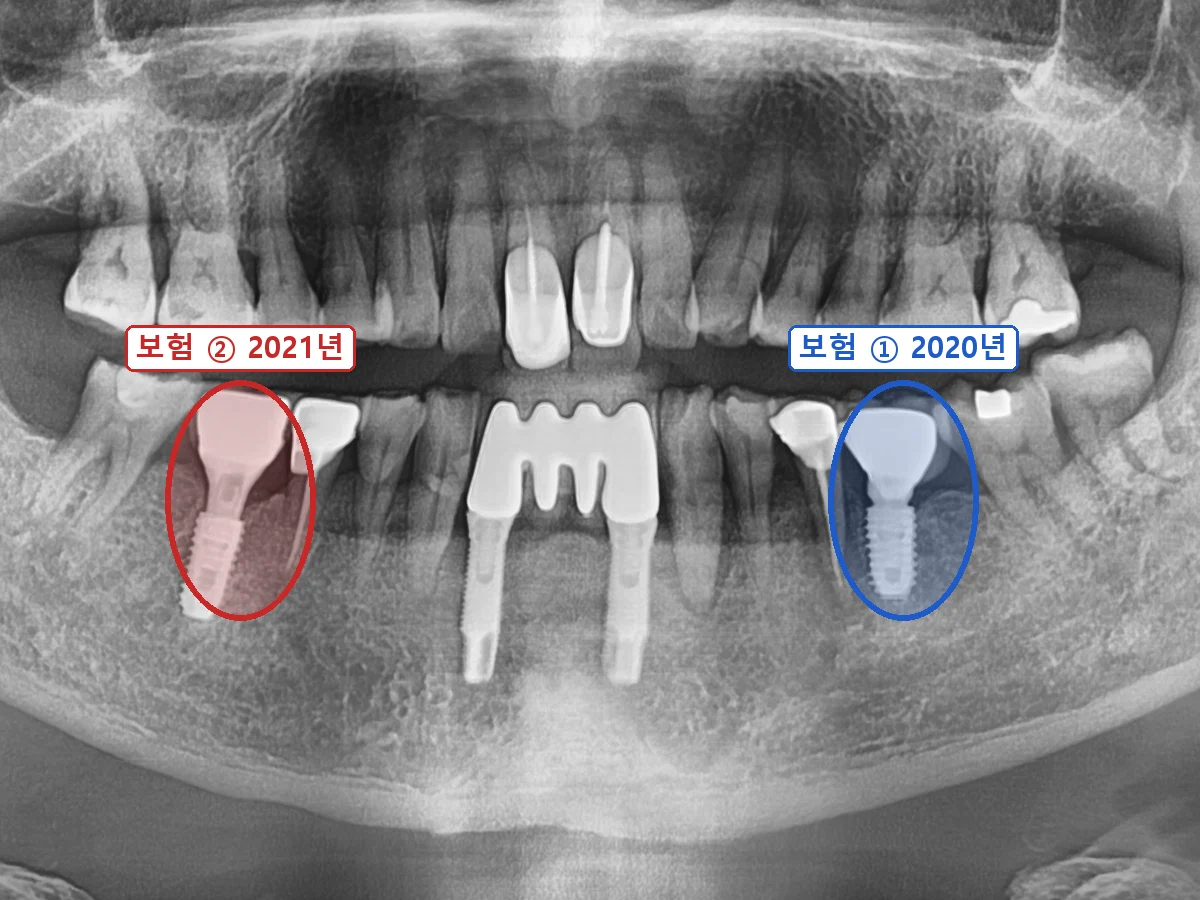
After · March 2025
Panoramic X-ray after the crowns. One implant each was placed in the lower back teeth on the left (2020) and right (2021), with non-precious metal PFM crowns, so the patient can chew evenly on both sides.
Condition
65 or older, could not chew properly because the lower back teeth on both sides hurt
Chosen
2 insured implants, one on each side
Not done
Bone grafting (both spots had enough bone)
Duration
About 3 months per implant
CASE02
Loose teeth, and unsure where to use the insurance
The loose teeth were saved with gum treatment, and insured implants were used only where teeth were already missing
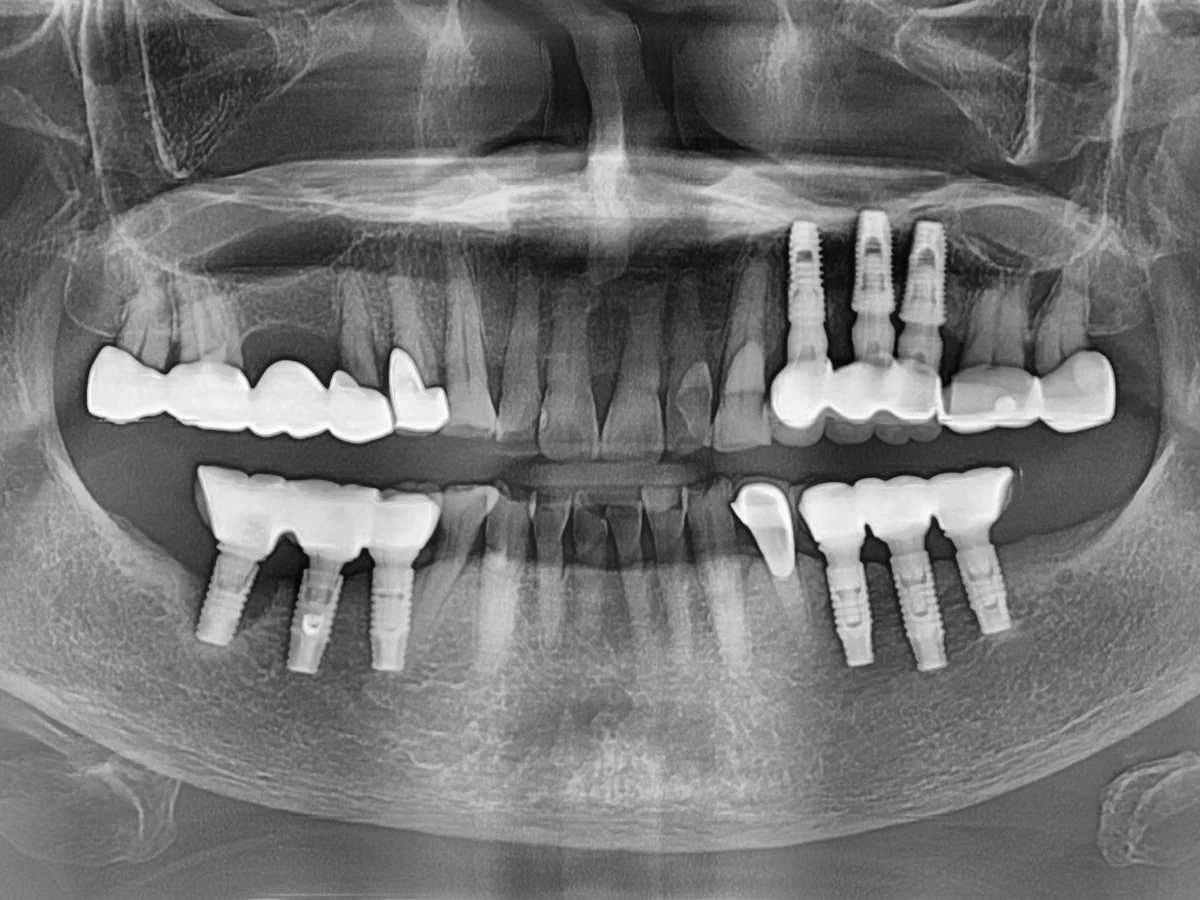
Before · July 2019
Panoramic X-ray before treatment. Before using the insured implants, full-mouth gum treatment (scaling and root planing) was done first in early 2021.
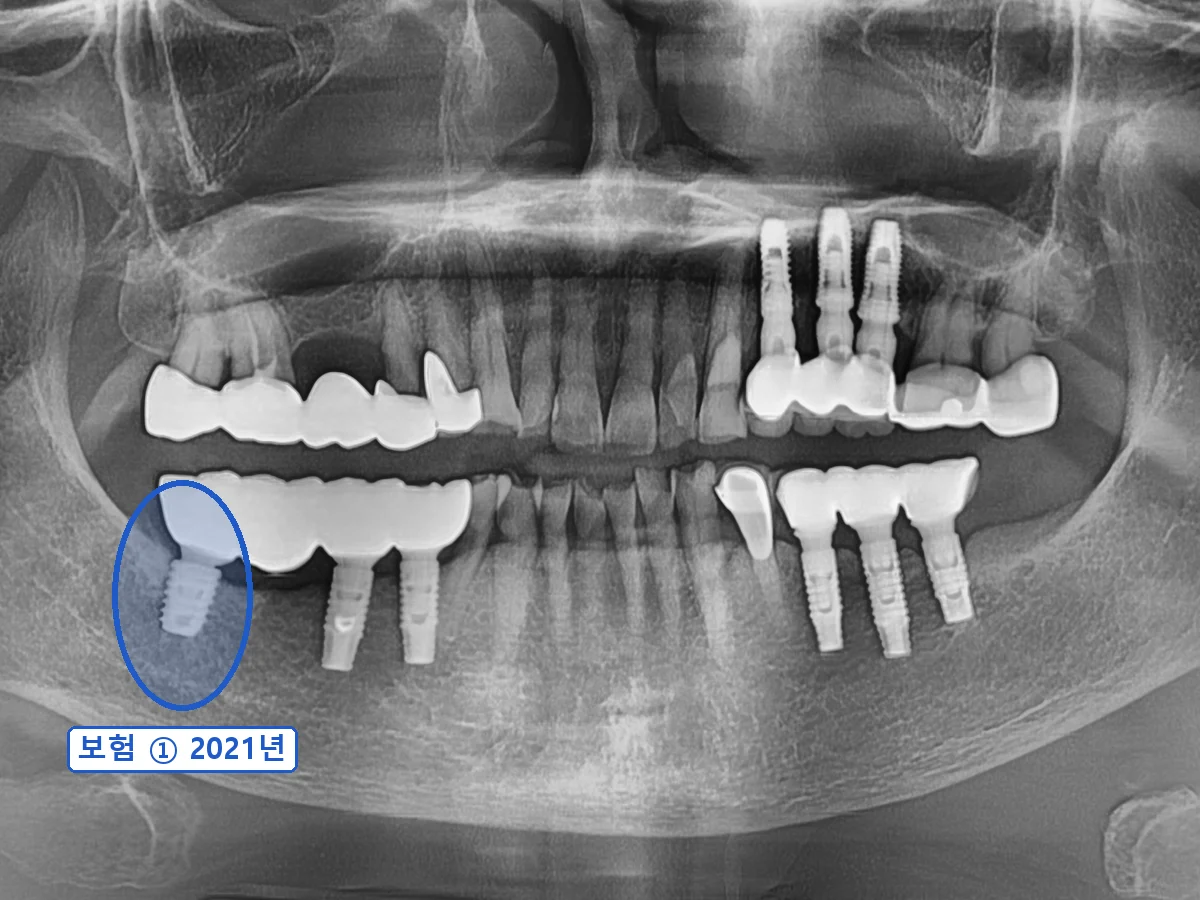
First insured implant · May 2023
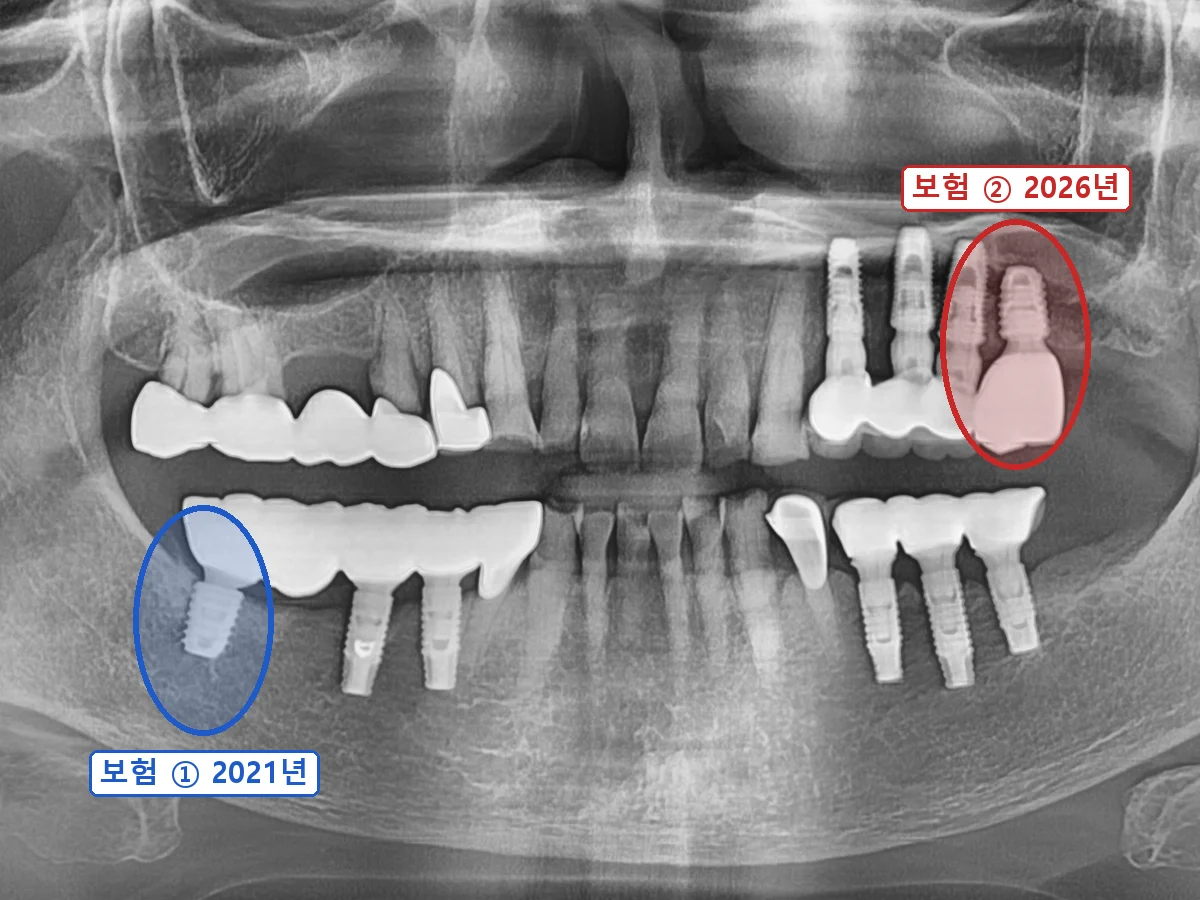
First insured implant. After gum treatment, it was placed in November 2021 in the last spot on the lower right (#47) and crowned. An old implant had been removed from this spot, so bone grafting was done as well.
Second insured implant · September 2026
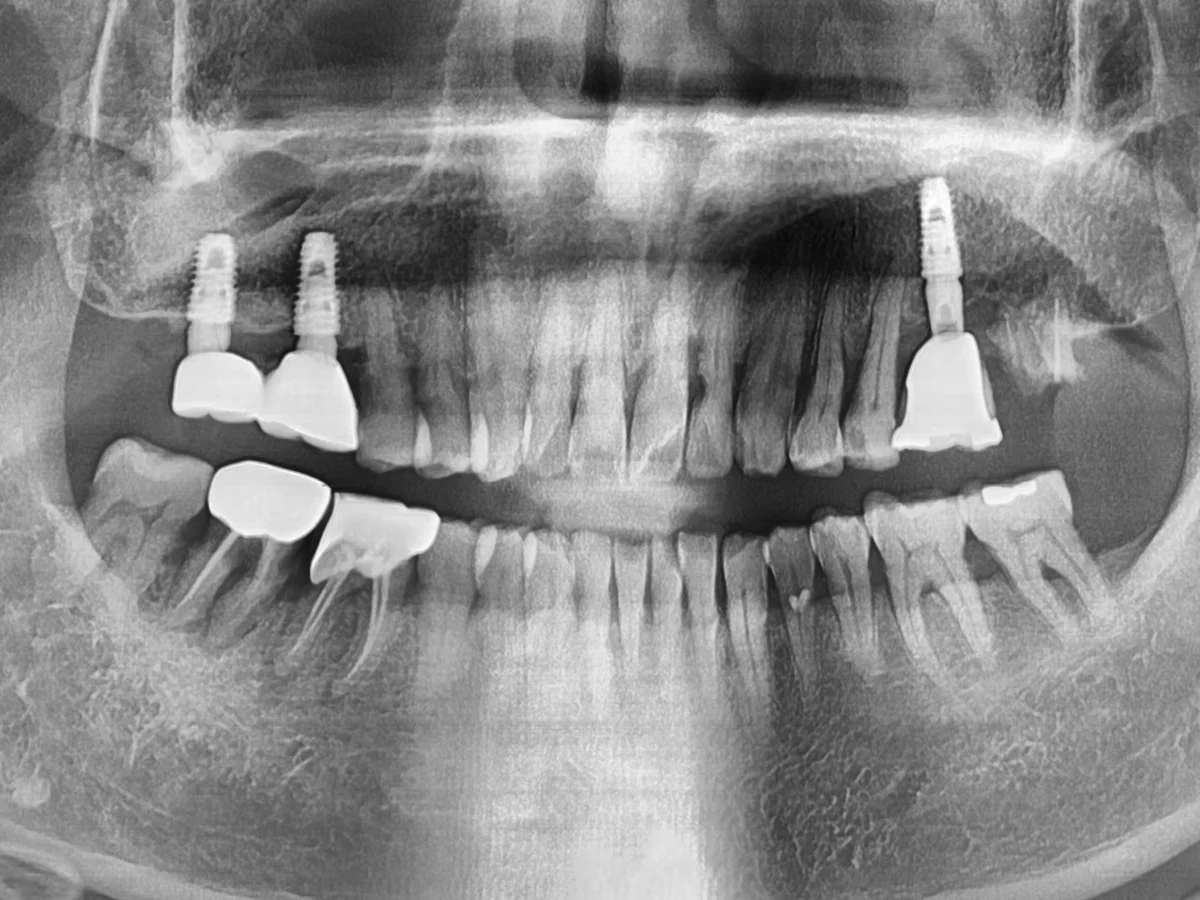
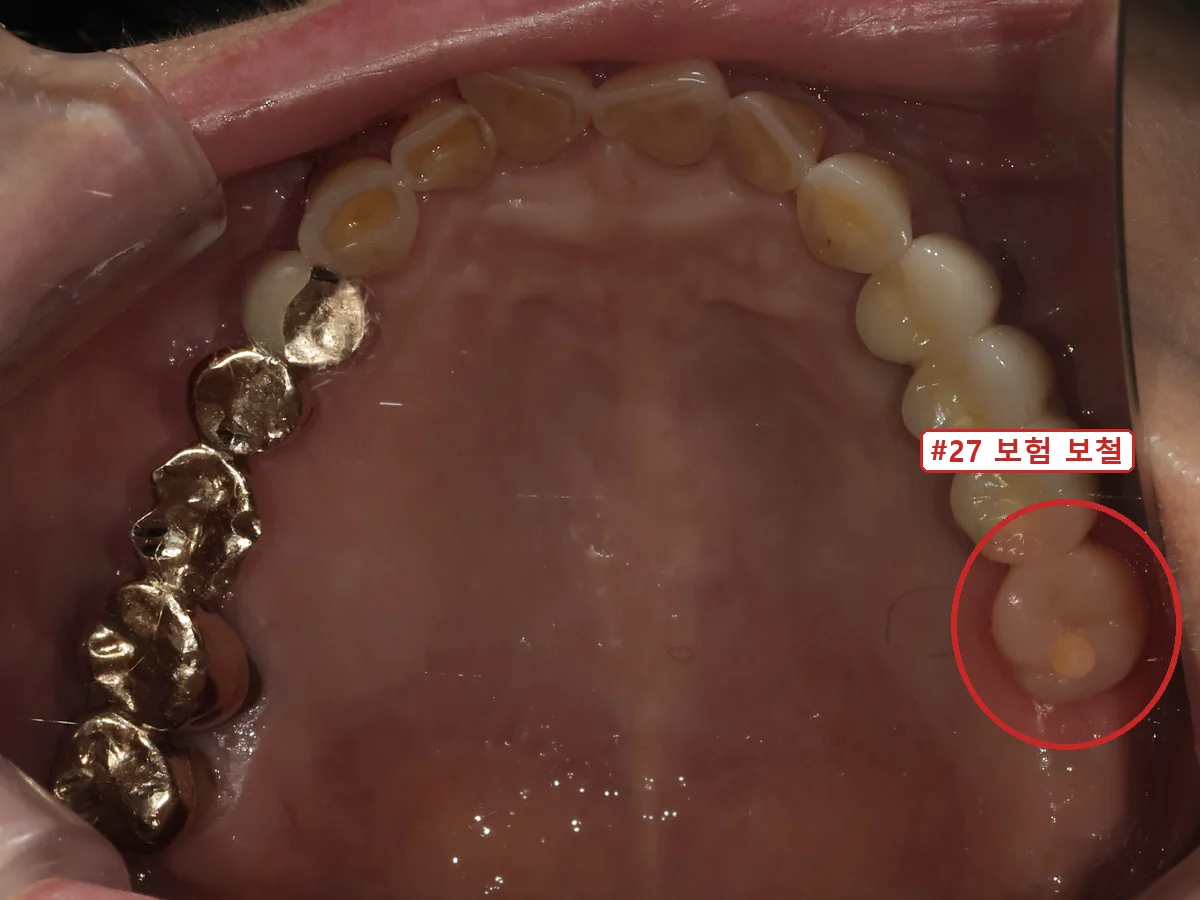
After the crown on the second insured implant. It was placed in April 2026 in the last spot on the upper left (#27), and a non-precious metal PFM crown was placed in September. The patient is still using the remaining natural teeth.
Condition
Missing teeth along with teeth loosened by gum disease
Chosen
Re-evaluation after gum treatment, 2 insured implants where teeth were missing (2021 and 2026)
Not done
Extraction of the loose teeth (the re-evaluation showed they could be saved)
Duration
About 3 months per implant
* Photos were taken under the same conditions and published with the patients' consent. Treatment results and side effects may vary from person to person.
02°
Who can get implants under Korean health insurance?
You are eligible for insured implants if all four points below apply.
Age · Age 65 or older
Coverage · NHI member or dependent (including Medical Aid recipients)
Remaining tooth · At least some teeth remain in the upper or lower jaw (partially edentulous). A jaw with no teeth left becomes eligible from January 1, 2027.
Number · Up to 2 in a lifetime. Insured implants done at other dental clinics count toward this total.
We can look up whether you already had insured implants at another clinic. You can also check with the National Health Insurance Service (1577-1000).
03°
How much do I pay?
30%Out-of-pocket share for NHI members and dependents
10~20%Near-poverty group with reduced out-of-pocket share
10~20%Medical Aid Type 1: 10%, Type 2: 20%
10% for near-poverty patients with rare or intractable diseases, 20% for near-poverty patients with chronic conditions and others (as of November 2026). Actual amounts are on the treatment cost guide page.
04°
Some things are not covered
Additional surgery such as bone grafting · Even with an insured implant, you pay separately for bone grafting and sinus lifts.
Materials outside the set options · Insured crowns are limited to non-precious metal PFM crowns or zirconia crowns. If you choose a one-piece implant or another crown material, the whole treatment is not covered.
From the third implant · Implants beyond the lifetime limit of 2 are done as regular implants.
05°
How an insured implant is done
Insurance does not mean fewer exams or checkups. Here are the steps from diagnosis to checkups, with real clinical photos.
Panoramic X-ray
CT
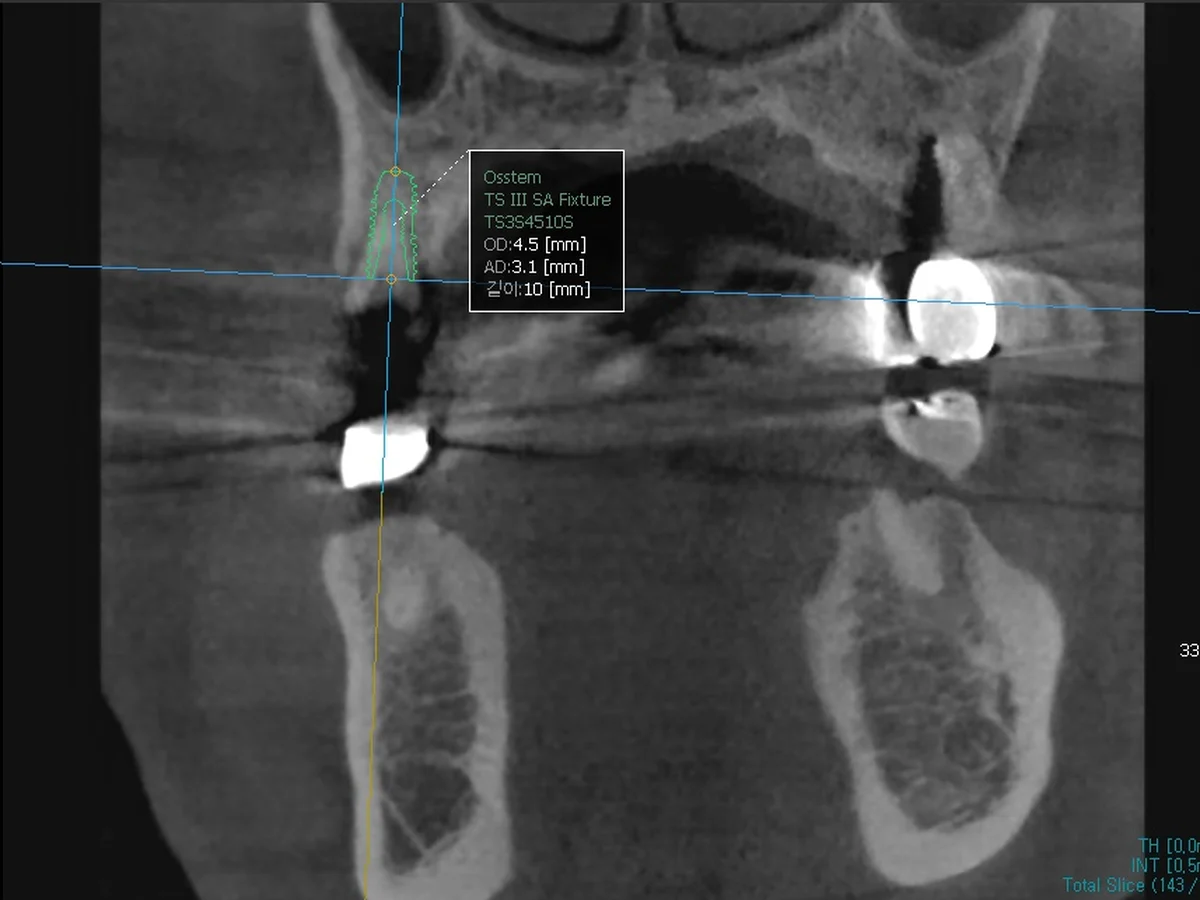
Diagnosis. A panoramic X-ray shows all the remaining teeth, and a 3D CT measures the bone height and width at the implant spot in millimeters.
STEP 01
We look at all the remaining teeth and the bone where the implant will go
A gum exam measures the gum depth and looseness of each remaining tooth, and a panoramic X-ray and Vatech 3D CT show the bone. We also tell you at this point whether the spot needs bone grafting.
Why we do thisInsured implants are limited to 2 in a lifetime, and once used, they cannot be taken back. You need to know first whether a spot needs bone grafting and whether any teeth can be saved to choose the right spots for the 2.
Choosing the spot
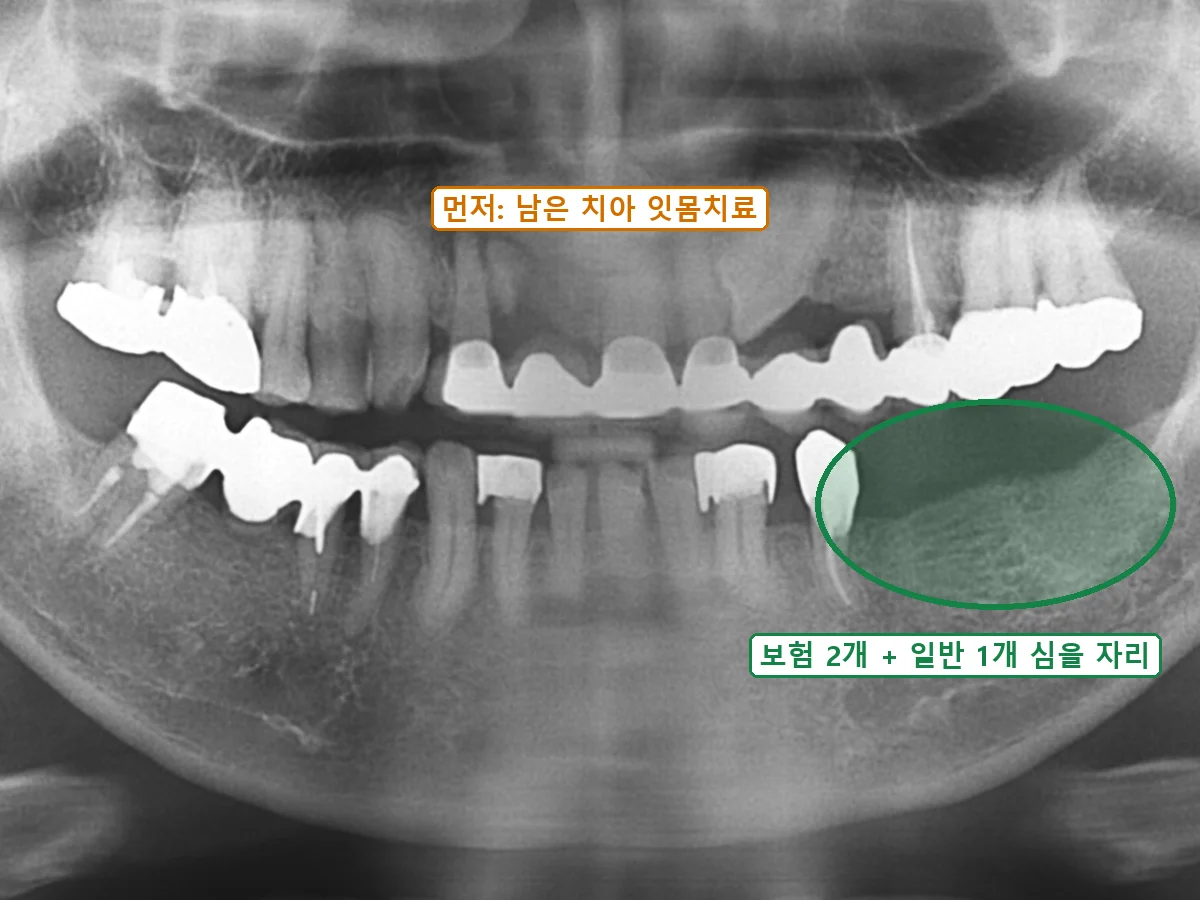
Choosing the spot. We mark on the panoramic X-ray the spots that matter for chewing and the sites with good bone that may support long-term use, and choose together. This patient had gum treatment first and used the insurance in two of the three empty spots on the lower left.
STEP 02
We choose together where to use the 2
We decide together, weighing the spots most important for chewing, the sites with good bone that may support long-term use, and the chance of losing other teeth later. If a tooth can be saved, we first recommend saving your insurance count.
Why we do thisIf you use them first on the spot that bothers you now, you cannot use insurance later when you lose a more important tooth. Looking at both now and the future helps the 2 implants serve you longest.
NHIS registration
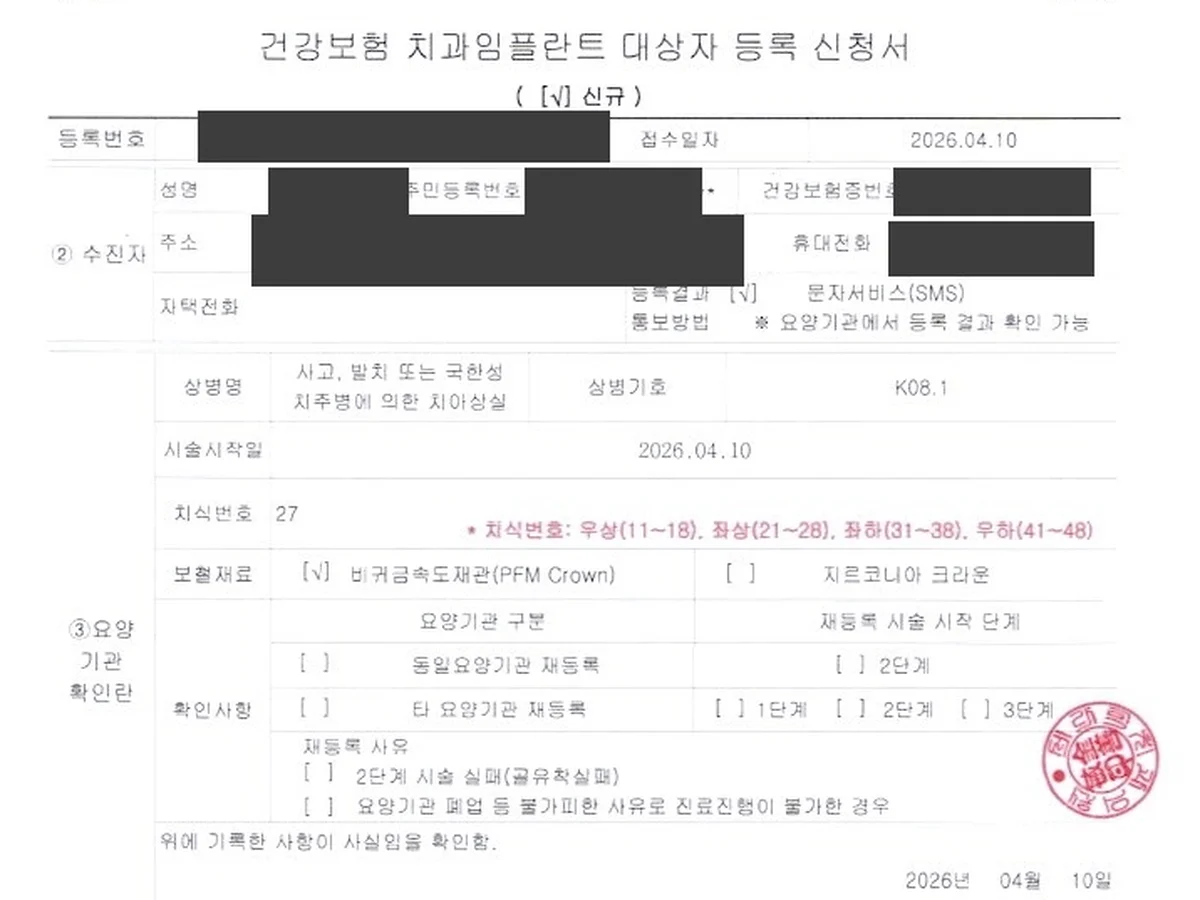
NHIS registration. This is the registration form listing the implant spot (tooth number) and the insured crown material (personal details hidden). We register with the National Health Insurance Service before starting treatment and proceed after receiving the result.
STEP 03
We register you with the National Health Insurance Service
Once the spot is chosen, the clinic applies to the NHIS on your behalf, and we start treatment after confirming the registration.
Why we do thisIf treatment starts before registration, insurance may not apply. Following this order lets you proceed with a 30% out-of-pocket share.
Right after placement · April 2026
Insured crown · September 2026
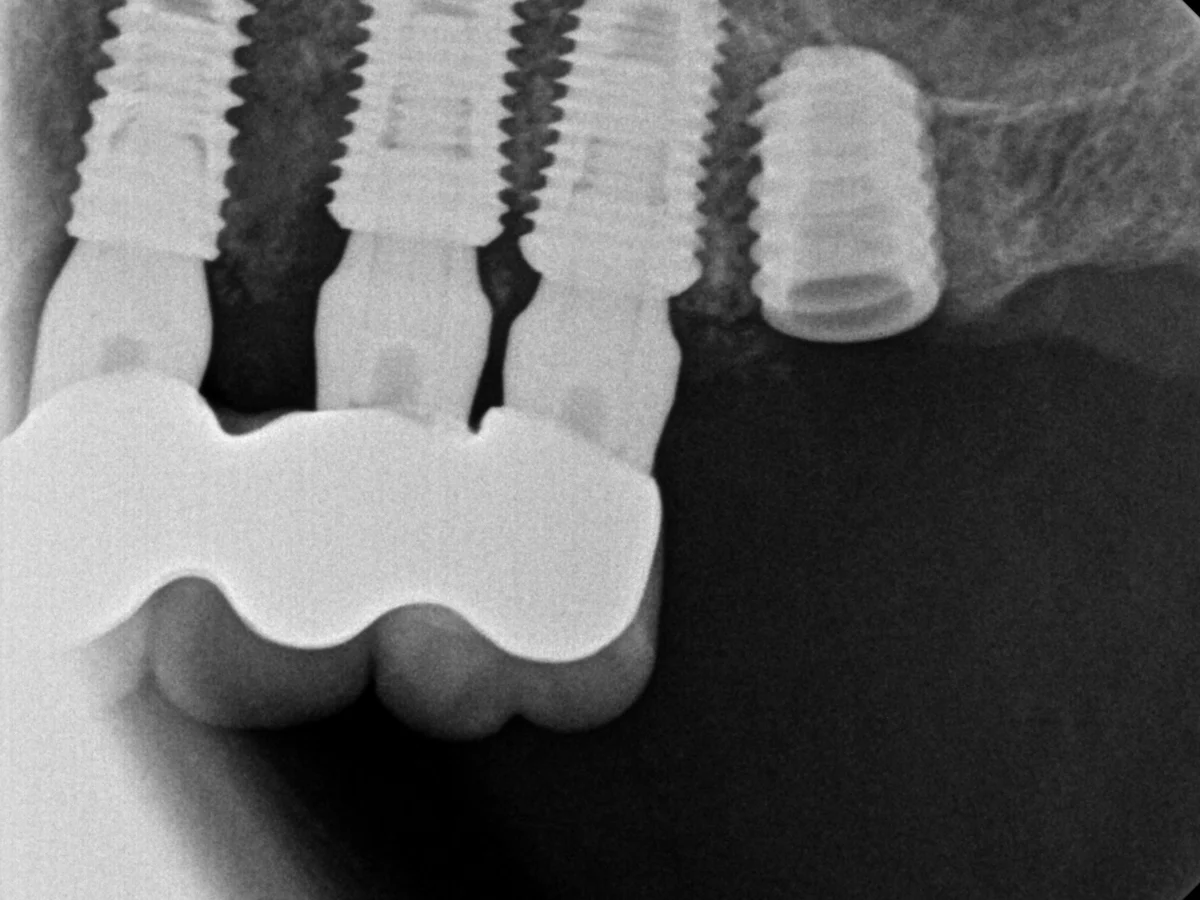
Placement and crown. The implant is placed the same way as a regular implant, and after the bone bonds to it, the insured crown (non-precious metal PFM for this patient) is placed. These show the same implant on the upper left at the very back (#27) right after placement and after the crown.
STEP 04
After placement, once the bone bonds, we place the insured crown
Under local anesthesia, the implant is placed in the planned spot. Bone bonding usually takes about 2–3 months in the lower jaw and 3–4 months in the upper jaw. Then a non-precious metal PFM crown or a zirconia crown is placed.
Why we do thisInsurance does not mean a shorter waiting time. Checking that the bone has bonded before placing the crown helps the implant last.
Checkup · February 2026
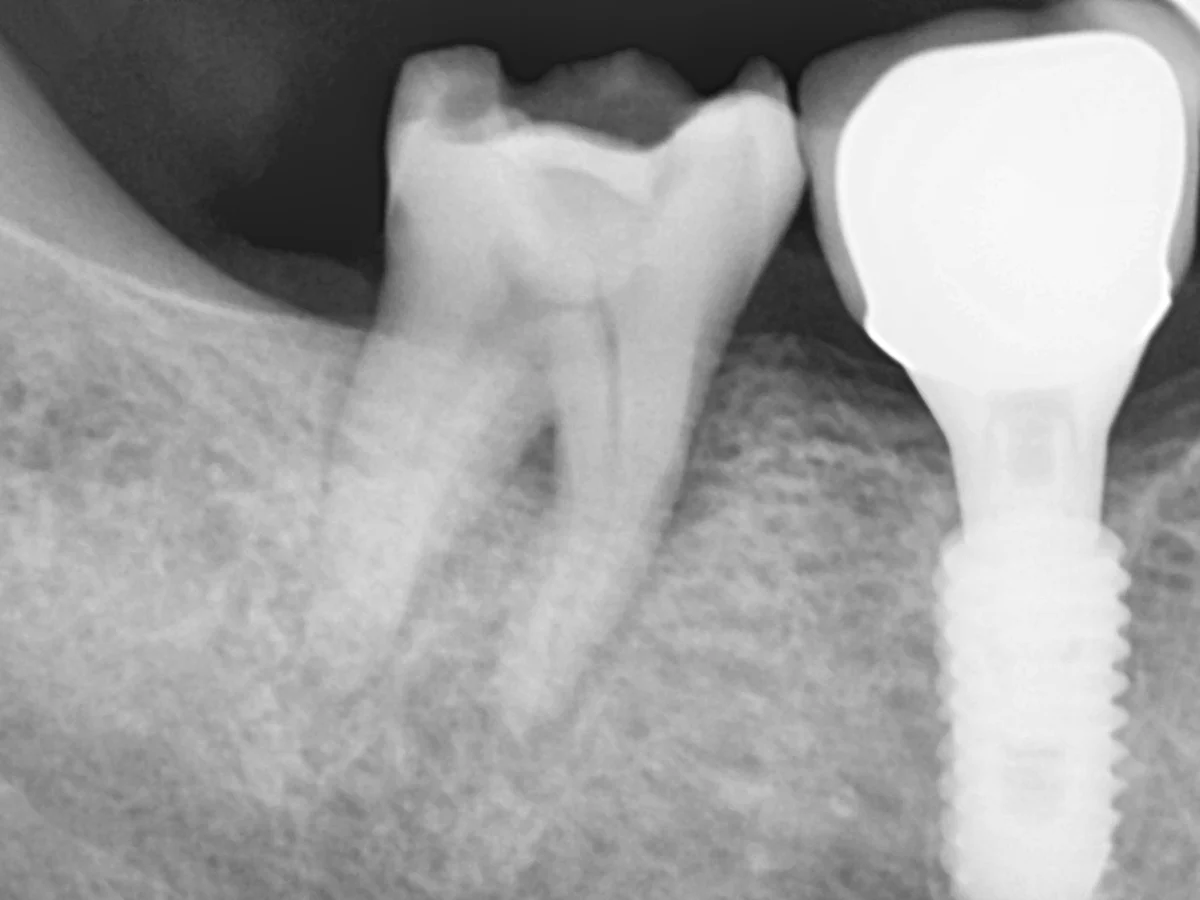
Regular checkups. We check the gum depth and bleeding around the implant and, if needed, compare bone height on X-rays. This is a checkup X-ray of an insured implant 4 years after its crown was placed in January 2022.
STEP 05
We check insured implants on the same schedule as regular implants
Checkups are at 1, 3 and 6 months after the crown, then every 6 months. If you have had gum disease, smoke, have diabetes or have several implants, we see you every 3 months.
Why we do thisIf you lose the 2 insured implants, you cannot get them under insurance again. Keeping them working for a long time matters most.
* Clinical photos were published with the patients' consent. Side effects such as temporary pain or discomfort may occur depending on the person.
06°
How are insured implants different from regular implants?
Insured implant
Regular implant
For
65 or older with at least some teeth (from January 2027, also people with no teeth), up to 2 in a lifetime
Not eligible for insurance, or the insured count is used up
Diagnosis, surgery and checkups
Same doctor, same 3D CT diagnosis, same checkup schedule
Same doctor, same 3D CT diagnosis, same checkup schedule
Crown material
Non-precious metal PFM crown or zirconia crown
Chosen for the spot, such as zirconia
Implant brand
Osstem Implant
Osstem Implant
Bone grafting
Not covered (separate cost)
Separate cost
Out-of-pocket share
30% (lower for the near-poverty group and Medical Aid)
You are 65 or older and still have at least some teeth
You have not yet used both insured implants
You wear a partial denture (it can be combined with a partial denture)
Other treatment comes first
Gum inflammation: gum treatment comes first.
You take bone medication (osteoporosis medication) or blood thinners: tell us the names, and we will check them and set the timing.
You may not need it now
Teeth that can be saved: we first explain how to keep them, if only to save your insurance count.
08°
Self-check
If the first three apply, you are likely eligible for insured implants. We can look up how many insured implants you have left.
09°
Side effects and limits
Please read
· You may have swelling and stiffness for 2–3 days after surgery.
· Inflammation can develop in the gums and bone around the implant (peri-implantitis), so regular checkups are needed.
· The crown may break or the screw may loosen.
· Smoking and uncontrolled diabetes make it harder for the bone to bond.
· Insured crowns are chosen from non-precious metal PFM crowns and zirconia crowns. A non-precious metal PFM crown has metal inside, so if the gums recede, the edge may show as a dark line. In spots that show when you smile, such as front teeth, the crown color and gum line edge may bother you, so we discuss this in advance.
· Losing an insured implant does not restore the insured count.
FAQ
FAQ
For insured implants, when does the age-65 rule apply?
You must be 65 or older for an insured implant, and the age is checked when you are registered with the National Health Insurance Service (NHIS). If your birthday is close, we check the dates with you at the consultation.
Insured implants count toward one lifetime total of 2, even at different clinics. If you have used both, we proceed with a regular implant. We can look up how many you have left.
Is bone grafting for implants covered by health insurance?
Even with an insured implant, additional surgery such as bone grafting or a sinus lift is not covered. We check with a CT first and tell you whether bone grafting is needed.
If I have no teeth left, can I not get insured implants?
At present, a jaw with no teeth left is not eligible for insured implants. From January 1, 2027, people 65 or older can get up to 2 insured implants even in a jaw with no teeth left. A partial denture over implants is covered, but a denture held in place by implants (overdenture) is not covered, for either the implants or the denture. If you already have an insured complete denture, you become eligible after 7 years have passed. Until then, people 65 or older can get an insured denture (once every 7 years), and we also explain full-mouth implants.
Are insured implants lower in quality?
At Ceramic Dental Clinic, insured implants are done by the same doctor, with the same CT diagnosis and the same checkup schedule. The difference is that the crown material is fixed: a non-precious metal PFM crown or a zirconia crown. We also use Osstem Implant for insured implants.
Can I get a partial denture and insured implants together?
Under NHIS rules, an insured partial denture and insured implants can both apply for people 65 or older. We look at your remaining teeth and decide together which to use where.
Do checkups for insured implants cost extra?
For checkups and adjustments within 3 months after the crown is placed, you pay only the consultation fee. After 3 months, crown-related maintenance is not covered by health insurance. If the gums around the implant need treatment, it is provided under the relevant health insurance item.
Evidence and references
Health Insurance Review & Assessment Service (HIRA), "Recognition criteria for dental implants" (Ministry of Health and Welfare Notice No. 2025-23, effective February 1, 2025: age 65 or older, 2 in a lifetime, 30% out of pocket, crown is a non-precious metal PFM crown or zirconia crown) · Resolution of the Health Insurance Policy Deliberation Committee on September 8, 2026 (people with no teeth left included from January 1, 2027). Reference date: November 5, 2026
FDI World Dental Federation consensus (2019): recommends implant checkups at intervals of 6 months or less
Academy of Osseointegration and American Academy of Periodontology consensus (AO/AAP, published 2025): risk factors for peri-implant disease and maintenance. doi:10.1002/JPER.25-0270
Maintenance item in the same criteria: within 3 months after the crown is placed, only the consultation fee is charged; after 3 months, crown-related maintenance is not covered. View the source
Questions from international patients who live in Korea.
Can I use Korean National Health Insurance?
If you are enrolled in Korea's National Health Insurance, insured treatments are billed under the same insurance rules as for other enrollees. Whether a treatment is covered depends on the treatment and the insurance rules, and we tell you before treatment starts. If you are not enrolled, you pay the full fee. Implant insurance applies only to enrollees who meet the conditions explained on this page, so patients visiting Korea without National Health Insurance are not eligible.
Can I be seen in English?
Yes. The doctor in charge of each field consults with you directly in English, so you do not need an interpreter.


 Before · January 2019
 After · March 2025
 Before · July 2019
 First insured implant · May 2023
 Second insured implant · September 2026
 Panoramic X-ray
 CT
 Choosing the spot
 NHIS registration
 Right after placement · April 2026
 Insured crown · September 2026
 Checkup · February 2026