Last reviewed October 29, 2026 · Dr. Ilseop Ahn (board-certified periodontist, specialist in integrated dentistry)
At a glance
Good for
When you have almost no teeth or have been told most teeth are hard to save
Treatment flow
Keep/wait-and-see/extract map for each tooth → choose dentures, implant-retained dentures, or fixed implants → temporary teeth → final restoration
Duration and limits
Usually several months to nearly a year, then check-ups every 3 months
Details
Having almost no teeth, or being told most of your teeth are hard to save, does not mean you must have them all extracted and replaced with full-mouth implants. At Ceramic Dental Clinic, we first measure gum depth, mobility, and bone height for each tooth and make a map sorting teeth into keep, wait-and-see, and extract, and then see whether keeping a few teeth can reduce the size of the plan. Options include dentures, dentures held by a few implants, and fixed full-arch implants, chosen according to the remaining bone and how well you can maintain them. The whole process usually takes from several months to nearly a year. A dentist trained in both gums and bone and in restorations handles everything from temporary teeth to the final restoration and check-ups every 3 months afterward.
01°
Even for 'full-mouth,' the method and scope differed from person to person
Depending on remaining teeth, bone, and ability to maintain them, some patients had a fixed rebuild, some had dentures held by a few implants, and some kept teeth that could be saved to reduce the scope.
CASE01
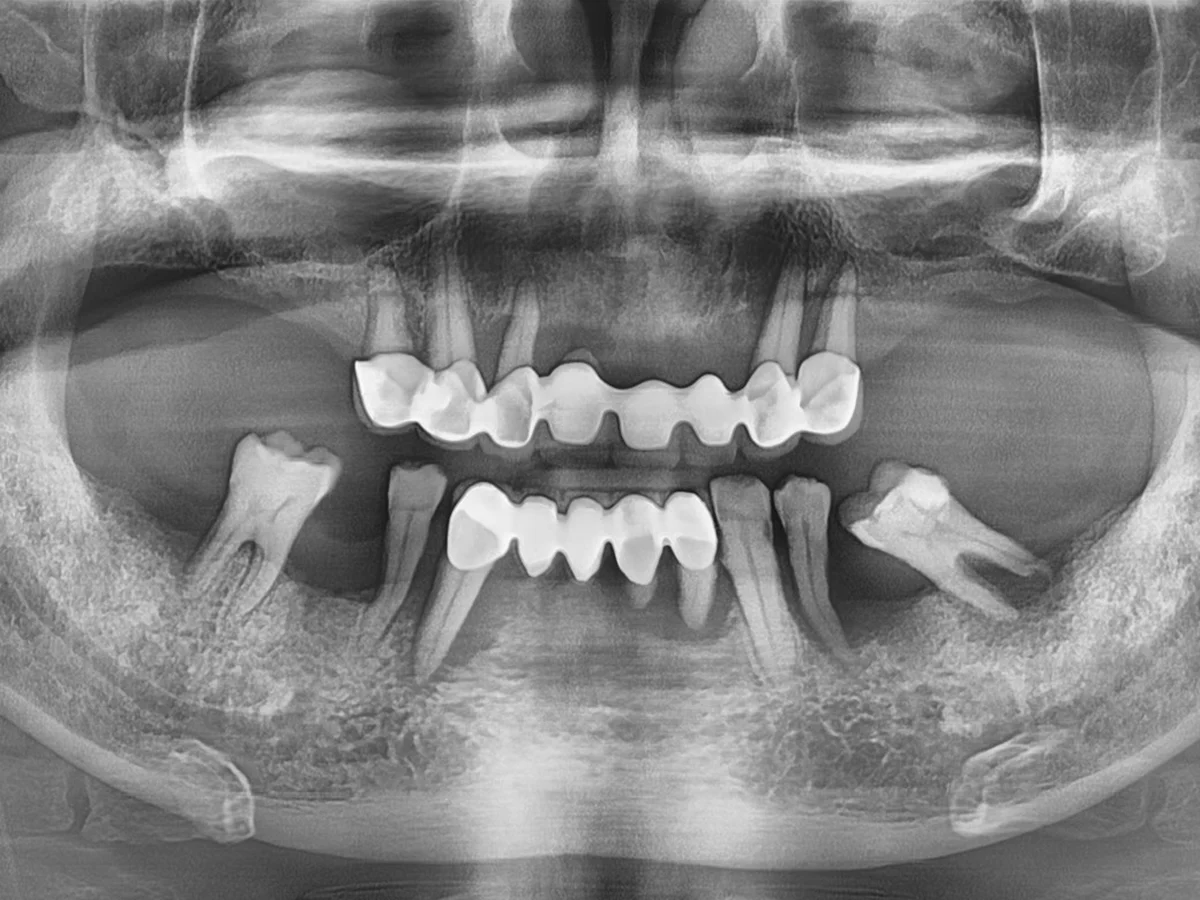
Most upper teeth were loose, making chewing difficult
Fixed full-arch implants in the upper jaw · Temporary teeth used throughout treatment
Before · Jul 2020
Before treatment, panoramic X-ray. For most upper teeth, the bone had dropped close to the root tips. The map sorting each tooth into keep or extract is shown below in STEP 02.
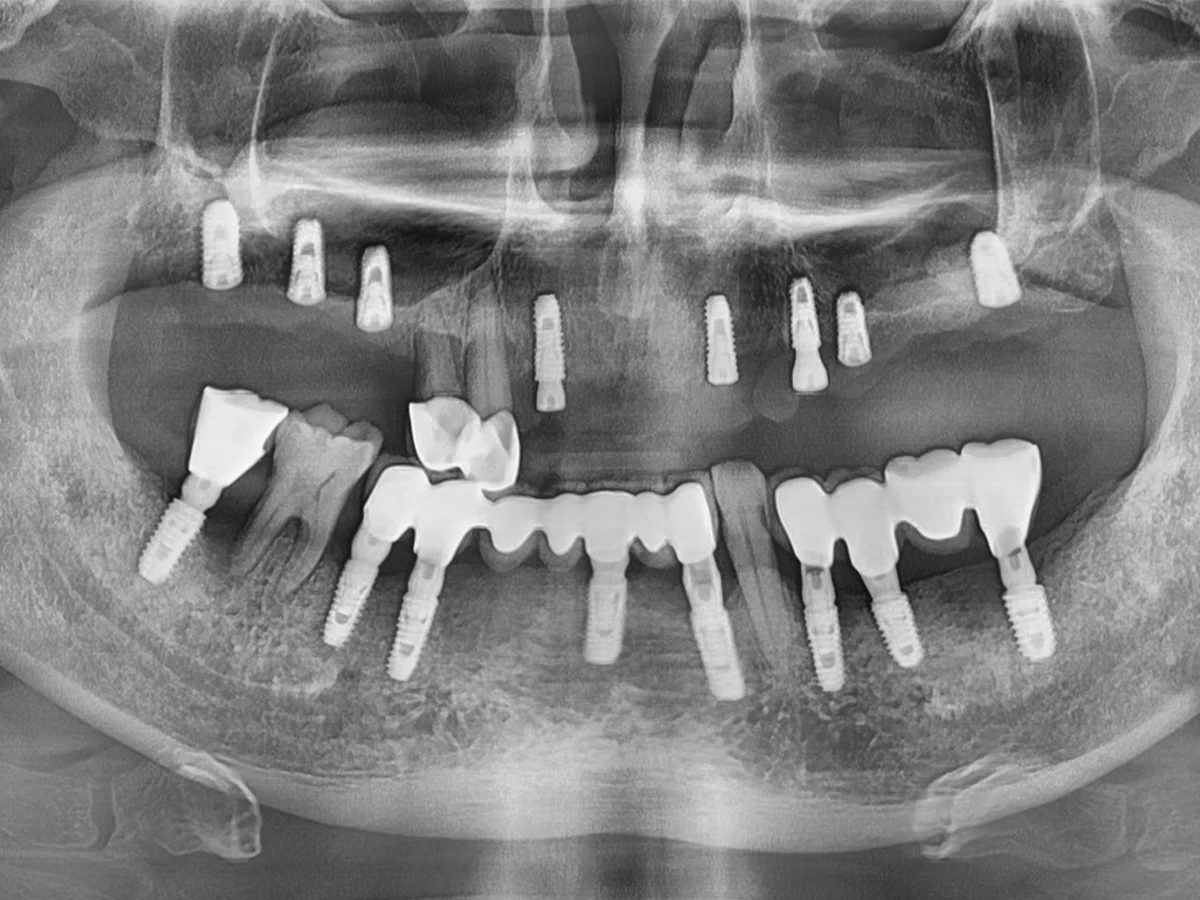
Temporary teeth stage · Jul 2021
Temporary teeth stage. While implants placed in the upper jaw bonded to the bone, the patient used a removable temporary denture to keep eating and going about daily life.
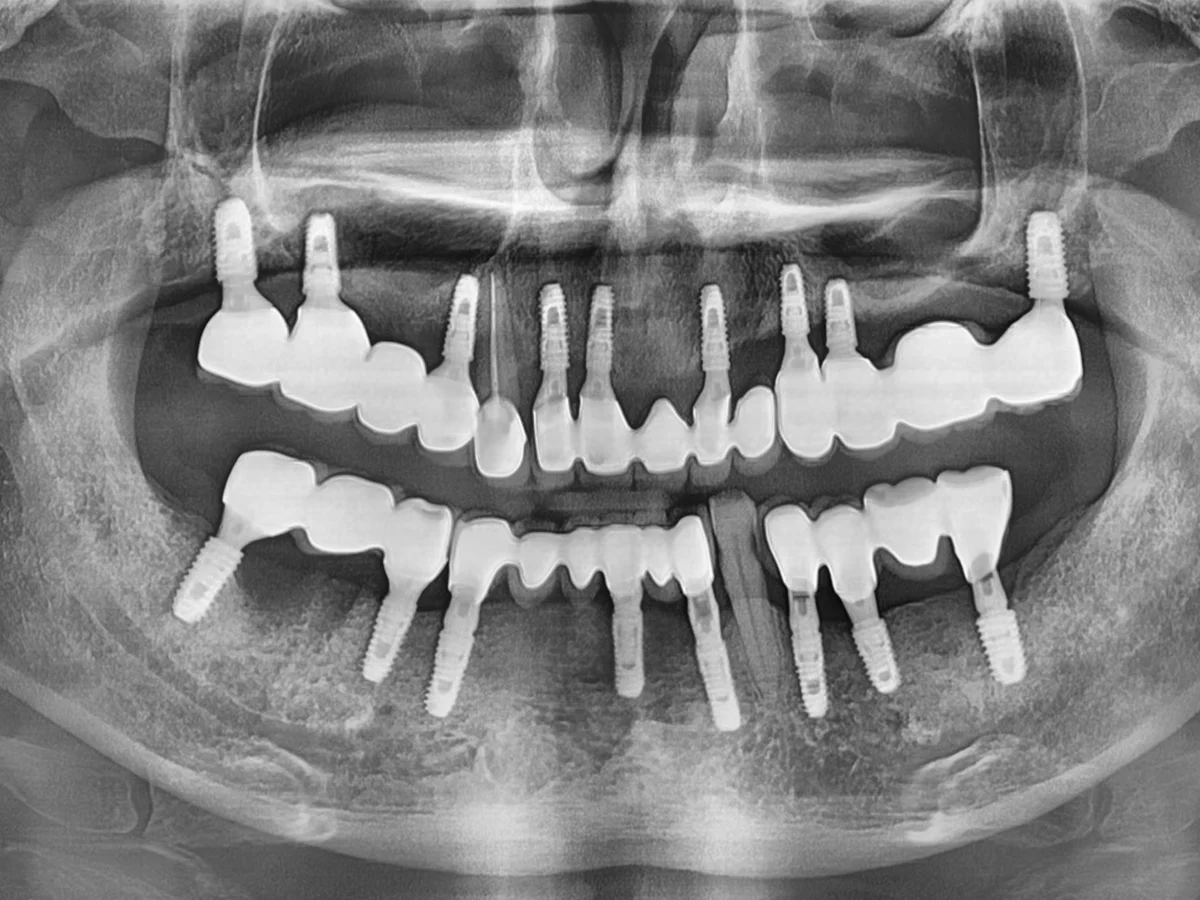
Final restoration · Jun 2022
Panoramic X-ray after the final restoration. The biting height and the shape that supports the lips were confirmed in the temporary teeth and transferred as is.
Condition
Advanced gum disease, with most upper teeth loose
Chosen
Fixed restoration on 8 implants · Bone grafts at 5 sites
Duration
About 1 year
Not done
Dentures (the patient did not want a removable type, and bone was sufficient)
Note
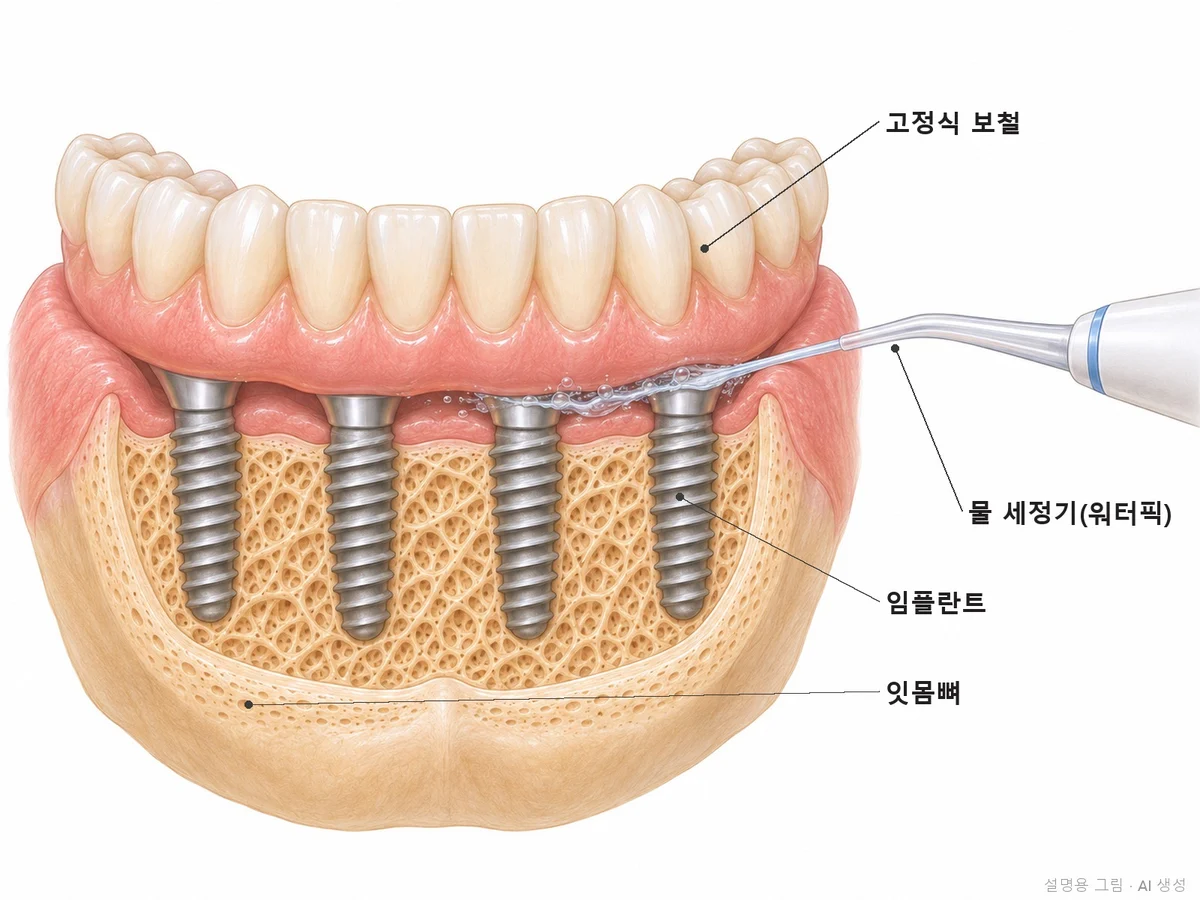
Cleaning under the restoration is difficult, so interdental brushes and a Waterpik must be used daily, with check-ups every 3 months
CASE02
A loose lower denture that needed adhesive
Denture held by a few implants · Smaller surgery and lower cost
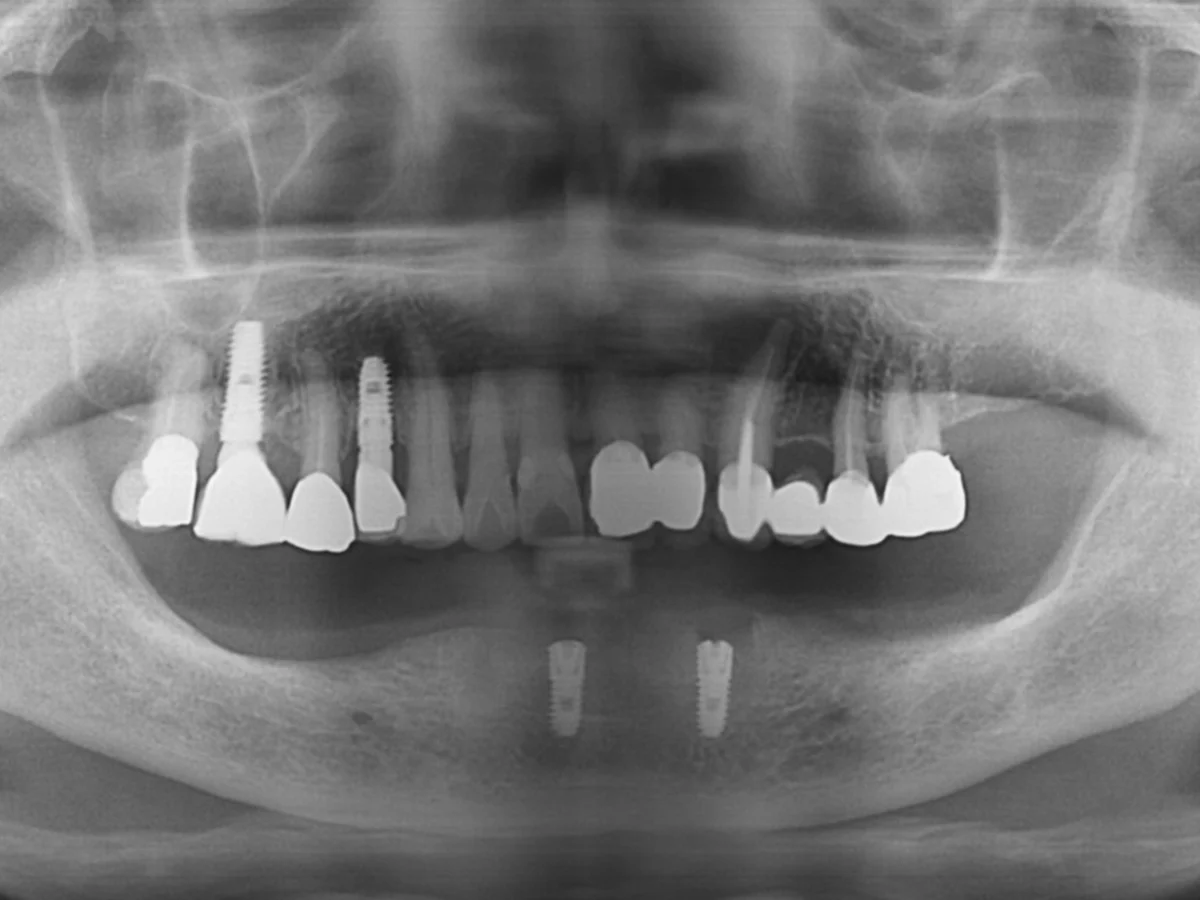
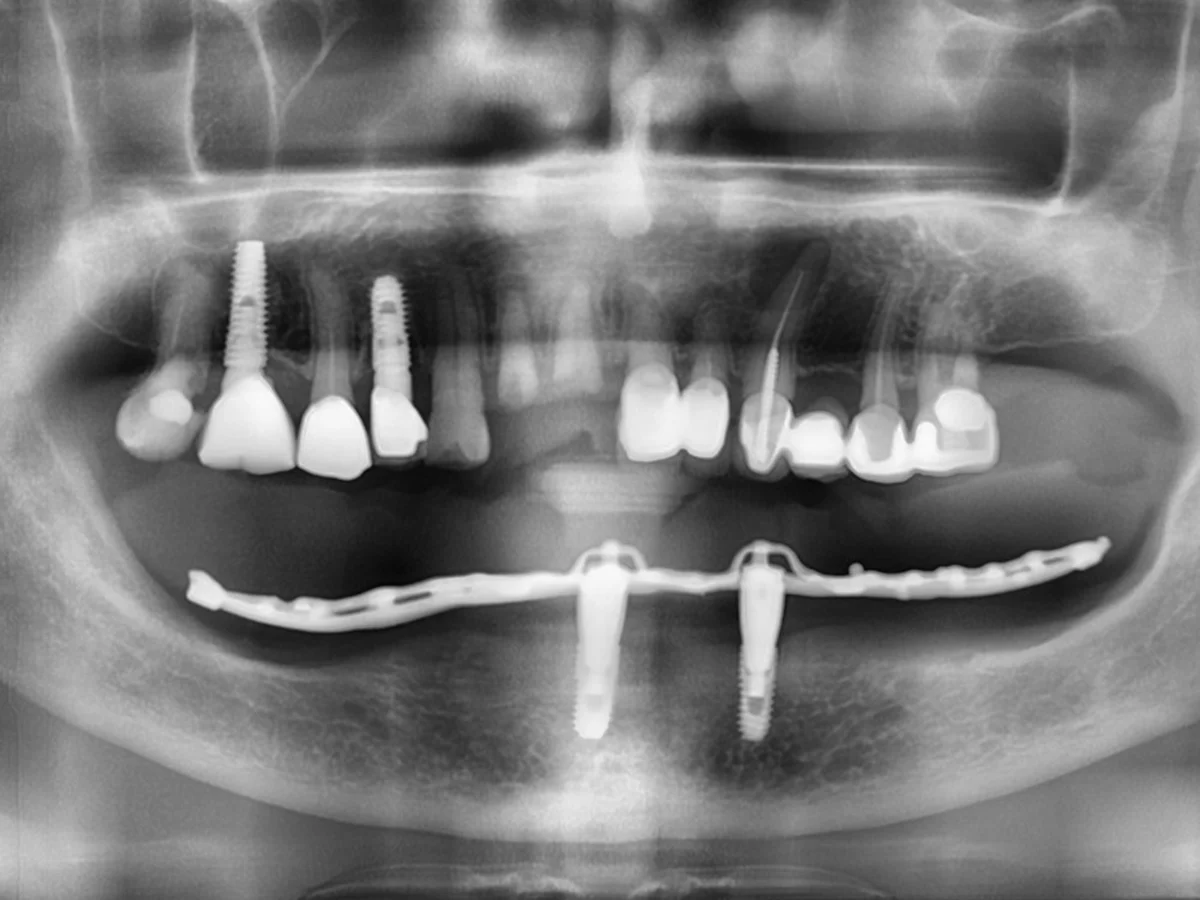
2 implants · Jul 2017
Panoramic X-ray after 2 implants were placed in the front of the lower jaw. Attachments on these two implants hold the denture.
Denture in use · Jul 2020
Panoramic X-ray 3 years later. The newly made lower denture is held by the 2 implants so it does not lift when chewing.
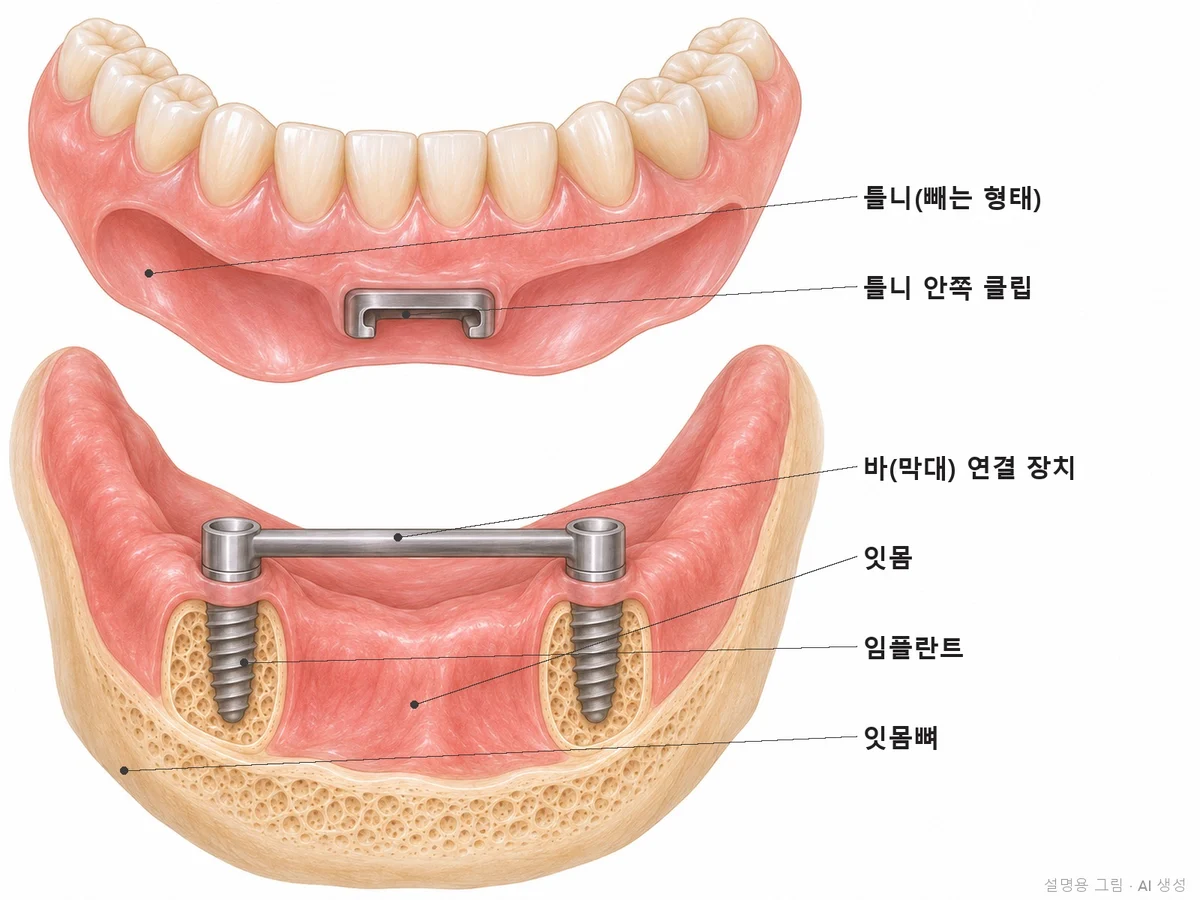
Bar type
The two implants are connected by a bar, and clips inside the denture snap onto it to hold it in place.
Condition
No lower teeth, loose denture
Chosen
2 lower jaw implants + implant-retained denture
Not done
Fixed full-arch implants (considering both bone volume and cost)
Duration
About 3–4 months
CASE03
Told all teeth had to come out, but some teeth could be kept
Teeth kept with gum treatment, implants only in the gaps
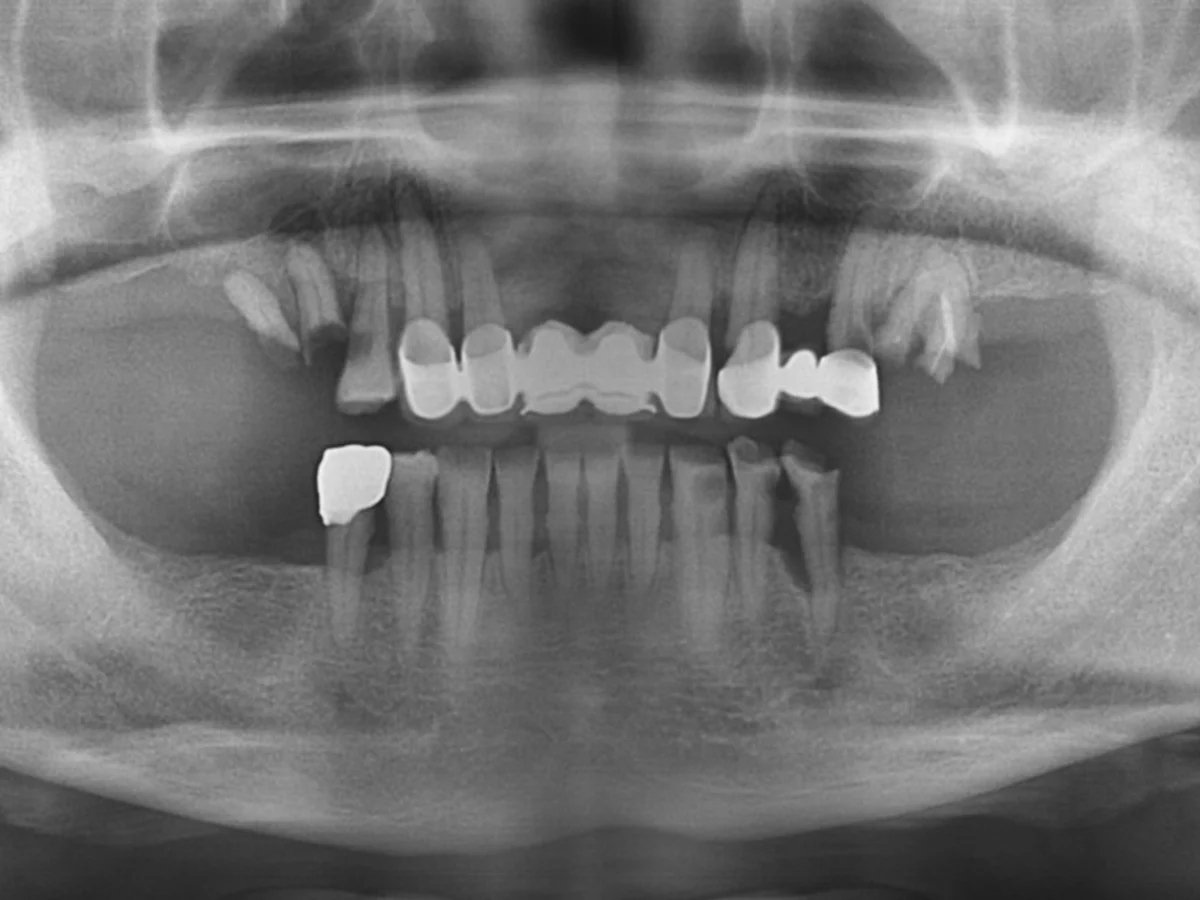
Before · Dec 2017
Before treatment, panoramic X-ray. Several teeth were loose and some were missing, but measuring gum depth for each tooth showed that several teeth could be kept with gum treatment.
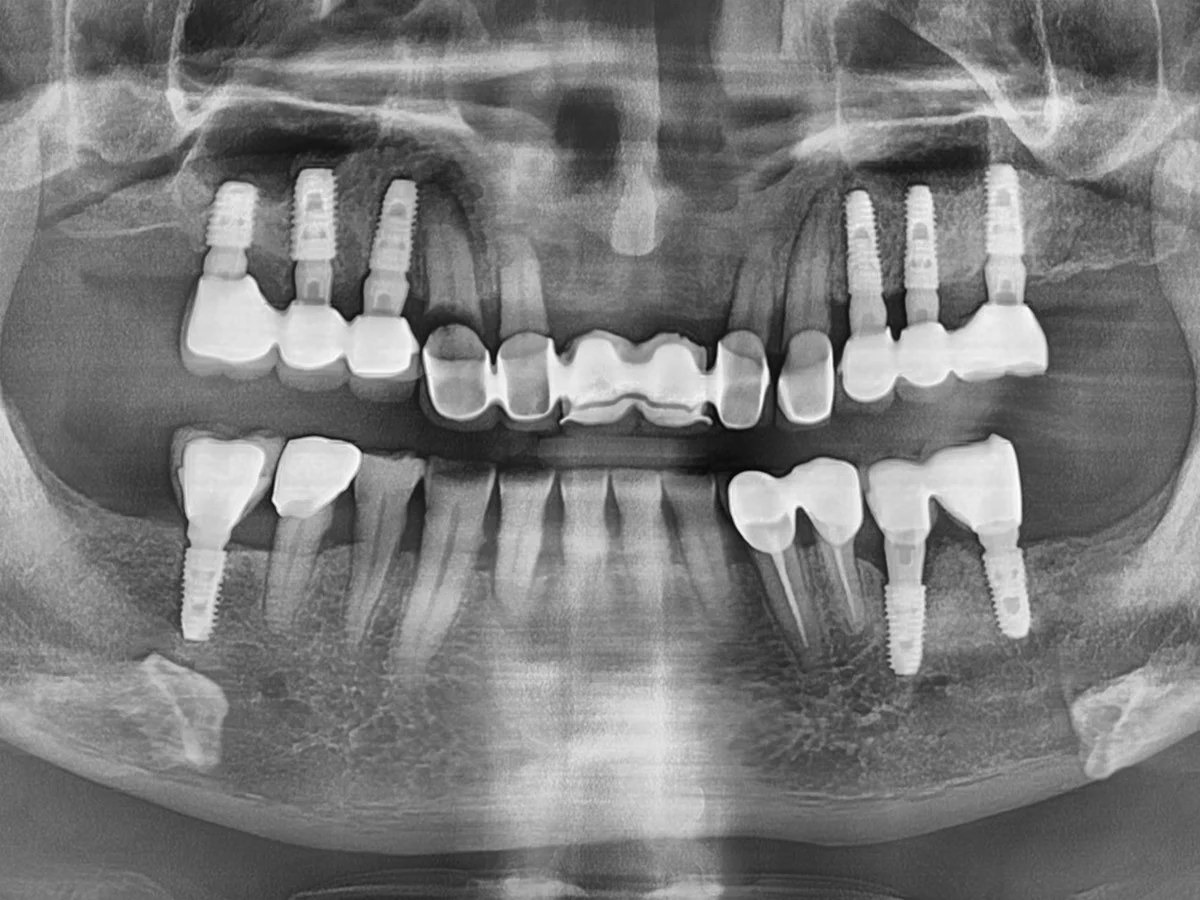
After · Jan 2020
After treatment, panoramic X-ray. The kept teeth were left as they were and implants were placed only in the gaps, so the scope was smaller than a full plan.
Condition
Several loose teeth, some missing
Chosen
Gum treatment for kept teeth: 4 upper and 9 lower · Implants: 6 upper and 3 lower
Not done
Extracting all teeth (some teeth could be kept)
Note
Kept teeth can become loose again if gum care stops
* Photos were taken under the same conditions and published with the patients' consent. Treatment results and side effects may vary from person to person.
02°
People who come to us for consultation
01People with almost no teeth
A plan to rebuild the whole upper or lower jaw is needed. The amount of remaining bone is the biggest factor in choosing the method.
02People whose remaining teeth are mostly loose
Gum disease has often progressed for a long time. Even among loose teeth, some can be kept, so each tooth must be assessed separately.
03People who find their dentures uncomfortable
This is when dentures are loose and need adhesive, or the foods you can chew have become limited. Holding the denture with a few implants may be the right option.
03°
How full-mouth implant treatment works
There are six steps, from choosing which teeth to keep to check-ups. For each step, we explain what we look at and why, with real clinical photos.
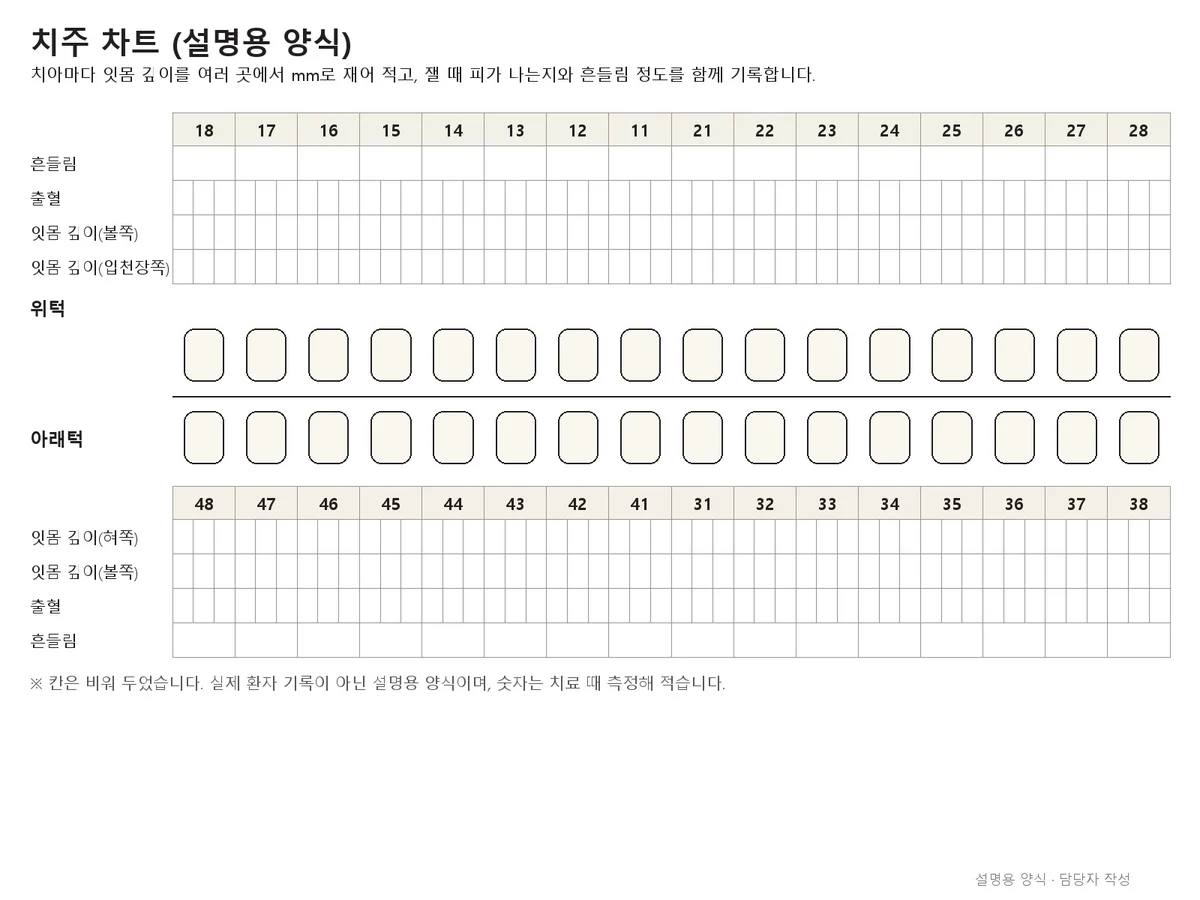
Periodontal chart
Periodontal chart. We measure the gum depth of each tooth in millimeters and record mobility and bleeding.
STEP 01
We measure each tooth separately
For each remaining tooth, we measure gum depth, mobility, and the height of bone around the root, and look at the height and width of the whole jawbone with panoramic X-rays and Vatech 3D CT.
Why we do thisEven if it feels like 'everything is loose,' each tooth is in a different condition. Judging them all at once can lead to extracting teeth that could have been kept.
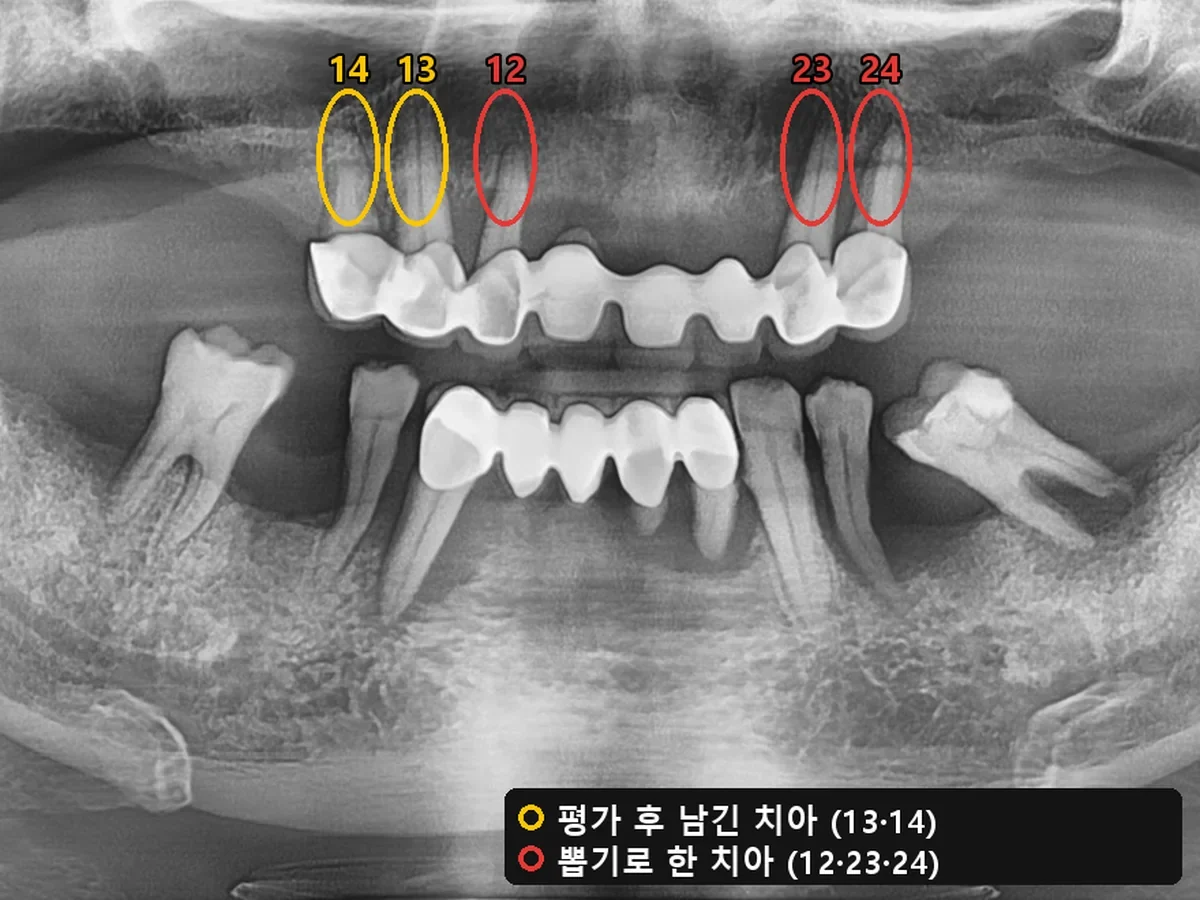
Map of teeth to keep · Jul 2020
Map of teeth to keep. After assessing each tooth, we color-code the teeth to keep and the teeth to extract, so you can see at a glance which teeth will be kept and which sites will be rebuilt. This is the same patient as CASE 01.
STEP 02
We make a map sorting teeth into keep, wait-and-see, and extract
Based on the measurements, we decide keep, wait-and-see, or extract for each tooth and show it to you on a map. Wait-and-see teeth are measured again after gum treatment before deciding.
Why we do thisA few teeth that can be kept can greatly change the size, cost, and duration of the whole plan. In particular, keeping teeth in positions such as the canines helps a lot in supporting the restoration.
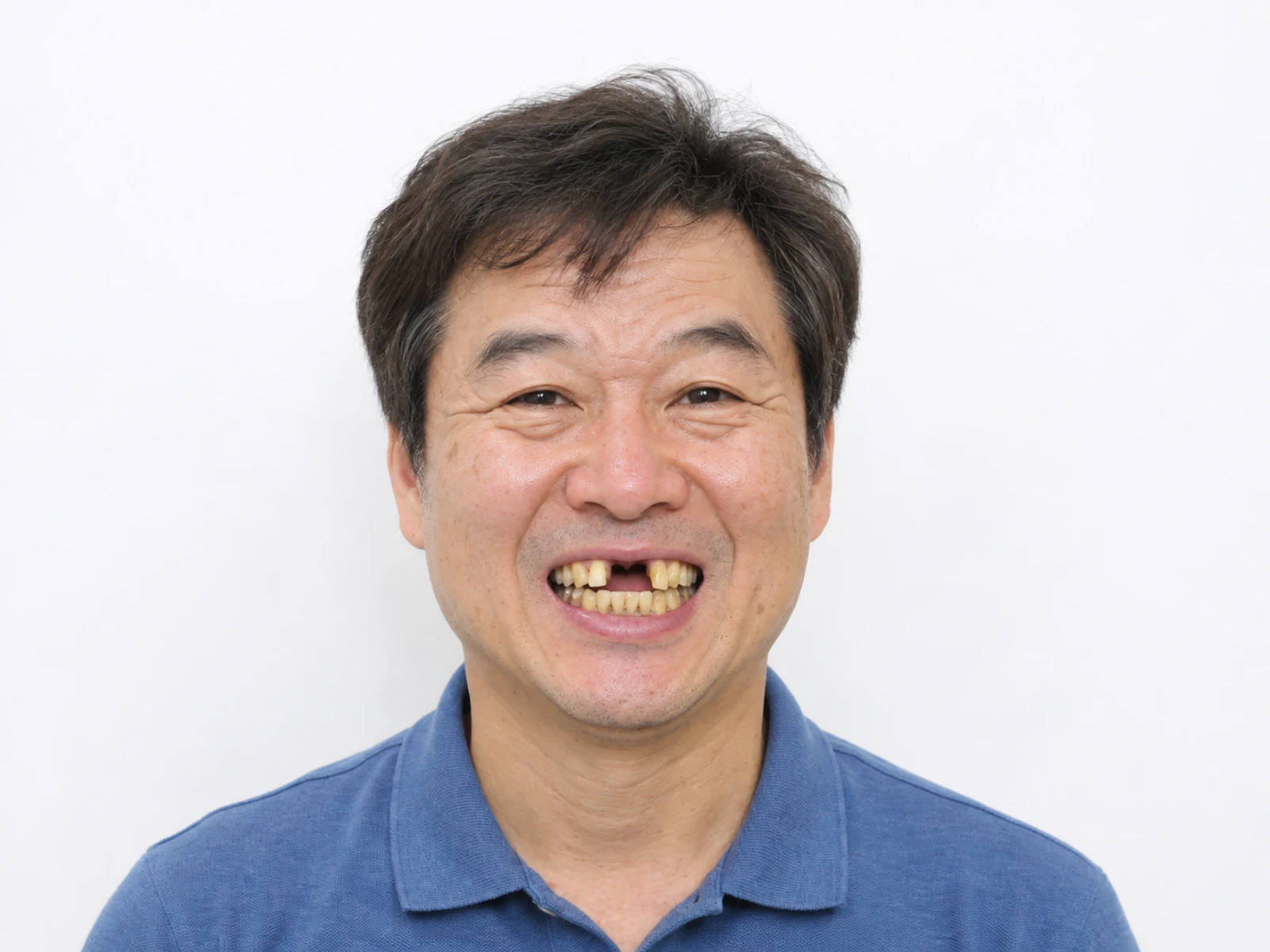
Face, front view · AI illustration
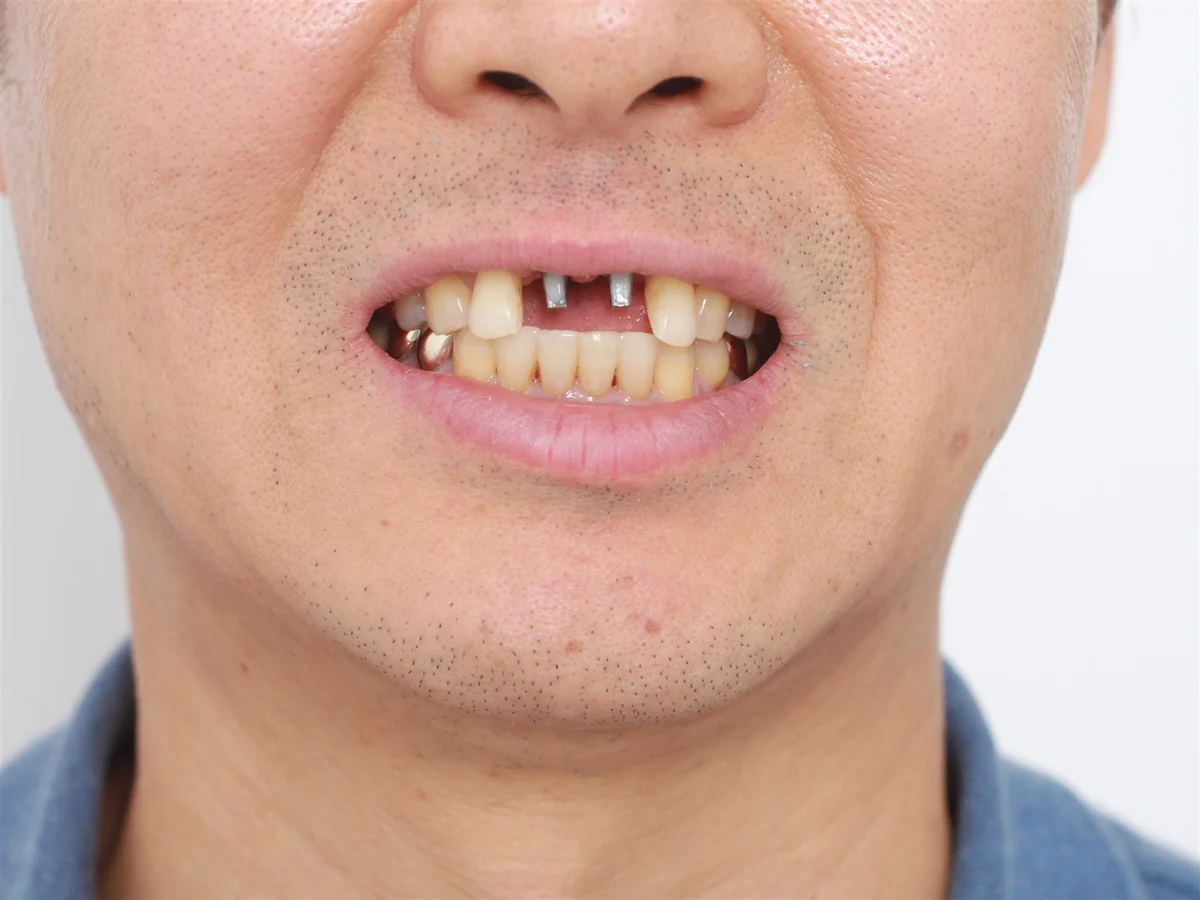
Lips and front teeth
Tooth shape design
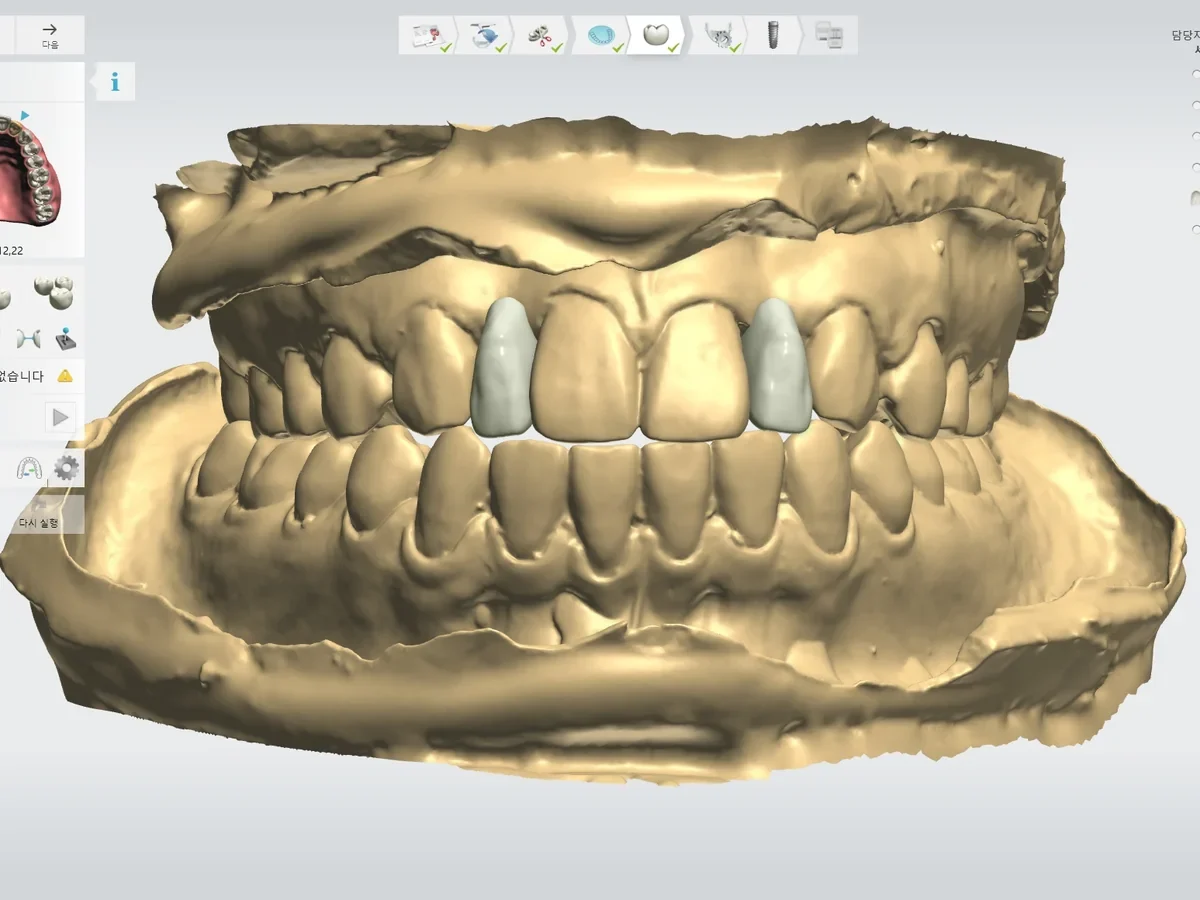
Design. We use face photos to see how much the lips need support, and design the tooth shape and implant positions together with CT and an iTero intraoral scan. The face image is an AI-generated example to aid understanding, and the design screen is from a different patient.
STEP 03
We redesign the biting height and even facial shape
When many teeth are lost, the biting height drops and the lips can look sunken. We use face photos to see how much the lips need support, first draw the final tooth shape with CT and an intraoral scan, and then decide the number and positions of implants to support those teeth.
Why we do thisIf implants are placed only where there is bone, teeth can end up in odd positions, making speech or facial shape look unnatural. Designing backward from the final teeth lets chewing and appearance both fit.
Right after placement · Dec 2016
Temporary teeth
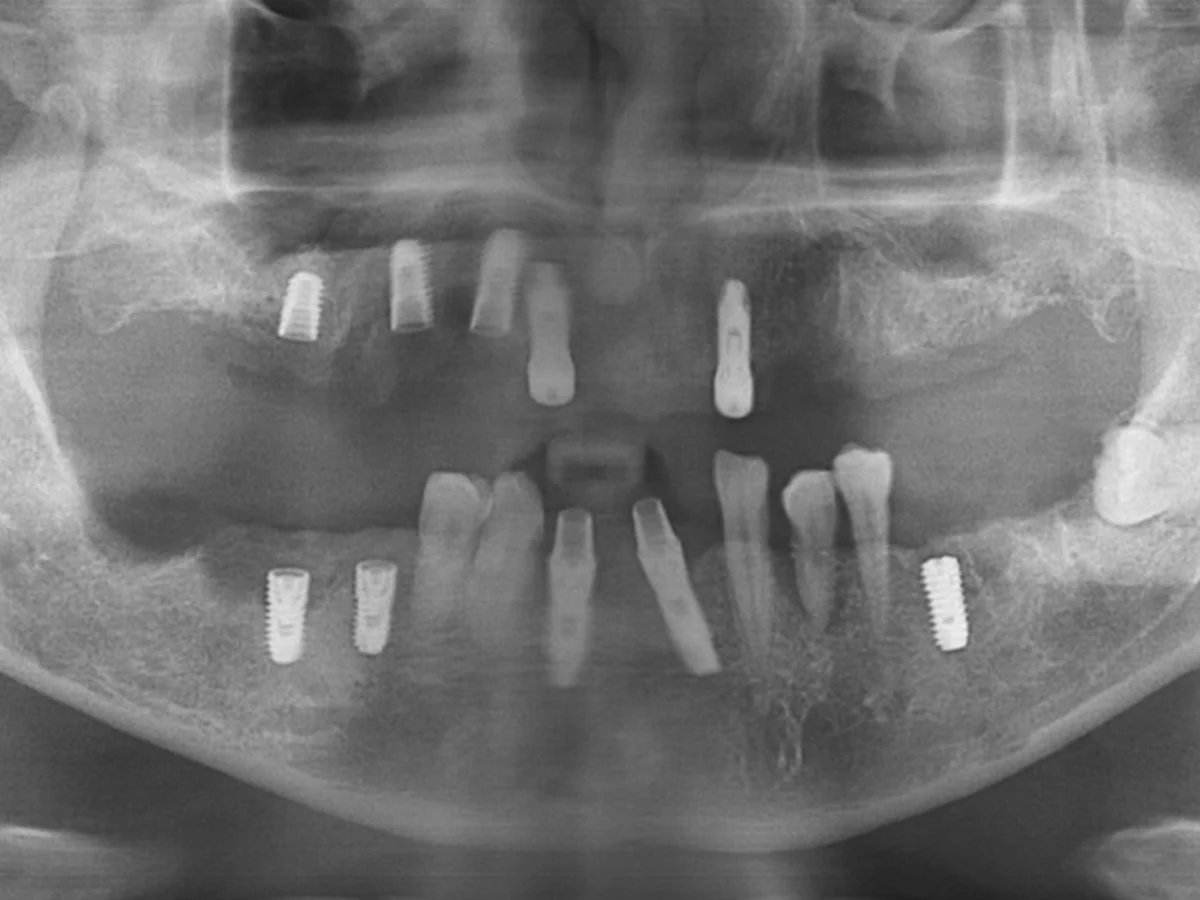
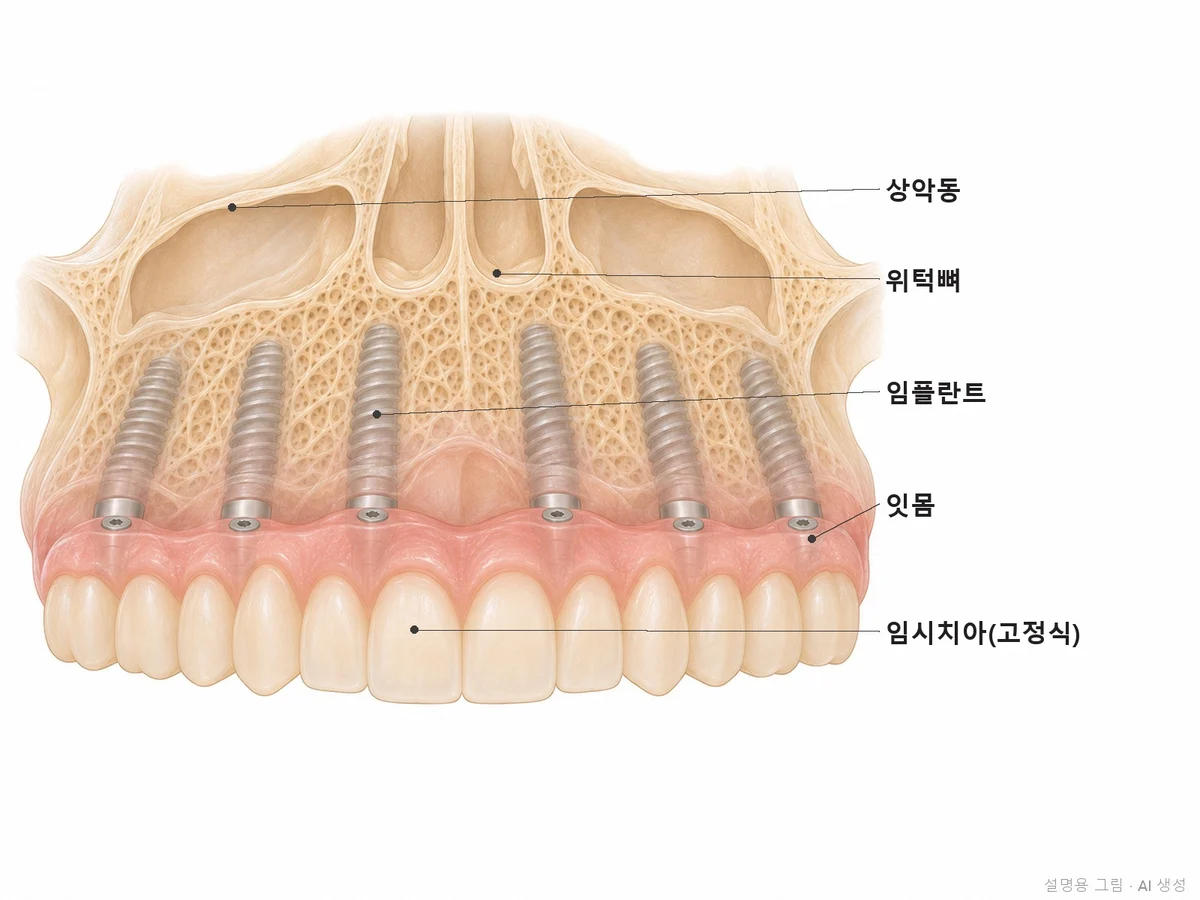
Placement and temporary teeth. Implants are placed at the planned sites (X-ray, left), and you live with temporary teeth while the bone bonds (illustration, right).
STEP 04
We place implants and you live with temporary teeth
Extractions and placement are done for the upper and lower jaws at the same time or in stages. While the bone bonds, you keep eating and going about daily life, such as going to work, with temporary teeth, and we adjust the biting height and shape little by little during this period. Temporary teeth may be placed on the day of implant placement, or a removable temporary denture may be used while the bone bonds.
Why we do thisTemporary teeth serve as a trial version of the final restoration. Using them for a few months and fixing any discomfort before moving to the final restoration reduces remakes.
Final restoration · Jun 2024
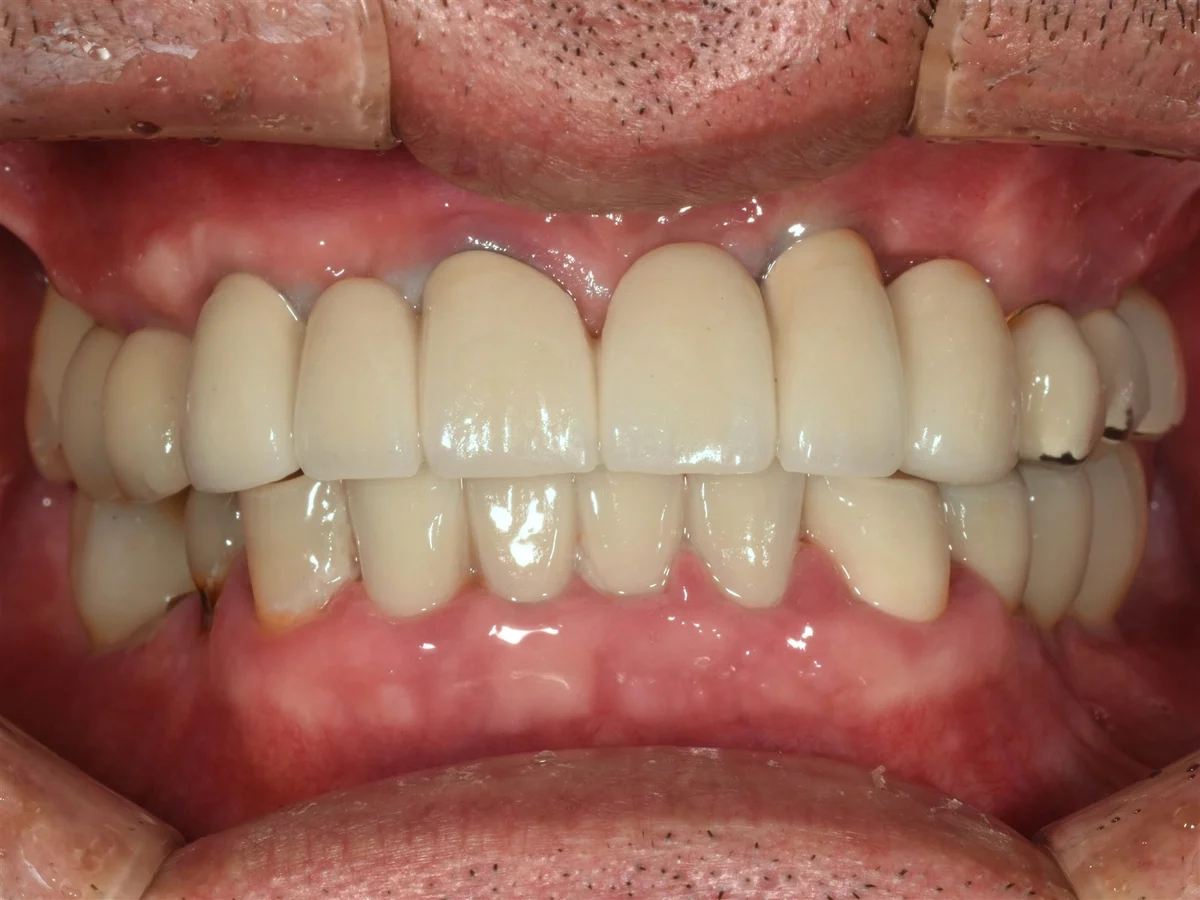
Final restoration. The height and shape confirmed in the temporary teeth are transferred as is to the final restoration.
STEP 05
We place the final restoration as confirmed in the temporary teeth
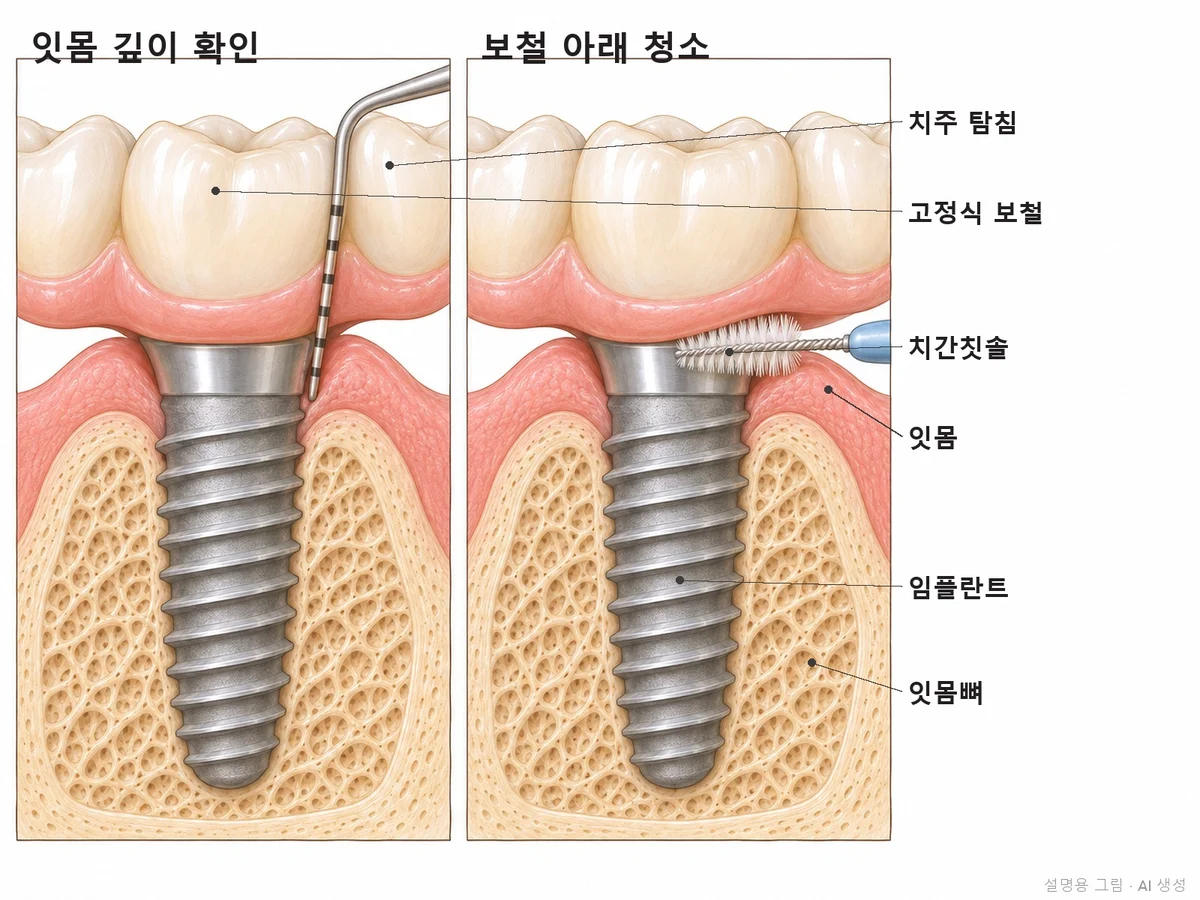
We confirm bone bonding with X-rays and then make the final restoration. For fixed types, we create a path for an interdental brush under the restoration and practice the cleaning method with you on the day it is fitted.
Why we do thisFixed restorations are not removed, so cleaning underneath is the biggest challenge. They must be shaped so they can be cleaned to prevent peri-implantitis.
Check-ups
Water flosser
3-month check-up. We check gum depth and bleeding around the implants and clean under the restoration with an interdental brush (left), and at home you rinse under the restoration with a water flosser (right).
STEP 06
We check every 3 months
People with several implants are considered higher risk and are checked every 3 months. We check gum depth and bleeding, screw loosening, and biting height, and compare bone height with X-rays if needed. People who grind their teeth at night also use a night guard.
Why we do thisFull-mouth implants are not a one-time treatment but a plan that includes care afterward. The earlier a problem is found, the more simply it can be solved.
* Clinical photos were published with the patients' consent. Side effects such as temporary pain or discomfort may occur depending on the person.
04°
How do dentures, implant-retained dentures, and fixed implants differ?
Dentures
Implant-retained dentures
Fixed full-arch implants
Retention
Rests on the gums, so it tends to move when chewing (especially in the lower jaw)
Snaps onto implants, so it rarely lifts
Fixed to implants and used like your own teeth
Number of implants
None
Usually 2 or more in the lower jaw, more in the upper jaw
Usually 4–6 or more per jaw (depends on bone and restoration type)
Care
Removed and cleaned daily
Removed and cleaned daily; attachments replaced when worn
Clean under the restoration with interdental brushes and a Waterpik (cleaning is difficult)
When bone is limited
Possible
Often possible with relatively little bone
Bone grafting may be needed, or it may be difficult
Korean National Health Insurance (NHI)
Age 65 or older: NHI-covered dentures (once every 7 years)
Not covered (both implants and denture are non-covered)
From January 2027, people aged 65 or older can receive up to 2 NHI implants even in a jaw with no teeth (as of November 2026)
The number of implants and the method are decided at the CT consultation, based on remaining bone and restoration type.
05°
For these people, another treatment comes first, or treatment is not needed
Good for you if
People with almost no teeth, or whose teeth are mostly hard to save
People whose dentures are loose and uncomfortable, limiting the foods they can chew
Other treatment comes first
People with teeth that can be kept: we first choose the teeth to keep, do gum treatment, and then make the plan.
People with very little bone: the options change, such as bone grafts or implant-retained dentures, so we check the bone first.
People with uncontrolled diabetes or who smoke heavily: we recommend getting it under control and quitting smoking first.
You may not need it now
People whose current dentures fit well without discomfort: there is no need to rush a change, and we check regularly that the dentures fit.
06°
How we follow up after placement
Implants do not get cavities, but the gums and bone around them can develop disease just like natural teeth.
1
The day after surgery
We disinfect the site and check for bleeding and swelling.
2
1–2 weeks later
Stitches are removed.
3
1 month after the crown is fitted
We check the biting height (occlusion) and how clean the area is.
4
Then at 3 and 6 months
We check again at 3 and 6 months after the crown.
5
Every 6 months after that
Regular check-ups continue.
6
Every 3 months for higher-risk patients
People who have had gum disease (periodontitis), smoke, have diabetes, or have several implants are checked every 3 months.
Full-mouth implants with several implants fall into the group checked every 3 months.
07°
Self-check
If any apply, we will check together which teeth can be kept first. Please bring your current dentures if you have them.
08°
Side effects and limits
Please read
· Because the surgical area is large, swelling and bruising are greater than with a single implant, and recovery time is needed.
· Some implants may not bond to the bone and may need to be placed again.
· Restorations can break or screws can loosen, and the attachments of implant-retained dentures wear with use and need replacing.
· Peri-implantitis can occur, and for fixed types, cleaning under the restoration is difficult, so care is especially important.
· If bone is very limited, options are fewer and bone grafting makes treatment longer.
· Full-mouth implants are not a one-time treatment but a plan that includes care afterward.
FAQ
FAQ
Do all my teeth have to be extracted for full-mouth implants?
Even in a full-mouth implant consultation, we do not assume all teeth will be extracted. At Ceramic Dental Clinic, we measure gum depth, mobility, and bone height for each tooth, keep the teeth that can be kept, and reduce the scope of the plan accordingly.
How many implants are needed for full-mouth implants?
Fixed full-arch implants usually need 4–6 or more per jaw, and implant-retained dentures need 2 or more for the lower jaw. This depends on the remaining bone and the type of restoration, so it is decided at the CT consultation.
Is there a period without teeth during full-mouth implant treatment?
Before starting full-mouth implants, we plan how you will keep eating and going about daily life with temporary teeth. When and how temporary teeth are made depends on the bone. Fixed temporary teeth may be placed on the day of implant placement, or you may use a removable temporary denture while the bone bonds.
Can I get full-mouth implants even if I am older?
Full-mouth implants are judged by general health, remaining bone, and your ability to maintain them, rather than by age. If surgery would be a heavy burden, we also consider implant-retained dentures with fewer implants.
What is the difference between dentures and full-mouth implants?
Dentures rest on the gums, so they tend to move when you chew, while full-mouth implants are fixed to implants placed in the bone and are used like your own teeth. Care differs too: removable types are cleaned daily, and fixed types require cleaning under the restoration with interdental brushes and a Waterpik.
I have no teeth at all. Does Korean National Health Insurance cover implants?
For people enrolled in Korea's National Health Insurance (NHI): currently, a jaw with no teeth at all is not eligible for NHI implants. From January 1, 2027, people aged 65 or older will be able to receive up to 2 NHI implants even in a jaw with no teeth. A partial denture on implants is covered, but an implant-retained denture (overdenture) is not covered for either the implants or the denture. People who already have an NHI-covered complete denture can receive this after 7 years have passed. Until then, people aged 65 or older can get NHI-covered dentures (once every 7 years) (as of November 2026).
How often do I need to come in after full-mouth implants?
Full-mouth implants involve several implants, so we check every 3 months. We check gum depth and bleeding, screw loosening, and biting height, and clean areas that are hard to brush at home.
How long do full-mouth implants take?
Full-mouth implants usually take from several months to nearly a year, depending on extractions, whether bone grafts are needed, and whether the upper and lower jaws are done together. You live with temporary teeth in the meantime, and we tell you the time for each step in advance.
Evidence and references
FDI World Dental Federation consensus (2019): recommends implant check-up intervals of 6 months or less
Academy of Osseointegration and American Academy of Periodontology consensus (AO/AAP, published 2025): risk factors for peri-implant disease and maintenance. doi:10.1002/JPER.25-0270
Questions from patients who travel to Seoul for treatment.
How much does an implant cost?
OSSTEM or Dentium implants are KRW 1,200,000 per implant, and implants with a zirconia crown are KRW 1,500,000. If bone is lacking, a bone graft is KRW 200,000 to 1,000,000 per site, depending on your jawbone. International and Korean patients pay the same fees. See our fee schedule.
How many visits do I need, and how long should I stay in Korea?
Implants need time for the bone and the implant to bond firmly. So you either visit Korea more than once or plan a longer stay. The schedule depends on your bone and whether a bone graft is needed, and we explain it after a CT scan.
Can I have my consultation in English?
Yes. The doctor in charge of each field consults with you directly in English. For implants and gum care, this is Dr. Ilseop Ahn, a board-certified periodontist. Before you travel, you can send photos of your teeth on WhatsApp or by email. An accurate diagnosis is made after we examine you in person.
What happens after I go home?
Implants do not decay, but the gums around them can become inflamed. If you notice swelling, bleeding or movement, it needs to be checked. Send us a photo on WhatsApp if anything worries you. Regular check-ups and scaling help keep the area healthy.
Results, the number of visits and schedules vary from person to person. More questions: Visiting from abroad.


 Before · Jul 2020
 Temporary teeth stage · Jul 2021
 Final restoration · Jun 2022
 2 implants · Jul 2017
 Denture in use · Jul 2020
 Bar type
 Before · Dec 2017
 After · Jan 2020
 Periodontal chart
 Map of teeth to keep · Jul 2020
 Face, front view · AI illustration
 Lips and front teeth
 Tooth shape design
 Right after placement · Dec 2016
 Temporary teeth
 Final restoration · Jun 2024
 Check-ups
 Water flosser